

The integrity of a research peptide isn’t typically lost during the final assay; it’s compromised the moment a reconstituted stock solution undergoes its first unnecessary thermal cycle. For researchers aiming to maintain the 99%+ purity standards required by the June 1, 2026 EMA guidelines, implementing peptide aliquotting best practices for labs isn’t a storage preference but a chemical necessity. Every freeze-thaw cycle triggers irreversible denaturation, leading to the inconsistent results and potency loss that derail high-stakes inquiry. You’re likely aware that even minor deviations in handling can render a high-value sequence, such as those used in recent trials showing 28.7% weight loss, effectively useless.
This technical guide provides the clinical protocols required to eliminate degradation and ensure 99%+ research integrity. We’ll detail the standardized SOPs for zero-loss transfer and the importance of using specialized labware, such as low-adsorption microcentrifuge tubes currently priced at $50.63 per 500 units. By adopting these precise methodologies, you’ll maximize the shelf-life of your reconstituted samples and secure the absolute stability of your data.
Key Takeaways
- Mitigate irreversible denaturation by identifying the precise thermodynamic triggers of the ‘freeze-thaw’ trap during stock solution handling.
- Eliminate non-specific binding and peptide loss by selecting high-density polypropylene over non-silanized glass for long-term storage vials.
- Standardize your laboratory environment through peptide aliquotting best practices for labs, focusing on laminar flow sanitization and pre-cooling receiving vials to 4°C.
- Secure sample longevity by utilizing ultra-low temperature storage at -80°C and avoiding the hidden thermal fluctuations of automatic defrost cycles.
- Maintain the 99%+ purity metric through rigorous single-inquiry volume calculations that eliminate the need for secondary handling or leftover solution storage.
The Thermodynamics of Peptide Degradation: Why Aliquotting is Mandatory
Aliquotting is defined as the procedure of partitioning a bulk reconstituted peptide solution into discrete, single-use volumes. This practice is a fundamental component of peptide aliquotting best practices for labs, serving as the primary defense against thermal degradation. When a lyophilized powder is reconstituted, it enters its most vulnerable state. Each subsequent exposure to temperature fluctuations compromises the molecular integrity that was established during synthesis. It’s not merely a matter of convenience; it’s a requirement for maintaining the rigorous standards of modern biochemistry.
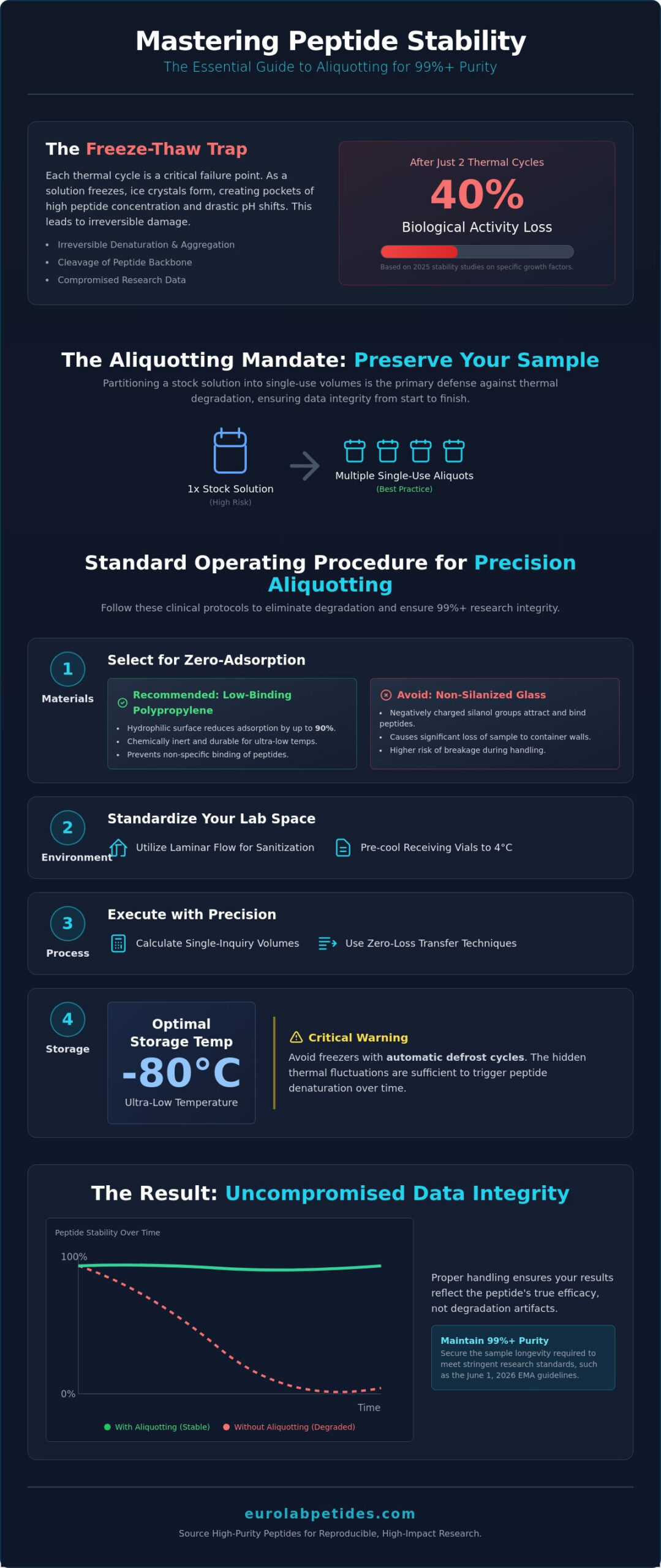
The “freeze-thaw trap” represents a significant risk to research accuracy. As a solution freezes, the formation of ice crystals excludes solute molecules, creating localized areas of high peptide concentration and drastic pH shifts. These micro-environmental changes often lead to irreversible aggregation or cleavage of the peptide backbone. Data from 2025 stability studies indicate that specific growth factors can lose up to 40% of their biological activity after only two thermal cycles. By utilizing single-use aliquots, the 99%+ purity metric verified by third-party analysis is preserved throughout the duration of the study. This ensures that the data generated is a reflection of the peptide’s efficacy rather than a result of handling-induced degradation.
Secondary Structure Vulnerability
The stability of a peptide is largely determined by its peptide structure and properties, specifically the arrangement of hydrogen bonds within alpha-helices and beta-sheets. Temperature fluctuations provide the kinetic energy necessary to disrupt these delicate bonds, leading to unfolding or misfolding. Larger, more complex sequences, such as Tesamorelin, exhibit higher sensitivity to these shifts compared to shorter, linear chains. Additionally, once in a solution state, peptides are susceptible to oxidation at methionine or cysteine residues. This process is significantly accelerated by repeated exposure to atmospheric oxygen during multiple vial openings. Standardizing peptide aliquotting best practices for labs minimizes this exposure, protecting the sequence’s chemical identity.
Concentration-Dependent Stability
Stability is often enhanced in higher concentration stock solutions because intermolecular interactions can provide a stabilizing effect against denaturation. In contrast, ultra-low volume or highly diluted aliquots may suffer from the “stochastic effect,” where the behavior of individual molecules becomes unpredictable, leading to inconsistent assay results. A critical concentration threshold is defined as the minimum molarity required to maintain a peptide’s native conformation and prevent significant adsorption to container walls. Adhering to strict aliquotting protocols ensures that stocks remain above this threshold until the moment of final dilution, preventing the “disappearance” of the solute during storage.
Material Science: Selecting Vials and Pipettes for Zero-Adsorption
Surface adsorption is the non-specific binding of peptide molecules to the interior surfaces of laboratory vessels. This phenomenon results in a precipitous decline in the molarity of the stock solution, frequently compromising experimental reproducibility. Adherence to peptide aliquotting best practices for labs requires a technical evaluation of the interaction between the peptide sequence and the storage substrate. Although 99%+ purity is verified during the analytical phase, this metric is only valid if the solute remains in the liquid phase. When molecules adhere to the container wall, the effective concentration available for research drops, leading to data that doesn’t accurately reflect the compound’s potential.
Polypropylene is generally superior to glass for peptide storage because glass contains silanol groups that carry a negative charge, which can attract and bind basic peptides. However, standard polypropylene is naturally hydrophobic and can sequester hydrophobic peptides through van der Waals forces. To mitigate this, Low Protein Binding (LPB) technology is employed. These specialized tubes are manufactured using modified resins that create a hydrophilic surface, reducing adsorption by up to 90% compared to standard materials. In scenarios involving highly “sticky” sequences, pre-lubrication with an inert protein, such as a 0.1% Bovine Serum Albumin (BSA) solution, is used to block potential binding sites on the vial surface. Ensuring these material standards are met is vital for maintaining the uncompromising integrity of research materials.
Surface Chemistry and Hydrophobicity
The amino acid sequence dictates the degree of surface interaction. Hydrophobic residues like Leucine or Phenylalanine increase the likelihood of binding to standard plastics. For extremely hydrophobic research compounds, silanized glass may be required to provide a chemically inert surface. According to established Peptide Aliquoting Guidelines, identifying ‘Peptide-Safe’ certifications on consumables is a critical step in protocol validation. Without these certifications, the risk of losing 10% to 50% of the peptide to the container walls remains a constant threat to research accuracy.
Pipetting Precision and Tip Selection
Low-retention pipette tips are a non-negotiable requirement for precision aliquotting. Standard tips often retain a significant percentage of the volume due to surface tension, leading to inaccurate dosage and wasted material. The impact of “dead volume” in standard syringes and tips can decrease research ROI by as much as 15% over a multi-aliquot batch. When handling viscous solvents like DMSO, positive displacement pipetting is the preferred method to ensure volumetric accuracy. This technique uses a piston-driven system that physically displaces the liquid, eliminating the air cushion that causes errors in standard air-displacement pipettes. Implementing these peptide aliquotting best practices for labs ensures that every microliter of the reconstituted solution is accounted for in the final inquiry.
Standard Operating Procedure (SOP) for Precision Aliquotting
Reconstitution is often conflated with aliquotting, but these are distinct operational phases. While reconstitution brings the lyophilized powder into a liquid state, aliquotting is the strategic division that secures long-term stability. Adhering to peptide aliquotting best practices for labs involves a transition from the bulk vial to discrete units within a controlled environment. A sterile laminar flow hood is required; its surfaces are sanitized with 70% ethanol before work begins. All receiving vials are pre-cooled to 4°C to prevent thermal stress during the transfer of the stock solution.
The calculation of the “Single-Inquiry Volume” is the next critical step. This volume must match the exact requirements of one research session. By ensuring zero leftover solution, the researcher eliminates the possibility of subsequent freeze-thaw cycles. Labeling is equally vital; each aliquot is marked with the concentration, date, solvent, and batch ID. This documentation mirrors the rigorous standards of European manufacturing, ensuring that the 99%+ purity established at synthesis is maintained until the moment of inquiry.
Step-by-Step Execution Protocol
- Step 1: Reconstitute the lyophilized powder according to the Peptide Reconstitution Calculator guidelines to achieve the desired stock concentration.
- Step 2: Gently homogenize the solution by inversion or gentle swirling. Mechanical shear stress from vortexing must be avoided to prevent the collapse of the secondary structure.
- Step 3: Rapidly transfer precise volumes into pre-chilled LPB microcentrifuge tubes using low-retention tips to minimize surface adsorption.
- Step 4: For oxygen-sensitive sequences, the headspace is purged with an inert gas like nitrogen or argon before the vial is sealed.
Volume Accuracy and Unit Conversion
Molar consistency must be verified across the entire batch, which often consists of 20 or more aliquots. High-throughput aliquotting can lead to evaporative loss, particularly when working with volatile solvents or in low-humidity environments. This loss can subtly increase the final concentration, leading to inconsistent research data. The final aliquot volume must be verified against the theoretical yield to ensure the target molarity remains uncompromising and aligned with the original certificate of analysis. Implementing these peptide aliquotting best practices for labs ensures that every microliter of the solution contributes to a stable and reproducible inquiry.
Thermal Lifecycle: Storage Conditions for Reconstituted Aliquots
The use of ultra-low temperature (ULT) freezers set to -80°C is the established gold standard for maintaining the long-term stability of reconstituted sequences. While standard -20°C storage is sufficient for short-term use, it doesn’t provide the same degree of kinetic stabilization required for delicate molecular structures. Temperature stratification within a storage unit can lead to localized warming zones, which is why peptide aliquotting best practices for labs mandate the placement of vials in the center of the freezer, away from the door. This objective approach to storage ensures that the 99%+ purity verified at the point of synthesis remains intact throughout the research lifecycle.
One of the most significant yet overlooked threats to aliquot integrity is the “frost-free” freezer. These units utilize automatic defrost cycles that cause internal temperatures to fluctuate by as much as 15 degrees Celsius several times a day. These hidden thermal cycles trigger the same “freeze-thaw trap” discussed in earlier sections, leading to progressive peptide denaturation even if the vial is never touched. For researchers, this means that a sample stored in a frost-free unit for 30 days may exhibit significantly lower potency than one kept in a constant-temperature environment. Additionally, light and moisture must be strictly controlled; amber vials or opaque storage boxes are used to prevent photo-oxidation, while airtight seals protect against hygroscopic contamination.
The Flash-Freezing Advantage
Rapid vitrification is superior to the slow cooling observed in standard laboratory freezers. When a solution is cooled slowly, large ice crystals form, which can physically shear the peptide structure and properties. Immersion in liquid nitrogen at -196°C achieves flash-freezing, bypassing the crystallization phase and locking the molecules into a glass-like state. This protocol is essential for preserving high-stakes research materials. Once vitrified, cryogenic aliquots must be handled with specialized forceps and transferred immediately to ULT storage to prevent any rise in temperature that could initiate recrystallization.
Shelf-Life Expectations by Peptide Type
Stability profiles vary significantly across different chemical classes. For instance, the pentadecapeptide BPC-157 exhibits relatively high stability in a frozen state compared to more volatile compounds like growth hormone secretagogues. The choice of solvent also dictates longevity; bacteriostatic water containing 0.9% benzyl alcohol can extend the shelf-life of a refrigerated aliquot but may impact the freezing point and long-term stability of frozen samples if not calculated correctly. Researchers should monitor aliquots for signs of precipitation or aggregation, such as a cloudy appearance or visible particulates. If these are detected, the aliquot must be discarded to maintain the integrity of the inquiry. To secure the most stable starting materials for your protocols, explore our high-purity research catalog and implement these peptide aliquotting best practices for labs today.
Quality Assurance: The EuroLab Standard for Research Integrity
Maintaining the uncompromising 99%+ purity established during synthesis requires a seamless transition from the manufacturing facility to the researcher’s benchtop. Adherence to peptide aliquotting best practices for labs is the final, non-negotiable stage of quality control. While each batch is analyzed via HPLC and mass spectrometry to ensure sequence validation, these metrics are only as stable as the lab’s internal handling protocols. The EuroLab standard dictates that research integrity isn’t a static claim but a verifiable metric that must be preserved through every pipetting step. If the aliquotting process is flawed, the third-party verification provided at the point of sale becomes irrelevant to the final data set.
Logistical reliability plays a critical role in this stability chain. With the implementation of the June 1, 2026 EMA guidelines, the scrutiny on synthetic peptide characterization has reached unprecedented levels. EuroLab’s stringent EU-based shipping protocols are designed to mitigate the risks associated with long-haul transit and regulatory delays often encountered with non-European sources. By ensuring the lyophilized product arrives in an optimal state, the supplier provides the foundation upon which internal stability efforts are built. This professional partnership ensures that the high-stakes precision required for modern biochemistry is never compromised by logistical failures.
Integrating COA Data into Aliquot Labelling
Batch-specific purity levels and net peptide content should directly dictate the calculation of aliquotting volumes. It’s insufficient to assume a 1:1 ratio between mass and volume; instead, the Certificate of Analysis (COA) data must be used to adjust for the specific trifluoroacetic acid (TFA) content or water weight of the batch. Utilizing EuroLab’s sequence validation data allows researchers to predict solubility challenges before reconstitution begins. For a comprehensive overview of maintaining these standards during procurement, consult our guide on How to Buy Research Peptides Safely in Europe. Precision in labeling, including the specific batch ID and exact molarity, ensures that any deviation in assay results can be traced back to a specific aliquotting event.
The Professional Researcher’s Commitment
Advancing from “standard” handling to “scientifically rigorous” protocols is what separates high-impact research from inconsistent inquiry. Every step, from the sanitization of the laminar flow hood to the final vitrification of the sample, is a commitment to data accuracy. EuroLab serves as a partner in this pursuit of European research excellence by providing the tools and transparency needed for uncompromising results. To ensure your laboratory is operating at peak efficiency, utilize the following 5-point audit for every high-value compound:
- Verify batch-specific purity against third-party HPLC/MS data before reconstitution.
- Utilize low-adsorption microcentrifuge tubes to prevent non-specific binding.
- Calculate single-inquiry volumes to eliminate secondary freeze-thaw cycles.
- Execute all peptide aliquotting best practices for labs within a pre-cooled, sterile environment.
- Secure long-term storage in a dedicated -80°C unit, avoiding frost-free fluctuations.
Explore our certified research peptides to secure the high-purity materials required for your next study and ensure your protocols meet the EuroLab standard for excellence.
Securing Long-Term Research Stability Through Standardized Protocols
The transition from a bulk reconstituted solution to discrete, single-use aliquots is the most critical phase in maintaining molecular integrity. By prioritizing material science, specifically the use of low-protein binding polypropylene, researchers eliminate the silent threat of surface adsorption. Implementing peptide aliquotting best practices for labs ensures that every inquiry is conducted with the same chemical precision as the first, effectively bypassing the irreversible denaturation caused by iterative thermal cycling. This methodical approach transforms handling from a variable into a constant, securing the validity of your experimental data.
Research integrity begins with uncompromising starting materials. Eurolab Peptides provides the foundation for your success with 99%+ purity verified by HPLC and mass spectrometry. Our stringent EU-based quality control and third-party independent laboratory testing ensure that your sequences arrive in an optimal state for immediate aliquotting. Secure High-Purity Peptides for Your Research Laboratory today and align your protocols with the highest European standards. Your commitment to rigorous laboratory methodology is the final safeguard for scientific excellence.
Frequently Asked Questions
What is the best type of vial for peptide aliquotting?
High-density, low protein binding (LPB) polypropylene vials are the superior choice for peptide aliquotting best practices for labs. These containers are engineered to minimize non-specific binding, which can otherwise sequester up to 50% of the peptide mass onto the vessel walls. Unlike standard non-silanized glass, LPB polypropylene is chemically inert and designed to withstand cryogenic temperatures down to -196°C without compromising the structural integrity of the seal.
Can I reuse a peptide aliquot after it has been thawed once?
Reusing a peptide aliquot after a single thaw cycle isn’t recommended due to the immediate onset of thermodynamic denaturation. As established in clinical stability studies, ice crystal formation during the freezing phase and pH shifts during melting can reduce biological potency by 40% after just two cycles. Single-use aliquots are the only verifiable method to ensure the 99%+ purity verified by HPLC is maintained throughout the duration of the study.
How does the choice of solvent affect aliquot stability?
Solvent choice directly impacts the kinetic stability and shelf-life of the frozen aliquot. Bacteriostatic water containing 0.9% benzyl alcohol provides necessary antimicrobial protection for refrigerated samples but may slightly alter the freezing point in ultra-low temperature environments. The solvent’s polarity must match the peptide’s hydrophobicity to prevent the solute from “crashing out” of the solution during the transition to a frozen state.
Is it necessary to use a laminar flow hood for aliquotting?
Utilizing a sterile laminar flow hood is mandatory to prevent both microbial contamination and premature atmospheric oxidation. Even brief exposure to non-sterile air can introduce proteases that catalyze the cleavage of the peptide backbone, rendering the sequence inactive. Maintaining a controlled environment is a core component of peptide aliquotting best practices for labs, ensuring that the chemical identity of the compound remains uncompromising during the division process.
What happens if I see cloudiness in my thawed aliquot?
Visible cloudiness or particulates in a thawed aliquot indicate irreversible aggregation or precipitation of the solute. This physical change suggests that the peptide has lost its native conformation and is no longer suitable for high-stakes research inquiry. If precipitation is observed, the sample must be discarded because using it will lead to inconsistent data that fails to meet the rigorous European standards for analytical accuracy.
How long can I store aliquots at -20°C compared to -80°C?
Storage at -20°C is generally restricted to a maximum of 30 days for reconstituted peptides, while -80°C is the gold standard for long-term stability exceeding 12 months. Standard -20°C freezers often feature automatic defrost cycles that trigger hidden thermal fluctuations. These cycles are avoided in ultra-low temperature units, providing the stable environment required to preserve the 99%+ purity metric over extended periods.
Do all peptides require the same aliquotting protocol?
Protocols must be adjusted based on the specific hydrophobicity and sequence length of the peptide. While most sequences are stable in LPB polypropylene, extremely hydrophobic compounds may require silanized glass to prevent significant surface adsorption. The June 1, 2026 EMA guidelines emphasize that handling must be tailored to the specific chemical properties of the synthetic peptide to ensure research integrity is maintained.
Can I aliquot peptides that have already been blended in a stack?
Blended stacks can be aliquotted, but they present unique challenges regarding differential solubility and precipitation. Each component in a complex mixture, such as an Advanced Metabolic Stack, may have a different critical concentration threshold. Researchers must ensure that all components remain fully homogenized during the transfer process to maintain the precise molar ratios established during the initial third-party verification of the batch.
