

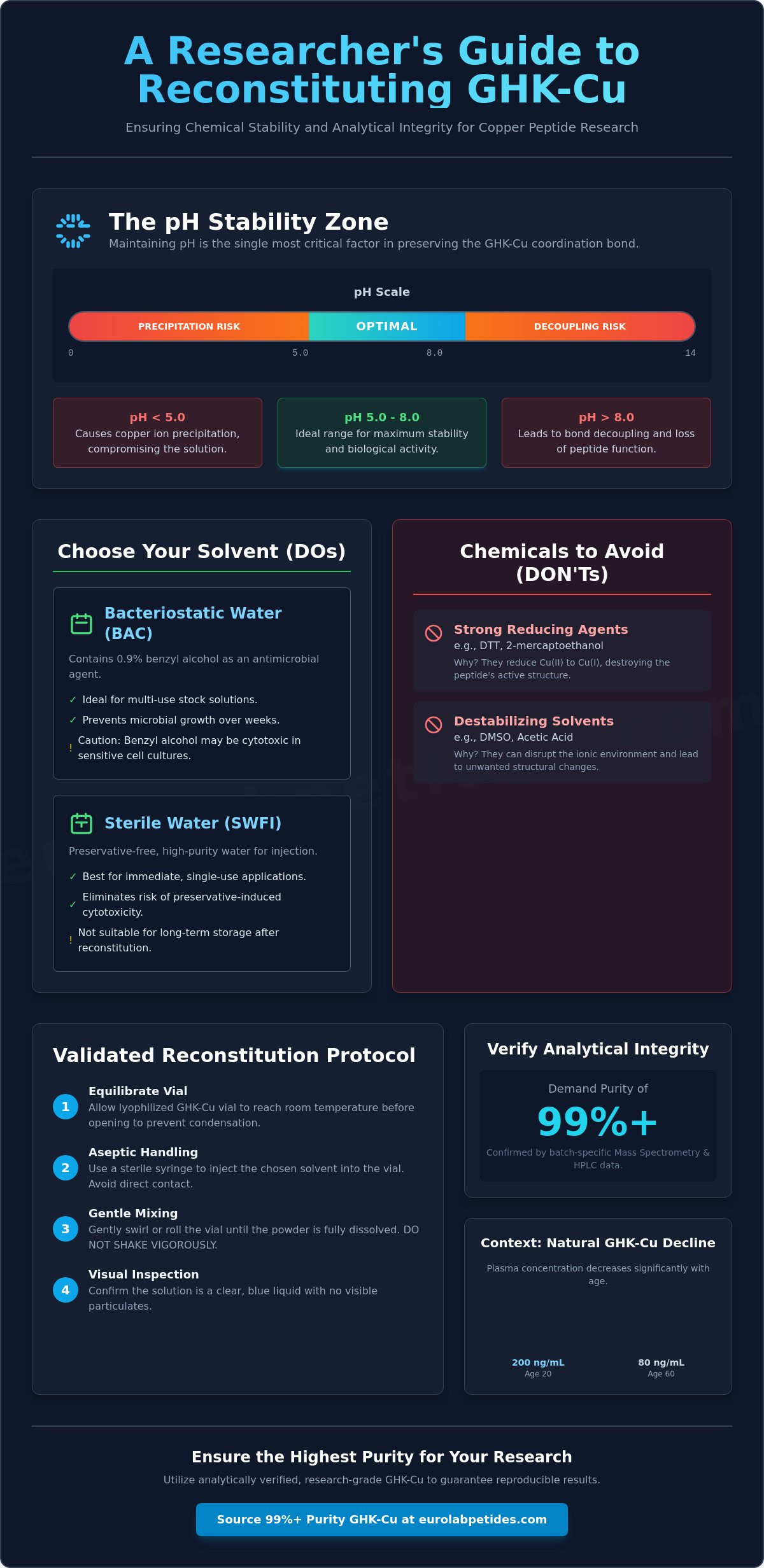
The chemical integrity of the Glycyl-L-histidyl-L-lysine copper complex relies entirely on the stability of its copper-tripeptide coordination bond. Identifying the correct buffer for reconstituting ghk-cu is critical, especially as the peptide’s concentration in human plasma naturally declines from 200 ng/mL at age 20 to just 80 ng/mL by age 60. Maintaining the integrity of research-grade material, which typically costs between $110 and $150 per 50mg vial for verified 98%+ purity, requires precise control over the solvent environment. You’re likely aware that pH-induced precipitation can instantly compromise a study, and the fear of losing peptide activity due to an incorrect solvent choice is a valid concern for any serious researcher.
This technical guide identifies the optimal buffers and solvents for maintaining the chemical stability and biological activity of GHK-Cu in stringent laboratory settings. We’ll provide a validated protocol for stock solution preparation and clarify the specific pH constraints that prevent degradation. With the FDA’s Pharmacy Compounding Advisory Committee scheduled to review GHK-Cu on July 23-24, 2026, establishing standardized reconstitution methods is more urgent than ever. You’ll gain a clear understanding of when to utilize bacteriostatic water versus phosphate-buffered saline to ensure a stable, high-purity solution for your specific research model, backed by the analytical standards of EuroLab Peptides.
Key Takeaways
- Select the correct buffer for reconstituting ghk-cu by maintaining a pH range of 5.0 to 8.0 to prevent copper ion precipitation and bond decoupling.
- Evaluate the specific requirements of your research model to choose between antimicrobial Bacteriostatic Water for multi-use stocks or preservative-free Sterile Water for Injection.
- Avoid the use of strong reducing agents like DTT or 2-mercaptoethanol, which compromise the peptide structure by reducing Cu(II) to Cu(I).
- Execute a standardized laboratory protocol that prioritizes temperature equilibration and aseptic handling to ensure the chemical stability of the reconstituted complex.
- Verify the analytical integrity of your stock solution by utilizing GHK-Cu with 99%+ purity, confirmed through batch-specific mass spectrometry and HPLC data.
Understanding GHK-Cu Stability: Why Buffer Selection is Critical
The molecular architecture of GHK-Cu distinguishes it from standard linear peptides. It functions as a specific coordination complex where the glycyl-L-histidyl-L-lysine tripeptide sequesters a Copper(II) ion. This structural arrangement is the foundation of its biological utility; however, the stability of this coordination bond is exceptionally sensitive to the ionic strength and pH of the environment. Selecting the correct buffer for reconstituting ghk-cu is not merely a procedural step but a prerequisite for maintaining analytical integrity. If the solvent environment shifts outside specific parameters, the copper ion dissociates from the peptide carrier, rendering the research material biologically inactive and compromising experimental reproducibility.
For most in-vitro studies, lyophilized GHK-Cu must be reconstituted into a medium that mimics physiological conditions. This requires a solvent that supports the complex’s solubility while preventing the precipitation of copper hydroxides. Researchers must ensure the final solution remains within a stable environment to preserve the tripeptide’s affinity for the metal ion. Using an incompatible solvent can lead to immediate degradation, often resulting in the failure of the coordination complex before the assay even begins.
The Chemistry of the Copper-Tripeptide Complex
The Copper peptide GHK-Cu utilizes the imidazole nitrogen of the histidine residue as a primary anchor point for the metal ion. This coordination is further stabilized by the amino group of the glycine and the amide nitrogens of the peptide backbone. Solvent polarity plays a critical role here; high-polarity solvents can disrupt the electrostatic interactions that maintain the complex’s geometry. The coordination bond is the primary factor in GHK-Cu structural integrity. When the correct buffer for reconstituting ghk-cu is utilized, these bonds remain secure, ensuring the molecule retains its intended biochemical properties during assays.
Lyophilization and Initial Solubility
Research laboratories utilize lyophilized peptides as the gold standard because the freeze-drying process removes moisture that would otherwise facilitate hydrolysis and oxidative stress. Upon visual inspection, high-purity GHK-Cu powder exhibits a distinct blue hue, a direct result of the d-d electronic transitions within the copper-peptide complex. At EuroLab Peptides, each vial is vacuum-sealed to prevent pre-reconstitution oxidation, ensuring the 99%+ purity remains intact until the moment of solvent introduction. Maintaining this purity requires that the powder reaches room temperature before the seal is breached to prevent condensation, which can alter the initial concentration and ionic balance of the stock solution.
Evaluating Reconstitution Solvents: BAC, SWFI, and PBS
Selecting the correct buffer for reconstituting ghk-cu is a decision driven by the specific experimental design rather than a universal laboratory standard. While GHK-Cu is highly aqueous-soluble, the solvent’s composition determines the longevity of the coordination complex once the lyophilized powder is dissolved. Standard options include Bacteriostatic Water (BAC), Sterile Water for Injection (SWFI), and Phosphate-Buffered Saline (PBS). Unlike more hydrophobic research materials, GHK-Cu doesn’t require the use of DMSO or Acetic Acid; these solvents can actually destabilize the ionic environment required for copper-tripeptide coordination and lead to unwanted structural modifications.
When to Choose Bacteriostatic Water
Bacteriostatic Water contains 0.9% benzyl alcohol, which serves as a critical antimicrobial agent for multi-use stock solutions. For laboratories utilizing 99%+ purity research peptides, BAC prevents the proliferation of microbes that could metabolize or degrade the material over the course of several weeks. However, researchers must account for the potential cytotoxicity of benzyl alcohol in sensitive cell culture models. In these instances, SWFI is the preferred alternative for immediate, single-use applications where the presence of preservatives might confound cellular response data or interfere with metabolic assays.
The Case for Phosphate-Buffered Saline (PBS)
Phosphate-Buffered Saline is widely considered the superior choice for maintaining a stable physiological environment. By providing a fixed pH of 7.4, PBS preserves the regenerative and protective actions inherent to the GHK-Cu molecule. In tissue repair and recovery models, even minor pH drifts can lead to the dissociation of the copper ion, effectively neutralizing the peptide’s biological utility. When preparing research peptides in PBS, it’s vital to ensure the buffer is endotoxin-free to maintain experimental validity. Minor shifts in ionic strength can alter the peptide’s solubility, making the choice of a stable buffer indispensable for long-term inquiry.
Sourcing verified, high-purity GHK-Cu from EuroLab Peptides ensures that your research begins with material synthesized to the highest European standards. Matching the correct buffer for reconstituting ghk-cu to your specific assay is the final step in securing reproducible results. Avoid the common pitfall of assuming all solvents are interchangeable; the chemistry of the copper-peptide complex demands a methodical, data-driven approach to reconstitution to ensure analytical integrity remains uncompromised throughout the study.
Chemical Constraints: pH Maintenance and Reducing Agent Avoidance
The chemical stability of the GHK-Cu complex is a function of its narrow environmental tolerances. Maintaining the coordination bond between the Copper(II) ion and the tripeptide sequence requires a solvent environment that prevents both protonation and reduction. Selecting the correct buffer for reconstituting ghk-cu must account for these chemical constraints to avoid the immediate dissociation of the metal ion. GHK-Cu exhibits its highest stability within a pH range of 5.0 to 8.0. Deviations from this window, whether toward extreme acidity or alkalinity, precipitate the failure of the complex and the subsequent loss of biological activity.
Specific research, such as the GHK-Cu Purification Protocol published via NCBI, utilizes 50 mM Tris-HCl at pH 8.0 to maintain the complex during lysis and elution. This demonstrates the necessity of a controlled environment. Beyond pH, the presence of strong reducing agents poses a significant risk to analytical integrity. Reagents like Dithiothreitol (DTT) or 2-mercaptoethanol effectively reduce the Copper(II) ion to Copper(I). This change in oxidation state disrupts the coordination geometry, causing the copper to decouple from the peptide carrier entirely.
Managing the pH ‘Sweet Spot’
For research intended to mimic human plasma, a pH of 7.4 is the ideal target. At this physiological level, the tripeptide maintains a high affinity for the copper ion. If the environment becomes strongly acidic, the protonation of the histidine nitrogen occurs, which leads to immediate copper release. This structural failure is easily monitored through visual inspection. The transition from a vibrant blue to a greenish or yellowish tint serves as the definitive visual threshold for GHK-Cu degradation. When the correct buffer for reconstituting ghk-cu is used, the solution remains a clear, characteristic blue, indicating that the coordination bonds are intact.
Chemical Incompatibilities in the Laboratory
Precise laboratory protocols must exclude several common reagents that are fundamentally incompatible with GHK-Cu. Chelating agents, most notably EDTA, must be strictly avoided; they possess a higher affinity for copper than the GHK peptide and will strip the metal ion from the complex. High salt concentrations should also be monitored, as they can alter the ionic strength of the solution, potentially leading to peptide aggregation or decreased solubility.
When handling ipamorelin or other growth hormone secretagogues in the same laboratory space, researchers must maintain strict segregation of equipment. Cross-contamination with peptides that require different reconstitution environments can introduce unwanted pH shifts or reactive residues. Each batch of GHK-Cu from Eurolab Peptides is verified for 99%+ purity, but this metric is only preserved if the reconstitution environment remains free from these specific chemical antagonists.
Standard Laboratory Protocol for GHK-Cu Reconstitution
Maintaining the analytical integrity of high-purity research materials requires a standardized, aseptic protocol. Before introducing the correct buffer for reconstituting ghk-cu, the vial must reach ambient temperature, typically between 20°C and 25°C. This period of equilibration, lasting approximately 20 to 30 minutes, prevents atmospheric moisture from condensing on the lyophilized powder when the seal is breached. Condensation introduces uncontrolled water content, which can lead to rapid hydrolysis or mass inaccuracies during sensitive assays. Once equilibrated, the septum is sanitized using 70% isopropyl alcohol. While a benchtop environment is often utilized, a laminar flow hood is preferred to ensure a strictly sterile field for solvent introduction.
The solvent must be introduced with minimal mechanical force. It’s recommended to aim the needle toward the inner glass wall of the vial, allowing the buffer to trickle down rather than striking the peptide cake directly. This technique minimizes the physical stress on the molecular structure. To achieve full homogenization, the vial should be gently swirled in a circular motion. Vigorous shaking is strictly prohibited; it introduces air into the solution and increases the air-liquid interface, which can lead to peptide denaturation or problematic foaming. If the cake doesn’t dissolve immediately, the vial can be left to stand at 4°C for several minutes before further gentle swirling.
Calculating Molar Concentrations
Precision in experimental design necessitates accurate concentration calculations. Researchers often utilize a peptide reconstitution calculator to determine the exact volume of solvent required for a specific molarity. Given that the molecular weight of GHK-Cu is approximately 402.5 g/mol, converting milligrams to micromolar concentrations involves a straightforward calculation. For instance, dissolving 50 mg of GHK-Cu in 1.24 mL of the correct buffer for reconstituting ghk-cu yields a 100 mM stock solution. Creating these concentrated master stocks allows for precise serial dilutions in subsequent tissue repair or recovery research models.
Post-Reconstitution Storage and Handling
Post-reconstitution handling determines the long-term viability of the peptide complex. Stock solutions remain stable at 4°C for 1 to 7 days, but long-term preservation requires storage at -20°C or -80°C. Aliquoting the solution into single-use microcentrifuge tubes is mandatory. This practice prevents the repetitive freeze-thaw cycles that compromise the copper-peptide coordination bond and lead to aggregation. Each aliquot must be labeled with the date of reconstitution, the specific solvent used, and the final concentration. For researchers requiring high-stakes precision, sourcing 99%+ purity material from Eurolab Peptides provides a verified foundation for these rigorous protocols.
EuroLab Peptides: Ensuring Analytical Integrity in Copper-Peptide Research
The validity of biochemical research is contingent upon the absolute purity of the reagents utilized. EuroLab Peptides provides GHK-Cu with verified 99%+ purity, establishing a baseline of quality that meets the rigorous demands of the scientific community. Each batch undergoes exhaustive analysis via High-Performance Liquid Chromatography (HPLC) and Mass Spectrometry to confirm both identity and sequence integrity. Even when utilizing the correct buffer for reconstituting ghk-cu, the precision of your data is fundamentally limited by the chemical quality of the starting material. Our multi-level quality control process ensures that each lyophilized vial is free from residual solvents and endotoxins, which are common contaminants that can confound experimental variables.
Uncompromising transparency is a core metric of our laboratory operations. We provide researchers with direct access to the Certificate of Analysis (CoA) for every specific lot, ensuring that the data reflects the exact chemical profile of the material in hand. All products are synthesized and shipped from within Europe. This EU-based logistics chain is critical for maintaining the stability of the peptide complex; it ensures rapid delivery and minimizes the duration of exposure to uncontrolled temperature fluctuations during transit. By adhering to stringent European manufacturing standards, EuroLab Peptides functions as a reliable partner for high-stakes inquiry.
Why Purity Matters in GHK-Cu Research
Impurities within a peptide sample, even at low percentages, can significantly disrupt the reproducibility of cellular signaling data. Residual TFA or heavy metals can trigger unintended inflammatory responses in cell culture models, leading to skewed results in tissue repair or recovery studies. Utilizing third-party tested peptides is the only method to ensure that the observed biological effects are solely attributable to the GHK-Cu molecule. Our stringent testing protocols exceed standard industry benchmarks for research-grade chemicals, providing a level of security that allows researchers to focus on data acquisition rather than reagent validation. The correct buffer for reconstituting ghk-cu can only preserve the coordination bond if the initial complex is free from competing ions and structural defects.
Logistics and Researcher Support
Our commitment to the scientific process extends beyond chemical synthesis. EU-based shipping ensures full compliance with regional regulatory standards and provides reliable tracking from the laboratory to your facility. We understand that handling complex molecules like GHK-Cu requires technical precision; therefore, we offer specialized support to assist researchers in optimizing their reconstitution and storage protocols. This ensures that the analytical integrity of the peptide is maintained from the moment of receipt through the final assay. Secure high-purity GHK-Cu for your next research project at EuroLab Peptides and ensure your work is built on a foundation of unrivaled chemical accuracy.
Optimizing Experimental Reproducibility through Precise Reconstitution
Achieving consistent data in copper-peptide research depends on the meticulous preservation of the GHK-Cu coordination bond. It’s established that the choice of the correct buffer for reconstituting ghk-cu dictates the stability of the Copper(II) ion; a pH shift outside the 5.0 to 8.0 range results in immediate decoupling. Researchers must prioritize physiological buffers like PBS for cell-based assays or Bacteriostatic Water for long-term stock preservation to ensure the peptide’s biological activity remains intact and the solution retains its characteristic blue hue.
The integrity of your research is only as reliable as your starting material. EuroLab Peptides ensures that every batch meets stringent European standards, providing 99%+ purity as verified by third-party HPLC and mass spectrometry analysis. Our EU-based shipping protocols minimize environmental exposure, protecting the vacuum-sealed integrity of your lyophilized samples. By adhering to these validated laboratory protocols and utilizing analytically verified peptides, you eliminate confounding variables and secure the accuracy of your findings.
Purchase 99%+ Purity GHK-Cu for Research at EuroLab Peptides and advance your inquiry with absolute chemical certainty. Your commitment to technical precision ensures the continued success of your laboratory objectives.
Frequently Asked Questions
Can normal saline be used as a substitute for PBS?
Normal saline (0.9% NaCl) is compatible with GHK-Cu but lacks the buffering capacity required to resist pH fluctuations during storage. While it supports initial solubility, it doesn’t provide the same level of stability as the correct buffer for reconstituting ghk-cu, such as Phosphate-Buffered Saline (PBS), which maintains a physiological pH of 7.4. Without a buffer, the solution’s pH can drift toward acidity, potentially leading to the dissociation of the copper ion over time.
What is the shelf life of GHK-Cu following reconstitution?
Reconstituted GHK-Cu remains stable for approximately 1 to 7 days when stored at 4°C. For extended research timelines, aliquoted solutions must be stored at -20°C or -80°C to maintain analytical integrity for up to 90 days. Repeated freeze-thaw cycles must be avoided because they induce mechanical stress that compromises the copper-tripeptide coordination bond and leads to peptide aggregation.
Why does a GHK-Cu solution transition from blue to green?
A transition to a greenish or yellowish tint indicates oxidation of the copper ion or a significant shift in the solvent’s pH. This color change serves as a visual marker that the Cu(II) coordination complex has been compromised. If the correct buffer for reconstituting ghk-cu wasn’t utilized, or if the solution was exposed to atmospheric oxygen for an extended period, the biological activity of the peptide is likely lost.
Is a vacuum-sealed vial required for the reconstitution process?
Vacuum sealing is critical for the storage of lyophilized peptides to prevent the ingress of moisture and oxygen before use. Reconstitution should occur within the original vacuum-sealed vial provided by the manufacturer to ensure the sterile environment remains intact. This prevents pre-reconstitution oxidation, which is vital for maintaining the 99%+ purity standards verified by mass spectrometry and HPLC testing.
Can GHK-Cu be mixed with BPC-157 in the same buffer?
Mixing GHK-Cu with other peptides like BPC-157 in a single stock solution isn’t recommended for high-precision research. Each peptide sequence has a distinct isoelectric point and optimal pH for stability; combining them increases the risk of peptide-peptide interactions or unwanted complexation. Such interactions can alter the intended biochemical properties and introduce confounding variables into your experimental data.
What are the consequences of shaking the vial during dissolution?
Shaking the vial induces mechanical stress and creates an air-liquid interface that leads to foaming and potential peptide denaturation. This physical agitation can disrupt the delicate coordination bonds between the copper ion and the tripeptide sequence. Researchers should employ gentle swirling to achieve homogenization, ensuring the complex remains structurally intact for subsequent laboratory assays.
Does GHK-Cu require protection from light during storage?
GHK-Cu is photosensitive and should be stored in amber vials or kept in a dark environment to prevent UV-induced degradation. Exposure to intense light can catalyze the oxidation of the peptide backbone or the copper ion, reducing the solution’s overall purity. Maintaining a dark, temperature-controlled environment is a standard laboratory requirement for preserving the chemical integrity of the copper-tripeptide complex.
