

The projected $163.98 billion peptide therapeutics market for 2026 reflects a paradigm shift toward multi-compound synergy that many laboratories are still ill-equipped to manage with absolute precision. You likely understand that while individual compound efficacy is documented, the interaction between multiple sequences introduces variables like receptor saturation and competitive inhibition that can compromise data integrity. This document serves as a researcher’s guide to using peptide stacks, providing the technical framework needed to navigate these complexities without the ambiguity found in non-clinical resources.
It’s essential to standardize your approach as the FDA begins its July 2026 independent review of previously restricted compounds. You’ll master the scientific principles required to design, manage, and analyze multi-peptide protocols for high-precision laboratory research. Precision is non-negotiable. We’ll detail methodologies for calculating complex reconstitution ratios and establishing stringent storage protocols to prevent degradation. This guide covers the selection of complementary compounds based on mechanistic divergence and optimized administration timing. Purity is verified through HPLC and mass spectrometry to ensure every variable remains controlled.
Key Takeaways
- Learn to leverage synergistic biological pathways by applying multiple sequences to achieve research outcomes that exceed single-compound benchmarks.
- Use a researcher’s guide to using peptide stacks to master mechanistic divergence, ensuring compounds target distinct pathways for maximum experimental efficiency.
- Analyze advanced protocols for tissue repair and metabolic regulation, focusing on the pharmacokinetic alignment of half-lives for standardized exposure.
- Refine operational precision by calculating exact reconstitution ratios and assessing the stability benefits of specific diluents in multi-vial environments.
- Protect the integrity of your data by implementing a 99%+ purity standard, preventing trace impurities from introducing uncontrolled variables into your study.
Defining Peptide Stacking in Laboratory Research
Peptide stacking is defined as the simultaneous or sequential application of multiple peptide sequences within a controlled research model. This methodology aims to leverage synergistic biological pathways to surpass the results achievable with single-compound protocols. While a fundamental understanding of What are Peptides? is necessary, advanced 2026 protocols require a shift from arbitrary compound selection to intentional mechanistic stacking. This researcher’s guide to using peptide stacks emphasizes that every addition to a protocol must serve a specific biochemical purpose verified by analytical data. In modern laboratory settings, 99%+ purity is the only acceptable baseline for these studies. Impurities in a multi-compound environment don’t just add noise; they can create uncontrolled chemical interactions that invalidate the entire data set.
In-vitro studies allow for the observation of isolated cellular responses, but moving to in-vivo models introduces significant complexity. These complex models require more rigorous control groups to account for systemic variables. Without stringent controls, it’s impossible to attribute observed effects to the stack rather than individual compound degradation or metabolic interference. Researchers must maintain an objective stance, relying on cold, hard data rather than anecdotal projections of compound efficacy. Following a researcher’s guide to using peptide stacks ensures that these variables are systematically managed to maintain the integrity of the inquiry.
The Synergy Hypothesis in Peptide Science
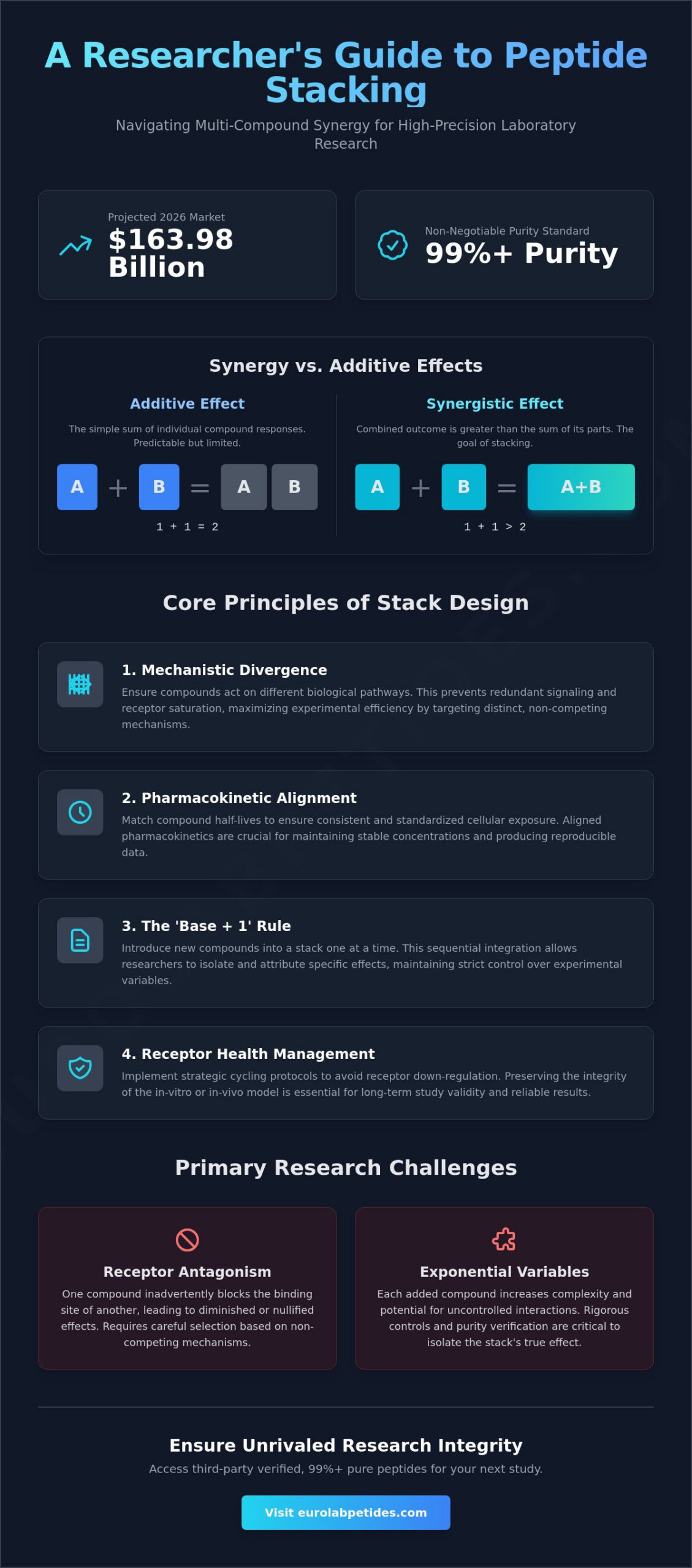
Synergy is distinct from additive effects. An additive effect is the simple sum of two individual compound responses. Synergy occurs when the interaction of multiple ligands produces a biological outcome greater than the mathematical total of their separate parts. This often happens when compounds influence a single cellular outcome through distinct, non-competing receptors. Synergy in peptide-receptor binding affinity is the potentiation of a signaling cascade through the simultaneous activation of complementary molecular targets.
Challenges of Multi-Compound Research
The primary challenge in multi-peptide studies is the exponential increase in experimental variables. Researchers must account for potential receptor antagonism, where one compound inadvertently blocks the binding site of another, leading to diminished returns. It’s a non-negotiable standard to establish a baseline with single compounds before progressing to a stack. This ensures that the 99%+ purity of each sequence is utilized effectively within the research framework. When data is analyzed via HPLC or mass spectrometry, the presence of even trace contaminants in a stacked model can skew results significantly. Third-party verification of each batch is an absolute necessity to ensure that research integrity remains unrivaled.
Core Principles of Stack Design: Mechanism and Synergy
Designing a multi-compound protocol requires a meticulous analysis of biochemical interactions. A researcher’s guide to using peptide stacks must prioritize four foundational principles to ensure experimental validity. First, mechanistic divergence ensures that compounds act on different biological pathways. This prevents redundant signaling and reduces the likelihood of receptor saturation. Second, pharmacokinetic alignment involves matching half-lives for consistent cellular exposure. Third, the ‘Base + 1’ rule for sequential integration dictates that new compounds are introduced individually. This allows researchers to isolate specific reactions and maintain control over experimental variables. Finally, receptor health management through strategic cycling avoids down-regulation, preserving the integrity of the in-vitro or in-vivo model.
Mechanistic Pathways: A Framework for Selection
Selection begins with the categorization of compounds by their primary function. Growth hormone secretagogues, for instance, operate via distinct mechanisms compared to mitochondrial bioregulators. Targeting the mitochondrial pathway with MOTS-c provides a different metabolic signal than traditional GHRH analogs. Researchers investigating cognitive baseline studies often incorporate nootropics to observe neuroprotective synergy. This structured approach prevents the risks of using unregulated peptides, where unknown interactions can compromise research outcomes. Every sequence must be selected based on its unique binding affinity and downstream signaling effects.
Accounting for Half-Life and Administration Timing
Administration timing is determined by the pharmacokinetic profile of each constituent. Short-acting peptides may require pulsatile administration to mirror endogenous rhythms. Conversely, long-acting analogs are utilized to maintain steady-state concentrations. Calculating the window of synergy requires identifying the period of maximum overlap in plasma concentration. This is critical in high-precision laboratory research where timing shifts can alter cellular responses. When designing these timelines, researchers should rely on the stringent data provided by third-party verification to confirm molecular weight and sequence accuracy. Utilizing high-purity tools from Eurolab Peptides ensures that the kinetic data remains consistent across all batches.
Purity is the non-negotiable metric that underpins these principles. Each batch is analyzed to confirm 99%+ purity, as trace contaminants can skew results in stacked models. By adhering to the methodologies in this researcher’s guide to using peptide stacks, laboratories can minimize interference and maximize the clarity of their findings. European manufacturing standards provide the unrivaled reliability necessary for these complex inquiries. Stringent testing protocols, including HPLC and mass spectrometry, are utilized to verify that every compound meets the required technical specifications before integration into a multi-peptide study.
Advanced Research Protocols: Synergistic Peptide Combinations
Advanced protocols in 2026 require a convergence of mechanistic insights to achieve high-precision results. This researcher’s guide to using peptide stacks identifies specific pairings that demonstrate unrivaled synergy in laboratory models. By aligning sequences that target distinct but complementary pathways, researchers can observe biological outcomes that single-compound studies often fail to yield. Every protocol must be underpinned by 99%+ purity and third-party verification to ensure that data remains objective and standardized. European manufacturing standards provide the necessary framework for maintaining this level of integrity across complex experimental designs.
Tissue Repair and Recovery Protocols
The interaction between BPC-157 and TB-500 represents a foundational study in angiogenic and migratory synergy. BPC-157 facilitates the expression of early growth response 1 (EGR-1) and promotes angiogenesis, while TB-500 (Thymosin Beta-4) acts through actin sequestration to enhance cellular migration. In laboratory settings, co-administration ratios of 1:1 or 1:2 are frequently analyzed to observe accelerated collagen synthesis in multi-peptide recovery models. These interactions are critical when evaluating the FDA clinical pharmacology of peptides, as immunogenicity and drug-drug interactions must be carefully monitored in stacked environments. Precision in these models ensures that the actin-binding properties of TB-500 don’t interfere with the signaling of BPC-157.
Metabolic and Longevity Research Stacks
Metabolic regulation models often combine Ipamorelin with CJC-1295 to investigate sustained growth hormone secretion. Ipamorelin acts as a selective ghrelin receptor agonist, while CJC-1295 functions as a GHRH analog. Their combination allows for a pulsatile release that mirrors endogenous patterns more closely than single-compound administration. Longevity research further incorporates Epitalon and GHK-Cu. Epitalon is studied for its role in telomere preservation and telomerase activation, while GHK-Cu is analyzed for its copper-binding affinity and gene expression modulation. Integrating mitochondrial peptides like MOTS-c into these stacks allows for a comprehensive metabolic pathway analysis, provided that each sequence is verified for sequence integrity through mass spectrometry.
Neuroprotective stacks involving Semax and Selank are also gaining prominence in neurological studies. These compounds demonstrate mechanistic overlap in their ability to modulate brain-derived neurotrophic factor (BDNF) and influence neurotransmitter balance. Stringent adherence to European standards ensures that these complex stacks remain free from trace contaminants that could skew neurological data. Each batch’s purity is verified to be 99%+, maintaining the uncompromising quality required for high-stakes scientific inquiry. By following this researcher’s guide to using peptide stacks, laboratories can ensure that their multi-compound protocols are both scientifically sound and reproducible.
Operational Logistics: Reconstitution, Storage, and Timing
Precision in the laboratory extends beyond compound selection; it requires uncompromising logistical management of multiple lyophilized vials. This section of a researcher’s guide to using peptide stacks focuses on the technical execution of multi-vial protocols where the risk of cross-contamination is highest. When managing stacks, each reconstitution event must be isolated to prevent the transfer of trace contaminants between sequences. Maintaining the integrity of the vacuum seal is an absolute requirement, as premature exposure to atmospheric oxygen can initiate degradation before the solvent is even introduced. Researchers rely on 99%+ purity standards to ensure that the baseline data remains untainted by manufacturing sub-products.
The choice of solvent significantly impacts the long-term stability of the research model. Bacteriostatic water, which contains 0.9% benzyl alcohol, is typically utilized to inhibit bacterial growth in multi-use vials. However, some fragile sequences may exhibit better stability in sterile saline (0.9% sodium chloride) if the pH of the benzyl alcohol solution interferes with the peptide’s isoelectric point. For researchers conducting high-stakes inquiries, verifying the compatibility of the solvent with the specific amino acid sequence is a non-negotiable step in protocol design. You can buy research peptides that meet stringent European standards to ensure your logistical variables remain controlled.
The Science of Reconstitution
Reconstitution must be performed with methodical care to avoid mechanical stress on the delicate peptide bonds. Using a peptide calculator is essential for establishing accurate molar concentrations across different vial sizes. When reconstituting fragile sequences like GHK-Cu, the solvent should be dribbled slowly down the inside wall of the glass vial rather than injected directly onto the lyophilized powder. This “swirling, not shaking” technique is a standard laboratory practice that prevents the shearing of the peptide structure. In a researcher’s guide to using peptide stacks, the emphasis is always on maintaining the native conformation of the molecule to ensure predictable receptor binding affinity.
Stability and Handling of Lyophilized Peptides
Storage requirements are determined by the intended duration of the study. Lyophilized peptides are most stable when stored in a climate-controlled environment at -20°C for long-term preservation. Once reconstituted, the degradation timeline accelerates significantly. Most solutions require constant refrigeration at 4°C and must be shielded from light to prevent photo-degradation. Third-party verification of each batch ensures that the lyophilization process has removed sufficient moisture to prevent hydrolysis during storage. Stringent adherence to these temperature protocols is necessary to maintain the unrivaled quality of the compounds throughout the duration of the in-vitro or in-vivo research model.
The Criticality of Purity in Multi-Compound Studies
In multi-compound research, the margin for error is non-existent. While a purity of 95% is often cited as acceptable for general in-vitro studies, this standard fails when applied to stacked models. A researcher’s guide to using peptide stacks must emphasize that 99%+ purity isn’t just a quality tier; it’s a prerequisite for experimental reproducibility. When multiple sequences are introduced to a single cellular model, the presence of trace impurities from each compound can lead to cumulative biochemical interference. These contaminants don’t just add noise. They can cause off-target effects that are impossible to isolate in a complex data set. If three compounds each contain 1% unknown manufacturing by-products, the resulting “impurity stack” can trigger synergistic toxicity or competitive receptor inhibition that invalidates the entire study.
Interpreting analytical reports is a core competency for any serious researcher. High-Performance Liquid Chromatography (HPLC) is utilized to determine the purity percentage of the sample, while mass spectrometry confirms the precise molecular weight and sequence identity. Every batch must be analyzed to ensure it meets these stringent specifications. If a Certificate of Analysis (CoA) shows peaks outside the target sequence, the material is compromised. Relying on European manufacturing standards provides an unrivaled level of security, as these facilities operate under stringent regulatory oversight that global markets often lack. EU-based shipping further ensures that temperature-sensitive sequences aren’t subjected to the degradation risks associated with prolonged international transit.
Third-Party Verification and Research Integrity
Independent lab testing serves as the final barrier between a successful study and a failed experiment. Third-party verification is a non-negotiable standard at Eurolab Peptides, where each batch is analyzed by external facilities to confirm sequence integrity. A CoA should clearly display the HPLC chromatogram and the mass spec results. If these documents aren’t provided with radical transparency, the research integrity is at risk. We prioritize multi-level quality control because we understand that high-stakes precision is the foundation of the scientific community. This “proof-first” methodology respects the intelligence of the researcher and ensures that the cold, hard data of chemical analysis drives the commitment to a protocol.
Ethical and Regulatory Standards for 2026
Adherence to in-vitro research guidelines within the European Union ensures that sourcing remains transparent and compliant. For data to be viable for peer-reviewed publication, the provenance of every compound must be documented. Transparent sourcing from EU-based facilities simplifies this process, providing logistical reliability and regulatory peace of mind. Researchers must maintain a meticulous record of batch numbers and analytical results. To ensure your laboratory meets these requirements, consult this final checklist on how to buy research peptides with uncompromising standards. Following this researcher’s guide to using peptide stacks will protect your study from the variables that compromise scientific inquiry and ensure that your results are based on uncompromising purity.
Advancing Multi-Peptide Methodologies for 2026
The evolution of laboratory research requires a move away from isolated compound studies toward complex, synergistic models. Successful execution depends on the principles of mechanistic divergence and stringent pharmacokinetic alignment. This researcher’s guide to using peptide stacks has outlined the technical requirements for maintaining data integrity, from calculated reconstitution ratios to the prevention of cross-contamination. Purity remains the most critical variable. Each batch must be analyzed via HPLC and mass spectrometry to ensure it meets the 99%+ threshold.
Eurolab Peptides provides the unrivaled tools necessary for these high-stakes inquiries. Our compounds are manufactured under European standards and undergo rigorous third-party verification to guarantee sequence integrity. You can Explore our 99%+ pure Research Stacks at EuroLab Peptides to secure standardized materials for your next study. High-precision laboratory research is built on the foundation of cold, hard data and uncompromising quality. The pursuit of objective excellence in biochemistry continues to drive experimental innovation.
Frequently Asked Questions
What is the most effective way to combine peptides for recovery research?
The most effective methodology involves targeting distinct mechanistic pathways to achieve a synergistic biological outcome. Researchers often combine an angiogenic agent like BPC-157 with an actin-sequestering compound like TB-500. This approach ensures that cellular migration and vascularization are addressed through non-competing signaling cascades. Following a researcher’s guide to using peptide stacks ensures that these interactions are documented with high-stakes precision.
Can I mix two different peptides in the same vial for reconstitution?
Mixing multiple lyophilized sequences in a single vial is not recommended for high-precision laboratory research. This practice introduces uncontrolled variables such as pH instability and potential chemical cross-reactions between sequences. Each compound should be reconstituted in its own vial to preserve molecular integrity. Maintaining isolated environments for each sequence is a non-negotiable standard for ensuring that 99%+ purity remains untainted during the study.
How do I calculate the correct dosage for a multi-peptide stack?
Calculations must be based on the precise molar concentration and molecular weight of each constituent peptide. Researchers utilize a peptide calculator to determine the volume of bacteriostatic water needed to reach the target micrograms per microliter. Accuracy is paramount in multi-compound studies to avoid receptor saturation. This researcher’s guide to using peptide stacks emphasizes that dosages must be established for each compound individually before they are integrated into a combined protocol.
What are the risks of using low-purity peptides in a stack?
The primary risk is cumulative impurity interference, where trace contaminants from multiple sources create synergistic toxicity or off-target effects. If each compound in a stack has only 95% purity, the resulting “impurity stack” can significantly skew experimental data. We prioritize 99%+ purity and third-party verification to eliminate these variables. Using sub-standard materials compromises the reliability of mass spectrometry results and invalidates the integrity of the research model.
Is it necessary to cycle peptide stacks to prevent receptor saturation?
Strategic cycling is required to prevent receptor down-regulation and maintain the sensitivity of the biological model. Continuous exposure to high concentrations of ligands can lead to a diminished cellular response over time. Implementing “on” and “off” periods allows receptors to reset to their baseline state. This methodical approach is a core principle of advanced stack design, ensuring that the signaling pathways remain responsive throughout the duration of the inquiry.
How long can a reconstituted peptide stack be stored before it degrades?
Reconstituted sequences typically remain stable for 14 to 28 days when stored under refrigeration at 4°C. Degradation rates vary depending on the specific amino acid sequence and the type of solvent used. Peptides like GHK-Cu are particularly sensitive to light and temperature fluctuations. For long-term stability, lyophilized vials should be kept at -20°C. Once in solution, the uncompromising quality of the peptide begins to diminish as hydrolysis occurs over time.
What is the difference between a synergistic stack and an additive stack?
A synergistic stack produces a biological outcome that is greater than the mathematical sum of its individual parts. This occurs when compounds potentiate each other through complementary pathways. An additive stack merely results in the combined effect of the compounds with no additional potentiation. Researchers aim for synergy by selecting compounds with mechanistic divergence. This ensures that the cellular signaling is optimized rather than just duplicated across the same receptor sites.
Are there any peptides that should never be stacked together?
Compounds that target the same receptor with high affinity should not be stacked together because they will engage in competitive inhibition. For example, stacking two different GHRP analogs may lead to receptor saturation without increasing the growth hormone pulse. This redundancy increases the metabolic load on the model without providing additional data value. Researchers must analyze the binding affinity of each sequence to ensure that the stack remains efficient and scientifically sound.
