

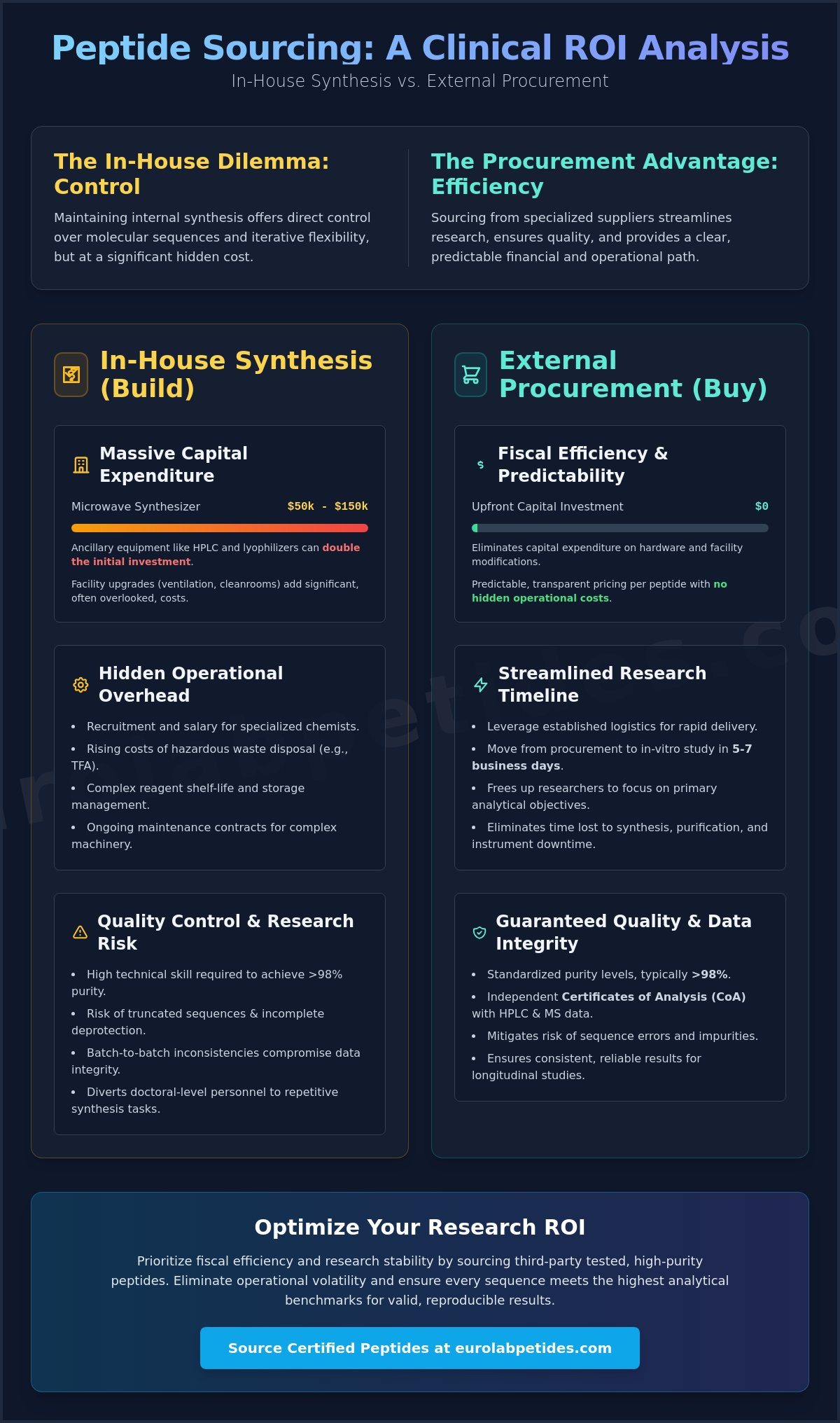
The assumption that internalizing peptide production yields long-term savings often ignores the staggering capital expenditure and operational volatility inherent in laboratory scale-up. When evaluating the buying peptides vs in-house synthesis cost, research institutions must account for more than the raw price per amino acid. While microwave-assisted synthesizers require initial investments ranging from $50,000 to $150,000, the total cost of ownership includes specialized chemist recruitment and the disposal of hazardous solvents. These logistical demands often offset the perceived benefits of internal production.
Maintaining absolute control over molecular sequences is essential for ensuring the integrity of longitudinal research. This analysis provides a clinical evaluation of the financial and operational trade-offs between internal synthesis and external procurement. We establish a clear ROI framework by analyzing hardware maintenance, reagent overhead, and the rigorous chromatographic purity standards necessary for valid in-vitro studies. By the end of this review, you’ll understand how to optimize your laboratory’s budget while ensuring maximum chemical precision and verifying that every sequence meets the highest analytical benchmarks.
Key Takeaways
- Quantify the total cost of ownership for internal synthesis by accounting for automated hardware, specialized labor, and ancillary purification equipment.
- Analyze the impact of hidden operational variables, such as reagent shelf-life management and the rising costs of hazardous waste disposal.
- Evaluate the buying peptides vs in-house synthesis cost through a clinical ROI framework that prioritizes research stability and fiscal efficiency.
- Identify how external validation via independent Certificates of Analysis mitigates the risk of sequence errors and inconsistent purity levels.
- Streamline research timelines by leveraging established regional logistics to move from procurement to in-vitro study in five to seven business days.
Evaluating the Buy vs. Build Decision in Peptide Research
Modern biochemistry laboratories operate at a strategic crossroads where the allocation of fiscal resources determines the velocity of discovery. The historical transition from manual Peptide Synthesis Methods to automated, high-throughput workflows has fundamentally altered the economic profile of molecular research. In the 2026 research landscape, characterized by intensified funding constraints and rigorous peer-review standards, the evaluation of buying peptides vs in-house synthesis cost must be grounded in empirical data rather than organizational tradition. Technical nomenclature, including terms like trifluoroacetic acid (TFA) removal and enantiomeric purity, is utilized to accurately assess whether a facility possesses the requisite infrastructure for high-fidelity production. Laboratories that fail to quantify these variables risk significant budgetary leakage and compromised experimental outcomes.
The Core Dilemma: Control vs. Efficiency
The perceived value of maintaining internal sequence control often stems from a desire for immediate iterative flexibility. However, the opportunity cost of diverting doctoral-level research personnel to the repetitive tasks of synthesis and purification is frequently underestimated. When researchers spend hours managing resin loading or monitoring cleavage reactions, the primary analytical objectives of the study are delayed. Initial considerations for peptides in various research stages must prioritize the total operational burden over the nominal cost of raw materials. A comprehensive analysis of the buying peptides vs in-house synthesis cost reveals that specialized labor and instrument downtime represent a significant portion of the internal expenditure. It’s essential to recognize that internalizing production doesn’t just add a capability; it adds a complex management layer to the laboratory’s operational structure.
Defining the Scope of In-Vitro Research Requirements
Standardizing purity requirements is non-negotiable for ensuring valid experimental outcomes in in-vitro studies. Variations in batch-to-batch consistency introduce confounding variables that compromise longitudinal data integrity. Research-grade precision requires more than the acquisition of basic synthesis hardware; it demands advanced analytical validation through high-performance liquid chromatography (HPLC) and mass spectrometry (MS). Without these integrated verification steps, internal synthesis risks producing sequences with truncated fragments or incomplete deprotection. These impurities are unacceptable in high-stakes professional inquiry where molecular accuracy is a verifiable metric. Laboratories must determine if their internal quality control protocols can match the standardized external validation provided by specialized manufacturers. Often, the technical overhead required to reach 98% purity levels in-house exceeds the cost of procurement from a certified provider.
Direct Capital Expenditure of Internal Synthesis Operations
The High Cost of Specialized Instrumentation
The acquisition of hardware is secondary to the ongoing fiscal demands of technical maintenance. Service contracts for SPPS and HPLC systems typically command a significant percentage of the original purchase price annually. Technical downtime results in research delays, as specialized parts often require international logistics. Software licensing for synthesis logs and data management infrastructure adds another layer of recurring expense. These systems must be rigorously maintained to ensure that every batch meets the 98% purity benchmarks required for precise research outcomes. If an instrument fails during a critical synthesis cycle, the entire batch of reagents is often rendered unusable, compounding the financial loss.
Personnel Allocation and Expertise Bottlenecks
Recruiting doctoral-level peptide chemists remains a primary challenge in the current scientific market. The scarcity of individuals with expertise in complex sequence assembly and chromatographic purification creates a high-cost labor environment. There’s a documented learning curve associated with new equipment; initial staff training often results in failed batches and wasted high-value reagents. Staff turnover poses a critical risk to proprietary synthesis protocols. If a lead chemist departs, the institutional knowledge required to replicate specific peptide folds or modifications isn’t easily replaced. For laboratories prioritizing efficiency, sourcing materials from a dedicated peptide research provider allows for the immediate initiation of studies without the burden of specialized recruitment or hardware management.
Analyzing Hidden Operational Overhead and Quality Control Risks
Operational overhead in peptide research extends far beyond the initial hardware procurement discussed in previous sections. While synthesis is often viewed as the primary technical challenge, it represents approximately 30% of the total laboratory workload. The remaining 70% is dedicated to post-synthesis purification and rigorous analytical validation. For many institutions, the buying peptides vs in-house synthesis cost calculation becomes unbalanced when these “hidden” phases are scrutinized. Managing a continuous supply chain of high-purity reagents requires meticulous inventory control, as any deviation in chemical stability directly correlates with synthesis failure. If a batch fails Mass Spectrometry (MS) validation, the institution loses the entire investment in reagents, labor, and energy. This risk of sunk cost is a critical variable that’s frequently underestimated in internal feasibility studies.
The Reagent and Consumable Drain
Protected amino acids, resins, and coupling reagents like Dimethylformamide (DMF) and Piperidine are highly sensitive to environmental factors. Chemical degradation occurs rapidly if storage temperatures aren’t strictly maintained, leading to incomplete coupling and truncated sequences. In low-volume synthesis environments, the financial impact of reagent waste is disproportionately high. It’s common for laboratories to discard expired stocks that weren’t utilized within their stability window. Furthermore, inventory management requires significant administrative time to prevent cross-contamination and ensure that every consumable meets the validated specifications required for high-fidelity research.
Hazardous Waste and Regulatory Compliance
Purification and Lyophilization Challenges
Achieving >98% purity levels through preparative high-performance liquid chromatography (HPLC) is a complex process that demands significant solvent consumption. The cost of HPLC-grade acetonitrile and water adds up quickly during the multiple runs required to isolate the target peptide from synthesis impurities. Once purified, the peptide must undergo professional-grade lyophilization to ensure long-term stability. This process is energy-intensive and time-consuming, often requiring 48 to 72 hours for a single batch. Without industrial-scale equipment, achieving a consistent, salt-free powder is difficult, which can introduce confounding variables into sensitive in-vitro studies.
The Strategic Advantages of Sourcing Third-Party Tested Peptides
Transitioning from internal production to external procurement offers a quantifiable shift in research ROI. While the total cost of ownership for a validated synthesis suite often exceeds $150,000 in initial capital alone, external sourcing allows laboratories to convert fixed costs into predictable variable expenses. When analyzing the buying peptides vs in-house synthesis cost, the primary advantage lies in the immediate access to high-fidelity sequences without the 48 to 72-hour energy drain of lyophilization or the technical burden of preparative HPLC. Specialized providers absorb the financial risk of synthesis failure, ensuring that the researcher only pays for materials that meet pre-defined analytical benchmarks. This model accelerates research timelines, frequently moving a project from the procurement phase to active experimentation within five to seven business days.
Third-Party Validation as a Scientific Standard
Internal quality control (QC) protocols often suffer from the inherent bias of “grading one’s own homework.” Relying on internal HPLC and MS validation without external oversight can lead to the propagation of systematic errors in longitudinal data. Utilizing certified peptides ensures that every sequence is accompanied by an independent Certificate of Analysis (COA). This document serves as a verifiable metric of purity, typically confirming levels of 98% or higher. Establishing this level of transparency is essential for maintaining moral consistency in biochemical research. It provides an objective layer of security that internal laboratories, often limited by staff turnover or hardware calibration drift, find difficult to replicate consistently over multiple years of study.
Inventory Agility and Research Flexibility
Maintaining an internal library of protected amino acids and resins requires significant administrative oversight and climate-controlled storage space. External sourcing provides laboratories with the agility to pivot between diverse research areas, such as metabolic studies or cognitive function research, without stocking specialized reagents for every possible sequence. This flexibility is particularly valuable when utilizing pre-formulated research stacks designed for specific in-vitro study areas. By removing the “dead time” associated with internal sequence assembly and purification, institutions can focus their doctoral-level labor on data interpretation and hypothesis testing. For laboratories seeking to maximize their analytical output, the most efficient path is to source high-purity research materials from a dedicated regional provider.
EuroLab Peptides: Optimizing Research ROI Through Rigorous Quality Standards
The decision to externalize peptide procurement is validated by the measurable reduction of operational volatility and the standardization of analytical results. When laboratories evaluate the buying peptides vs in-house synthesis cost, the focus shifts from raw material prices to the long-term reliability of the supply chain and the precision of the resulting data. EuroLab Peptides addresses these institutional needs by providing a clinical, data-driven alternative to internal synthesis suites. By absorbing the capital risks and technical burdens of production, we allow research teams to prioritize hypothesis testing and data interpretation. The adoption of external sourcing is the logical endpoint for laboratories seeking to maximize their fiscal efficiency while maintaining the highest standards of biochemical accuracy.
The EuroLab protocol is characterized by a multi-stage validation sequence designed to instill absolute security in the professional user. Every batch is subjected to internal chromatographic analysis before being submitted for independent, external laboratory verification. This redundant testing ensures that the target sequence is isolated with maximum fidelity, effectively eliminating the risks associated with internal quality control drift or hardware calibration errors. Regional logistics within Europe are meticulously managed to ensure that molecular stability is maintained during transit. Cold-chain protocols are utilized where necessary, preventing the degradation of sensitive lyophilized powders and ensuring that materials arrive in a state ready for immediate reconstitution.
Uncompromising Purity and Analytical Transparency
Verifiable metrics are provided for every batch, establishing a foundation of radical honesty and accountability. Regional manufacturing standards are strictly observed, ensuring that all chemical synthesis processes comply with rigorous European regulatory frameworks. This localized approach serves as a shorthand for reliability, contrasting with the inconsistent quality often found in the global market. Technical documentation, including comprehensive Certificates of Analysis (COA), is provided to support those who buy research peptides for high-stakes inquiry. These documents confirm that every sequence meets the 98% purity benchmark required for valid in-vitro studies, ensuring that experimental outcomes aren’t compromised by truncated fragments or residual solvents.
Partnering for Scientific Excellence
Operational burdens are significantly reduced when research teams transition away from the maintenance of internal synthesis hardware. EuroLab provides tailored solutions for specialized study areas, including Longevity & Vitality Research, Weight Management Research, and Tissue Repair & Recovery Research. Specialized technical support is provided to assist with reconstitution and storage protocols, ensuring that the integrity of the peptides is preserved throughout the duration of the study. Integrating high-purity materials, such as the Advanced Metabolic Stack or individual sequences like SLU-PP-332, into your next research protocol ensures that your focus remains on scientific discovery rather than the logistical complexities of chemical manufacturing. This strategic partnership reinforces a commitment to excellence and moral consistency in the pursuit of professional biochemical inquiry.
Advancing Research Efficiency through Strategic Procurement
The transition from internal production to external sourcing represents a fundamental shift in laboratory resource management. By converting fixed capital expenditures into predictable variable costs, institutions mitigate the financial risks associated with hardware maintenance and failed batches. A clinical analysis of the buying peptides vs in-house synthesis cost confirms that the total cost of ownership for internal suites often exceeds the value generated by nominal sequence control. Utilizing external validation through independent third-party testing removes the inherent bias of internal quality control, ensuring that every sequence meets the rigorous demands of modern biochemistry. It’s a strategic move that prioritizes analytical precision over the logistical complexities of chemical manufacturing.
EuroLab Peptides provides the infrastructure necessary for high-stakes inquiry, offering specialized in-vitro grade purity exceeding 99%. Our European-based logistics ensure maximum molecular stability during transit, allowing your team to maintain absolute focus on analytical discovery. Explore EuroLab’s Third-Party Tested Research Peptides to integrate verifiable precision into your next study. We look forward to supporting your pursuit of scientific excellence with rigorous, data-driven solutions.
Frequently Asked Questions
Is in-house peptide synthesis always more expensive than buying?
Internal synthesis is not always more expensive, but it requires a high production volume to amortize the initial capital expenditure and specialized labor costs. For the majority of research facilities, the buying peptides vs in-house synthesis cost analysis reveals that external procurement is more fiscally efficient. This is due to the significant overhead of maintaining a validated synthesis suite and the continuous expense of reagent inventory. Most institutions find that the variable cost of purchasing is lower than the fixed cost of internal operations.
What are the primary hidden costs of running a peptide synthesizer?
Hidden costs include specialized labor, recurring maintenance contracts, and the waste of high-value reagents due to chemical degradation. Technical downtime for repairs often results in research delays, as specialized parts require complex logistics. Additionally, climate-controlled storage for hygroscopic amino acids and the energy consumption of continuous lyophilization cycles add significant operational overhead. These variables are frequently underestimated when laboratories calculate the total cost of ownership for automated synthesis hardware.
How does third-party testing impact the overall value of purchased peptides?
Third-party testing provides an objective layer of security by providing a non-negotiable standard of external validation. It ensures that every batch is accompanied by an independent Certificate of Analysis (COA), which eliminates the internal bias associated with “grading one’s own homework.” This transparency guarantees that purity levels meet the required benchmarks, such as 98% or higher, for precise in-vitro studies. Verifiable metrics from an external laboratory instill absolute trust in the professional user and the integrity of their data.
Can a small research lab afford the equipment for internal peptide synthesis?
Initial hardware procurement for a microwave-assisted synthesizer typically ranges from $50,000 to $150,000, which is often prohibitive for small laboratory budgets. This expenditure does not include the high-performance liquid chromatography (HPLC) systems or industrial lyophilizers required for purification and stabilization. When these ancillary requirements are factored in, the total investment often exceeds the available grant funding. Small labs find that sourcing materials externally allows them to focus resources on data interpretation rather than equipment maintenance.
What is the typical failure rate for in-house peptide synthesis batches?
Failure rates vary based on sequence complexity, but even experienced laboratories encounter batch rejection due to incomplete coupling or truncated sequences. Complex modifications and long amino acid chains increase the risk of synthesis errors that are only detected during post-synthesis analytical validation. A failed batch results in a total loss of reagents and labor, which negatively impacts the laboratory’s ROI. External providers absorb this risk, ensuring that the researcher only pays for sequences that meet pre-defined purity standards.
How does the cost of hazardous waste disposal affect the synthesis ROI?
Hazardous waste disposal is a non-negotiable recurring expense that significantly reduces the ROI of internal production. Synthesis operations generate large volumes of toxic and flammable byproducts, such as Dimethylformamide (DMF) and Piperidine, which require specialized collection services. Compliance with regional environmental safety standards also involves an administrative burden, including the management of Safety Data Sheets (SDS). These logistical demands add a layer of complexity and cost that is eliminated when sourcing from a certified external provider.
Why is HPLC purification considered the most expensive part of the process?
Preparative HPLC is resource-intensive due to high solvent consumption and the requirement for doctoral-level analytical expertise. The process of isolating the target peptide from synthesis impurities accounts for approximately 70% of the total laboratory workload. It requires significant volumes of HPLC-grade acetonitrile and water, alongside expensive columns that have a limited functional lifespan. Because this phase is both time-consuming and technically demanding, it represents the primary bottleneck in achieving the high-purity standards necessary for professional research.
Does sourcing peptides externally compromise proprietary research data?
Sourcing from a professional provider does not compromise proprietary research data when established confidentiality protocols and non-disclosure agreements are observed. Reputable manufacturers operate under strict security standards to protect sequence identity and the study’s primary objectives. This allows institutions to optimize their buying peptides vs in-house synthesis cost without risking their intellectual property. Professional partners prioritize scientific transparency and data security, ensuring that sensitive research information remains protected throughout the procurement and delivery phases.
