

Isolated compound administration often fails to replicate the integrated multi-pathway signaling required for sophisticated physiological modeling. While single-peptide protocols provide baseline data, they frequently yield inconsistent results because biological systems utilize compensatory mechanisms to maintain homeostasis. This technical limitation highlights the primary benefits of peptide stacks vs single compounds, where strategic combinations are engineered to achieve a level of biochemical synergy that isolated molecules can’t facilitate.
It’s understood that managing complex variables while maintaining the analytical transparency necessary for reproducible data remains a significant hurdle in modern laboratory settings. This article analyzes the mechanisms of synergistic potentiation and explores how specific peptide combinations target complementary biological pathways in metabolic and tissue repair models. We provide a technical overview of multi-peptide protocols, focusing on the rigorous purity benchmarks mandated by the June 2026 EMA guidelines and the methodology for sourcing validated research stacks within the European market.
Key Takeaways
- Define the biochemical distinction between additive results and synergistic potentiation to optimize multi-vector pathway modulation.
- Evaluate the technical benefits of peptide stacks vs single compounds through the lens of receptor sensitivity and integrated signaling in complex research models.
- Examine the application of specific combinations like the Recovery Research Stack for addressing multifaceted tissue repair and inflammatory signaling.
- Identify methodological strategies for managing experimental variables to ensure high-fidelity data when administering multiple sequences simultaneously.
- Source third-party validated, European-synthesized research kits to meet the rigorous characterization standards required for modern laboratory inquiry.
Mechanisms of Peptide Stacking in Research Models
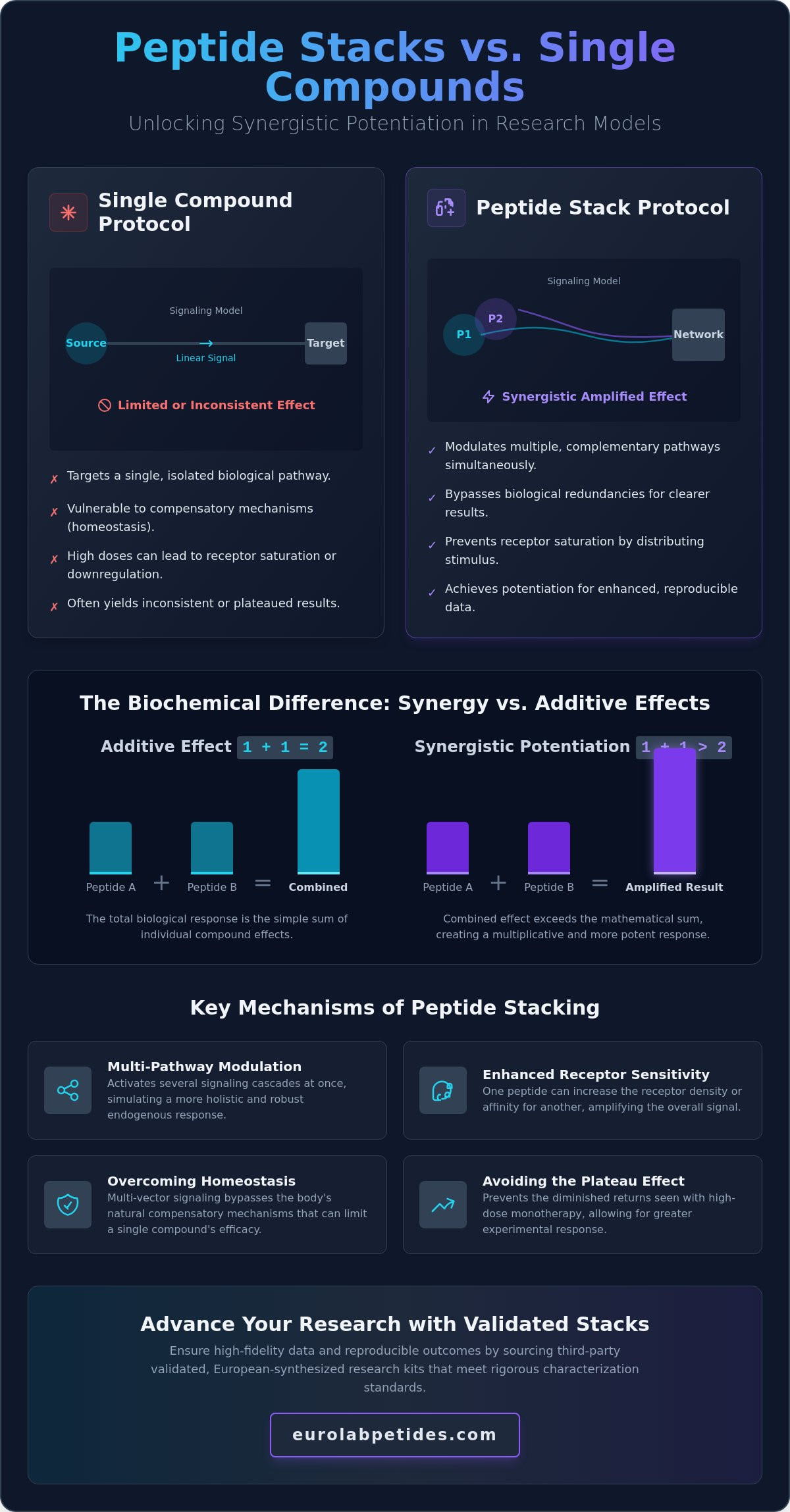
Peptide stacking is defined as the concurrent administration of two or more distinct amino acid sequences within a controlled research environment. Unlike isolated compound studies, which examine the linear effect of a single molecule on a specific receptor, stacking aims to replicate the complex, multi-vector signaling characteristic of endogenous systems. The primary benefits of peptide stacks vs single compounds lie in their ability to bypass biological redundancies that often lead to inconsistent data in mono-compound trials. Many physiological processes are governed by parallel pathways; if one is stimulated in isolation, the system may compensate through alternative mechanisms, potentially obscuring the compound’s true efficacy. In-vitro models benefit from this approach by simulating a more holistic environment where multiple biological triggers are present. All discussed protocols are strictly intended for laboratory-only research contexts to ensure objective data collection and regulatory compliance.
Targeting Complementary Biological Pathways
Stacking protocols are engineered to address multiple signaling cascades simultaneously, effectively mitigating the rate-limiting steps often encountered in cellular repair or metabolic studies. For instance, the combination of Growth Hormone Secretagogues and GH mimetics targets both the production and the sensitivity of the growth axis. This dual-action approach prevents early receptor saturation that often occurs with high-dose single-compound administration. By distributing the stimulus across complementary pathways, researchers can observe enhanced cellular responses without the rapid downregulation typically associated with aggressive mono-therapy. This methodology is central to the ongoing evolution of peptide therapeutics, where multi-target strategies are becoming the standard for complex research models. It’s clear that single-vector targeting often hits a ceiling that only a multi-peptide protocol can surpass.
In-Vitro vs. In-Vivo Considerations
In isolated in-vitro environments, the absence of systemic feedback loops makes stacking critical for observing tissue interactions that would otherwise remain dormant. Stacking allows for the observation of cross-talk between different cell types in a way that isolated administration cannot replicate. Managing the stability of lyophilized peptides when combined in research media requires precise analytical control, as interactions between sequences can alter solubility or binding affinity. The benefits of peptide stacks vs single compounds are most evident when these variables are strictly monitored through high-purity verification and standardized reconstitution protocols. It’s essential that researchers verify the identity of each sequence before combination to avoid confounding results. To maintain data integrity, all stacked compounds must be categorized as research-grade materials and handled according to stringent laboratory safety standards.
Synergy vs. Additive Effects: A Biochemical Analysis
Distinguishing between additive and synergistic outcomes is fundamental to evaluating the benefits of peptide stacks vs single compounds. In a standard additive model, the total biological response equals the sum of individual compound contributions (1+1=2). Conversely, synergistic potentiation occurs when the combined effect exceeds the mathematical sum of its parts (1+1=3). This phenomenon is often driven by one peptide increasing the receptor sensitivity or density for a secondary sequence, creating a multiplicative rather than linear result. Research into the synergistic effects of peptide combinations demonstrates that multi-vector targeting can overcome the “plateau effect” observed in high-dose mono-compound administration.
Quantifying these outcomes requires an understanding of “cross-talk” between endocrine and paracrine pathways. While single compounds target a specific receptor, stacks can trigger a cascade of secondary messengers that amplify the original signal. This is particularly evident in metabolic and tissue repair research, where the activation of one pathway often creates a metabolic demand that a second peptide can satisfy. By coordinating these signals, researchers can achieve physiological states that are unattainable through isolated administration. For those investigating complex repair mechanisms, utilizing a pre-validated Recovery Research Stack can provide the necessary molar precision to observe these interactions without the noise of inconsistent ratios.
The Math of Potentiation
In biochemical modeling, synergy is visualized as a leftward shift in the dose-response curve. This shift indicates that a specific biological threshold can be reached using lower concentrations of each constituent peptide. Lowering the required concentration is a critical strategy for maintaining data integrity; it reduces the risk of off-target effects and systemic toxicity that often accompany high-dose protocols. By utilizing lower-dose synergistic protocols, researchers can isolate the primary mechanism of action with greater clarity while minimizing confounding variables associated with cellular stress or receptor downregulation.
Case Study: Growth Hormone Secretagogue Synergy
The interaction between Growth Hormone Releasing Hormones (GHRHs) and Growth Hormone Releasing Peptides (GHRPs) serves as a gold-standard example of synergistic potentiation. While CJC-1295 provides a sustained stimulus for GH release, its efficacy is limited by the natural somatostatin inhibition within the model. Adding a compound like Ipamorelin effectively inhibits somatostatin and provides a secondary pulsatile stimulus. As detailed in the Ipamorelin: A Technical Profile, this combination results in a GH pulse that is significantly larger than the sum of the pulses produced by either compound alone. This pulsatile versus sustained release dynamic allows for more sophisticated modeling of endogenous endocrine rhythms in laboratory settings.
Pathway Modulation: Strategic Stacking in Specific Research Areas
Strategic modulation of biological pathways requires a multi-vector approach that isolated administration cannot provide. By aligning sequences that target distinct but related physiological mechanisms, researchers can bypass the limitations of single-target signaling. This methodology is central to understanding the benefits of peptide stacks vs single compounds, particularly when investigating systemic responses like tissue regeneration or metabolic adaptation. Multi-peptide protocols allow for the simultaneous stimulation of primary and secondary pathways, ensuring that the biological model doesn’t hit the ceiling effect common in mono-compound studies.
Tissue Repair and Recovery Synergy
The Recovery Research Stack utilizes the biochemical complementarity of BPC-157 and TB-500 to address the complex requirements of tissue regeneration. BPC-157 acts primarily through the modulation of angiogenesis and the upregulation of growth factor receptors, as detailed in this BPC-157: A Technical Guide. When paired with TB-500, which facilitates actin sequestration and cellular migration, the protocol targets both the structural and vascular components of repair. These two compounds are considered the gold standard for recovery research because they address the multifaceted nature of wound healing that single-compound protocols often fail to resolve. In-vitro wound models demonstrate that this dual-action approach significantly accelerates fibroblastic migration compared to mono-compound controls, providing a more robust data set for recovery kinetics.
Metabolic and Weight Management Research
In metabolic research, the objective is often to trigger mitochondrial biogenesis while simultaneously enhancing glucose oxidation. The use of the Advanced Metabolic Stack allows for the observation of these processes in tandem, providing a more comprehensive model of metabolic flexibility. Recent studies on Peptides to Enhance Drug Efficacy suggest that designing sequences to work in concert can improve the overall fidelity of the research model. For instance, the ERR agonist SLU-PP-332 can be analyzed alongside GLP-1 mimetics to observe the interplay between peripheral metabolic activity and central neurological signaling. This is particularly relevant when modeling laboratory-induced metabolic syndrome, where isolated compound efficacy is often masked by systemic insulin resistance. Stacking Tesofensine with metabolic peptides allows researchers to differentiate between neurological appetite signaling and direct metabolic rate modulation.
Longevity Research Stacks often incorporate Epitalon and GHK-Cu to investigate cellular senescence and telomere maintenance. While Epitalon influences telomerase activity, GHK-Cu provides critical copper-mediated DNA repair signaling. This synergistic interaction provides a robust framework for studying aging at the cellular level, further illustrating the benefits of peptide stacks vs single compounds in achieving high-stakes precision in longevity models. By addressing both the genetic and epigenetic factors of aging, these stacks provide a level of data depth that isolated compounds cannot replicate.
Managing Variables: Methodological Challenges of Peptide Stacking
The transition from mono-compound administration to multi-peptide protocols necessitates a more rigorous approach to experimental design. While the benefits of peptide stacks vs single compounds include enhanced pathway modulation, they also introduce a higher volume of experimental variables that can obscure primary data points. Professional researchers mitigate this “data noise” by implementing strict control protocols that isolate the contribution of each individual sequence. Without these controls, it’s impossible to determine whether an observed effect is truly synergistic or merely an artifact of high total peptide concentration. Maintaining data integrity requires that every variable, from molarity to reconstitution media, is standardized across all test groups.
Isolating Variables in Multi-Peptide Studies
Identifying the specific contribution of individual compounds within a stack requires a four-arm study design. This includes a negative control group, two groups receiving single compounds, and a final group receiving the stack. To quantify synergy accurately, researchers often employ the Bliss Independence Model or the Loewe Additivity Model, which provide a mathematical framework for determining if the combined effect is statistically significant. Ensuring identical molar concentrations across all groups is essential for comparative accuracy. If the concentration of the stacked compounds isn’t balanced against the single-compound controls, the resulting data will be skewed by total peptide volume rather than synergistic interaction.
The Critical Role of Purity and Testing
In a stacking protocol, 99%+ purity is a non-negotiable requirement. Impurities in one compound can interact with the amino acid sequence of another, leading to unpredictable chemical reactions that compromise the entire research model. Such cross-contamination often results in baseline data drift that’s difficult to correct post-hoc. High-stakes research demands that every batch undergoes rigorous external validation via High-Performance Liquid Chromatography (HPLC) and Mass Spectrometry (MS) to verify both identity and purity. EuroLab Peptides adheres to a multi-level quality protocol, ensuring that each sequence meets these stringent benchmarks before inclusion in a pre-formulated kit. For researchers requiring absolute precision, it’s critical to source third-party tested research stacks that guarantee purity through verifiable certificates of analysis.
Standardizing the reconstitution process is equally vital for consistency. Lyophilized peptides must be reconstituted in identical volumes of bacteriostatic water or specialized research media to maintain uniform concentration. Variations in pH or temperature during storage can lead to peptide degradation, which occurs at different rates for different sequences. By utilizing standardized storage protocols, researchers ensure that the ratio of compounds within a stack remains constant throughout the duration of the trial, preserving the fidelity of the synergistic observation.
EuroLab Peptides: Sourcing Validated Research Stacks in Europe
Professional inquiry into the benefits of peptide stacks vs single compounds requires a sourcing partner capable of providing absolute analytical transparency and logistical reliability. EuroLab Peptides provides pre-formulated Research Stacks, including the Longevity Research Stack, Muscle Research Stack, Cognitive Research Stack, and Recovery Research Stack, all synthesized within European facilities. This regional focus ensures adherence to stringent manufacturing standards while facilitating localized logistics for rapid, secure delivery across the continent. By maintaining a supply chain within Europe, the risks associated with international customs fluctuations and temperature excursions during transit are significantly mitigated. EuroLab Peptides maintains strict alignment with the analytical transparency standards driven by the June 2026 EMA guidelines, ensuring that research-grade materials meet the highest characterization benchmarks currently required in the chemical synthesis space.
Consistency in multi-peptide protocols is dependent on the initial chemical synthesis and subsequent purity validation. Every compound undergoes a rigorous quality assurance cycle, involving both in-house analysis and independent laboratory validation via HPLC and Mass Spectrometry. This dual-layer verification process ensures that the molar ratios within each stack remain precise, allowing researchers to focus on pathway modulation rather than batch-to-batch variability. All products are strictly categorized for in-vitro and laboratory development use, aligning with European regulatory frameworks for research chemicals. This proof-first approach respects the time and intelligence of the professional user, providing the empirical evidence needed before institutional commitment.
Technical Specifications of EuroLab Stacks
Precision-measured ratios are utilized in every Research Stack to maximize synergistic potential and ensure reproducibility in complex models. Stoichiometric accuracy is maintained during the lyophilization process, resulting in highly stable cakes that resist degradation during shipping. Each vial is subjected to vacuum sealing and rigorous stability testing to ensure high-fidelity results upon reconstitution. A detailed Certificate of Analysis (COA) is provided for every compound, documenting purity levels that consistently exceed the 99% benchmark. This level of transparency is essential for researchers who must account for every chemical variable within their experimental models to prevent data noise and ensure the integrity of the synergistic observation.
Procurement and Support for European Institutions
Navigating the complexities of European research chemical regulations is simplified through partnership with a localized supplier. EuroLab Peptides provides direct access to technical data sheets and validation reports for institutional procurement officers, streamlining the acquisition process for university and private laboratory settings. Understanding how to buy research peptides in the current regulatory environment requires a focus on purity and verified sourcing. Technical support is available to assist in the selection of the Advanced Metabolic Stack or other specialized kits, ensuring that the chosen sequences align with specific research objectives. This commitment to professional standards positions EuroLab as a primary resource for high-stakes biochemical inquiry in Europe.
Advancing Analytical Precision Through Multi-Peptide Protocols
The transition from mono-compound studies to sophisticated stacking protocols represents a shift toward higher physiological fidelity in laboratory models. Understanding the benefits of peptide stacks vs single compounds allows researchers to move beyond linear dose-response curves, instead utilizing synergistic potentiation to target complementary signaling cascades. These multi-vector strategies are essential for overcoming biological redundancies and achieving measurable outcomes in complex tissue repair and metabolic research. Maintaining this level of precision requires a non-negotiable commitment to chemical purity and standardized methodology to ensure that observed results are statistically significant.
EuroLab Peptides supports high-stakes inquiry by providing research kits characterized by absolute analytical transparency. Every batch is subjected to third-party HPLC and MS testing to ensure a 99%+ purity benchmark, facilitating data integrity in every trial. With European-based synthesis and localized distribution, the logistical variables of international procurement are neutralized, allowing for rapid and secure delivery to specialized institutions. It’s our priority to provide the elite tools required for serious professional inquiry.
Explore EuroLab Peptides’ Range of Validated Research Stacks to integrate these advanced tools into your next research model. We look forward to supporting your commitment to rigorous scientific discovery.
Frequently Asked Questions
What is the primary benefit of peptide stacking over single compounds in research?
The primary benefit is the ability to achieve synergistic potentiation, where the combined effect of two sequences exceeds the sum of their individual contributions. By targeting multiple biological pathways simultaneously, researchers can bypass the compensatory mechanisms that often limit the efficacy of mono-compound protocols. This approach allows for more complex modeling of endogenous systems, providing a more comprehensive data set for physiological interactions in controlled laboratory settings.
Are peptide stacks more likely to cause receptor desensitization in laboratory models?
Stacking often mitigates receptor desensitization by allowing for lower molar concentrations of each individual compound. While high-dose single-compound administration frequently leads to rapid receptor downregulation, multi-peptide protocols distribute the biological stimulus across distinct signaling cascades. This methodology maintains receptor sensitivity over longer trial durations. It’s essential to monitor the dose-response curve for each constituent sequence to ensure that synergistic effects don’t inadvertently trigger saturation thresholds.
How do researchers determine the ideal ratio for a peptide stack?
The ideal ratio is determined through molar concentration calculations and preliminary dose-finding titration studies. Researchers typically evaluate the benefits of peptide stacks vs single compounds by testing various stoichiometric ratios to identify the point of maximum synergistic significance. Mathematical models, such as the Loewe Additivity Model, are frequently employed to analyze these interactions. Standardizing these ratios is critical for ensuring data reproducibility across different batches and experimental phases.
Can I stack any two peptides, or are there known contraindications in research?
Arbitrary stacking is discouraged because certain sequences may exhibit chemical incompatibility or compete for the same receptor sites. Competitive inhibition occurs when two peptides have high affinity for the same binding domain, potentially neutralizing the intended effect. Researchers must analyze the primary amino acid sequences for potential cross-reactivity or solubility issues before combination. Validated kits, such as the Recovery Research Stack, utilize sequences with established biochemical complementarity to ensure experimental fidelity.
What is the difference between a pre-mixed stack and individual compounds in a kit?
A pre-mixed stack contains multiple sequences in a single vial, whereas a research kit provides individual compounds in separate vials. Kits are generally preferred for rigorous inquiry because they allow for precise control over reconstitution and individual dosing variables. This separation prevents potential peptide-to-peptide interactions during long-term storage in a lyophilized state. Individual vials ensure that the identity and purity of each molecule remain verifiable through independent laboratory validation before experimental combination.
How does third-party testing impact the validity of a peptide stack study?
Third-party testing is a non-negotiable standard for ensuring the identity and purity of every sequence within a protocol. Without independent HPLC and Mass Spectrometry validation, researchers risk introducing unknown impurities that can cause unpredictable data drift or baseline noise. Validated purity benchmarks, such as the 99% guarantee provided by EuroLab Peptides, ensure that observed biological responses are attributable solely to the peptides and not to manufacturing contaminants or residual solvents.
Are peptide stacks legal for laboratory research in Europe?
Peptide stacks are legal in Europe when used strictly as research chemicals for in-vitro laboratory development. These compounds are categorized as chemicals intended for scientific inquiry and are not approved for human consumption or clinical application. Suppliers must comply with regional regulatory standards, including the June 2026 EMA guidelines on synthetic peptide characterization. Institutional procurement officers should ensure that all materials are sourced from localized suppliers who provide verifiable documentation of research-only compliance.
Why is BPC-157 and TB-500 the most studied research stack for recovery?
The combination of BPC-157 and TB-500 is extensively studied due to their distinct but complementary roles in tissue repair. BPC-157 facilitates angiogenesis and growth factor upregulation, while TB-500 promotes actin sequestration and cellular migration. This dual-action approach addresses both the vascular and structural requirements of regeneration. By analyzing the benefits of peptide stacks vs single compounds in this context, researchers can observe accelerated healing kinetics that isolated sequences fail to replicate in wound models.
