

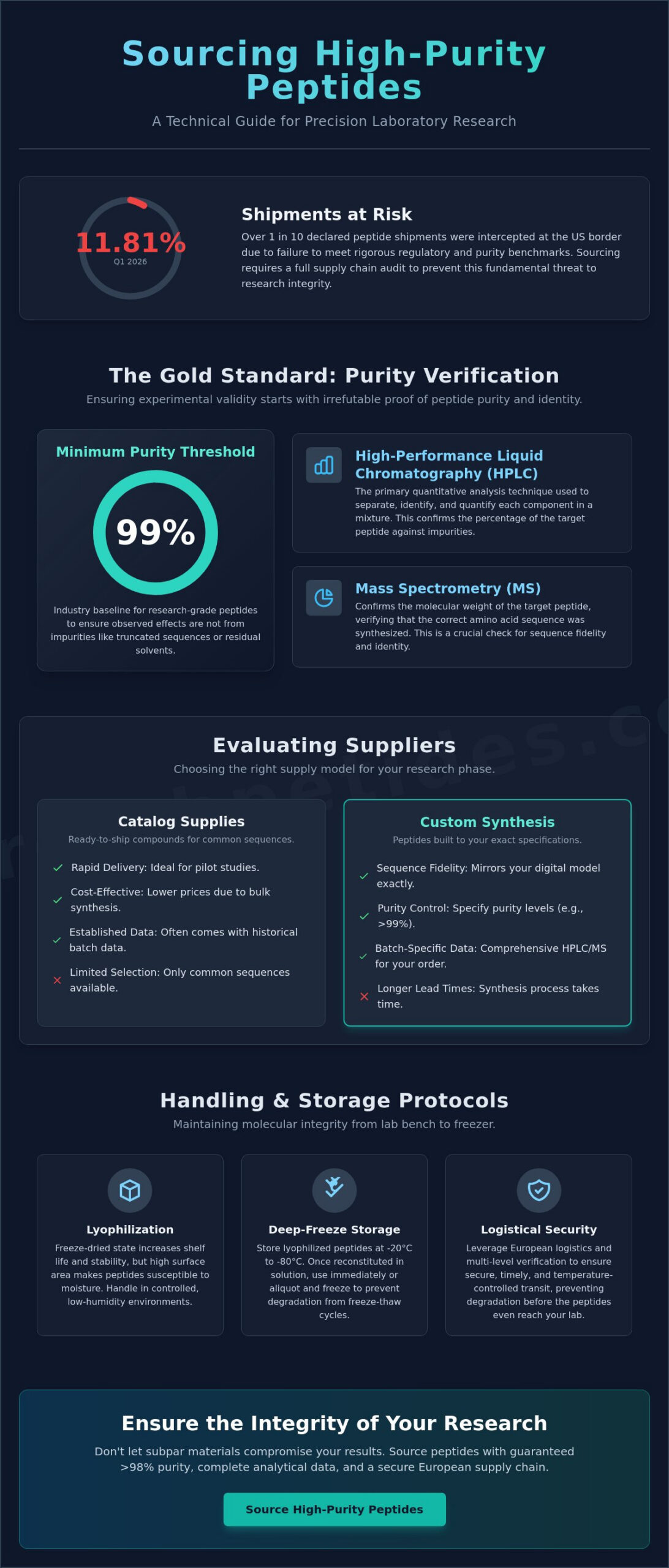
In the first quarter of 2026, 11.81% of declared peptide shipments were intercepted at the United States border, largely because manufacturers failed to meet rigorous regulatory benchmarks. For the professional researcher, sourcing small scale peptide research supplies requires more than just finding a vendor; it demands a technical audit of the entire supply chain to ensure analytical stability. We understand that batch-to-batch inconsistency or the absence of transparent third-party testing data isn’t just an inconvenience. It’s a fundamental threat to the integrity of your experimental model.
This article provides a comprehensive technical framework for evaluating, sourcing, and handling high-purity peptides for small-scale laboratory research. You’ll gain a clear understanding of how to verify HPLC and MS data to confirm the 99% purity standards that have become the industry baseline in 2026. We also detail the logistical protocols necessary to prevent degradation during transit, emphasizing the reliability found in European-based manufacturing. By prioritizing empirical results over anecdotal claims, you can establish a procurement process that meets the high-stakes precision your research demands.
Key Takeaways
- Establish precise requirements for milligram-quantity screening to ensure experimental accuracy when sourcing small scale peptide research supplies.
- Identify the critical role of High-Performance Liquid Chromatography (HPLC) and Mass Spectrometry (MS) in verifying a minimum purity threshold of 98% for research-grade materials.
- Compare the logistical advantages of ready-to-ship catalog supplies against the specific parameters of custom synthesis for pilot studies.
- Maintain molecular integrity through standardized storage protocols, utilizing lyophilization and deep-freeze environments to mitigate the risk of peptide degradation.
- Leverage regional European logistics and multi-level verification frameworks to ensure the security and timely arrival of high-purity research materials.
Defining Requirements for Small-Scale Peptide Research
Small-scale laboratory research requires a departure from the protocols used in industrial-scale synthesis. While industrial manufacturing prioritizes throughput and cost-per-kilogram, the procurement of small scale peptide research supplies is governed by the necessity for milligram-level precision and sequence fidelity. Initial in-vitro screening protocols depend on these small quantities to validate molecular interactions before escalating to broader experimental models. Precision at this stage is non-negotiable. Even minor deviations in peptide concentration or purity can invalidate a study’s reproducibility.
The transition from a theoretical computational model to physical benchwork application represents a critical juncture in biochemical inquiry. Researchers must source peptides that mirror their digital sequences with absolute accuracy. This process involves sophisticated peptide synthesis techniques, typically utilizing solid-phase methodologies to ensure the correct assembly of amino acid residues. By focusing on small-batch procurement, laboratories can maintain tighter control over variables like TFA (trifluoroacetic acid) content and salt concentration. These factors are often overlooked in bulk commercial batches but remain vital for sensitive laboratory environments.
The Scope of In-Vitro Research Applications
Peptides serve as essential molecular tools across diverse scientific disciplines. In metabolic research, compounds such as SLU-PP-332 are utilized to investigate the modulation of estrogen-related receptors, providing insights into mitochondrial function and energy expenditure. Similarly, tissue repair and recovery research models rely on specific peptide sequences to study cellular migration and extracellular matrix remodeling. Longevity studies require consistent, high-purity sequences to evaluate long-term biological markers without the interference of synthesis byproducts. Identifying these research niches early allows for the selection of small scale peptide research supplies that align with specific experimental endpoints.
Technical Constraints of Small-Batch Supplies
The technical demands of small-scale research introduce unique constraints regarding stability and handling. Milligram-scale accuracy is vital for concentration-dependent studies where the dose-response curve must be precisely mapped. If the initial mass is inaccurate, every subsequent dilution in the experimental series is compromised. Scientific reproducibility depends on several factors:
- Stability: Small quantities of lyophilized peptides have a high surface-area-to-volume ratio. This makes them more susceptible to moisture absorption and degradation if they aren’t handled in controlled environments.
- Purity Benchmarks: For in-vitro models, a purity level of 98% or higher is considered the baseline. This ensures that observed biological effects are attributable to the peptide itself rather than residual solvents or truncated sequences.
- Verification: Validation depends on the ability to replicate results across different batches. This is only possible when suppliers provide comprehensive analytical data for every small-scale order.
By understanding these requirements, researchers can mitigate the risks associated with batch-to-batch inconsistency. Establishing a rigorous framework for sourcing ensures that the laboratory focus remains on data generation rather than troubleshooting supply quality.
Analytical Standards: Verifying Purity and Identity
Analytical integrity serves as the primary foundation for any laboratory inquiry involving peptides. For in-vitro models, a purity threshold of 98% or higher is mandatory. This metric isn’t arbitrary; it’s dictated by the extreme sensitivity of cellular assays. Even trace amounts of synthesis by-products can trigger non-specific cellular responses, leading to false positives or misleading dose-response curves. The FDA guidance on peptide products highlights the complexity of characterizing these molecules, underscoring the need for rigorous analytical oversight in both clinical and laboratory environments.
The presence of impurities, such as truncated sequences or residual trifluoroacetic acid (TFA), directly compromises data integrity. Truncated sequences occur when amino acid coupling fails during the synthesis cycle, resulting in “deletion peptides” that mimic the target molecule’s structure. These impurities can bind to receptors with varying affinities, effectively acting as competitive inhibitors. When researchers procure small scale peptide research supplies, they must ensure these contaminants are identified and quantified through rigorous testing before any benchwork begins.
Analytical Techniques for Peptide Characterization
High-Performance Liquid Chromatography (HPLC) and Mass Spectrometry (MS) are the essential tools for ensuring the quality of small scale peptide research supplies. HPLC is the gold standard for peptide purity verification. It functions by separating the target peptide from impurities based on hydrophobic interactions, allowing for a precise calculation of the area under the curve (AUC). While HPLC establishes the purity percentage, MS is utilized to confirm the molecular identity. It measures the mass-to-charge ratio of ions to determine the exact molecular weight. If the observed mass deviates from the theoretical value, the sequence assembly is considered flawed and the batch must be rejected.
The Necessity of Third-Party Laboratory Testing
Objective security is only achieved through independent analytical validation. Relying solely on a manufacturer’s in-house data creates a conflict of interest that high-stakes research can’t afford. A comprehensive Certificate of Analysis (CoA) must be provided for every batch, detailing the specific lot number and date of analysis. This document shouldn’t just state a numerical percentage; it must include the raw HPLC chromatograms and MS spectra for researcher review. Interpreting a CoA requires looking beyond the “98%” label to check for baseline noise in the chromatogram, which can indicate the presence of hidden impurities.
A verifiable commitment to quality is what separates elite suppliers from catalog vendors. EuroLab maintains a strict protocol where every batch undergoes external validation to ensure absolute accountability. Researchers seeking 100% transparent data can examine the EuroLab multi-level quality protocol to understand how these analytical standards are applied to every order. By prioritizing these metrics, laboratories protect their experimental models from the variables of chemical inconsistency.
Evaluating Suppliers: Catalog Supplies vs. Custom Synthesis
Procurement strategies for laboratory investigation typically diverge into two categories: custom synthesis and catalog-based sourcing. For those requiring small scale peptide research supplies, the primary differentiator is lead time. Custom synthesis for high-purity sequences often necessitates a production window of 15 to 25 business days, excluding transit. Catalog items are maintained in a lyophilized state and are available for immediate dispatch. This eliminates the synthesis bottleneck, allowing benchwork to commence without the delays associated with sequence queueing and pilot-scale optimization.
Cost-efficiency is another critical metric when evaluating these sourcing models. Custom synthesis involves significant setup costs for small-batch runs because the labor-intensive purification process remains constant regardless of the final yield. Catalog supplies leverage economies of scale in the initial synthesis phase while providing the milligram-quantity precision required for pilot studies. Transitioning to custom development is only analytically justified when a researcher requires a unique sequence modification or a specific isotopic label not available in standardized inventories.
Logistical reliability is frequently compromised when sourcing from global markets. Shipments originating from outside regional trade zones face higher risks of border refusal or temperature excursions during extended customs holds. Regional European logistics provide a more secure chain of custody. Localized support ensures that technical inquiries regarding Regulatory Guidelines for Peptide Analysis are addressed by professionals who understand regional compliance standards. This proximity reduces the likelihood of degradation and ensures that the analytical data provided with the shipment remains valid upon arrival.
The Advantages of Ready-to-Ship Research Peptides
Ready-to-ship peptides offer immediate utility for time-sensitive laboratory investigations. These catalog items are synthesized in larger parent batches, which ensures that quality is standardized across multiple vials. This consistency is vital for exploratory research where the objective is to establish a baseline before moving to more complex experimental designs. By utilizing pre-validated small scale peptide research supplies, investigators reduce the variables introduced by batch-specific synthesis fluctuations.
Sourcing Strategy for Research Stacks
Streamlining procurement through research stacks allows for a more cohesive experimental approach. These pre-configured selections, such as the Longevity Research Stack or the Muscle Research Stack, ensure that the peptides utilized in a single model are compatible in terms of purity and concentration. Researchers should consult a comprehensive guide on How to Buy Research Peptides to understand the standards required for these multi-peptide models. This integrated sourcing strategy minimizes administrative overhead and ensures that all components of a research protocol meet the same rigorous analytical benchmarks.
Handling and Storage Protocols for Laboratory Stability
The maintenance of molecular integrity in small scale peptide research supplies depends on strict adherence to standardized handling and storage protocols. Peptides are predominantly distributed in a lyophilized state. Lyophilization, or freeze-drying, is a process where water is removed via sublimation under vacuum. This state minimizes the risk of hydrolysis and enzymatic degradation, which are the primary causes of peptide instability in aqueous solutions. Upon arrival in the laboratory, these vials must be transferred immediately to a controlled environment to ensure the chemical properties remain within the verified analytical specifications.
Temperature control is the most critical variable for long-term preservation. While lyophilized peptides exhibit short-term stability at ambient temperatures during transit, long-term storage at -20°C is required for most sequences. For storage durations exceeding one year, a temperature of -80°C is recommended to mitigate the risk of oxidative damage. Vials should be stored in a dark environment, as many peptide sequences are photosensitive and can undergo photolytic degradation when exposed to UV light. Additionally, the use of desiccants within storage containers is necessary to manage the hygroscopic nature of the lyophilized powder, preventing moisture ingress that could initiate degradation.
Reconstitution Best Practices
The transition from a solid to a liquid state introduces significant risks to peptide stability. Selecting the appropriate diluent is the first step; bacteriostatic water or sterile saline is typically utilized depending on the specific solubility profile of the peptide. Mechanical agitation must be avoided during reconstitution to preserve molecular structure. Instead of vigorous shaking, vials should be gently swirled. Excessive force can lead to peptide shearing or denaturation, where the secondary and tertiary structures are permanently altered, rendering the compound biologically inactive. Using a consistent reconstitution volume is also essential for maintaining the accuracy of concentration-dependent studies.
Long-Term Stability and Aliquoting
Once a peptide is reconstituted, its shelf-life is drastically reduced. Aqueous solutions are highly susceptible to bacterial growth and chemical degradation. To prevent the loss of small scale peptide research supplies, the primary solution should be divided into single-use aliquots. This practice eliminates the need for frequent freeze-thaw cycles. Each cycle of freezing and thawing subjects the peptide to significant thermal stress, which can cause aggregation and precipitation. It’s a fundamental requirement for researchers to label each aliquot with the date of reconstitution and the exact concentration to ensure experimental reproducibility.
Researchers can find specific handling parameters for complex sequences in the BPC-157 Technical Guide. Establishing these protocols ensures that the analytical data provided at the point of synthesis remains accurate throughout the duration of the study. For laboratories requiring verified stability and high-purity materials, the full range of options is available through EuroLab peptide supplies. Proper tracking and labeling of these materials are mandatory for maintaining the high-stakes precision required by the specialized research community.
EuroLab Peptides: Precision Sourcing for European Research
EuroLab Peptides operates as a specialized partner for the European scientific community, providing a clinical alternative to the volatility of global chemical markets. Sourcing small scale peptide research supplies within the Eurozone mitigates the risks associated with international trade fluctuations and customs-related degradation. We prioritize regional manufacturing standards to ensure that every vial meets the rigorous demands of sophisticated laboratory models. This commitment to localized excellence provides researchers with a secure chain of custody from synthesis to delivery.
The personality of our brand is defined by radical honesty and accountability. We don’t rely on anecdotal evidence; instead, we provide the objective data of technical analysis. Every batch is subjected to a multi-level quality protocol that includes both in-house verification and independent third-party validation. This process ensures that the 98% purity benchmark is a verifiable metric rather than a marketing claim. High-stakes precision is maintained through the rhythmic repetition of these quality benchmarks across every product line we offer.
The EuroLab Quality Protocol
The EuroLab protocol is built on the principle of absolute transparency. Every batch is subjected to rigorous testing for purity, consistency, and molecular identity. Researchers are provided with direct access to HPLC chromatograms and Mass Spectrometry reports for every order. This empirical approach is essential for those who need to understand What Are Peptides? in the context of professional analytical inquiry. By featuring these formal certifications prominently, we project a persona of meticulous reliability that respects the user’s intelligence and time.
Streamlining Research Procurement
Procurement is streamlined through a professional e-commerce platform designed for the specialized needs of laboratory investigators. This system provides immediate access to small scale peptide research supplies, including specialized research stacks for metabolic and longevity studies. These stacks, such as the Longevity Research Stack or the Recovery Research Stack, are engineered to provide compatible sequences for complex experimental designs. This reduces the administrative burden of sourcing individual components while ensuring that all materials meet the same elite standards of synthesis.
Our operations strictly adhere to in-vitro research and laboratory development purposes. We do not provide products for human consumption, medical advice, or pharmaceuticals. Our focus is entirely on providing elite tools for serious professional inquiry. By maintaining a proof-first flow in our communication and delivery, we establish ourselves as a deeply serious partner in the chemical synthesis space. Explore our full range of research-grade peptides to secure the high-purity materials required for your next experimental model. For professionals who demand the same level of authenticity and verification in their personal lifestyle gear, Lab X Supply provides a trusted marketplace for premium sneakers and slides.
Advancing Experimental Integrity through Analytical Rigor
Scientific reproducibility depends on the elimination of chemical variables. The transition from theoretical models to physical benchwork requires a meticulous approach to both procurement and storage. Analytical validation through HPLC and Mass Spectrometry remains the only objective method to confirm that small scale peptide research supplies meet the 98% purity threshold necessary for in-vitro accuracy. By adhering to strict reconstitution and aliquoting protocols, researchers can prevent the molecular degradation that often compromises long-term studies.
The selection of a sourcing partner must be based on a commitment to radical transparency and regional logistical security. EuroLab Peptides provides this security through independent third-party laboratory testing on all batches, with HPLC/MS data available upon request. Our specialized in-vitro research focus ensures that every compound is handled with the precision required for high-stakes inquiry. Establishing these standards today protects the validity of your future data.
Order Research-Grade Peptides with Third-Party Verification and secure the analytical foundation your laboratory demands. We look forward to supporting your next breakthrough with uncompromising quality.
Frequently Asked Questions
What is the difference between research-grade and pharmaceutical-grade peptides?
Research-grade peptides are synthesized specifically for laboratory experimentation and in-vitro modeling. While these substances maintain high analytical purity, they don’t require the specific cGMP certifications mandatory for clinical administration in humans. Pharmaceutical-grade peptides are manufactured under stricter regulatory oversight for therapeutic use. EuroLab products are strictly intended for research purposes and aren’t for human consumption.
How do I verify the purity of my peptide supplies?
Purity verification is achieved through the objective analysis of High-Performance Liquid Chromatography (HPLC) and Mass Spectrometry (MS) reports. The HPLC chromatogram provides a quantitative percentage of the target peptide relative to synthesis by-products. MS confirms that the synthesized sequence assembly matches the theoretical molecular weight. Researchers should always request batch-specific data when procuring small scale peptide research supplies.
Why is third-party testing essential for small-scale peptide research?
Third-party testing establishes an objective layer of security that in-house analysis can’t provide. Independent laboratories verify that numerical benchmarks, such as 99% purity, are met without the conflict of interest inherent in self-reporting. This transparency is critical for high-stakes research where chemical inconsistency could lead to flawed data or the total failure of a multi-month experimental study.
Can research peptides be stored at room temperature during shipping?
Lyophilized peptides are chemically stable at ambient temperatures for the duration of standard regional transit cycles. The freeze-drying process removes moisture, which significantly slows the primary degradation pathways. Once the shipment is received, the vials must be transferred to a freezer at -20°C or -80°C for long-term preservation of molecular integrity and sequence fidelity.
What is the standard lead time for peptide delivery within Europe?
Delivery of small scale peptide research supplies within the European research community typically occurs within three to five business days. Regional logistics reduce the risk of border delays or temperature excursions often associated with international trade zones. Catalog items are dispatched from regional hubs to ensure minimal lead times for time-sensitive laboratory investigations.
What are the risks of using peptides with less than 98% purity in laboratory models?
Utilizing peptides with less than 98% purity introduces uncontrolled variables into the experimental model. Residual solvents or truncated sequences can trigger non-specific biological responses that are indistinguishable from the target peptide’s effects. This lack of precision invalidates dose-response curves and compromises the overall analytical integrity of the laboratory inquiry.
How should I handle peptides that are prone to oxidation or degradation?
Peptides containing Cysteine or Methionine residues require specialized handling to prevent oxidative damage. Vials should be kept in a desiccated environment and protected from all light exposure. Reconstitution should be performed using deoxygenated diluents, and aliquoting into single-use vials is recommended to eliminate the molecular stress caused by repeated freeze-thaw cycles.
Are EuroLab Peptides products suitable for clinical use?
EuroLab Peptides products are not suitable for clinical use, medical advice, or human administration. These compounds are synthesized exclusively for in-vitro laboratory research and development applications. Every product is clearly labeled for research use only to comply with regional regulatory standards and to maintain the professional safety of the specialized scientific community we serve.
