

With the 2026 expiration of core patents in 160 countries, the landscape of GLP-1 receptor agonist studies has shifted significantly; however, the increased availability of semaglutide for research does not inherently guarantee the chemical precision required for high-stakes metabolic assays. Inconsistent purity levels and the absence of standardized reconstitution protocols often introduce confounding variables that can invalidate months of laboratory work. You recognize that maintaining absolute control over peptide stability and molarity is non-negotiable for achieving reproducible data in complex biological models. Minor deviations in synthesis can lead to peptide degradation, fundamentally altering receptor affinity and compromising the validity of your results.
This article provides a rigorous biochemical analysis of Semaglutide’s molecular structure, receptor affinity, and standardized laboratory handling protocols tailored for 2026 applications. We’ll establish the exact parameters for determining molecular suitability within specific research models while providing precise concentration benchmarks for in-vitro assays. By the conclusion, you’ll possess the technical framework necessary to source HPLC-verified reagents within Europe and implement a multi-level quality control process that ensures the integrity of your longitudinal data through verified third-party validation.
Key Takeaways
- Analyze the specific biochemical profile of Semaglutide, including its C-18 fatty diacid side chain and molecular mass of ~4113.58 g/mol, to ensure accurate chemical modeling.
- Establish precise experimental parameters for semaglutide for research by evaluating its selective binding affinity for the GLP-1 receptor and subsequent GPCR complex activation.
- Benchmark Semaglutide against multi-receptor agonists through a comparative analysis of Ki values and receptor affinity metrics to determine model suitability.
- Implement standardized laboratory protocols for the reconstitution of lyophilized peptides and the calculation of exact molarity for cellular assays.
- Validate research integrity by interpreting HPLC and Mass Spectrometry benchmarks to confirm a 99%+ purity threshold and detect potential impurities.
Molecular Structure and Biochemical Profile of Semaglutide
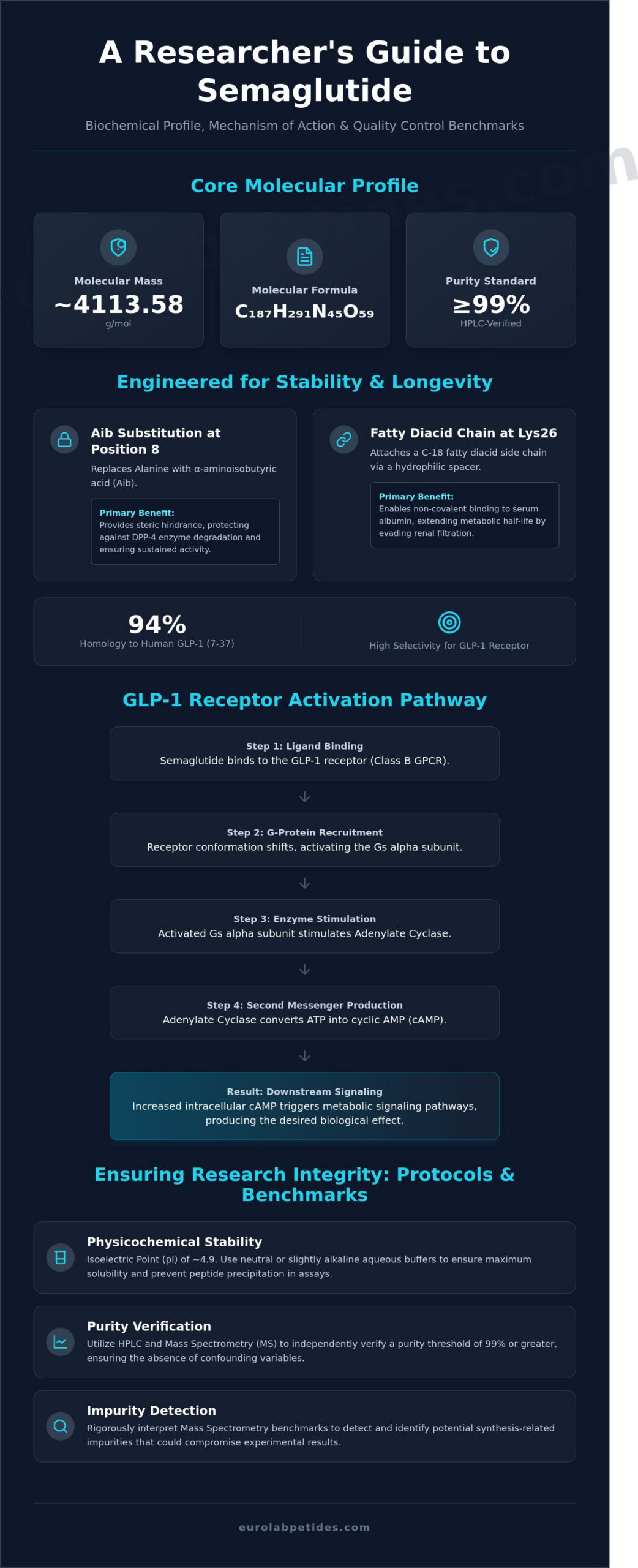
Semaglutide is defined as a long-acting synthetic analog of human glucagon-like peptide-1 (GLP-1). It’s engineered specifically to overcome the rapid enzymatic degradation that limits the utility of endogenous GLP-1 in longitudinal metabolic studies. For those requiring a technical semaglutide overview, the molecule is characterized by its C-18 fatty diacid side chain attached via a hydrophilic spacer. The molecular formula is C187H291N45O59. The calculated molecular mass is approximately 4113.58 g/mol. This mass reflects the complex synthesis required to maintain stability across various semaglutide for research applications.
Structural modifications are the foundation of this peptide’s utility in a laboratory setting. The primary alteration involves the substitution of Alanine with alpha-aminoisobutyric acid (Aib) at position 8. This specific alteration provides steric hindrance against enzymatic cleavage. Additionally, the inclusion of the albumin-binding side chain at the Lys26 position significantly extends the metabolic half-life. By facilitating non-covalent binding to serum albumin, the peptide evades renal filtration. This mechanism ensures a sustained concentration within the research model, allowing for more consistent data collection over extended periods.
Amino Acid Sequence Analysis
Semaglutide shares approximately 94% homology with the endogenous human GLP-1 (7-37) sequence. Divergence from the native sequence is intentional. It serves to enhance pharmacokinetic durability. Specifically, the modification at the Lys26 position allows for the attachment of the fatty diacid. This architectural shift provides the necessary resistance to common enzymatic pathways. For a deeper understanding of how these sequences are constructed, you can review our comprehensive guide to peptides for structural context. Utilizing high-purity semaglutide for research ensures that these sequence modifications remain consistent across different batches, preventing confounding variables in your assays.
Physicochemical Stability
The isoelectric point (pI) of semaglutide is approximately 4.9. This value is a critical metric for researchers when selecting appropriate buffer systems to prevent peptide precipitation. Solubility is highest in aqueous solutions at neutral or slightly alkaline pH levels. Conversely, solubility in non-aqueous laboratory solvents remains significantly limited. The peptide’s structural integrity is specifically designed to resist dipeptidyl peptidase-4 (DPP-4) degradation, ensuring that the agonist remains active for extended durations in cellular assays. Precise control over these physicochemical properties is essential for maintaining the reliability of in-vitro experimental outcomes.
Mechanism of Action: GLP-1 Receptor Agonism in Research
Semaglutide exhibits high selective binding affinity for the human GLP-1 receptor. As a Class B G-protein coupled receptor (GPCR) agonist, it interacts with the large extracellular domain and the transmembrane helical bundle of the receptor simultaneously. This dual-point binding mechanism is essential for the stabilization of the active conformation. In semaglutide for research protocols, this high affinity is utilized to study metabolic signaling without significant cross-reactivity with the glucose-dependent insulinotropic polypeptide (GIP) or glucagon receptors. The structural modifications discussed previously, particularly the Aib substitution, do not compromise this binding efficacy; instead, they ensure the agonist remains available for receptor interaction over extended experimental durations.
Upon ligand binding, the GLP-1R undergoes a conformational shift that facilitates the recruitment of the heterotrimeric G-protein complex. Specifically, the Gs alpha subunit is activated. This activation stimulates adenylate cyclase, which is the membrane-bound enzyme responsible for the conversion of adenosine triphosphate (ATP) into cyclic adenosine monophosphate (cAMP). The subsequent upregulation of intracellular cAMP serves as a primary second messenger. It triggers downstream effectors, most notably protein kinase A (PKA) and the exchange protein directly activated by cAMP 2 (Epac2). These pathways are critical for modulating intracellular calcium concentrations and exocytotic machinery within the target cell. It’s essential to maintain precise control over these variables to ensure data reproducibility in cellular assays.
In pancreatic beta-cell models, the elevation of cAMP levels directly influences glucose-dependent insulin secretion. Unlike other secretagogues, the insulinotropic effect of semaglutide is strictly dependent on the ambient glucose concentration. This specificity makes semaglutide for research a valuable tool for investigating the physiological thresholds of insulin release and the protective mechanisms of beta-cell preservation. The mechanism involves the closure of ATP-sensitive potassium channels and the subsequent depolarization of the plasma membrane, which opens voltage-gated calcium channels. The resulting calcium influx promotes the fusion of insulin-containing vesicles with the cell membrane, providing a clear metric for agonistic activity.
Maintaining the integrity of these signaling pathways requires reagents that meet strict analytical standards. While the FDA on semaglutide medications provides guidance on clinical formulations, laboratory researchers must prioritize the use of high-purity lyophilized peptides to avoid confounding results from degradation products. For those conducting these detailed cellular assays, it’s advisable to source HPLC-verified semaglutide to ensure that the observed GPCR activation is a result of the primary molecule rather than synthesis byproducts or impurities.
Comparative Analysis: Semaglutide vs. Multi-Receptor Agonists
The biochemical differentiation between semaglutide for research and multi-receptor agonists is defined by the degree of receptor selectivity. While semaglutide is a mono-agonist with exclusive affinity for the GLP-1R, newer peptides like tirzepatide and retatrutide utilize polypharmacology. Tirzepatide functions as a dual agonist for the GLP-1 and glucose-dependent insulinotropic polypeptide (GIP) receptors, whereas retatrutide incorporates glucagon receptor (GCG) agonism. Benchmarking these molecules requires an analysis of Ki values. Lower Ki values for semaglutide at the GLP-1R confirm a more potent and selective binding profile compared to the GLP-1 component of multi-agonists. This specificity is critical when the research objective is to isolate the physiological effects of GLP-1 signaling without the interference of GIP-mediated pathways.
Semaglutide vs. Tirzepatide in Metabolic Models
In-vitro metabolic models often contrast the single-receptor agonism of semaglutide with the dual-receptor agonism of tirzepatide. Tirzepatide’s GIP component is theorized to act synergistically with GLP-1 to modulate lipid metabolism and adipocyte sensitivity. However, semaglutide remains the preferred tool for studies focusing on glucose-dependent insulinotropism and gastric emptying rates. The choice between these analogs depends on whether the study aims to investigate pure GLP-1R activation or the broader metabolic impact of co-agonism. Technical documentation regarding Semaglutide Pharmacological Properties provides the necessary baseline for these comparative assays.
Research Implications of Side-Chain Variations
The structural distinction between these analogs is largely driven by acylation strategies. While semaglutide utilizes a C-18 fatty diacid, tirzepatide employs a C-20 fatty diacid. These variations directly influence the strength of albumin binding and, consequently, the metabolic half-life in cellular models. Longer fatty acid chains generally correlate with higher albumin affinity and reduced renal clearance. For long-term cellular assays, the C-18 side chain of semaglutide for research allows for a standardized dosing frequency that is well-documented in existing literature, ensuring high reproducibility across different laboratory environments.
For those investigating multi-axis metabolic regulation, semaglutide is frequently paired with growth hormone secretagogues. See our technical profile of Ipamorelin for cross-axis research comparisons. This approach allows for the analysis of synergistic effects on tissue repair and metabolic rate within controlled research stacks, provided that the purity of each reagent is verified through independent HPLC analysis.
Laboratory Handling, Reconstitution, and Storage Protocols
The transition from theoretical biochemical analysis to bench-side application requires strict adherence to standardized handling protocols. Maintaining the structural integrity of semaglutide for research is contingent upon minimizing environmental stressors that trigger peptide degradation. Because semaglutide is a complex 31-amino acid peptide, its secondary structure is susceptible to denaturation if handled improperly. Researchers must prioritize the elimination of confounding variables by establishing precise molarity and concentration benchmarks before initiating cellular assays.
To calculate the molarity (µM) for in-vitro models, the molecular mass of approximately 4113.58 g/mol serves as the primary constant. For a standard 5 mg vial, the addition of 1.215 mL of diluent results in a 1 mM stock solution. From this stock, serial dilutions can be performed to reach the nanomolar concentrations typically required for GLP-1R binding assays. Accuracy at this stage is paramount. Even minor volumetric errors can significantly shift the dose-response curve and compromise the validity of the resulting data.
The Reconstitution Process
Selecting the appropriate diluent depends on the specific requirements of the research model. Bacteriostatic water, containing 0.9% benzyl alcohol, is frequently utilized to inhibit bacterial growth in multi-dose applications. Conversely, sterile 0.9% sodium chloride is preferred for sensitive cellular assays where preservative interference must be excluded. To achieve a 2 mg/mL concentration, exactly 2.5 mL of diluent is introduced into a 5 mg vial. Vigorous agitation must be avoided to maintain peptide integrity, as mechanical shear stress can lead to irreversible denaturation or aggregation. Instead, the vial should be gently swirled until the lyophilized cake is fully dissolved into a clear, colorless solution.
Stability and Temperature Control
Stability varies significantly depending on the physical state of the peptide. Lyophilized semaglutide for research remains stable for up to 24 months when stored in a desiccated environment at temperatures between -20°C and -80°C. Once reconstituted, the stability window narrows considerably. Reconstituted solutions should be maintained at 2°C to 8°C and utilized within 7 to 14 days to ensure maximum potency. Exposure to ambient light must be minimized. Amber vials or light-shielded storage containers are required to prevent potential photo-degradation of the peptide side chains.
To maintain high-stakes precision in your laboratory, it’s essential to source HPLC-verified semaglutide that meets 99%+ purity standards. This ensures that your storage and reconstitution efforts are applied to a reagent of the highest baseline quality.
Quality Assurance: HPLC and Mass Spectrometry Benchmarks
High-purity reagents are the foundation of experimental reproducibility. For semaglutide for research, a purity threshold of 99% or higher is the non-negotiable industry benchmark for 2026. This level of refinement is necessary to ensure that the observed biological responses are attributable solely to the GLP-1 receptor agonist rather than synthesis byproducts. Inconsistent purity in research-grade chemicals often introduces confounding variables that can invalidate longitudinal data and waste laboratory resources.
HPLC is the primary analytical tool for assessing chemical purity through the separation of molecular components. A high-resolution chromatogram should display a single, sharp peak at the expected retention time. Secondary peaks, often referred to as “shoulders,” indicate the presence of truncated sequences or isomers. Mass Spectrometry (MS) complements this by confirming the molecular identity and weight. By measuring the mass-to-charge ratio, MS verifies that the synthesized peptide matches the theoretical molecular weight of ~4113.58 g/mol, providing an absolute safeguard against misidentification.
Identifying Contaminants in Research Chemicals
The synthesis of complex peptides often involves the use of Trifluoroacetic acid (TFA) as a cleavage reagent. If not properly removed through multi-stage lyophilization and purification, residual TFA or other solvents can introduce toxicity into cellular models. Purity levels falling below 98% significantly increase the risk of confounding variables, as these impurities may interfere with GPCR signaling or alter the isoelectric point of the solution. Before procurement, you should consult our 2026 guide to buying research peptides in Europe to understand the critical relationship between analytical purity and data integrity.
EuroLab Peptides: Sourcing for the Scientific Community
EuroLab Peptides implements a multi-level quality control protocol that prioritizes transparency and regional manufacturing excellence. Every batch of semaglutide for research undergoes independent third-party laboratory testing to validate its analytical profile. This rigorous approach relies on empirical results rather than anecdotal claims. Researchers can access comprehensive Certificates of Analysis (CoA) that include both HPLC chromatograms and Mass Spectrometry reports for every vial provided.
Our logistics infrastructure supports 2026 shipping timelines within the EU; this ensures reagents reach your facility without the degradation risks associated with prolonged transit. All products are strictly designated for in-vitro research use and are not intended for human consumption or medical application. By adhering to these professional standards, we provide the scientific community with the elite tools required for high-stakes metabolic inquiry and precise cellular modeling.
Advancing Metabolic Research with Analytical Precision
The integrity of longitudinal metabolic studies depends on the use of reagents that meet rigorous analytical standards. As previously analyzed, the structural modifications of the GLP-1 analog require precise handling to maintain receptor affinity and prevent enzymatic degradation. By implementing the standardized reconstitution and storage protocols outlined, researchers ensure that their in-vitro models remain free from the confounding variables associated with peptide aggregation. It’s essential to prioritize chemical stability to protect the validity of your experimental outcomes.
Achieving reproducible data in 2026 demands a commitment to verifiable quality metrics. Utilizing semaglutide for research that has been subjected to multi-level validation, including HPLC and Mass Spectrometry, provides the necessary assurance that molecular identity and 99%+ purity are maintained. EuroLab Peptides remains a meticulous partner for the scientific community; we provide independent third-party laboratory validation and secure European logistics to support high-stakes professional inquiry.
Order HPLC-Verified Semaglutide for Research at EuroLab Peptides to secure reagents backed by comprehensive documentation and regional manufacturing excellence. We look forward to supporting your specialized laboratory requirements with absolute chemical precision.
Frequently Asked Questions
What is the molecular weight of Semaglutide for research calibration?
The molecular weight of semaglutide is approximately 4113.58 g/mol, derived from its molecular formula of C187H291N45O59. This specific value is a critical constant for researchers when calculating the precise molarity of stock solutions for in-vitro assays. Utilizing this exact mass ensures that concentration benchmarks remain consistent across different experimental batches, which is essential for achieving reproducible dose-response data in metabolic signaling studies.
How should Semaglutide be reconstituted for in-vitro studies?
Reconstitution of lyophilized semaglutide for research should be performed using bacteriostatic water or sterile 0.9% saline. The diluent must be introduced slowly down the side of the vial to avoid mechanical shear stress on the peptide. Researchers typically aim for a 1 mM or 2 mg/mL stock concentration by adding the appropriate volume of solvent. The vial should be gently swirled rather than shaken until the lyophilized cake is fully dissolved into a clear solution.
Does Semaglutide require specific temperature control during storage?
Yes, strict temperature control is mandatory to prevent peptide degradation. Lyophilized vials must be stored in a desiccated environment at -20°C or -80°C for long-term stability of up to 24 months. Once the peptide is reconstituted, the solution must be refrigerated at 2°C to 8°C. Protection from ambient light is also necessary, as UV exposure can trigger photo-degradation of the peptide’s side chains and compromise its biochemical integrity.
What is the difference between Semaglutide and Tirzepatide in a research setting?
The primary difference lies in receptor selectivity; semaglutide is a selective mono-agonist for the GLP-1 receptor, whereas tirzepatide is a dual agonist targeting both GLP-1 and GIP receptors. In a laboratory setting, semaglutide is utilized to isolate the specific physiological pathways of GLP-1R activation. Tirzepatide is preferred for studies investigating the synergistic effects of co-agonism on lipid metabolism and adipocyte sensitivity, making the choice dependent on the specific research model.
How long does reconstituted Semaglutide remain stable in a lab?
Reconstituted semaglutide solutions generally maintain their potency for 7 to 14 days when stored correctly at 2°C to 8°C. Beyond this timeframe, the risk of peptide aggregation and hydrolytic degradation increases significantly. For high-precision cellular assays, it’s advisable to prepare fresh working solutions from lyophilized stock. Using degraded peptides can introduce confounding variables that negatively impact the accuracy of intracellular signaling measurements and longitudinal data sets.
Why is HPLC testing critical for Semaglutide research integrity?
HPLC testing is the primary analytical method used to verify that semaglutide for research meets the 99%+ purity threshold required for scientific inquiry. This process identifies synthesis byproducts, truncated sequences, or residual solvents like TFA that could interfere with GPCR signaling. Without a verified HPLC chromatogram, researchers cannot be certain that the observed experimental outcomes are solely attributable to the target molecule, which fundamentally undermines the integrity of the study.
Can Semaglutide be used for human consumption or clinical purposes?
No, semaglutide provided for laboratory use is strictly for in-vitro research purposes and is not for human consumption. These products are not manufactured under clinical-grade pharmaceutical standards and lack the necessary regulatory approvals for therapeutic administration. They are designated as “Research Use Only” tools intended for professional scientists conducting metabolic or biochemical assays. Any use beyond the scope of professional research violates established safety and laboratory protocols.
For those interested in the therapeutic use of these compounds under medical guidance, Helio Peptide provides physician-supervised wellness programs, including peptide therapy and hormone replacement, to ensure safe and effective clinical application.
What is the primary mechanism of action of Semaglutide in metabolic research?
The primary mechanism involves the selective activation of the GLP-1 receptor, which is a Class B G-protein coupled receptor. This interaction stimulates the Gs alpha subunit, leading to the upregulation of intracellular cyclic adenosine monophosphate (cAMP). In pancreatic beta-cell models, this signaling cascade facilitates glucose-dependent insulin secretion. Researchers study this pathway to analyze the thresholds of insulinotropic responses and the broader impact of GLP-1R agonism on cellular metabolic regulation.
