

Can a synthetic heptapeptide derived from ACTH(4-10) maintain its molecular integrity across extended incubation periods while simultaneously modulating complex gene expression in ischemic models? While preclinical data indicates a 1.4-fold increase in hippocampal BDNF protein following application, many laboratory protocols remain hindered by fragmented data regarding Semax research applications and the peptide’s inherent stability. It’s evident that the lack of standardized reconstitution protocols for high-precision assays presents a significant challenge for researchers managing the transition between immune and cognitive research areas.
This technical profile provides a rigorous exploration of the molecular mechanisms and gene-regulatory effects that define this PGP-stabilized analog. Precision is non-negotiable. The analysis facilitates a comprehensive understanding of the peptide’s interaction with the TrkB receptor and its role in neuronal survival. A validated protocol for laboratory storage and handling is provided, alongside a guide to identifying high-purity European sources where ≥99% HPLC verification standards are maintained for 2026 regulatory compliance.
Key Takeaways
- Define the molecular architecture of the ACTH(4-10) derivative and its PGP-stabilized sequence designed for enhanced proteolytic resistance in laboratory environments.
- Analyze the kinetics of BDNF modulation and trkB receptor activation to evaluate neuroplasticity within hippocampal research models.
- Identify specialized Semax research applications in the fields of cerebrovascular ischemia and neuroprotection against excitotoxicity.
- Implement standardized laboratory protocols for the reconstitution of lyophilized peptides to ensure maximum molecular stability during long-term incubation.
- Establish rigorous quality benchmarks by interpreting third-party HPLC and MS data to ensure batch-specific purity levels exceed the 99% standard.
Molecular Architecture of Semax: The ACTH(4-10) Derivative
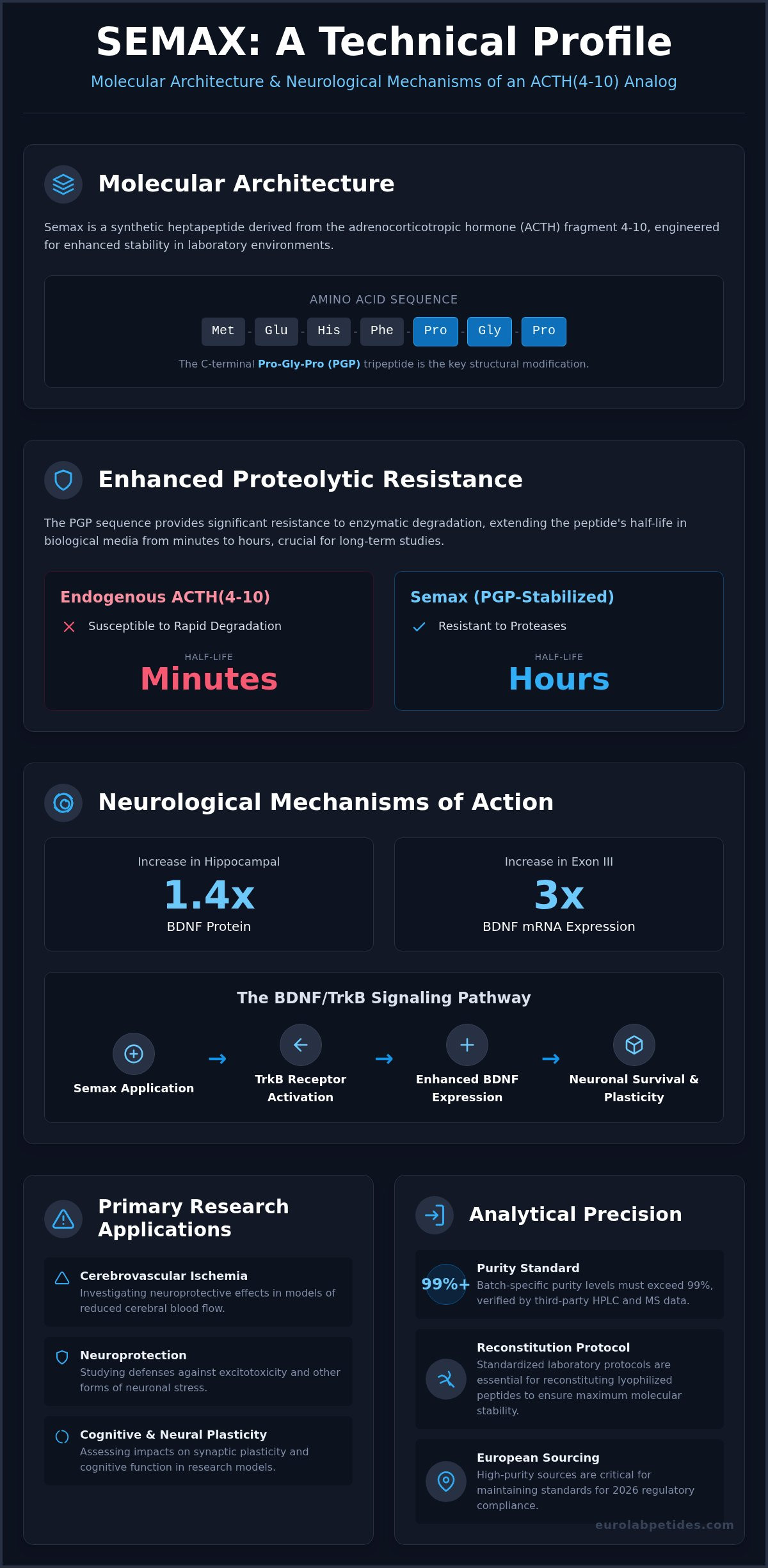
Semax is defined as a synthetic heptapeptide derived from the adrenocorticotropic hormone (ACTH) fragment 4-10. Its precise molecular sequence is documented as L-Methionyl-L-glutamyl-L-histidyl-L-phenylalanyl-L-prolyl-glycyl-L-proline. Within the specialized field of peptides, this specific configuration is engineered to overcome the rapid enzymatic degradation that typically limits the utility of endogenous neuropeptides. The inclusion of the C-terminal Pro-Gly-Pro (PGP) tripeptide is the defining structural characteristic that differentiates this analog from its parent fragment. This modification ensures that Semax research applications can extend into complex in-vitro and in-vivo models where sustained peptide presence is required for accurate data collection. By stabilizing the core ACTH sequence, researchers can observe prolonged biological activity that isn’t possible with the original 4-10 fragment.
Structural Modifications and Proteolytic Resistance
The primary limitation of endogenous ACTH(4-10) in a laboratory setting is its susceptibility to rapid enzymatic hydrolysis. Endogenous fragments are typically degraded within minutes by circulating aminopeptidases and endopeptidases, which complicates long-term observations. Semax incorporates the PGP sequence to provide significant proteolytic resistance. While endogenous ACTH(4-10) exhibits a half-life measured in mere minutes, Semax maintains structural integrity for several hours in biological media. The Pro-Gly-Pro C-terminus prevents enzymatic breakdown by creating a steric hindrance that shields the peptide bond from targeted cleavage by common proteases. This structural fortification allows for lower concentration requirements in longitudinal studies compared to non-stabilized analogs. It’s this resistance that makes the peptide an elite tool for serious professional inquiry into neurological stability.
Comparison with Endogenous Melanocortins
Semax is distinguished from other melanocortins, such as alpha-MSH, by its highly specific receptor binding profile and lack of systemic hormonal activity. Although it originates from the ACTH sequence, it doesn’t stimulate the adrenal cortex or induce corticosteroid release in research models. This absence of hormonal feedback loops is critical for researchers focusing on the central nervous system (CNS). By bypassing peripheral endocrine pathways, Semax research applications allow for the isolated study of neurotrophic factors and cognitive modulation. Technical analysis confirms that its primary interactions occur via the modulation of BDNF expression and melanocortin receptor signaling without the confounding variables of systemic stress responses. This precision ensures that any observed effects on neuroplasticity or ischemia are a direct result of CNS-specific mechanisms rather than indirect hormonal influence.
Neurological Mechanisms: BDNF Modulation and Neuroplasticity
Semax research applications frequently investigate the peptide’s ability to stimulate neurotrophic systems. One of the most documented effects is the upregulation of Brain-Derived Neurotrophic Factor (BDNF) in hippocampal research models. Unlike standard ACTH analogs, the peptide initiates a sustained activation of the trkB receptor. This interaction is characterized by specific tyrosine phosphorylation kinetics that occur shortly after administration, providing a measurable metric for neuroplasticity. The downstream results include enhanced synaptogenesis and improved neuronal survival in vitro. These mechanisms are often explored in conjunction with melanocortin receptors (MC4R), suggesting a synergistic relationship between melanocortin signaling and neurotrophic pathways.
The BDNF/trkB Signaling Pathway
Quantitative analysis of exon III BDNF mRNA expression shows a 3-fold increase in transcriptional activity following peptide exposure. This shift is vital for maintaining neurotrophic support during periods of cellular stress, such as hypoxia. For researchers focused on Cognitive Research Stack parameters, these signaling pathways offer a clear objective for high-precision assays. Semax increases the expression of BDNF and its receptor trkB in hippocampal tissue to facilitate enhanced neuronal survival and synaptic plasticity.
Transcriptional Regulation in Ischemic Models
The peptide’s influence extends to the transcriptional regulation of genes associated with the immune and vascular systems. In rat focal ischemia studies, genome-wide analysis reveals that the peptide modulates the expression of over 50 genes within the first 24 hours. This includes the suppression of pro-inflammatory cytokines like TNF-alpha and the promotion of anti-inflammatory agents such as IL-10. This dual modulation is a core component of Semax neuroprotective research, focusing on the reduction of infarct size in stroke models. Because these effects are highly dependent on chemical integrity, sourcing through a reliable European partner is essential for ensuring that experimental outcomes aren’t skewed by impurities. These findings indicate that Semax research applications are critical for understanding how peptides can stabilize cellular environments during acute ischemic events.
Primary Research Applications in Neurobiology and Ischemia
Semax research applications encompass a broad spectrum of neurological pathology models, ranging from acute ischemic injury to chronic neurodevelopmental conditions. While previous sections detailed the molecular structure and signaling pathways, laboratory utility is best demonstrated through its performance in cerebrovascular ischemia and stroke recovery models. The peptide is frequently employed to investigate neuroprotective strategies against excitotoxicity, specifically focusing on the mitigation of glutamate-induced calcium influx. By stabilizing the cellular environment, researchers can observe the peptide’s influence on neuronal survival during the critical hours following a vascular event.
Cerebrovascular Ischemia and Immune Response
In rat focal ischemia models, analytical data confirms a significant suppression of inflammatory gene expression within the first 24 hours of administration. This research focuses on the peptide’s ability to modulate the vascular endothelial growth factor (VEGF), which is essential for investigating angiogenesis and the restoration of blood flow to infarcted tissue. Experimental evidence suggests a specific window of efficacy in acute ischemia models; the most pronounced transcriptional changes occur when the peptide is introduced shortly after the onset of the ischemic event. These studies demonstrate that the peptide does not merely provide passive protection but actively directs the immune response to prevent secondary tissue damage. This makes it a primary tool for laboratories exploring the intersection of immunology and cerebrovascular health.
Cognitive Function and Nootropic Investigation
Beyond acute injury, the peptide is a staple in neurobehavioral research involving cognitive function and memory consolidation. Laboratory animals subjected to conditioned avoidance reaction (CAR) tests show measurable improvements in learning speed and attention when treated with the heptapeptide. In the study of nootropics, the focus remains on how stabilized ACTH analogs enhance neuroplasticity without the stimulant-related side effects common in other agents. Comparative studies often place the peptide against traditional neuroprotective compounds to evaluate its superior metabolic stability and CNS-specific targeting.
Technical analysis has also expanded into neurodevelopmental research. Peer-reviewed data found in Semax ADHD and Rett syndrome research highlights the peptide’s potential in modulating BDNF to address developmental cognitive deficits. These findings suggest that the scope of Semax research applications is not limited to age-related decline or trauma; it is equally relevant for investigating the biological basis of attention and neurodevelopmental stability. For high-precision research, maintaining the chemical purity of the analog is non-negotiable to ensure these behavioral outcomes are reproducible across different laboratory environments.
Laboratory Protocol: Reconstitution and Stability for In-Vitro Models
Precision in laboratory handling is a prerequisite for reproducible Semax research applications. While the peptide is engineered for enhanced stability, its transition from a lyophilized state to a liquid medium requires adherence to strict biochemical protocols. Failure to maintain aseptic conditions or the use of improper diluents can introduce artifacts into neurobiological data, compromising the validity of the study. Standardized handling ensures that the molecular structure remains intact for high-precision assays.
Selecting the appropriate diluent is a critical decision in the reconstitution process. Sterile bacteriostatic water is often utilized due to its ability to inhibit bacterial growth, making it suitable for studies where the peptide solution is accessed multiple times. However, for high-precision in-vitro models, phosphate-buffered saline (PBS) is typically preferred. PBS maintains a stable physiological pH, which is essential when observing trkB receptor phosphorylation or BDNF expression in hippocampal cell cultures. Researchers must account for the salt content in PBS, as it may influence the solubility limit of the heptapeptide at high concentrations.
Mechanical degradation is a frequently overlooked variable in peptide preparation. Although Semax is a short-chain peptide, it isn’t immune to the effects of physical stress. High-shear forces, such as those generated by vortexing or aggressive agitation, can lead to the aggregation of peptide molecules. This physical denaturation alters the bioavailability of the compound in cellular assays, leading to inconsistent results across different laboratory batches.
Storage Guidelines for Lyophilized Semax
Lyophilized Semax exhibits maximum stability when stored at temperatures of -20°C or -80°C. At these sub-zero temperatures, the kinetic energy of the molecules is minimized, effectively halting most degradative pathways. The integrity of the peptide during storage is a fundamental variable that directly impacts the reliability of Semax research applications in longitudinal studies. It’s imperative to protect the vials from light exposure and moisture ingress. Moisture acts as a catalyst for hydrolysis, which can break the peptide bonds and render the sample useless for research. Standard protocol dictates the use of desiccated storage containers to ensure the powder remains in a state of high-purity until the moment of reconstitution.
Solubility and Reconstitution Parameters
Calculating molar concentrations for cellular incubation assays requires absolute precision. The molecular weight of the heptapeptide must be factored against the volume of the diluent to ensure that the dosage delivered to the in-vitro model is accurate. Reconstitution should be performed by allowing the diluent to flow slowly down the side of the vial, rather than being injected directly into the powder. Gentle swirling is superior to vigorous shaking for maintaining Semax integrity. This method ensures uniform dissolution without introducing excessive air bubbles or mechanical stress.
To ensure the highest analytical precision in your laboratory, source your materials from a provider committed to third-party tested Semax research chemicals.
Ensuring Analytical Precision: Sourcing High-Purity Semax in Europe
The procurement of high-purity analogs is a critical determinant of experimental validity in neurological studies. For Semax research applications, the presence of even minor impurities can introduce confounding variables that skew results in sensitive in-vitro models. Analytical precision is maintained by adhering to a minimum purity benchmark of 99%, as verified by High-Performance Liquid Chromatography (HPLC). This standard ensures that the biological activity observed in research-such as trkB receptor activation or gene expression modulation-is attributable solely to the heptapeptide sequence rather than residual synthesis byproducts or degraded fragments.
Navigating the European market to buy research peptides requires an understanding of regional regulatory frameworks as of 2026. While the substance remains outside the definition of a medicinal product when sold strictly for laboratory use, compliance with the Human Medicines Regulations 2012 in the UK and updated EU pharmaceutical legislation is non-negotiable. Ethical sourcing necessitates a proof-first approach, where suppliers provide objective evidence of chemical integrity before a commitment is made. It’s vital that research facilities prioritize vendors who provide batch-specific data rather than generic specifications.
Quality Verification via HPLC and MS Analysis
High-Performance Liquid Chromatography (HPLC) is employed to determine the quantitative purity of a batch by separating the target peptide from related substances and residual solvents. Mass Spectrometry (MS) complements this by providing accurate mass measurement, confirming the molecular identity of the L-Methionyl-L-glutamyl-L-histidyl-L-phenylalanyl-L-prolyl-glycyl-L-proline sequence. Batch-specific Certificates of Analysis (COAs) are essential for reproducibility; they allow researchers to verify that the assay content matches the labeled specifications. Analytical testing of high-grade batches often reveals purity levels exceeding 99.8%, ensuring that synthesis residuals are within acceptable limits for high-precision neurobiological research. Without these metrics, the integrity of the data remains questionable.
EuroLab Peptides Multi-Level Quality Control
EuroLab Peptides utilizes an independent third-party laboratory verification process to ensure every batch meets rigorous quality benchmarks. By prioritizing regional European sourcing and localized logistics, the brand maintains temperature-stable transit, which is vital for preserving the integrity of sensitive heptapeptides. This methodical approach to quality assurance provides a verifiable metric of excellence that respects the intelligence of the specialized community. Transparency is achieved through the provision of empirical results and formal certifications for every product in the catalog. View the technical specifications and purity data for Semax at EuroLab Peptides to ensure your laboratory operates with the highest caliber of research tools. This commitment to transparency supports the long-term success of Semax research applications across diverse scientific disciplines.
Advancing Neurological Inquiry with High-Precision Heptapeptides
The transition from theoretical modeling to empirical validation in neurobiology requires reagents that meet the most stringent analytical standards. The structural stability conferred by the Pro-Gly-Pro C-terminus ensures that Semax research applications remain viable across extended in-vitro incubation periods; this provides a reliable baseline for observing BDNF modulation. Achieving reproducible results in ischemic and cognitive models depends entirely on the chemical integrity of the ACTH(4-10) analog. Researchers must prioritize substrates that have undergone rigorous secondary validation to ensure that observed kinetics aren’t compromised by proteolytic degradation or synthesis impurities.
EuroLab Peptides serves as a transparent partner for the specialized community, offering regional European distribution that ensures temperature-stable transit to your facility. Every batch is supported by independent third-party HPLC/MS verification, with a guaranteed purity of greater than 99%. These verifiable metrics provide the absolute security required for high-stakes laboratory inquiry. Explore high-purity Semax for neurobiological research to secure the precision your data demands. We look forward to supporting your next phase of discovery with elite chemical synthesis standards.
Technical Specifications: Frequently Asked Questions
What is the primary mechanism of action for Semax in neurological research?
The primary mechanism involves the modulation of Brain-Derived Neurotrophic Factor (BDNF) and its high-affinity receptor, trkB. This interaction facilitates specific tyrosine phosphorylation kinetics that support neuronal survival and synaptogenesis in vitro. Additionally, the peptide interacts with melanocortin receptors (MC4R) to influence neurotrophic signaling pathways without inducing systemic hormonal release. These pathways are central to current Semax research applications focusing on neuroplasticity and cognitive function within controlled laboratory models.
Is Semax peptide intended for human consumption or clinical use?
The peptide is strictly intended for in-vitro laboratory research and animal models; it’s not for human consumption, medical advice, or clinical use. Regulatory compliance in the European market requires that these substances are handled exclusively by qualified professionals within a controlled research environment. EuroLab Peptides adheres to these standards by providing high-purity chemicals labeled for research use only to ensure laboratory safety and absolute legal adherence.
How does the Pro-Gly-Pro modification affect the stability of Semax?
The Pro-Gly-Pro (PGP) tripeptide modification at the C-terminus provides significant proteolytic resistance against common aminopeptidases and endopeptidases. This structural addition creates steric hindrance that prevents the rapid enzymatic hydrolysis typically observed with endogenous fragments. Consequently, the half-life of the molecule is extended from minutes to several hours in biological media. This allows for sustained observation in longitudinal research models where peptide integrity is a critical variable.
What is the recommended storage temperature for lyophilized Semax?
Lyophilized Semax should be stored at temperatures between -20°C and -80°C to maintain long-term molecular stability and prevent degradation. At these sub-zero ranges, the kinetic energy available for degradative chemical reactions is minimized, effectively preserving the peptide’s primary structure. Vials must also be protected from light exposure and moisture ingress within desiccated containers to prevent hydrolysis before the point of reconstitution in the laboratory environment.
What diluents are appropriate for reconstituting Semax for in-vitro assays?
Appropriate diluents include sterile bacteriostatic water or phosphate-buffered saline (PBS), depending on the specific requirements of the research assay. Sterile bacteriostatic water is suitable for multi-use vials due to its antimicrobial properties, while PBS is preferred for cellular incubation assays to maintain a stable physiological pH. Researchers must ensure that the chosen diluent is compatible with the target molar concentration to avoid precipitation or unwanted denaturation of the heptapeptide.
How does Semax influence BDNF expression in hippocampal models?
The peptide induces a measurable upregulation of exon III BDNF mRNA and protein levels within hippocampal tissue. Preclinical data shows a 1.4-fold increase in BDNF protein levels following application, which supports neuroprotective strategies in ischemic research. This upregulation is a key metric in Semax research applications, as it directly correlates with the peptide’s ability to modulate synaptic plasticity and protect against excitotoxic stress in neuronal cultures.
What purity level is required for reproducible Semax research results?
A purity level of ≥99% is required to ensure the reproducibility and analytical precision of neurobiological research results. Lower purity grades may contain synthesis residuals or truncated peptide fragments that introduce confounding variables into high-precision assays. Verification through independent third-party HPLC and Mass Spectrometry (MS) is the non-negotiable standard for establishing the chemical identity and assay content of every batch used in professional inquiry.
What are the main differences between Semax and the endogenous ACTH(4-10) fragment?
The main difference lies in the addition of the Pro-Gly-Pro tripeptide to the core Met-Glu-His-Phe sequence of ACTH(4-10). While the endogenous fragment is rapidly degraded by proteases, the synthetic heptapeptide is engineered for metabolic stability and prolonged biological activity. Unlike the full-length ACTH hormone, this analog lacks the sequence required to stimulate the adrenal cortex, ensuring that CNS-specific effects are isolated from systemic hormonal variables during laboratory studies.
