

The transition from dual-agonist tirzepatide to the triple-agonist retatrutide isn’t a mere iterative update; it marks a fundamental shift in how we model metabolic energy expenditure in laboratory settings. While dual-receptor agonists have established a robust baseline for incretin research, the integration of glucagon receptor activation introduces a layer of complexity that requires precise quantification. Researchers often find it difficult to reconcile the divergent signaling pathways of these peptides for metabolic research when transitioning from established in-vitro models to more advanced triple-agonism simulations.
This comparative analysis provides a technical framework to guide the selection of high-purity ligands for metabolic inquiry. You’ll gain a clear understanding of the receptor affinity differences between dual and triple agonists, alongside the specific role of glucagon in modulating energy expenditure. We’ll also establish a standardized protocol for handling lyophilized research peptides to ensure that your metabolic models remain consistent and reproducible. This review concludes with a breakdown of the structural specifications necessary to achieve the high-stakes precision required in modern biochemical synthesis.
Key Takeaways
- Differentiate between the dual-receptor signaling of tirzepatide and the triple-receptor agonism of retatrutide to optimize experimental design.
- Analyze receptor binding affinities and metabolic synergies to select the most effective peptides for metabolic research for your laboratory’s specific objectives.
- Explore the unique role of glucagon receptor activation in modeling energy expenditure and investigating metabolic dysfunction-associated steatotic liver disease.
- Apply rigorous handling and storage protocols for lyophilized peptides to ensure 99%+ purity and prevent degradation during in-vitro studies.
- Determine when to prioritize a GIP/GLP-1 focused approach versus an integrated triple-agonist model for cardiovascular and metabolic simulations.
Molecular Fundamentals: Tirzepatide’s Dual Agonism vs. Retatrutide’s Triple Action
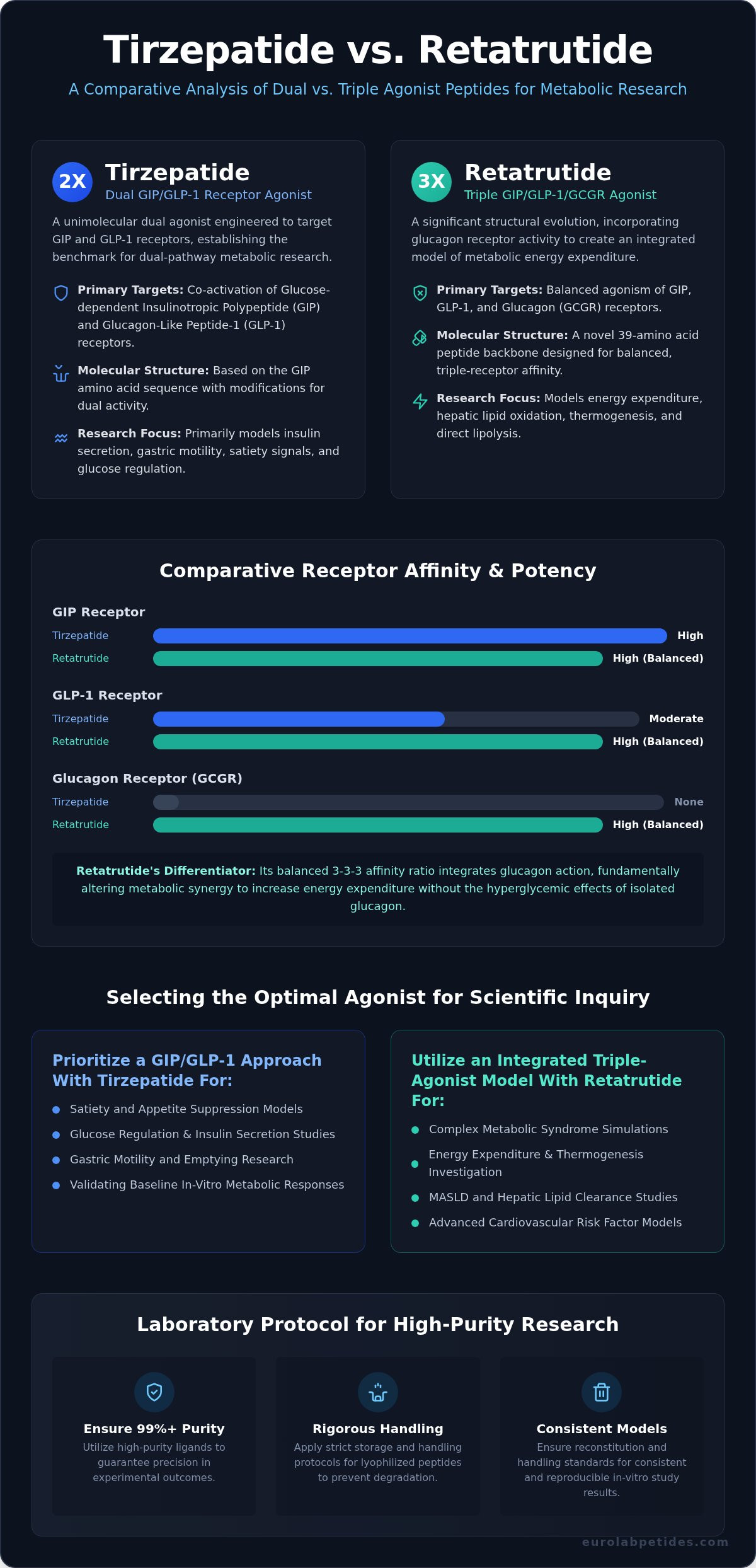
The progression of peptides for metabolic research is currently defined by the transition from dual to triple receptor agonism. Tirzepatide functions as a unimolecular dual agonist, specifically engineered to target the glucose-dependent insulinotropic polypeptide (GIP) and glucagon-like peptide-1 (GLP-1) receptors. Retatrutide represents a significant structural evolution, building upon the fatty-acid-modified peptide backbone to incorporate glucagon receptor (GCGR) activity. This transition is characterized by a shift from purely insulinotropic models to integrated energy expenditure simulations. While tirzepatide’s structure is based on the GIP sequence, retatrutide utilizes a 39-amino acid peptide backbone that allows for a precise 3-3-3 receptor affinity ratio, ensuring balanced potency across all targeted pathways.
The Role of GIP and GLP-1 in Metabolic Models
In laboratory metabolic models, the co-activation of GIP and GLP-1 receptors provides a robust framework for studying insulin secretion and gastric motility. GLP-1 receptor agonism is the primary driver for delayed gastric emptying and the suppression of appetite through hypothalamic signaling. GIP receptor activation complements this by enhancing insulin sensitivity and modulating lipid storage in adipose tissues. Tirzepatide established the dual-agonist research paradigm by demonstrating that these synergistic effects exceed the cumulative results of individual mono-agonists. For researchers focused on satiety and glucose regulation, this dual-pathway approach remains a critical benchmark for validating in-vitro metabolic responses.
Glucagon Agonism: The Retatrutide Differentiator
The primary differentiator for retatrutide is the strategic integration of glucagon receptor agonism. While GLP-1 and GIP focus on nutrient intake and insulin management, Retatrutide’s triple-agonist mechanism actively stimulates hepatic lipid oxidation and increases thermogenesis. This addition is vital for investigating complex metabolic syndromes that require more than appetite suppression for resolution. In laboratory settings, the activation of the glucagon receptor facilitates the study of increased energy expenditure and direct lipolysis. The 3-3-3 affinity ratio is specifically designed to prevent the hyperglycemic effects traditionally associated with isolated glucagon, allowing for a controlled investigation into integrated metabolic pathways. This makes the triple agonist an elite tool for research into MASLD and advanced cardiovascular risk factors where lipid clearance is a primary metric of success.
Comparative Pharmacodynamics: Receptor Affinity and Metabolic Synergies
The functional efficacy of peptides for metabolic research depends on the precise calibration of receptor binding affinities. While tirzepatide operates as a “twincretin” with a heavy bias toward GIP receptor activation, retatrutide’s pharmacodynamic profile is characterized by balanced potency across three distinct pathways. This equilibrium is quantified through in-vitro assays measuring cyclic adenosine monophosphate (cAMP) accumulation, where retatrutide demonstrates a 3-3-3 ratio of affinity. This specific Retatrutide vs. Tirzepatide comparison reveals that adding the glucagon component doesn’t just add a third effect; it fundamentally alters the metabolic synergy of the molecule.
| Receptor Target | Tirzepatide Affinity | Retatrutide Affinity |
|---|---|---|
| GIP Receptor | High (Potent Agonist) | High (Balanced) |
| GLP-1 Receptor | Moderate (Weak vs. Native) | High (Balanced) |
| Glucagon Receptor | None | High (Balanced) |
Bioavailability and half-life are critical variables in laboratory administration protocols. Both molecules utilize a C20 fatty acid diacid moiety to facilitate albumin binding, extending their half-life to approximately five to seven days. This allows for stable, long-term exposure in cellular models without the rapid degradation typical of native incretins. For those conducting Weight Management Research, ensuring the stability of these ligands is paramount for reproducible data.
Receptor Binding Kinetics
Kinetics studies indicate that tirzepatide acts primarily as a GIP receptor-biased agonist. Its GLP-1 activation is significantly lower than that of native GLP-1, which is a deliberate design choice to minimize gastrointestinal signaling in specific models. Retatrutide, however, maintains high potency at the GLP-1 receptor while introducing glucagon agonism. This triple-action profile facilitates a significant increase in metabolic rate by stimulating hepatic glucose production in the short term, which is then counterbalanced by increased peripheral energy use and lipolysis.
Therapeutic Potential in Research Models
In-vitro models of adipocyte differentiation show that triple agonism drives superior lipid breakdown compared to dual-agonist models. Glucagon receptor activation promotes mitochondrial biogenesis in muscle tissue, a mechanism that isn’t present in tirzepatide-only studies. Researchers must account for potential counter-regulatory mechanisms; the glucagon component’s tendency to raise blood glucose is effectively mitigated by the potent insulinotropic effects of the GIP and GLP-1 components. This complex interplay makes retatrutide an advanced tool for investigating the reversal of mitochondrial dysfunction in metabolic syndromes.
Targeted Research Applications: Obesity, MASLD, and Cardiovascular Models
While primary literature often emphasizes weight reduction, the utility of these peptides for metabolic research extends into specialized disease models that require multi-pathway modulation. Retatrutide’s triple-agonist profile allows for the investigation of metabolic dysfunction-associated steatotic liver disease (MASLD) with a granularity that dual agonists cannot match. By engaging the glucagon receptor, researchers can observe direct effects on hepatic fat metabolism that are independent of the insulinotropic pathways driven by GIP and GLP-1. This distinction is critical for laboratories modeling the transition from simple steatosis to advanced fibrosis.
Comparative data from a head-to-head clinical trial provides a foundation for laboratory hypotheses regarding receptor saturation and metabolic turnover rates. In models of type 2 diabetes (T2D), tirzepatide’s GIP-dominant structure remains a benchmark for studying insulin sensitivity and glycemic control. However, retatrutide’s balanced affinity offers a broader scope for investigating the reversal of insulin resistance through the concurrent stimulation of thermogenic pathways. These differences dictate the selection of ligands based on whether the research objective is glycemic stabilization or the activation of latent energy expenditure.
Hepatometabolic Research and Liver Health
Glucagon receptor activation is the primary mechanism for reducing intrahepatic fat content in laboratory models. In studies of NASH and MASLD, triple agonism has demonstrated a high capacity for lipid clearance, potentially slowing the progression of fibrosis. This is achieved through the upregulation of lipid oxidation pathways within the hepatocytes, a process that tirzepatide influences primarily through indirect systemic improvements. The use of high-purity ligands ensures that these hepatic responses are not confounded by peptide degradation or impurities.
Cardiovascular and Renal Outcome Studies
Research subjects administered with these ligands often show significant shifts in lipid profiles and systolic blood pressure, providing data for cardiovascular risk modeling. Renal protection is another emerging area, where the synergy between GLP-1 and GIP receptors facilitates improved glomerular filtration rates in chronic kidney disease models. Retatrutide expands the scope of metabolic research beyond weight loss by integrating glucagon-mediated energy expenditure with systemic vascular and renal stabilization.
Emerging investigative avenues include obstructive sleep apnea and osteoarthritis pain pathways. The reduction of systemic inflammation, often measured via C-reactive protein levels in in-vitro models, suggests that these peptides may modulate pain signaling in degenerative joint conditions. This multi-systemic influence justifies the use of an Advanced Metabolic Stack in complex longitudinal studies where cross-system interactions are the primary focus of inquiry. Reliable data in these emerging fields depends on the consistent application of standardized research protocols and the use of third-party validated compounds.
Laboratory Handling: Stability, Purity, and Reconstitution for In-Vitro Studies
Scientific accuracy in in-vitro modeling is contingent upon the biochemical integrity of the ligands utilized. For peptides for metabolic research, maintaining a purity threshold of 99% or higher isn’t merely a quality benchmark; it’s a requirement for ensuring that observed cellular responses are attributable solely to the agonist. Impurities or truncated sequences can interfere with receptor binding kinetics, leading to inconsistent cAMP assays or skewed metabolic turnover data. High-stakes precision in the laboratory starts with the verification of these technical specifications through third-party High-Performance Liquid Chromatography (HPLC) and Mass Spectrometry (MS) analysis.
Mechanical stress and temperature fluctuations are the primary drivers of peptide primary structure degradation. When handling triple agonists like retatrutide, researchers must avoid vigorous agitation or vortexing. These actions can lead to the shearing of the peptide chain or the formation of aggregates, which renders the molecule biologically inactive. Instead, gentle axial rotation is recommended to ensure complete homogenization without compromising the molecular structure. Access high-purity peptides for metabolic research to ensure your laboratory data meets the highest standards of analytical validation.
Maintaining Peptide Integrity
Lyophilized peptides should be stored at -20°C for short-term use, while long-term preservation requires temperatures of -80°C to prevent hydrolysis and oxidation. Triple agonists are particularly sensitive to light exposure; therefore, storage in amber vials or light-shielded environments is mandatory. Researchers should monitor for signs of degradation, such as changes in the physical state of the cake or reduced solubility upon reconstitution. If a solution appears cloudy or contains visible particulates after proper handling, the peptide’s integrity has been compromised and it shouldn’t be used for quantitative assays.
Precision Reconstitution Protocol
The reconstitution process must be performed using sterile bacteriostatic water or 0.9% sterile saline, depending on the requirements of the specific in-vitro model. Accurate concentration calculation is essential for dose-dependent studies, and the use of a digital reconstitution tool is recommended to minimize human error in laboratory environments. For multi-dose vial management, it’s critical to minimize the number of freeze-thaw cycles, as each cycle induces thermal stress that can degrade the peptide. Aliquoting the reconstituted solution into single-use volumes is the most effective strategy for maintaining consistent potency across longitudinal studies.
Conclusion: Selecting the Optimal Agonist for Scientific Inquiry
The determination to utilize tirzepatide versus retatrutide rests on the intended research endpoint and the specific metabolic pathways being modeled. While tirzepatide remains the definitive tool for investigating dual GIP/GLP-1 mediated insulinotropic effects, retatrutide’s inclusion of glucagon receptor agonism is necessary for modeling integrated energy expenditure and hepatic lipid oxidation. The evolution of peptides for metabolic research suggests a clear trajectory toward multi-receptor targets that more accurately simulate complex physiological feedback loops. Selecting the correct ligand ensures that laboratory observations remain relevant as the scientific community moves beyond simple dual-receptor models.
Researchers Selection Framework
A structured approach is required when transitioning from established dual-agonist protocols to advanced triple-agonist simulations. Researchers should evaluate their requirements based on the following metrics:
- Primary Signaling Focus: Prioritize tirzepatide for satiety and glycemic stabilization studies; select retatrutide for investigations into thermogenesis and lipolysis.
- Model Complexity: Determine if the inclusion of the glucagon receptor aligns with the specific metabolic syndrome being modeled, such as MASLD or advanced fibrosis.
- Analytical Depth: Consider whether the research requires the balanced 3-3-3 affinity ratio unique to retatrutide for quantifying multi-pathway synergies.
- Resource Allocation: Assess the 2026 budgetary requirements for high-purity triple agonists against the depth of data provided by more established dual-agonist ligands.
Sourcing High-Purity Agonists in Europe
The integrity of in-vitro data is inseparable from the chemical excellence of the compounds used. EuroLab Peptides maintains a multi-level quality protocol that ensures 99% plus purity for all peptides for metabolic research, verified through independent third-party laboratory testing. When you buy research peptides, the inclusion of current HPLC and MS data is a non-negotiable standard for maintaining laboratory rigor and ensuring reproducible results.
Accessing specialized peptides with localized European logistics provides a shorthand for reliability in a market often complicated by quality concerns. For researchers focused on weight management research, the use of verified agonists is the only method to guarantee that metabolic observations are not confounded by peptide degradation. Absolute security in professional inquiry is achieved only through radical transparency and the consistent application of objective technical analysis. Final research integrity depends on the verification of every molecular specification before the commencement of any metabolic study.
Advancing Analytical Precision in Metabolic Modeling
The transition from dual-receptor paradigms to triple-agonist frameworks represents the next logical progression in metabolic modeling. While tirzepatide remains the established standard for studying insulinotropic signaling, retatrutide’s integration of glucagon receptor activation facilitates a more holistic investigation into energy expenditure and hepatic lipid oxidation. Achieving reproducible data in these high-stakes environments requires peptides for metabolic research that meet rigorous technical specifications. The selection of an agonist must be dictated by the specific metabolic pathways under inquiry to ensure experimental validity.
EuroLab Peptides facilitates this precision through a multi-level quality protocol. Every batch is subjected to independent third-party HPLC and mass spectrometry testing to guarantee a 99% plus purity benchmark. Our specialized European logistics infrastructure ensures the secure and efficient delivery of these elite tools for in-vitro laboratory development. By prioritizing verifiable metrics and objective data over marketing hyperbole, researchers can maintain the absolute accountability required for serious professional inquiry. Standardizing your sourcing is the final step in securing the integrity of your research data.
Source High-Purity Retatrutide for Your Research Laboratory to establish a foundation of precision for your next metabolic study.
Frequently Asked Questions
Is Retatrutide more effective than Tirzepatide in laboratory research models?
Efficacy is determined by the specific metabolic pathway under investigation rather than a universal benchmark. Retatrutide demonstrates higher mean efficacy in weight reduction models, showing an average of 24.2% body weight reduction at 48 weeks in Phase 2 trials, due to glucagon-mediated energy expenditure. Tirzepatide is often preferred for studies focusing strictly on insulinotropic signaling and satiety where glucagon activation is not required.
What is the primary difference between a dual agonist and a triple agonist?
The fundamental distinction lies in the number of hormone receptors activated by the peptide sequence. A dual agonist like tirzepatide activates GLP-1 and GIP receptors to manage insulin secretion and appetite. A triple agonist adds the glucagon receptor to its mechanism of action, which introduces hepatic lipid oxidation and thermogenesis into the peptides for metabolic research modeling framework.
Can Retatrutide and Tirzepatide be used together in the same research stack?
Co-administration is generally considered redundant in metabolic models because retatrutide already encompasses the receptor targets of tirzepatide. Utilizing both simultaneously may lead to receptor saturation or competitive binding at the GLP-1 and GIP sites, which can confound experimental results. Researchers typically select a single molecule based on whether glucagon integration is necessary for the specific study objectives.
What are the common side effects observed in animal models using Retatrutide?
Observations in research subjects typically include dose-dependent gastrointestinal responses and transient increases in heart rate. These effects are attributed to GLP-1 receptor signaling and the stimulatory nature of glucagon agonism on the cardiovascular system. Precise quantification of these responses is necessary for establishing safety profiles and determining the maximum tolerated dose during preclinical laboratory development.
How should Retatrutide be stored to maintain maximum stability?
Lyophilized peptides for metabolic research must be stored at -20°C for short-term preservation and -80°C for long-term stability. Protection from light and moisture is mandatory to prevent hydrolysis and oxidation of the amino acid chain. Once reconstituted, solutions should be aliquoted into single-use volumes and maintained at 4°C to minimize thermal degradation during the active study period.
What is the recommended reconstitution liquid for research peptides?
Reconstitution should be performed using sterile bacteriostatic water or 0.9% sterile saline to ensure a stable environment for the peptide molecule. The choice of diluent depends on the specific buffer requirements and pH sensitivity of the in-vitro assay being conducted. Mechanical stress, such as vigorous shaking, must be avoided during this process to prevent the shearing of the peptide chains.
Are these peptides available for human use or clinical prescription?
These compounds are strictly intended for in-vitro research and laboratory development purposes only. While tirzepatide has received FDA approval for specific clinical indications, retatrutide remains an investigational molecule in the TRIUMPH clinical program as of 2026. Sourcing these chemicals is restricted to professional laboratory settings to ensure they are not utilized for human consumption.
Why is third-party testing essential for metabolic research peptides?
Independent validation through HPLC and mass spectrometry ensures the peptide meets the 99% purity threshold required for analytical accuracy. Contaminants or truncated sequences can produce false positives or interfere with receptor binding kinetics, rendering the data unreliable. Verifiable analytical data from an external laboratory is a non-negotiable standard for maintaining research integrity and ensuring the reproducibility of results.
