

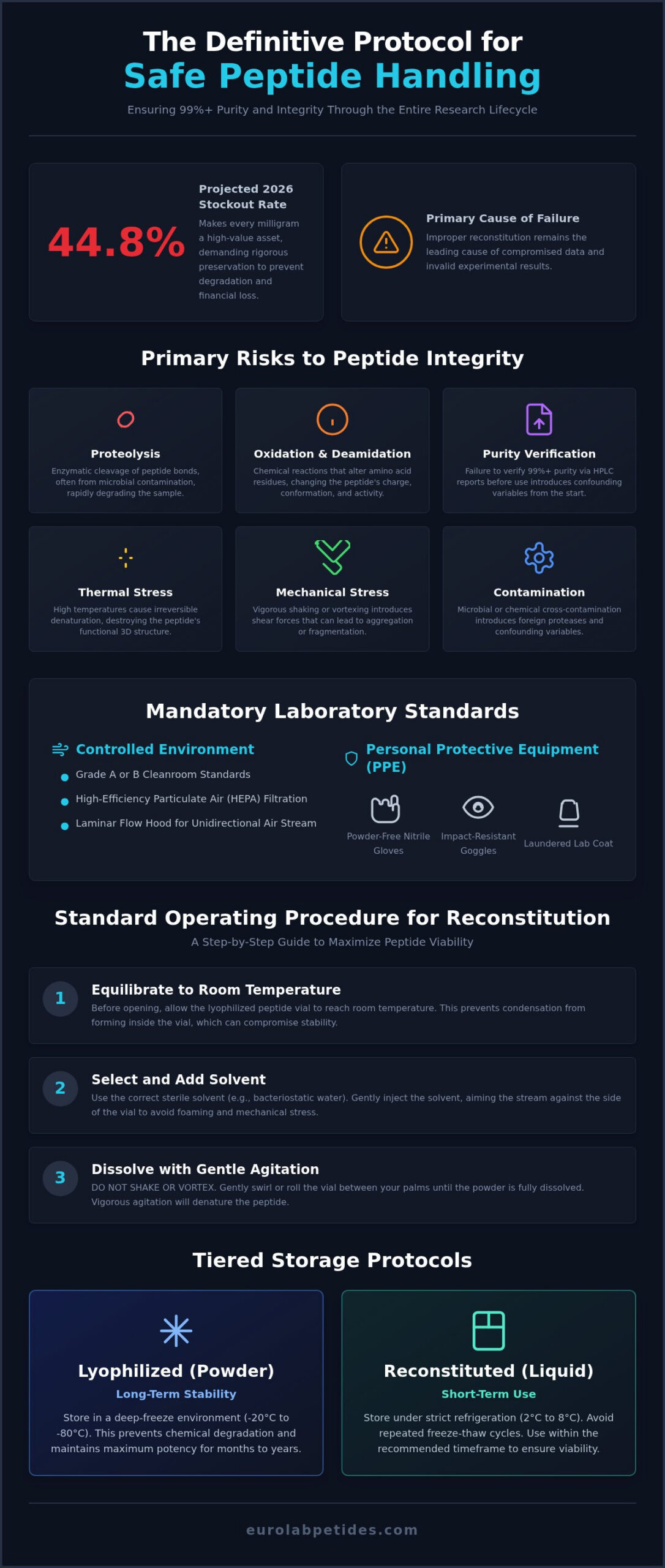
Does your current laboratory SOP account for the fact that a 44.8% stockout rate for compounds like BPC-157 in 2026 makes every milligram of inventory a high-value asset that cannot afford degradation? Maintaining the precise molecular architecture of a compound requires more than basic storage; it demands a rigorous adherence to the safe handling of research peptides to prevent the immediate loss of chemical potency. You recognize that the integrity of your longitudinal data is inseparable from the chemical stability of your reagents, yet improper reconstitution remains the primary cause of experimental failure in the specialized research community.
This clinical guide establishes a definitive protocol for maintaining 99%+ peptide purity through every phase of the research lifecycle, from procurement to final analysis. We provide a structured framework for mitigating cross-contamination risks and ensuring the long-term stability of reconstituted solutions. This protocol previews the essential technical specifications for lyophilization physics, precise solvent ratios, and the specific regulatory compliance standards required to maintain a secure and professional laboratory environment.
Key Takeaways
- It’s critical to identify and mitigate the biochemical risks of proteolysis, oxidation, and deamidation to preserve the structural integrity of amino acid chains.
- Mandatory PPE and Grade A or B cleanroom standards must be enforced to eliminate cross-contamination risks during high-precision laboratory procedures.
- Master a standardized reconstitution protocol that prioritizes the safe handling of research peptides through precise temperature equilibration and solvent selection.
- Tiered storage protocols should be implemented, utilizing deep-freeze environments for lyophilized inventory and strict refrigeration for reconstituted solutions.
- Material purity must be verified via HPLC reports and third-party validation to secure a baseline of 99%+ quality before initiating in-vitro studies.
Biochemical Stability and the Risks of Improper Handling
Peptides are defined as short chains of amino acids linked by covalent peptide bonds. Their inherent structural fragility necessitates a rigorous approach to the safe handling of research peptides. Unlike larger proteins, these sequences often lack the extensive tertiary folding that might provide a buffer against environmental stressors. Consequently, even minor deviations from established laboratory protocols can result in immediate molecular degradation. In the context of professional biochemistry, safe handling refers to the standardized application of protocols designed to prevent this degradation while ensuring the laboratory environment remains free from environmental contamination.
The primary biochemical risks during sample manipulation include proteolysis, oxidation, and deamidation. Proteolysis involves the enzymatic cleavage of peptide bonds, while oxidation typically targets specific residues like methionine or cysteine. Deamidation, the removal of an amide group from glutamine or asparagine, alters the peptide’s charge and conformation. Understanding the biochemical profile of peptide therapeutics and research analogs highlights why these pathways lead to a loss of biological activity. When degradation occurs, the validity of in-vitro data is compromised, rendering research results statistically insignificant or fundamentally inaccurate.
Thermal and Mechanical Sensitivity
High temperatures provide the kinetic energy required to overcome the weak non-covalent interactions that maintain a peptide’s secondary structure. This often leads to irreversible denaturation, where the peptide loses its functional shape. Beyond thermal concerns, mechanical stress presents a significant threat to sample integrity. Vigorous shaking or vortexing introduces shear forces that can disrupt delicate molecular bonds within the sequence, leading to aggregation or fragmentation. Thermal degradation in lyophilized peptides is the process by which elevated temperatures accelerate chemical reactions, such as hydrolysis or oxidation, leading to the permanent loss of the compound’s structural and functional identity.
Contamination Vectors in Laboratory Settings
Microbial contamination remains a primary risk factor when vials are unsealed outside of ISO-standard environments. Even trace quantities of bacteria or fungi can introduce exogenous proteases that rapidly catabolize the sample. Furthermore, cross-contamination between distinct research categories, such as a Recovery Research Stack and a Cognitive Research Stack, must be prevented through strict segregation and the safe handling of research peptides. The presence of foreign peptide sequences or chemical residues from previous manipulations can produce confounding variables in data sets. A sterile, controlled environment is the only viable setting for these procedures, as it ensures that the empirical results reflect the properties of the target compound alone.
Mandatory Laboratory Environment and PPE Standards
Establishing a controlled environment is the primary metric of professional laboratory inquiry. Grade A or B cleanroom standards are mandatory for sensitive manipulations to ensure that the safe handling of research peptides is maintained at every stage of the workflow. These environments utilize High-Efficiency Particulate Air (HEPA) filtration to maintain a class-specific particulate count, which is essential for preventing microbial ingress. Laminar flow hoods are utilized to provide a unidirectional air stream that protects the sample from airborne particulates. This level of environmental control addresses significant peptide safety concerns related to environmental contamination and cross-reactivity.
Standardized Personal Protective Equipment (PPE) serves as the final barrier between the researcher and the compound. Powder-free nitrile gloves are required for all procedures. Lab coats must be laundered in a professional facility to prevent the transfer of domestic allergens or fibers into the cleanroom. Eye protection, typically in the form of impact-resistant goggles, is a non-negotiable requirement to prevent accidental ocular exposure during the manipulation of liquid reagents.
Personal Protective Equipment (PPE) Requirements
The selection of powder-free gloves is critical to prevent chemical interference. Traditional powdered gloves utilize cornstarch or calcium carbonate, which can act as a contaminant in sensitive biochemical assays or alter the results of mass spectrometry analysis. When handling bulk lyophilized powders, respiratory protection in the form of an N95 or higher-rated respirator is required to prevent the inhalation of airborne particles. All used PPE and contaminated materials must be processed through biohazardous waste streams. This ensures that accidental exposure risks are neutralized before the materials exit the laboratory facility.
Surface and Equipment Sterilization
Sterilization protocols for all contact surfaces must be strictly enforced using 70% isopropyl alcohol (IPA). This specific concentration is utilized because it penetrates the cell walls of microorganisms more effectively than 99% concentrations, which often cause external proteins to coagulate too quickly. Lab benches and storage units are cleaned at standardized intervals, typically before and after every manipulation session. All reusable glassware must undergo verified autoclave cycles, usually at 121°C for a minimum of 15 minutes, to ensure absolute sterility. Securing high-purity compounds is a prerequisite for these safety protocols; researchers should ensure their material is obtained through sterile sourcing from EuroLab Peptides to maintain laboratory integrity.
Standard Operating Procedure for Reconstitution
Reconstitution represents the most volatile phase in the sample lifecycle, marking the transition of a compound from a stable lyophilized state to a fragile aqueous solution. This process requires precise execution to avoid the molecular cleavage or aggregation described in previous sections. The safe handling of research peptides during this phase begins with temperature equilibration. Vials must be allowed to reach room temperature, typically between 20°C and 25°C, before the seal is compromised. Opening a chilled vial introduces the risk of atmospheric moisture condensation, which can lead to the immediate hydrolytic degradation of the lyophilized cake.
The transition to a liquid state must be managed with extreme care. Mechanical forces, such as those generated by high-speed vortexing, are strictly prohibited as they can shear the delicate covalent bonds of the amino acid chain. Instead, researchers must employ a “gentle swirl” technique, allowing the solvent to naturally integrate with the powder through slow, horizontal rotation. This methodical approach ensures the structural integrity of the compound remains intact for subsequent in-vitro analysis.
Solvent Selection and Purity
The choice of diluent is governed by the specific biochemical requirements of the study and the intended duration of the reconstituted solution. Bacteriostatic water, which contains 0.9% benzyl alcohol, is the preferred solvent for multi-use research vials due to its ability to inhibit microbial proliferation over extended periods. For single-use in-vitro applications where alcohol interference must be eliminated, Sterile Water for Injection (SWFI) is utilized. In cases where the peptide sequence exhibits extreme sensitivity to pH, sterile 0.9% sodium chloride may be required to maintain an isotonic environment. To ensure accuracy in these concentrations, researchers should utilize a peptide reconstitution calculator to determine the precise volume of solvent required to reach the target mg/mL specification.
The Reconstitution Process Step-by-Step
Adherence to a repeatable step-by-step protocol is essential for maintaining a sterile and stable environment. The safe handling of research peptides requires that every manipulation is performed within the controlled parameters established in the laboratory’s Chemical Hygiene Plan.
- Sanitization: The rubber septum must be thoroughly cleansed with a fresh 70% isopropyl alcohol swab and allowed to air dry completely before needle insertion.
- Solvent Introduction: The syringe needle is angled so the solvent flows slowly down the interior glass wall of the vial. Direct impingement of the liquid onto the lyophilized powder must be avoided to prevent foaming and denaturation.
- Dissolution: After the solvent is fully introduced, the vial should sit undisturbed for 2 to 5 minutes. If particulates remain, rotate the vial slowly between the palms until the solution is clear.
- Verification: A final visual inspection is conducted under adequate lighting. The solution must be transparent and free of any visible undissolved matter before it is cleared for experimental use.
Storage Standards for Lyophilized and Reconstituted Peptides
Storage protocols represent the final operational phase in the safe handling of research peptides. Molecular stability is dictated primarily by the chemical state of the compound and its environmental exposure. Lyophilized powders exhibit the highest degree of long-term stability when maintained at temperatures between -20°C and -80°C. These ultra-low temperatures effectively halt the kinetic energy required for hydrolytic or oxidative reactions. Protection from electromagnetic radiation is equally critical. Peptides must be housed in amber glass vials or within opaque storage containers to prevent photo-degradation, which can alter the peptide’s primary structure.
Once a compound is reconstituted, its half-life is significantly reduced. Aqueous solutions must be maintained under strict refrigeration between 2°C and 8°C. Even under these conditions, biochemical stability is usually limited to a 30-day window. The ‘Freeze-Thaw’ rule is a non-negotiable standard in professional laboratories. Repeated cycles of freezing and thawing induce severe mechanical stress through ice crystal formation. This process leads to the permanent denaturation of the peptide sequence, rendering the research material ineffective for precise in-vitro analysis.
The Aliquoting Protocol
To mitigate the risks associated with repeated thermal cycling, an aliquoting protocol is employed. Reconstituted solutions are divided into single-use, sterile microcentrifuge tubes immediately following the initial dissolution. Each aliquot must be labeled with the peptide nomenclature, the precise concentration in mg/mL, and the date of reconstitution. This practice ensures that only the required volume is exposed to room temperature for a specific experiment. For sequences with high structural complexity, researchers should consult the BPC-157 technical guide to understand how specific pentadecapeptide configurations respond to varied storage durations.
Monitoring and Inventory Control
Rigorous inventory control requires the use of digital logging systems to monitor storage temperatures in real-time. Any deviation from the target temperature range must be documented as a potential compromise of sample integrity. Researchers must conduct a visual inspection before every manipulation. Signs of degradation include persistent cloudiness, which indicates microbial proliferation or molecular aggregation, and the appearance of precipitation. Any color change, particularly yellowing, suggests advanced oxidation. Compromised or expired materials must be disposed of according to the facility’s chemical waste protocols to prevent the use of sub-standard reagents. To ensure your laboratory inventory starts with the highest baseline stability, secure your compounds through the high-purity lyophilized powders from EuroLab Peptides.
Sourcing Integrity: Verification as a Safety Prerequisite
Adherence to rigorous laboratory protocols is futile if the initial reagent is chemically compromised. The safe handling of research peptides begins at the point of procurement, where verification of material purity and identity is a non-negotiable prerequisite. Analytical validation through High-Performance Liquid Chromatography (HPLC) and Mass Spectrometry (MS) provides the empirical evidence required to proceed with high-stakes in-vitro studies. HPLC reports quantify the purity level by measuring the area under the curve for the target peptide sequence versus detectable impurities. A minimum threshold of 99% purity is the industry benchmark for professional inquiry. MS confirms the molecular identity by measuring the mass-to-charge ratio, ensuring the actual molecular weight aligns with the theoretical sequence of the compound.
Sourcing within Europe ensures that these analytical standards are backed by regional regulatory compliance and localized logistics. This proximity reduces the risk of long-haul transit delays that can expose lyophilized powders to temperature fluctuations. When the starting material is verified, the researcher can be confident that the data generated is a result of the peptide’s biological activity rather than a reaction to unexpected contaminants or degraded analogs.
Third-Party Validation Standards
In-house testing by manufacturers is often insufficient for verifying batch consistency due to the lack of objective distance. Independent third-party laboratory testing serves as the gold standard for accountability in the chemical synthesis space. EuroLab Peptides’ multi-level quality protocol functions as a benchmark, requiring that every batch is subjected to external validation before it enters the research supply chain. This transparency allows laboratory staff to maintain a repeatable SOP based on verified data. Researchers should review the specialized guide on how to buy research peptides safely to establish procurement channels that meet these rigorous technical specifications.
Logistics and Cold Chain Security
The safe handling of research peptides extends to the logistical chain before the vial even reaches the lab bench. Transit temperatures have a direct impact on the stability of lyophilized cakes. Choosing suppliers with expedited, climate-controlled shipping options is essential for preventing the early-stage degradation pathways such as oxidation or deamidation. Professional vendors utilize specialized packaging to maintain a stable thermal environment, protecting the structural integrity of the amino acid chains during the critical window of delivery. Secure your research integrity with EuroLab Peptides’ third-party tested catalog to ensure your laboratory inventory starts with the highest possible baseline of purity and stability.
Advancing Laboratory Standards for 2026 and Beyond
The maintenance of molecular integrity is the non-negotiable foundation of all specialized biochemical inquiry. By integrating the technical specifications for reconstitution with the storage standards established in this protocol, laboratory staff can ensure that the safe handling of research peptides remains a verifiable metric of their operational excellence. Success in in-vitro studies depends on the elimination of environmental variables, from the initial sanitization of the vial septum to the precise execution of the aliquoting protocol.
It’s the primary step in ensuring data validity to start your research with material that has already undergone rigorous external validation. EuroLab Peptides provides the high-purity lyophilized powders necessary for these demanding applications. Each compound is third-party laboratory tested to confirm 99%+ purity and is intended strictly for in-vitro research use. With discreet and secure European shipping, your laboratory inventory is protected from the logistical risks of long-haul transit.
Secure High-Purity Peptides for Your Research Laboratory and establish a repeatable standard for your specialized community.
Frequently Asked Questions
Is it safe to handle research peptides without a fume hood?
Handling sealed vials does not strictly require a fume hood provided the laboratory maintains a Grade A or B cleanroom environment. However, any manipulation involving bulk lyophilized powders must be conducted within a laminar flow hood or fume hood to prevent the inhalation of airborne particulates. This precaution is a standard component of the safe handling of research peptides, ensuring both researcher safety and the prevention of sample contamination.
How long can reconstituted peptides remain stable in a standard refrigerator?
Reconstituted peptides typically maintain their biochemical stability for 14 to 30 days when stored at 2-8°C. This window is sequence-dependent; more complex chains may exhibit earlier signs of degradation such as aggregation or precipitation. Accuracy in longitudinal data requires that these solutions are monitored daily for clarity and that digital logs track any deviations in refrigeration temperature.
Can I use tap water for peptide reconstitution in a lab setting?
Tap water is never utilized for reconstitution because it contains minerals, chlorine, and microbial contaminants that trigger immediate molecular degradation. These impurities facilitate oxidation and enzymatic cleavage, which compromise the compound’s primary structure. Professional protocols require high-purity solvents such as bacteriostatic water or sterile water for injection to ensure the validity of in-vitro results.
What happens if a peptide vial is accidentally shaken vigorously?
Vigorous shaking introduces mechanical shear forces that can lead to irreversible denaturation or the formation of insoluble aggregates. This disruption of the delicate molecular bonds alters the peptide’s conformation and biological activity. If a vial is shaken, the presence of persistent foam or cloudiness usually indicates that the sample’s integrity has been compromised beyond the point of experimental utility.
Are research peptides sold by EuroLab Peptides intended for human clinical trials?
No, EuroLab Peptides products are strictly for in-vitro laboratory research and are not intended for human consumption, clinical trials, or any therapeutic use. The safe handling of research peptides provided by EuroLab Peptides must be restricted to professional laboratory settings by qualified personnel. These compounds are specialized reagents for analytical inquiry and are not classified as pharmaceuticals or medicines.
What is the shelf life of a lyophilized peptide stored at -20°C?
Lyophilized peptides stored at -20°C generally maintain a shelf life of up to 24 months if they remain sealed and protected from light. For storage requirements exceeding two years, a temperature of -80°C is recommended to further inhibit kinetic energy and oxidative pathways. It’s essential to use a non-frost-free freezer to avoid the thermal fluctuations associated with automatic defrost cycles.
How do I dispose of contaminated or degraded peptide solutions safely?
Contaminated or degraded solutions must be processed through biohazardous waste streams according to the facility’s Chemical Hygiene Plan. Vials and syringes should be placed in puncture-resistant sharps containers for subsequent autoclaving or incineration. This protocol ensures that accidental exposure risks are neutralized and that the laboratory remains compliant with regional environmental safety regulations.
Why is bacteriostatic water preferred over sterile water for multi-use vials?
Bacteriostatic water is the preferred diluent for multi-use vials because the 0.9% benzyl alcohol content inhibits microbial proliferation after the initial septum puncture. Sterile water lacks this preservative, which means it doesn’t prevent the growth of bacteria introduced during repeated needle insertions. For any study requiring multiple samplings from a single vial, the bacteriostatic agent is critical for maintaining solution sterility.
