

Analytical transparency remains the only valid currency in biochemical research; purity is a verifiable metric rather than a subjective marketing claim. For the professional researcher, the presence of contaminants or batch-to-batch inconsistency isn’t merely a logistical hurdle but a fundamental threat to the integrity of in-vitro data. You likely recognize that the surge in the global peptide therapeutics market, valued at $49.68 billion in 2026, has increased the circulation of compounds with questionable provenance. Securing high-purity, third-party tested peptides is no longer an optional safeguard; it’s a non-negotiable requirement for ensuring that experimental results are both reproducible and scientifically sound.
This article provides a rigorous framework for auditing peptide suppliers and interpreting the technical data found within HPLC and Mass Spectrometry reports. You’ll discover the specific analytical standards, such as ISO/IEC 17025:2017, that distinguish elite synthesis from inferior alternatives. We’ll examine the verification protocols required to confirm identity and potency, offering a clear path to sourcing high-purity compounds within the European regulatory landscape. By moving from anecdotal trust to empirical validation, you can eliminate the fear of contaminants and maintain the highest standards of professional inquiry.
Key Takeaways
- Learn how High-Performance Liquid Chromatography (HPLC) and Mass Spectrometry (MS) provide empirical proof of both purity percentages and molecular identity.
- Understand why third-party tested peptides are essential for mitigating the risks of batch-to-batch inconsistency and ensuring the integrity of in-vitro data.
- Master a technical framework for auditing Certificates of Analysis; this includes procedures for cross-referencing lot-specific data with independent testing facilities.
- Distinguish between the inherent limitations of in-house quality control and the objective validation provided by external, ISO-standard laboratories.
- Establish a reliable sourcing strategy for European research by prioritizing providers who utilize multi-level verification protocols for every batch.
What Are Third-Party Tested Peptides in a Research Context?
Third-party testing is defined by the absolute independence of the verifying entity. In the context of chemical synthesis, this means the analytical laboratory possesses no financial interest in the commercial success or failure of the compound. This separation is vital for establishing an objective baseline of quality that is untainted by the conflict of interest inherent in self-certification. For the professional researcher, third-party tested peptides represent a commitment to radical transparency, where quality is treated as a verifiable metric rather than a marketing claim.
Analytical chemistry serves as the foundation for these benchmarks. Every batch must undergo a standardized quality control (QC) procedure to ensure the final product matches the theoretical design. This process utilizes High-Performance Liquid Chromatography (HPLC) and Mass Spectrometry (MS) to map the chemical profile of the sample. Without this external audit, there’s no empirical way to distinguish high-purity research tools from inferior alternatives that may contain synthesis byproducts or unreacted reagents.
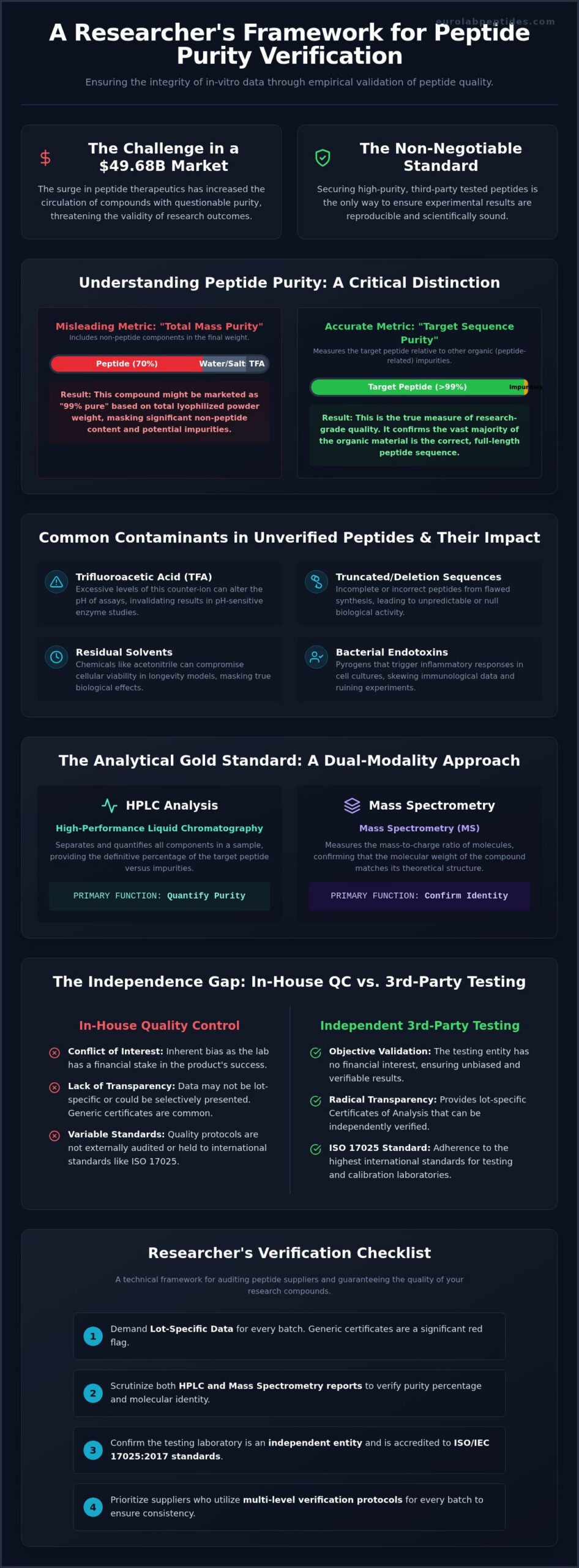
A critical distinction must be made between “99% pure” and “99% purity of the target sequence.” Total mass purity can be misleading; it often includes the total weight of the powder, which may contain significant amounts of water, salts, and counter-ions. True research integrity depends on the purity of the specific amino acid sequence relative to all other organic impurities. High-purity compounds ensure that the biological activity observed in a study is the result of the peptide itself, not a confounding variable introduced during a flawed synthesis process.
The Non-Negotiable Standard for In-Vitro Studies
In-vitro models require a controlled environment where variables are strictly isolated. Impurities like residual solvents can introduce confounding factors that invalidate an entire study. For instance, in weight management research, minor contaminants can interfere with metabolic signaling pathways, leading to inaccurate data. Residual solvents such as acetonitrile or dichloromethane can compromise cellular viability in longevity models, masking the true biological effect of the peptide. Furthermore, the use of mislabeled or unverified research chemicals carries significant legal and safety implications for the institution involved.
Common Contaminants in Unverified Peptides
Unverified lots frequently contain residual trifluoroacetic acid (TFA), which is a counter-ion used during the cleavage and purification stages of solid-phase synthesis. Excessive TFA levels alter the pH of assays, which is particularly detrimental to pH-sensitive enzyme studies. Other common contaminants found in non-certified lots include:
- Truncated sequences: Peptides that failed to reach full length during the coupling steps.
- Deletion mutations: Sequences missing a specific amino acid, resulting from poor synthesis efficiency.
- Bacterial endotoxins: Pyrogens that trigger inflammatory responses in cell cultures, skewing immunological data.
- Heavy metals: Residual catalysts used in production that were not adequately removed during filtration.
Sourcing third-party tested peptides ensures these specific impurities are screened and quantified. This level of technical scrutiny is essential for maintaining the high-stakes precision required by the specialized research community.
The Analytical Process: Decoding HPLC and Mass Spectrometry
The verification of chemical integrity relies on a dual-modality analytical approach. While visual inspection is insufficient for determining quality, the empirical data derived from High-Performance Liquid Chromatography (HPLC) and Mass Spectrometry (MS) provides an objective profile of a compound’s composition. HPLC is a technique used to separate and quantify the components of a peptide mixture. This method remains the industry standard for determining purity levels, yet its utility depends entirely on the provenance of the data. Professional researchers must insist on lot-matched reports; generic certificates fail to account for the stochastic variations inherent in separate synthesis cycles.
Comprehensive physicochemical characterization is required to ensure that the material received matches the specific lot tested by an independent laboratory. This level of scrutiny is what defines third-party tested peptides. Without this data, the researcher cannot account for impurities that may alter the metabolic or cellular response in an experimental model. Establishing a baseline of certainty requires a technical understanding of the chromatograms and spectra provided in a Certificate of Analysis (COA).
How to Read an HPLC Chromatogram
The chromatogram is a visual representation of the separation process. The primary peak represents the target peptide, and its residence time should align with established standards for that specific sequence. Analysts examine the baseline for smaller “noise” peaks, which indicate the presence of synthesis byproducts, truncated sequences, or residual reagents. Purity is calculated by measuring the Area Under the Curve (AUC) for the main peak relative to the total area of all detected peaks. A purity metric of 99% signifies that the target sequence accounts for nearly the entire organic mass detected in the sample.
Understanding Mass Spectrometry Reports
While HPLC measures purity, Mass Spectrometry confirms identity. The MS report displays the mass-to-charge ratio of the ions present in the sample. This allows researchers to match the observed mass against the theoretical molecular weight of the peptides under investigation. Discrepancies often reveal “double hits,” where an amino acid is added twice, or incomplete deprotection, where protecting groups remain attached to the side chains. A single, sharp MS peak corresponding to the calculated mass serves as the ultimate proof of sequence identity. When sourcing third-party tested peptides, the alignment of the MS peak with the theoretical mass is a non-negotiable metric for research validity.
Researchers requiring high-stakes precision can access the analytical verification for research compounds provided for every batch in our catalog to ensure absolute study integrity.
In-House vs. Independent Third-Party Testing: The Independence Gap
Self-certification represents a systemic vulnerability in the biochemical supply chain. When a manufacturer performs their own quality assessments, they possess a direct financial incentive to report optimal results. This conflict of interest compromises the validity of the data, as there’s no external check on the reporting process. True third-party tested peptides require a definitive analytical barrier between the point of production and the point of validation. This separation ensures that the purity metrics provided to the researcher are objective and untainted by commercial pressures.
Reputable third-party laboratories must adhere to ISO/IEC 17025:2017 standards, which govern the competence of testing and calibration laboratories. This accreditation ensures that the facility utilizes standardized methodologies and maintains rigorous equipment calibration protocols. Without these standards, analytical results lack the necessary precision for high-stakes research. Radical honesty in reporting is only achievable when the testing entity has no stake in the product’s sale.
The Risks of Relying on In-House COAs
Internal laboratories often operate without the oversight required for international accreditation. This lack of transparency allows for “cherry-picking,” a practice where a manufacturer tests only the most successful portion of a batch to represent the entire lot. Furthermore, uncertified facilities may lack the rigorous calibration schedules needed for HPLC and MS equipment, leading to drifting baselines and inaccurate purity scores. In non-transparent environments, it’s possible for baseline noise to be digitally filtered to artificially inflate the perceived quality of the compound. These practices introduce variables that can quietly invalidate weeks of in-vitro study.
The Gold Standard: Blind External Audits
Independent laboratories provide what is essentially a blind audit of the synthesis process. Samples are submitted in neutral packaging to prevent laboratory technicians from identifying the source, which eliminates subconscious bias toward specific suppliers. This objective verification is a critical differentiator when buying research peptides in a market where quality benchmarks vary significantly. Transparency isn’t just a marketing asset in the 2026 research market; it’s the primary metric for reliability. A third-party report provides a layer of empirical truth that internal documents can’t replicate.
EuroLab Peptides utilizes a multi-level quality control protocol to bridge this independence gap. Every batch undergoes initial internal verification to confirm that synthesis parameters align with the target sequence. This is immediately followed by submission to independent, ISO-certified facilities for external validation. This dual-layered approach confirms that the third-party tested peptides delivered to the researcher meet the highest analytical benchmarks. By prioritizing regional manufacturing standards and external audits, EuroLab provides the technical transparency required for serious professional inquiry.
How to Verify Peptide Quality: A Researcher’s Checklist for 2026
Establishing a rigorous procurement protocol is essential for maintaining experimental integrity. While the presence of a Certificate of Analysis is a baseline requirement, the authenticity of the data must be scrutinized through active verification. The following framework provides a technical sequence for auditing third-party tested peptides before they are integrated into an in-vitro study.
- Request a lot-specific Certificate of Analysis. Generic reports are insufficient. The COA must correspond to the specific synthesis lot number of the vials being purchased.
- Cross-reference with the independent laboratory. Reputable testing facilities often maintain a searchable database where report serial numbers can be validated.
- Evaluate the synthesis methodology. Solid Phase Peptide Synthesis (SPPS) remains the preferred method for ensuring high-purity sequences; however, the efficiency of the coupling steps must be reflected in the final purity score.
- Assess stability and storage requirements. Verify that the compound is delivered as lyophilized powder to ensure maximum shelf-life and resistance to degradation during transit.
- Confirm the supplier’s research focus. Professional suppliers prioritize technical specifications and strictly adhere to in-vitro research-only standards.
Adherence to this checklist minimizes the risk of introducing confounding variables into a study. By treating sourcing as an extension of the laboratory process, researchers can ensure that every compound meets the necessary analytical benchmarks.
Red Flags in Peptide Sourcing
Certain operational markers indicate a lack of analytical rigor. Suppliers who offer medical advice or mention human consumption are likely operating outside the professional biochemical space. This often correlates with a disregard for regional regulatory compliance. Additionally, MS reports that omit molecular weight data or provide illegible chromatograms should be rejected. Prices that fall significantly below the market cost of high-purity synthesis often suggest the presence of truncated sequences or residual solvents that have not been adequately removed during the purification phase. Using third-party tested peptides is the only way to avoid these hidden defects.
Verifying the Lab’s Reputation
The credibility of an analytical report is tied to the credentials of the facility that produced it. Researchers should verify the physical address and accreditation status of the testing laboratory. A legitimate facility will possess a verifiable history in the biochemistry sector and typically holds ISO 17025 certification. To confirm a COA’s authenticity, the researcher should use the unique report ID found on the document to cross-reference the data directly with the laboratory’s official records. Direct contact with the lab is often the most efficient way to confirm that a serial number matches the specific lot in question.
To ensure your research is supported by verified data, you can access our multi-level verification reports for all available research compounds.
EuroLab Peptides: A Multi-Level Quality Protocol for European Research
EuroLab Peptides addresses the specific logistical and regulatory requirements of the European scientific community. By prioritizing regional manufacturing standards and technical transparency, the business functions as a reliable partner for institutions requiring high-stakes precision. The reliance on third-party tested peptides isn’t merely a preference; it’s a structural requirement for ensuring that experimental data remains reproducible across different laboratory environments. Our commitment to analytical excellence is reflected in the multi-level quality control process applied to every compound in our catalog.
Localized logistics provide a distinct advantage for European researchers who previously navigated the complexities of international customs and fluctuating quality standards. By maintaining a supply chain within Europe, we ensure that the delivery of research tools adheres to regional regulatory compliance while minimizing the risk of degradation during transit. Every batch, including the components of our Longevity Research Stack, is subjected to a rigorous validation lifecycle before it reaches the end user. This process ensures that the focus remains on experimental outcomes rather than compound variability.
The EuroLab Testing Lifecycle
The path to analytical certainty begins with raw material verification. During Phase 1, synthesis monitoring is conducted to ensure that amino acid coupling efficiency meets theoretical benchmarks. Phase 2 involves an initial in-house screening using HPLC and Mass Spectrometry to identify any immediate synthesis errors or truncated sequences. This internal audit serves as a preliminary filter before the compound enters Phase 3. The final stage requires submission to independent, ISO-certified facilities for validation. This third-party audit results in the issuance of a lot-specific Certificate of Analysis, confirming that the third-party tested peptides meet the required purity and identity metrics. This three-phase approach eliminates the conflict of interest inherent in self-certification.
Sourcing Specialized Compounds Safely
Complex sequences require specialized synthesis techniques to prevent deletion mutations and incomplete deprotection. For example, maintaining sequence integrity in a growth hormone secretagogue like Ipamorelin demands meticulous attention to solid-phase synthesis parameters. Similarly, our Weight Management Research chemicals are synthesized to set a new benchmark for European labs, focusing on the elimination of residual solvents and bacterial endotoxins. We strictly adhere to ‘Research Use Only’ standards, ensuring that our catalog remains dedicated to laboratory development and in-vitro inquiry. This focus allows us to provide a level of technical depth that is often absent in generalist suppliers. Researchers can rely on these benchmarks to maintain the integrity of their metabolic and cellular models.
Review our multi-level quality protocol and verified research catalog to secure high-purity compounds for your next study.
Advancing Research Integrity through Analytical Rigor
The transition from anecdotal trust to empirical validation is the hallmark of serious biochemical inquiry. As established throughout this analysis, the integrity of in-vitro data depends on the absolute purity and correct identification of the target sequence. Relying on self-certified reports introduces systemic vulnerabilities that can quietly invalidate experimental models. By insisting on third-party tested peptides, researchers ensure that every compound is screened for residual solvents, truncated sequences, and bacterial endotoxins by an independent, ISO-certified facility. This rigorous separation between production and validation remains the only method for achieving reproducible results in a high-stakes research environment.
EuroLab Peptides supports the European scientific community by providing localized logistics and clinical-grade analytical standards. Every lot in our catalog is accompanied by an independent Certificate of Analysis, ensuring that technical transparency is a non-negotiable standard for your laboratory. Maintaining this level of scrutiny protects the validity of your study and establishes a foundation of certainty for future developments in longevity and metabolic research. Secure high-purity, third-party tested peptides for your laboratory today. We invite you to utilize our verified research catalog to advance your professional inquiry with absolute security.
Frequently Asked Questions
Is third-party testing mandatory for research peptides?
Third-party testing is not legally mandated for compounds sold strictly for in-vitro laboratory research. However, it’s a non-negotiable scientific standard for ensuring experimental validity and data reproducibility. Without this external audit, researchers lack the empirical evidence required to prove that observed biological effects aren’t caused by synthesis byproducts or residual reagents. Professional institutions often require these validation protocols to maintain compliance with internal quality assurance benchmarks.
Can a Certificate of Analysis (COA) be faked?
Certificates of Analysis can be falsified or manipulated through digital editing or by using representative data from a different synthesis batch. This risk necessitates active verification of the report’s serial number with the issuing laboratory. Authenticity is confirmed when the lot-specific data on the COA aligns with the lab’s internal records. Securing third-party tested peptides from transparent suppliers who provide searchable report IDs is the most effective way to mitigate this risk.
How much purity is required for in-vitro research?
High-stakes in-vitro research typically requires a purity level of 99% or higher to isolate the target sequence’s biological activity. Lower purity thresholds introduce confounding variables, such as truncated sequences or residual solvents, that can skew cellular response data. While some preliminary screenings may utilize 95% to 98% purity, definitive metabolic or longevity models demand the highest analytical benchmarks to ensure reproducibility and absolute data integrity.
What is the difference between HPLC and Mass Spectrometry?
HPLC measures the quantity and purity of the components, while Mass Spectrometry confirms the specific chemical identity of the peptide. HPLC separates the mixture to determine the percentage of the target sequence relative to organic impurities. MS provides the molecular weight, allowing researchers to verify that the synthesized amino acid sequence matches the theoretical design. Both modalities are required for a comprehensive physicochemical characterization of any research compound.
Why do research peptides need to be lyophilized?
Lyophilization, or freeze-drying, is required to maintain the long-term stability and structural integrity of the peptide during transit and storage. In a liquid state, peptides are highly susceptible to enzymatic degradation and temperature-induced hydrolysis. Removing water through sublimation creates a stable powder that resists degradation. This process ensures that the compound remains viable for precise reconstitution at the point of use in the laboratory.
How can I verify if a third-party lab is legitimate?
Verification of an analytical laboratory’s legitimacy involves confirming its ISO/IEC 17025:2017 accreditation and physical operational status. Legitimate facilities maintain a public presence and typically offer a verification portal for their issued reports. Researchers should check the lab’s credentials through national accreditation bodies. Direct communication with the facility to verify a specific report serial number provides final confirmation that the testing was conducted according to international standards.
What happens if a peptide batch fails third-party testing?
Batches that fail to meet the required purity or identity benchmarks are rejected and excluded from the commercial supply chain. The synthesis process is then audited to identify the point of failure, such as incomplete deprotection or poor coupling efficiency. Following refinement, a new synthesis lot is produced and subjected to the same multi-level validation lifecycle. This ensures that only third-party tested peptides meeting the 99% threshold are delivered to researchers.
Does EuroLab Peptides provide COAs for every order?
EuroLab Peptides provides lot-specific Certificates of Analysis for every batch of research compounds available in our catalog. These reports are not generic; they correspond exactly to the synthesis lot number of the vials delivered to the laboratory. This commitment to technical transparency allows researchers to verify the HPLC and MS data before beginning their studies. Access to this data is a standard component of our localized logistics and support for European institutions.
