

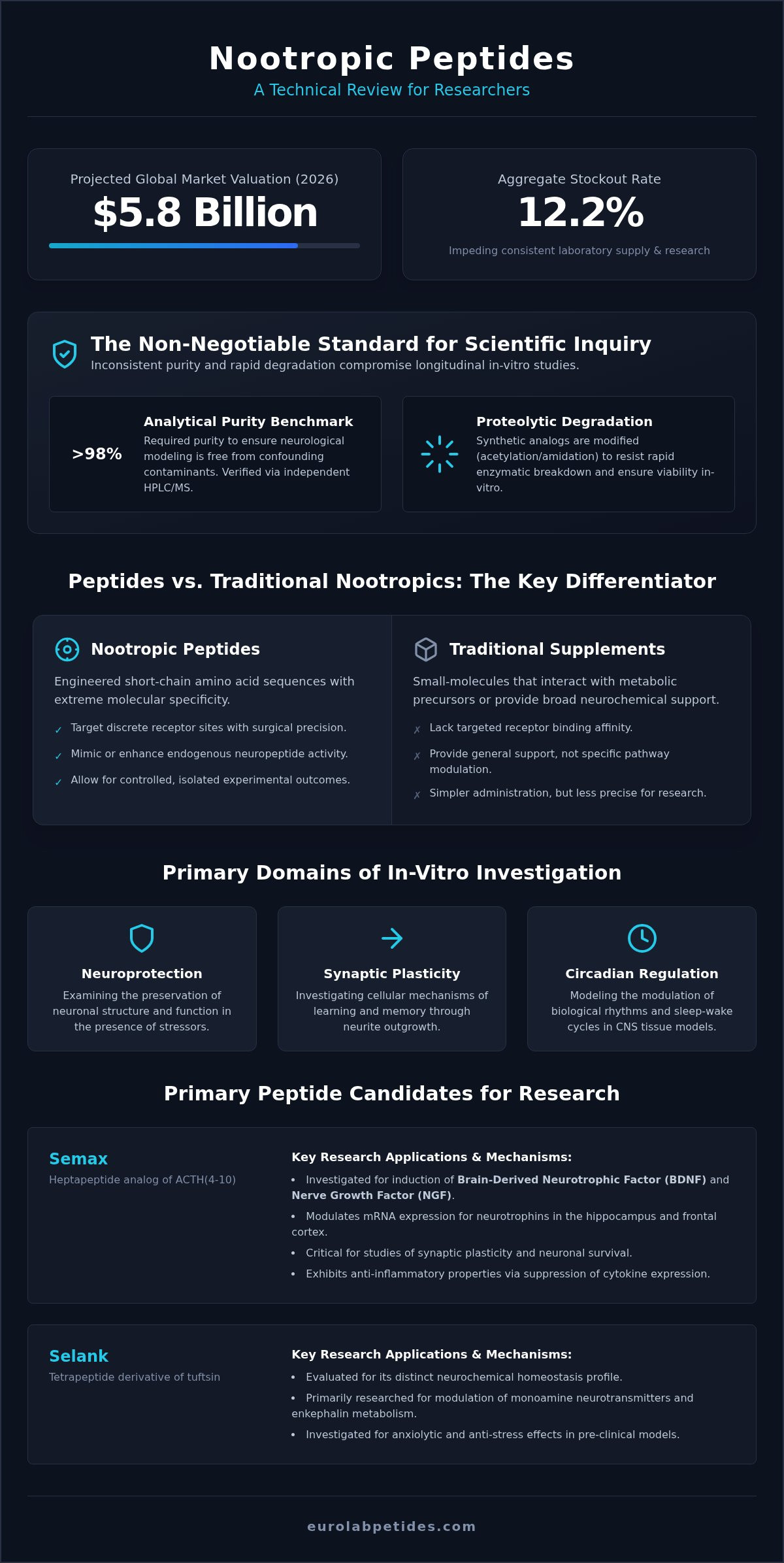
The global nootropics market is estimated to reach a valuation of $5.8 billion in 2026, yet a 12.2% aggregate stockout rate continues to impede consistent laboratory work. For those conducting nootropic peptides research, the primary obstacle isn’t merely availability; it’s the lack of standardized analytical purity across global suppliers. It’s understood that inconsistent HPLC results and rapid proteolytic degradation often compromise the integrity of longitudinal in-vitro studies.
This technical review provides a rigorous examination of peptide-based cognitive enhancers, focusing on neurotrophic signaling and the complexities of blood-brain barrier penetrance in experimental models. Validated protocols for sample preparation are established, alongside a definition of the 98% purity benchmark required for professional scientific inquiry. The most viable candidates for cognitive research are identified, and a framework for sourcing third-party verified materials within the current European regulatory landscape is provided. The analysis moves from biochemical mechanisms to the logistical standards necessary for reproducible data.
Key Takeaways
- Analyze the induction of Brain-Derived Neurotrophic Factor (BDNF) and Nerve Growth Factor (NGF) by synthetic heptapeptide and tetrapeptide analogs.
- Establish standardized laboratory handling procedures for nootropic peptides research to mitigate the effects of rapid proteolytic degradation on experimental outcomes.
- Validate the analytical purity of research samples using non-negotiable >98% benchmarks and independent HPLC/MS verification.
- Evaluate the methodological requirements for modeling blood-brain barrier penetrance in contemporary in-vitro neuroscience research.
- Utilize the Cognitive Research Stack to conduct high-stakes comparative studies within the 2026 European regulatory framework.
Defining Nootropic Peptides in Contemporary Neuroscience Research
Nootropic peptides are defined as short-chain amino acid sequences specifically engineered to modulate central nervous system (CNS) targets. These sequences, often consisting of fewer than fifty amino acids, function as signaling molecules that mimic or enhance the activity of endogenous neuropeptides. A critical distinction exists between these naturally occurring substances and synthetic research analogs. It’s established that synthetic analogs are frequently modified through acetylation or amidation to resist enzymatic degradation. This technical evolution marks a transition in Defining Nootropic Peptides, shifting from the use of broad small-molecule “smart drugs” to high-specificity peptide tools. Rigorous nootropic peptides research demands an absolute purity standard of 98% or higher to ensure that in-vitro neurological modeling remains free from confounding contaminants.
Peptides vs. Traditional Nootropic Supplements
The primary differentiator between these classes is receptor binding affinity. Traditional supplements typically interact with metabolic precursors or provide broad neurochemical support. In contrast, peptides are characterized by their extreme molecular specificity. They target discrete receptor sites with surgical precision, which allows for more controlled experimental outcomes. While small molecules might offer simpler administration routes, they don’t provide the same targeted signaling advantages in laboratory settings. These advantages are essential for researchers seeking to isolate specific biochemical pathways. Maintaining objective research methodologies requires a focus on these verifiable metrics. Precision is the non-negotiable metric.
The Scope of In-Vitro Cognitive Investigation
Contemporary investigation is categorized into three primary domains:
- Neuroprotection: Examining the preservation of neuronal structure and function in the presence of stressors.
- Synaptic Plasticity: Investigating the cellular mechanisms of learning and memory models through neurite outgrowth.
- Circadian Regulation: Modeling the modulation of biological rhythms and sleep-wake cycles in CNS tissue.
These areas are explored using the Cognitive Research Stack, which serves as a benchmark for comparative neurological studies. In 2026, the procurement of these substances is governed by rigorous regional regulatory compliance standards within Europe. These regulations mandate that all materials are sold strictly for in-vitro research. Standardized nootropic peptides research depends on this transparent, data-driven framework to maintain the integrity of the scientific process. By relying on regional manufacturing and localized logistics, laboratories can ensure a consistent supply of high-purity analogs required for longitudinal modeling.
Primary Peptide Candidates for Cognitive Function Research
The selection of specific analogs for nootropic peptides research is dictated by their sequence-specific interactions with CNS receptors. Unlike broad-spectrum stimulants, these candidates are investigated for their capacity to induce targeted neurotrophic signaling. The primary focus remains on synthetic analogs that exhibit enhanced stability against proteolytic enzymes. It’s established that these modifications are necessary to ensure that the peptide remains viable long enough to interact with its intended molecular target in an in-vitro environment.
Semax and Neurological Signaling Models
Semax is characterized as a heptapeptide analog of the adrenocorticotropic hormone fragment ACTH(4-10). It is frequently utilized in models investigating the induction of Brain-Derived Neurotrophic Factor (BDNF) and Nerve Growth Factor (NGF). Technical analysis suggests that Semax modulates mRNA expression for these neurotrophins within the hippocampus and frontal cortex. This signaling pathway is critical for studies regarding synaptic plasticity and neuronal survival. Observations in neural tissues also indicate significant anti-inflammatory properties, specifically through the suppression of cytokine expression. For a detailed breakdown of these pathways, researchers should review The Mechanism of Semax in Neurological Models. Data remains the priority.
Selank and Neurochemical Homeostasis
Selank, a synthetic tetrapeptide derivative of the endogenous immunomodulator tuftsin, is evaluated for its distinct neurochemical homeostasis profile. It is primarily researched for its interaction with the GABAergic system. In-vitro models demonstrate that Selank influences GABA receptor binding affinity without the sedative profiles associated with traditional anxiolytic tools. Analysis of monoamine metabolism in the cerebral cortex shows that it modulates serotonin and dopamine levels. This provides a more refined model for neurochemical balance than small-molecule counterparts. Precision is the non-negotiable metric.
Epitalon is investigated for its role in telomerase activation within the aging brain model. It is a synthetic tetrapeptide (Ala-Glu-Asp-Gly) modeled after epithalamin. Research focuses on its ability to induce telomere elongation in somatic cells, which serves as a metric for cellular longevity studies. Similarly, Delta Sleep-Inducing Peptide (DSIP) is utilized to research sleep-dependent memory consolidation. It is a nonapeptide that modulates the activity of the hypothalamic-pituitary-adrenal axis, specifically targeting the synchronization of delta-wave activity in neural models. These candidates represent the most viable tools for professional inquiry. The Cognitive Research Stack provides a structured approach for comparative analysis of these compounds. Each batch undergoes multi-level quality control to ensure the >98% purity standard essential for reproducible data.
Mechanisms of Action: Modulating BDNF and Neuroplasticity
The biochemical efficacy of nootropic peptides is primarily evaluated through their capacity to modulate neurotrophic factors and enhance synaptic plasticity. Analysis of nootropic peptides research focuses on the intracellular signaling cascades that follow peptide-receptor binding. These mechanisms represent a significant departure from the metabolic support provided by traditional supplements. Instead, peptides act as direct ligands or modulators for high-affinity receptors within the CNS. The objective is to quantify the induction of Brain-Derived Neurotrophic Factor (BDNF) and Nerve Growth Factor (NGF), which are essential for neurite outgrowth and the maintenance of synaptic density.
Neurotrophic Factor Expression and Neural Plasticity
In laboratory settings, the upregulation of BDNF is quantified through mRNA expression analysis and protein quantification via ELISA. Technical evaluation suggests that specific peptide analogs, such as Semax, facilitate the activation of the Tropomyosin receptor kinase B (TrkB). This activation triggers the MAPK/ERK and PI3K/Akt pathways, which are the primary drivers of Long-Term Potentiation (LTP). LTP serves as the fundamental cellular model for memory consolidation. By enhancing the strength of synaptic connections, these analogs provide a sophisticated framework for cognitive function research. Observations indicate that increased BDNF levels correlate with improved synaptic vesicle docking and neurotransmitter release efficiency in hippocampal cultures.
Neuroprotective Pathways and Cellular Resilience
Peptides are also investigated for their role in mitigating oxidative stress and cellular apoptosis within neural cultures. This is achieved through the suppression of pro-inflammatory cytokines, such as TNF-alpha and IL-1 beta. In models of glutamate-induced excitotoxicity, certain sequences demonstrate a capacity to stabilize mitochondrial membrane potential, thereby preventing the release of cytochrome c. The structural stability of BPC-157 in neurological models is a primary area of inquiry, particularly regarding its influence on the nitric oxide (NO) signaling system. It’s established that maintaining NO homeostasis is critical for protecting the vascular integrity of neural tissues. Nootropic peptides research continues to prioritize these protective mechanisms, as they establish the baseline metrics for cellular resilience in complex in-vitro environments. Data-driven validation remains the non-negotiable standard for assessing these neuroprotective outcomes.
Methodological Challenges: CNS Penetrance and In-Vitro Stability
The biochemical utility of nootropic peptides research is often constrained by the inherent fragility of short-chain amino acid sequences. Unlike small-molecule compounds, peptides are susceptible to rapid proteolytic degradation, which significantly reduces their half-life in physiological environments. Managing this degradation is essential for maintaining the integrity of longitudinal in-vitro studies. Researchers must implement specific handling protocols to ensure that the peptide remains viable long enough to interact with its intended CNS targets. Lyophilization is the recognized standard for preserving molecular integrity, as it removes moisture that would otherwise facilitate hydrolytic cleavage of the peptide bonds.
Optimizing Sample Stability and Storage
Maintaining the secondary structure of a peptide requires strict adherence to thermal standards. Lyophilized samples should be stored at -20°C for short-term use, while -80°C is preferred for archival purposes. Once a peptide is reconstituted, its stability decreases rapidly. It’s established that repeated freeze-thaw cycles lead to aggregation and denaturation, which effectively renders the sample useless for precise neurological modeling. Standardized protocols for storing lyophilized peptides emphasize the use of amber vials to prevent photodegradation and the inclusion of desiccants to minimize humidity exposure.
Analytical Techniques for CNS Research
The blood-brain barrier (BBB) presents a significant obstacle in experimental design due to its selective permeability. In many models, intranasal delivery is utilized to bypass the BBB, facilitating direct transport to the CNS via the olfactory and trigeminal nerve pathways. This method is particularly useful for investigating neurotrophic signaling without the confounding variables of systemic metabolism. Precision during the preparation phase is equally critical. Utilizing a peptide reconstitution calculator ensures that molar concentration and solvent selection are accurate, which is a prerequisite for reproducible data. EuroLab Peptides ensures that all research materials meet these rigorous standards through independent HPLC and Mass Spectrometry validation. For laboratories requiring verified purity for high-stakes inquiry, sourcing research-grade peptides with transparent analytical results is the only viable path forward.
Sourcing Research-Grade Peptides: Purity and Analytical Validation
High-stakes precision in chemical synthesis is the foundation of reproducible in-vitro data. Within the specialized community of nootropic peptides research, the standard for excellence is defined by a purity threshold of 98% or higher. Any variance below this benchmark introduces uncontrolled variables, such as residual solvents, counter-ions like trifluoroacetic acid (TFA), or truncated peptide sequences. These contaminants often interfere with neurotrophic signaling pathways, leading to skewed results in neurological modeling. Professional inquiry requires a shift from anecdotal trust to verifiable metrics provided by multi-level quality control processes.
Interpreting Laboratory Reports (COA)
A Certificate of Analysis (COA) serves as the primary document for quality assurance. High-Performance Liquid Chromatography (HPLC) is utilized to determine the chemical purity of the sample. A single, sharp peak on the chromatogram indicates a homogenous substance, while secondary peaks suggest the presence of impurities. Mass Spectrometry (MS) is then employed to verify the identity of the peptide by measuring its molecular weight. The observed mass must align with the theoretical mass of the specific amino acid sequence. Utilizing third-party tested peptides is a non-negotiable standard for researchers who prioritize radical honesty and analytical accountability. This external validation ensures that the material matches the technical specifications required for sophisticated comparative studies.
Procurement and Compliance in Europe
The landscape for acquiring research materials is characterized by rigorous regional regulatory standards. In 2026, compliance with European Union guidelines for research chemicals necessitates a transparent chain of custody and localized logistics. Gray-market suppliers often bypass these standards, resulting in significant risks regarding sample stability and molecular integrity during transit. EuroLab Peptides operates as a meticulous partner for the scientific community, emphasizing regional manufacturing and administrative transparency. Understanding buying research peptides in this environment involves evaluating the supplier’s commitment to empirical results over marketing hyperbole.
Reliability is established through the consistent delivery of high-purity analogs. The Cognitive Research Stack is provided as a curated tool for researchers, backed by comprehensive HPLC and MS data for every batch. By prioritizing regional regulatory adherence and efficient logistics, the integrity of the nootropic peptides research is maintained from synthesis to delivery. This methodical approach respects the intelligence of the user and the high-stakes nature of neurological inquiry. Quality is not a marketing claim; it’s a verifiable metric of laboratory excellence.
Advancing Precision in Neurological Inquiry
The evolution of nootropic peptides research in 2026 is defined by a shift toward sequence-specific neurotrophic modulation. It’s established that the integrity of in-vitro models depends on the strict preservation of molecular structure through lyophilization and precise reconstitution protocols. By prioritizing high-affinity receptor interactions and quantifying BDNF upregulation, researchers establish verifiable metrics for cognitive modeling. Reproducibility is only achievable when analytical purity is treated as a standardized metric rather than a commercial variable.
Securing materials for high-stakes inquiry requires a partner committed to radical accountability and regional regulatory compliance. Every batch is 98%+ purity guaranteed and undergoes independent third-party HPLC/MS verification to ensure absolute transparency. Secure European-based shipping and localized logistics provide the reliability needed for longitudinal studies. Explore the Cognitive Research Stack for Professional Laboratory Inquiry to integrate these high-purity tools into your next comparative study. Scientific excellence begins with the quality of the starting material.
Technical Reference and Frequently Asked Questions
What is the primary mechanism of nootropic peptides in cognitive research?
The primary mechanism involves the modulation of neurotrophic factors like Brain-Derived Neurotrophic Factor (BDNF) and Nerve Growth Factor (NGF). These signaling molecules activate intracellular cascades, specifically the MAPK/ERK and PI3K/Akt pathways, through high-affinity receptor binding. This process is fundamental to nootropic peptides research focusing on synaptic plasticity and Long-Term Potentiation (LTP). Unlike small-molecule stimulants, peptides provide targeted induction of endogenous repair and growth mechanisms within neural cultures.
How should nootropic research peptides be stored to prevent degradation?
Lyophilized peptides should be stored at -20°C for short-term preservation or -80°C for extended archival to ensure molecular integrity. Once a sample is reconstituted, it’s highly susceptible to enzymatic degradation and should be maintained at 2-8°C. Researchers must avoid repeated freeze-thaw cycles as these lead to peptide denaturation and aggregation. Amber vials are recommended to prevent photodegradation during the storage of sensitive research analogs within the laboratory.
Is Semax or Selank more effective for neuroprotective models?
Semax is generally the preferred candidate for neuroprotective models due to its documented effect on mRNA expression for neurotrophins in the hippocampus. It’s often investigated for its capacity to mitigate glutamate-induced excitotoxicity in neural tissues. Selank is better suited for research regarding neurochemical homeostasis and the GABAergic system. Both candidates are included in the Cognitive Research Stack to facilitate comparative analysis of their distinct biochemical pathways and signaling profiles.
What purity level is required for in-vitro cognitive studies?
A purity level of 98% or higher is the non-negotiable standard for professional in-vitro cognitive studies. Analytical validation must be performed via High-Performance Liquid Chromatography (HPLC) and Mass Spectrometry (MS) to identify any residual contaminants. Lower purity grades introduce uncontrolled variables, such as counter-ions or truncated sequences, which compromise the reproducibility of data. EuroLab Peptides provides transparent Certificates of Analysis for every batch to meet these rigorous demands.
How do I reconstitute nootropic peptides for laboratory use?
Reconstitution is performed by adding a precise volume of bacteriostatic water or sterile saline to the lyophilized powder. A peptide reconstitution calculator should be used to ensure molar concentration accuracy and precision dosing for the specific experiment. The solvent should be added slowly along the side of the vial. Gentle swirling is required to dissolve the cake; vigorous shaking must be avoided to prevent mechanical denaturation of the peptide structure.
Can nootropic peptides cross the blood-brain barrier in research models?
Most peptides don’t passively cross the blood-brain barrier (BBB) due to their molecular size and hydrophilic nature. In nootropic peptides research, intranasal delivery models are frequently utilized to bypass this barrier via olfactory pathways. Other experimental designs involve chemical modifications, such as acetylation, to enhance lipophilicity or the use of carrier-mediated transport models. The BBB remains a primary methodological challenge in establishing effective CNS penetrance in laboratory settings.
Are EuroLab Peptides tested by independent third-party laboratories?
Yes, all EuroLab Peptides research materials undergo a multi-level quality control process that includes independent third-party laboratory testing. This protocol involves both HPLC and Mass Spectrometry to verify the purity and identity of every sequence. Radical honesty is maintained by providing researchers with full access to these analytical results. This external validation ensures that every batch meets the high-stakes precision required for professional scientific inquiry and reproducible results.
What is the legal status of sourcing nootropic peptides for research in Europe in 2026?
As of 2026, sourcing these substances in Europe remains legal provided they’re used strictly for in-vitro research and laboratory inquiry. Regional regulatory compliance mandates a transparent chain of custody and localized logistics to ensure safety and accountability. These compounds aren’t approved for human consumption or medicinal use. EuroLab Peptides adheres to all European standards, providing a secure and compliant channel for the procurement of high-purity research analogs.
