

In high-stakes immunomodulatory research, the delta between a breakthrough and a failed assay often rests on the precision of a single peptide’s primary structure. You’re likely familiar with the frustration of navigating conflicting data on reconstitution stability or the pervasive ambiguity regarding purity standards for research chemicals. These inconsistencies don’t just delay timelines; they compromise the integrity of the entire experimental framework. This technical profile addresses those gaps by providing a definitive biochemical analysis of Thymosin Alpha-1, delivering the rigorous data required to establish standardized laboratory protocols and ensure absolute experimental reproducibility.
We’ll examine the specific 28-amino acid sequence and the signaling pathways that govern T-cell maturation and cytokine production. By moving beyond generic immunomodulatory claims, this analysis focuses on verifiable metrics and third-party validation as the only acceptable standards for serious inquiry. You’ll gain a comprehensive understanding of molecular interactions alongside practical, methodology-based guidance for laboratory handling. This transition from raw data to actionable protocol ensures that your focus remains on the successful execution of your in-vitro studies, supported by the objective data of technical analysis and regional manufacturing excellence.
Key Takeaways
- Define the molecular parameters, including the 28-amino acid sequence and chemical formula (C129H215N33O55), essential for precise in-vitro modeling.
- Map the primary signaling pathways involving Toll-like receptors (TLR9 and TLR2) to understand cellular immune modulation and MHC upregulation.
- Evaluate the efficacy of Thymosin Alpha-1 as an adjunct in oncological and viral replication research models, specifically within melanoma and hepatitis studies.
- Establish standardized laboratory protocols for reconstitution and stability to ensure assay consistency across diverse experimental conditions.
- Identify the critical benchmarks for sourcing research-grade materials, focusing on HPLC validation and the necessity of batch-specific Certificates of Analysis.
Biochemical Profile and Molecular Structure of Thymosin Alpha-1
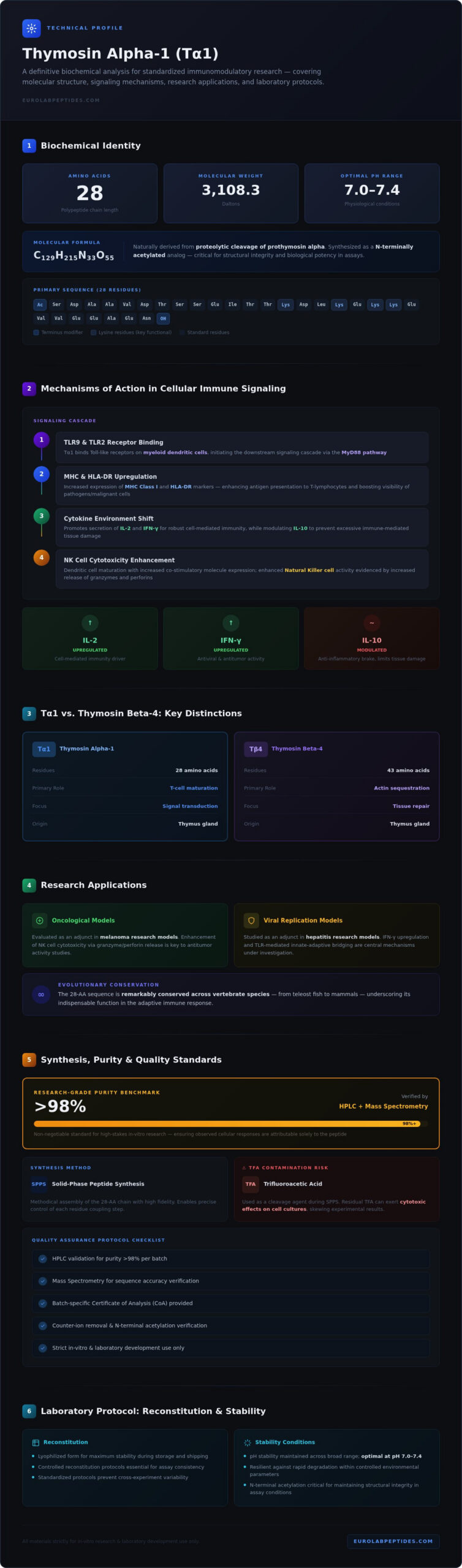
Thymosin Alpha-1 (Tα1) is categorized as a highly conserved, 28-amino acid polypeptide. While it’s naturally sequestered within the thymus gland, research applications utilize a synthetic analog that mirrors the biological activity of the endogenous peptide. It’s derived via the proteolytic cleavage of prothymosin alpha, a larger precursor protein. This specific peptide sequence has demonstrated remarkable evolutionary conservation across diverse vertebrate species. The preservation of this sequence from teleost fish to mammals underscores its indispensable function in the adaptive immune response. The molecular formula is established as C129H215N33O55, with a corresponding molecular weight of approximately 3,108.3 Daltons.
The 28-Amino Acid Sequence
The primary structure of Thymosin Alpha-1 consists of a specific sequence: Ac-Ser-Asp-Ala-Ala-Val-Asp-Thr-Ser-Ser-Glu-Ile-Thr-Thr-Lys-Asp-Leu-Lys-Glu-Lys-Lys-Glu-Val-Val-Glu-Glu-Ala-Glu-Asn-OH. A defining feature of this sequence is the N-terminal acetylation. This modification is critical for maintaining structural integrity and biological potency during in-vitro assays. Unlike Thymosin Beta-4, which is a 43-amino acid peptide primarily involved in actin sequestration and tissue repair, Tα1 is specifically oriented toward T-cell maturation and signal transduction. The peptide maintains stability across a broad pH range, though optimal activity is typically observed in physiological conditions around pH 7.0 to 7.4. Stability profiles indicate that the peptide remains resilient against rapid degradation, provided the environment is maintained within controlled parameters.
Synthesis and Purity in Research Settings
Standardized production of research-grade materials relies on Solid-Phase Peptide Synthesis (SPPS). This methodical approach allows for the precise assembly of the 28-amino acid chain with high fidelity. During the synthesis process, Trifluoroacetic acid (TFA) is frequently utilized as a cleavage agent. Residual TFA can exert cytotoxic effects on cell cultures, which potentially skews experimental results. Achieving a purity benchmark of >98% is a non-negotiable standard for high-stakes research. This level of refinement, verified through High-Performance Liquid Chromatography (HPLC) and Mass Spectrometry (MS), ensures that observed cellular responses are attributable solely to the peptide itself rather than contaminants or synthetic byproducts. EuroLab Peptides adheres to these rigorous metrics, providing batch-specific analytical validation to ensure experimental consistency within the scientific community. These materials are strictly intended for in-vitro research and laboratory development, where absolute precision is a prerequisite. Precise removal of counter-ions and the verification of sequence accuracy are essential steps in the quality assurance protocol.
Mechanisms of Action in Cellular Immune Signaling
Thymosin Alpha-1 exerts its primary influence through the targeted activation of Toll-like receptors (TLRs), specifically TLR9 and TLR2, within myeloid dendritic cells. It binds these receptors to initiate a signaling cascade that upregulates the expression of Major Histocompatibility Complex (MHC) Class I and Human Leukocyte Antigen DR (HLA-DR). These molecules are essential for effective antigen presentation to T-lymphocytes. By increasing the density of these markers on the cell surface, the peptide enhances the visibility of intracellular pathogens and malignant cells to the adaptive immune system. This interaction facilitates a significant shift in the cytokine environment, promoting the secretion of Interleukin-2 (IL-2) and Interferon-gamma (IFN-γ). These cytokines are critical for robust cell-mediated immunity. Simultaneously, the peptide modulates the levels of Interleukin-10 (IL-10), an anti-inflammatory cytokine, to prevent excessive immune-mediated tissue damage.
Dendritic Cell and NK Cell Activation
The interaction with TLRs is primarily mediated through the myeloid differentiation primary response 88 (MyD88) pathway. This pathway acts as a vital bridge between the innate and adaptive immune responses. Upon activation, dendritic cells undergo maturation, characterized by increased co-stimulatory molecule expression. Beyond this, the peptide significantly enhances Natural Killer (NK) cell-mediated cytotoxicity. This is evidenced by an increased release of granzymes and perforins in research models. For investigators focusing on these specific pathways, sourcing validated compounds from Immune System Research suppliers ensures that experimental results are not confounded by peptide degradation or synthetic impurities. This precision is necessary when quantifying the innate immune response in high-stakes in-vitro environments.
T-Cell Polarization and Balance
In the context of adaptive immunity, Tα1 directs the differentiation of naive T-cells toward a Th1 phenotype. This polarization is vital for research models targeting viral replication and oncological progression, as Th1 cells are the primary drivers of the cellular immune response. In inflammatory models, the peptide also demonstrates a capacity to influence the activity of regulatory T-cells (Tregs). This suggests a sophisticated role in maintaining immune homeostasis by balancing pro-inflammatory and anti-inflammatory signals. Thymosin Alpha-1 is a pleiotropic immune modulator with specific affinity for thymocyte maturation. Its ability to influence both the early detection of antigens and the long-term maturation of the T-cell repertoire makes it a central subject in longevity and vitality research.
Evaluating Tα1 in Oncological and Viral Research Models
Research into Thymosin Alpha-1 increasingly focuses on its role as a biological response modifier in complex disease environments. In oncological models, the peptide is evaluated for its capacity to increase the immunogenicity of malignant cells. Specifically, in dacarbazine-based melanoma research, Tα1 is investigated for its ability to upregulate MHC Class I expression on the surface of tumor cells. This mechanism is critical because it facilitates the recognition and subsequent destruction of malignant cells by CD8+ cytotoxic T-lymphocytes. Laboratory data suggest that the peptide acts as a potent adjunct, potentially overcoming the immune evasion strategies employed by aggressive melanoma cell lines.
The peptide’s utility extends into systemic inflammatory response syndrome (SIRS) and sepsis models. Investigators utilize Tα1 to study the modulation of the “cytokine storm,” a state of hyper-inflammation that often leads to multi-organ failure. By balancing pro-inflammatory signals with the induction of regulatory T-cells, the peptide is analyzed for its capacity to maintain immune homeostasis. Emerging research also explores its application in multiple sclerosis (MS) models, where the focus lies on the suppression of Th17-mediated neuro-inflammation. These studies aim to quantify the peptide’s ability to preserve the blood-brain barrier’s integrity through the stabilization of the immune repertoire.
Oncology Adjunct Research
In vitro models frequently examine the synergistic effects of Tα1 when combined with interferon-alpha (IFN-α). This combination is analyzed for its ability to amplify apoptotic signaling pathways in malignant cell populations. Furthermore, research focuses on the peptide’s potential to mitigate chemotherapy-induced immunosuppression. By stimulating the maturation of bone marrow-derived progenitor cells, it may counteract the lymphopenia typically associated with cytotoxic agents. For researchers comparing these immunomodulatory mechanisms with regenerative peptides, a BPC-157 technical guide offers a detailed analysis of tissue repair protocols that often parallel these oncological studies.
Antiviral and Antimicrobial Applications
Studies involving Hepatitis B and C viral replication highlight the peptide’s dual-action profile. It’s investigated for its capacity to inhibit viral entry while simultaneously promoting host-mediated clearance. This research is vital for understanding how the adaptive immune system can be primed to recognize persistent viral antigens. In antimicrobial research, Tα1 is evaluated within fungal infection models, specifically those involving Aspergillus. The peptide appears to stimulate Th1-dependent antifungal responses, which include the recruitment and activation of neutrophils. Similar investigations are conducted in severe respiratory infection research, where the objective is to restore cellular immunity in compromised host environments through standardized biochemical intervention.
Laboratory Protocols: Reconstitution and Stability of Lyophilized Tα1
Standardized laboratory protocols are essential for maintaining the biochemical integrity of Thymosin Alpha-1 during in-vitro experimentation. Upon receipt, the peptide is typically in a lyophilized (freeze-dried) state, which ensures long-term stability by removing moisture under vacuum. To initiate an assay, precise reconstitution is required. Researchers must utilize either 0.9% Sterile Saline or Bacteriostatic Water, depending on the specific requirements of the cell culture or experimental model. Maintaining a concentration range of 1 mg/mL to 5 mg/mL is generally recommended for standardized dosing across various immunomodulatory studies. Deviating from these parameters can lead to solubility issues or unintended pH shifts that compromise the experimental environment.
Step-by-Step Reconstitution Process
The volume of diluent required is determined by the desired final concentration and the total mass of the peptide vial. Researchers should utilize a peptide reconstitution calculator to ensure mathematical precision before beginning the process. During diluent addition, the liquid should be directed against the glass wall of the vial rather than directly onto the lyophilized cake. Mechanical shear can disrupt the delicate peptide bonds, so a “gentle swirl” technique is employed until the solution is completely clear. One must never shake the vial. Once dissolved, the solution should be immediately aliquoted into single-use microcentrifuge tubes to prevent the degradation associated with repeated freeze-thaw cycles.
Stability and Shelf-Life Metrics
In its lyophilized form, Thymosin Alpha-1 remains stable at room temperature for brief periods during transit, though long-term storage is optimized at -20°C or -80°C. Degradation markers, such as the presence of truncated peptide fragments or oxidation products, should be monitored via HPLC if the material’s been stored for extended durations. Reconstituted Thymosin Alpha-1 should be utilized within 7-14 days when stored at 2-8°C for maximum experimental integrity. For investigators requiring the highest levels of purity and documented stability for their protocols, sourcing from Immune System Research experts ensures every batch meets rigorous European manufacturing standards. Proper handling ensures that the observed biological activity remains a direct result of the peptide’s primary structure rather than environmental artifacts.
Sourcing Research-Grade Thymosin Alpha-1 in Europe
Procurement of high-purity Thymosin Alpha-1 within the European research community necessitates a rigorous adherence to analytical verification. A batch-specific Certificate of Analysis (COA) serves as the primary instrument of quality assurance. It provides empirical evidence that the synthesized peptide matches the required technical specifications. Researchers shouldn’t rely on generic product descriptions; instead, the focus must remain on the raw data provided by advanced instrumentation. This proof-first approach ensures that the chemical identity of the peptide is verified before it’s introduced into sensitive experimental models.
EuroLab Quality Standards: HPLC and MS Analysis
High-Performance Liquid Chromatography (HPLC) is utilized to determine the chemical purity of the sample. A high-resolution chromatogram should ideally display a single, symmetrical peak, indicating the absence of truncated sequences or synthetic byproducts. While HPLC measures purity, Mass Spectrometry (MS) is the gold standard for identity verification. By calculating the precise molecular mass, MS confirms that the 28-amino acid sequence matches the theoretical profile. EuroLab Peptides implements a multi-level quality control process to ensure that every batch exceeds a purity benchmark of 99%. This protocol involves both in-house analysis and independent third-party laboratory testing to provide an objective, non-negotiable standard of excellence. For a detailed breakdown of procurement protocols, researchers may consult this guide on how to buy research peptides.
Strictly Research-Only Compliance
All materials provided are strictly for in-vitro research and laboratory development. This distinction between laboratory-grade reagents and clinical pharmaceuticals is a fundamental component of moral consistency within the chemical synthesis space. European-based sourcing and logistics offer a significant advantage for regional researchers. Localized supply chains ensure that sensitive peptides aren’t exposed to the prolonged thermal fluctuations often encountered in transcontinental shipping. This regional regulatory alignment facilitates a more reliable procurement process, supporting the high-stakes precision required by the specialized scientific community. The following benchmarks are utilized to evaluate sourcing reliability:
- Mandatory inclusion of batch-specific HPLC and MS reports.
- Third-party validation from accredited European analytical laboratories.
- Strict adherence to cold-chain logistics for transit stability.
- Transparent reporting of residual TFA levels and counter-ion content.
By prioritizing these verifiable metrics, the brand projects a persona of radical honesty and accountability. It doesn’t attempt to be friendly; it aims to be professional, efficient, and deeply serious. This methodical approach to sourcing ensures that the transition from data to delivery is seamless, respecting the user’s time and intelligence through a sequence of validation before asking for a commitment.
Advancing Immunomodulatory Research Standards
The successful execution of immunomodulatory assays depends on the absolute fidelity of the peptide’s primary structure. By establishing standardized reconstitution protocols and understanding the TLR-mediated signaling pathways, researchers ensure experimental reproducibility. This technical profile has delineated the 28-amino acid sequence and the critical purity benchmarks necessary for valid in-vitro studies. Precision in the laboratory isn’t a suggestion; it’s a prerequisite for the integrity of the specialized community’s collective data. Every variable must be controlled to prevent environmental artifacts from confounding results.
Maintaining these rigorous standards requires access to materials that are verified through objective data rather than anecdotal claims. EuroLab Peptides provides research-grade Thymosin Alpha-1 that’s third-party tested for >99% purity, with batch-specific HPLC/MS reports available to every investigator. Our secure European shipping and logistics infrastructure ensures that sensitive reagents arrive with their biochemical integrity intact. You’re invited to View Analytical Data and Purchase Thymosin Alpha-1 for Research to support your next phase of laboratory development. We look forward to facilitating your scientific breakthroughs with these precision-engineered tools.
Frequently Asked Questions
What is the primary role of Thymosin Alpha-1 in immunological research?
Thymosin Alpha-1 functions as a potent biological response modifier in immunological research, specifically targeting T-cell maturation pathways. It binds to Toll-like receptors on dendritic cells to initiate the MyD88-dependent signaling cascade. This process facilitates the upregulation of MHC Class I molecules and promotes a Th1-type immune response. Investigators utilize this peptide to study the modulation of cytokine profiles, including the induction of IL-2 and IFN-γ in various cellular models.
How should Thymosin Alpha-1 be stored for maximum long-term stability?
Long-term stability is maintained by storing the lyophilized peptide at temperatures of -20°C or -80°C. While the freeze-dried cake remains stable at room temperature for short durations during transit, sub-zero storage is required to prevent degradation over time. Once the peptide is reconstituted, it’s kept under refrigeration at 2-8°C. To ensure experimental integrity, researchers should use the reconstituted solution within a 7-14 day window for maximum reliability.
Can Thymosin Alpha-1 be reconstituted with Bacteriostatic Water?
Yes, researchers frequently use Bacteriostatic Water for the reconstitution of this peptide in laboratory settings. This diluent contains 0.9% benzyl alcohol, which acts as a preservative to inhibit the growth of bacteria in the solution. Alternatively, 0.9% Sterile Saline is utilized for assays where benzyl alcohol might interfere with cell viability. The choice between these diluents depends on the specific requirements of the in-vitro model and the intended duration of the study.
What is the molecular weight of the Thymosin Alpha-1 peptide?
The molecular weight of the synthetic 28-amino acid peptide is established at approximately 3,108.3 Daltons. Its precise chemical formula is C129H215N33O55. Verification of this mass through Mass Spectrometry (MS) is the standard method for confirming the identity of the peptide sequence. Sourcing materials that match these specific biochemical parameters ensures that the observed biological activity is attributable to the intended primary structure rather than synthetic impurities or truncated fragments.
What is the difference between Thymosin Alpha-1 and Thymosin Beta-4?
These two peptides differ significantly in both structure and biological function. Thymosin Alpha-1 is a 28-amino acid sequence focused on immune signaling and T-cell maturation. In contrast, Thymosin Beta-4 is a larger 43-amino acid peptide primarily involved in actin sequestration and tissue regeneration. While both are thymic-derived, their research applications don’t overlap; Tα1 targets adaptive immunity, whereas Tβ4 is investigated for its role in cellular migration and wound repair mechanisms.
What purity level is required for Thymosin Alpha-1 in in-vitro studies?
High-stakes in-vitro research requires a purity benchmark of at least 98%, though >99% is the preferred standard for absolute precision. Lower purity levels often indicate the presence of residual Trifluoroacetic acid (TFA) or counter-ions, which can exert cytotoxic effects on cell cultures. EuroLab Peptides provides batch-specific HPLC reports to verify these metrics. Ensuring such high levels of refinement eliminates confounding variables, allowing researchers to attribute cellular responses solely to the peptide’s activity.
How does Thymosin Alpha-1 influence T-cell maturation in laboratory models?
In laboratory models, the peptide influences maturation by promoting the differentiation of naive CD4+ T-cells into mature Th1 cells. It also increases the expression of HLA-DR and co-stimulatory molecules on the surface of antigen-presenting cells. This activity enhances the visibility of antigens to the immune system, facilitating a more robust cellular response. Researchers monitor these changes to quantify the peptide’s efficacy in reversing immunosuppressed states within various experimental frameworks.
Are EuroLab Peptides products suitable for clinical use?
No, EuroLab Peptides products are strictly intended for in-vitro research and laboratory development. These materials are categorized as research-grade reagents and aren’t suitable for human consumption, clinical use, or pharmaceutical applications. The brand prioritizes moral consistency and regulatory alignment by providing chemicals exclusively for the specialized scientific community. Users must adhere to all laboratory safety protocols and regional regulations governing the handling of non-clinical synthetic peptides during their investigations.
