

Can a single molecular modification extend a peptide’s half-life from 30 minutes to over eight days while facilitating a 10-fold increase in mean growth hormone levels? Data from foundational Phase 1 clinical trials suggests this is precisely the case for CJC-1295 with Drug Affinity Complex. For researchers, the challenge isn’t just understanding these potent pharmacokinetic shifts; it’s navigating the persistent ambiguity in nomenclature and the rigorous stability requirements of GHRH analogs.
You likely recognize that inconsistent labeling of DAC and non-DAC variants often compromises the integrity of longitudinal studies. This technical review provides a comprehensive scientific profile of the peptide, detailing the specific biochemical mechanisms that drive pituitary signaling. We prioritize objective data over anecdotal evidence to ensure your laboratory protocols meet the highest standards of precision. You’ll gain a clear understanding of GHRH signaling pathways, alongside verified guidance for the reconstitution and storage of high-purity material. This analysis concludes with a technical comparison between DAC and Mod GRF 1-29, establishing definitive selection criteria for specialized research applications.
Key Takeaways
- Define the biochemical architecture of CJC-1295 as a 29-amino acid tetrasubstituted analog and its function as a GHRH secretagogue.
- Differentiate between the extended pharmacokinetic profile of DAC variants and the short-acting nature of Mod GRF 1-29 for precise study design.
- Examine the primary research vectors for these analogs, particularly their roles in investigating cellular senescence and lipid metabolism within metabolic models.
- Establish standardized laboratory protocols for peptide reconstitution and long-term storage to ensure data reproducibility and molecular stability.
- Detail the selection criteria for procuring research-grade materials in Europe, focusing on the importance of independent third-party analytical validation.
Biochemistry and Mechanism of CJC-1295 as a GHRH Analog
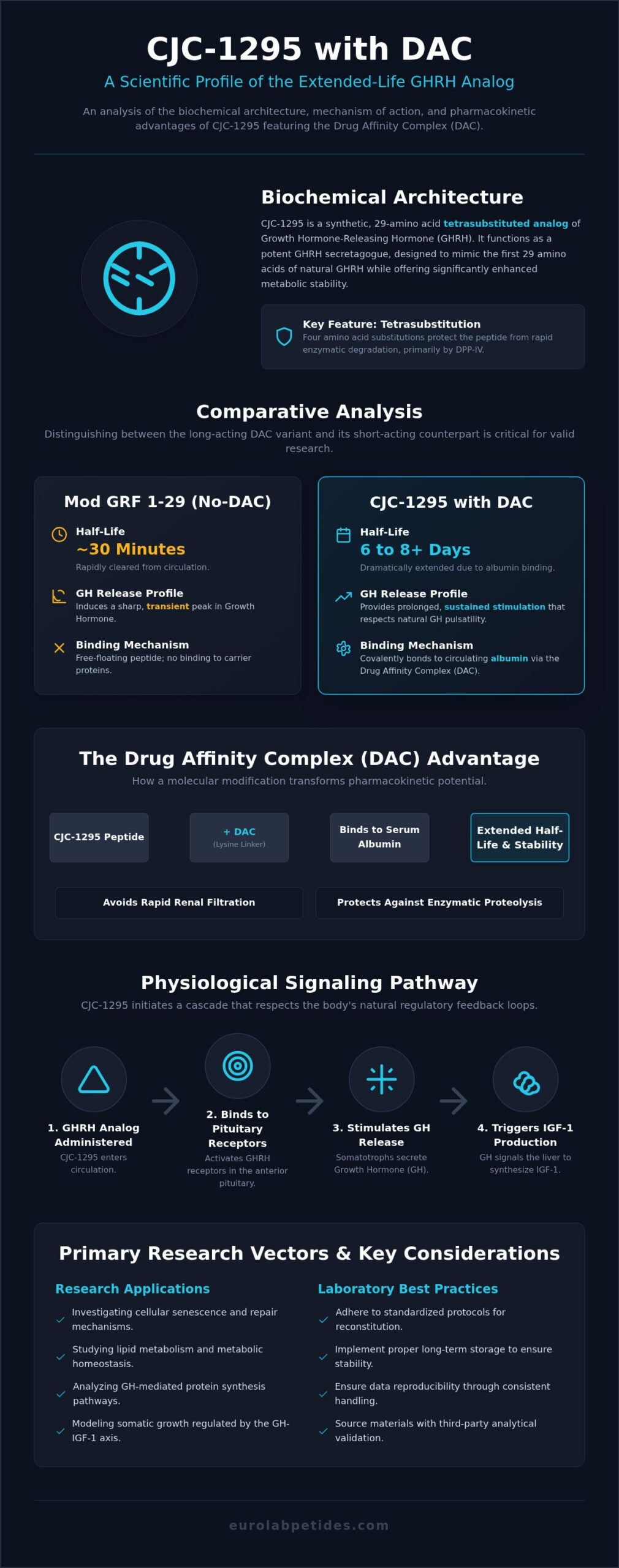
The peptide CJC-1295 is a synthetic, 29-amino acid tetrasubstituted analog of endogenous Growth Hormone-Releasing Hormone (GHRH). It functions as a potent GHRH secretagogue, specifically engineered to mimic the signaling properties of the first 29 amino acids of the natural GHRH molecule while exhibiting significantly enhanced metabolic stability. By binding to GHRH receptors located in the anterior pituitary gland, it stimulates the somatotrophs to synthesize and secrete growth hormone (GH) into the systemic circulation.
Unlike the administration of exogenous growth hormone, which bypasses the body’s regulatory feedback loops, CJC-1295 maintains the physiological pulsatility of GH release. This preservation of the natural secretory rhythm is a critical distinction for researchers studying metabolic regulation. Exogenous GH often results in sustained, non-pulsatile elevations that can lead to receptor desensitization or metabolic disturbances. In contrast, GHRH analogs like CJC-1295 encourage the pituitary to release GH in a manner that respects endogenous inhibitory signals, such as somatostatin, providing a more controlled model for investigating GH-mediated biological pathways.
The Role of Tetrasubstitution in Peptide Stability
Natural GHRH (1-29) possesses an extremely short half-life, typically measured in minutes, due to rapid enzymatic degradation by dipeptidyl peptidase IV (DPP-IV). The molecular design of CJC-1295 addresses this limitation through four strategic amino acid substitutions at positions 2, 8, 15, and 27. These modifications, particularly the substitution of D-Alanine at the second position, protect the peptide backbone from proteolytic cleavage.
This structural reinforcement allows the analog to remain active in the plasma for extended durations compared to its non-substituted counterparts. For laboratory research models, this stability is essential. It ensures consistent receptor occupancy and predictable signaling kinetics without the need for constant infusion or impractical dosing frequencies. The D-Ala substitution, specifically, is the primary factor that prevents the rapid N-terminal degradation that otherwise renders natural GHRH inactive within the circulatory system.
Growth Hormone and IGF-1 Signaling Pathways
The primary downstream effect of pituitary GHRH receptor activation is the systemic increase in Insulin-like Growth Factor 1 (IGF-1), synthesized predominantly in the liver. As GH levels rise, they initiate a secondary signaling cascade that elevates circulating IGF-1, which then mediates most of the growth-promoting and metabolic effects attributed to the GH axis. In cellular longevity and metabolic research, this pathway is a central focus for investigating protein synthesis, lipid oxidation, and cellular repair mechanisms.
The GH-IGF-1 axis serves as a primary endocrine signaling system that regulates somatic growth, metabolic homeostasis, and cellular proliferation through the coordinated release of pituitary growth hormone and hepatic insulin-like growth factor 1.
Comparative Analysis: CJC-1295 DAC vs. Mod GRF 1-29 (No-DAC)
Nomenclature in the peptide research space often leads to technical inaccuracy. Specifically, the term “CJC-1295” is frequently applied to two distinct molecules with vastly different pharmacokinetic properties. The original molecule includes a Drug Affinity Complex (DAC), whereas the version without this modification is more accurately identified as Modified GRF 1-29. Distinguishing between these two is essential for ensuring experimental validity and data reproducibility.
The Drug Affinity Complex (DAC) Mechanism
The Drug Affinity Complex is a lysine linker coupled to a reactive maleimide group. This structure allows the peptide to form a covalent bond with the Cys34 residue on circulating albumin. By leveraging albumin as a carrier, the peptide avoids rapid renal filtration and enzymatic proteolysis. Research indicates that this specific modification results in prolonged stimulation of growth hormone, extending the half-life from approximately 30 minutes to between 6 and 8 days. In various laboratory media, the DAC-modified peptide demonstrates superior stability compared to its non-conjugated counterparts, maintaining structural integrity in the presence of serum-derived proteases.
Albumin binding significantly alters the bioavailability profile. While Mod GRF 1-29 provides a transient peak in GH secretion, CJC-1295 with DAC establishes a sustained elevation of basal GH levels. This distinction is critical for experimental design. Mod GRF 1-29 is typically preferred for studies mimicking the natural pulsatile release of GH, whereas the DAC variant is utilized when constant systemic exposure is required for longitudinal data collection.
Selecting the Appropriate Variant for Laboratory Models
Choosing between these variants depends on the desired secretory pattern. Mod GRF 1-29 is the superior choice for investigating acute GH pulses, especially when combined with a GHRP like Ipamorelin to maximize secretagogue synergy. This combination effectively bypasses somatostatin inhibition, providing a robust model for pituitary response studies. Conversely, the DAC variant is suited for longevity models focusing on chronic IGF-1 elevation and steady-state metabolic shifts. For laboratories requiring high-purity GHRH analogs, EuroLab provides analytical-grade research materials verified through independent testing to ensure rigorous quality standards.
Primary Research Vectors: Longevity and Metabolic Models
Current investigations into CJC-1295 prioritize its utility in modeling somatic growth and metabolic restoration. Because it stimulates the endogenous release of GH, researchers use it to examine downstream transcriptional changes in protein synthesis and cellular repair. In-vitro models often focus on the peptide’s ability to modulate cellular senescence, particularly in musculoskeletal and dermal fibroblasts. These studies are essential for mapping the regenerative potential of the GH axis in aging populations.
Dual-signaling protocols, involving the administration of GHRH analogs alongside Growth Hormone Releasing Peptides (GHRPs), are a primary focus in contemporary research. This approach aims to maximize pituitary output by simultaneously activating the GHRH receptor and inhibiting somatostatin. These synergistic models provide data on the upper limits of pituitary secretory capacity and the subsequent impact on systemic tissue regeneration. By isolating these signaling pathways, laboratories can observe the specific contribution of GHRH analogs to cellular homeostasis.
Longevity and Vitality Research Applications
Within the broader longevity research framework, GHRH analogs are utilized to study mitochondrial biogenesis and the mitigation of oxidative stress. By elevating circulating IGF-1, these analogs facilitate the study of age-reversal markers at a cellular level. However, historical data highlights the necessity of rigorous monitoring; for instance, the discontinuation of a Phase II clinical trial in 2006 due to a patient death underscores the critical importance of isolating safety variables in laboratory settings. Researchers now focus on these models to identify the metabolic thresholds where cellular vitality is optimized without compromising systemic stability.
Metabolic and Weight Management Research
Adipose tissue regulation is another significant vector. Researchers utilize these analogs to investigate lipolysis mechanisms, specifically the mobilization of free fatty acids from visceral fat stores. Integration into weight management research protocols allows for the observation of glucose metabolism and insulin sensitivity shifts. By analyzing the peptide’s influence on nutrient partitioning, laboratories can better understand the metabolic consequences of sustained GH axis activation. This research is vital for developing models that address metabolic dysfunction and lipid accumulation in controlled environments.
Laboratory Standards: Handling, Reconstitution, and Stability
Research accuracy depends entirely on the structural integrity of the peptide. Utilizing high-purity lyophilized powder is the only method to ensure that secondary degradation products don’t interfere with GHRH receptor assays. When handling CJC-1295, laboratories must adhere to strict environmental controls to prevent premature hydrolysis or oxidation of the peptide chain. Because the molecule is sensitive to physical stress, the following standardized reconstitution protocol is utilized in professional settings:
- The vial’s rubber stopper is cleaned with 70% isopropyl alcohol to ensure surface sterility.
- Bacteriostatic water (0.9% benzyl alcohol) is introduced slowly, allowing the liquid to stream down the interior glass wall to prevent the formation of air bubbles.
- The vial is rotated with a gentle swirling motion until the lyophilized cake is fully dissolved.
- Vigorous agitation or shaking is strictly avoided, as mechanical shear forces can disrupt the peptide’s delicate structure and lead to aggregation.
The use of bacteriostatic water containing 0.9% benzyl alcohol is mandatory to inhibit microbial growth and maintain solution sterility during multi-dose research applications. Procure third-party tested CJC-1295 to ensure the highest analytical standards for your laboratory.
Stability of Lyophilized vs. Reconstituted CJC-1295
Lyophilized vials exhibit significant stability when stored under appropriate conditions. While the powder remains stable at room temperature for up to 90 days during transit, long-term storage requires a temperature of -20°C to maintain molecular integrity for over 24 months. A dry, dark environment is necessary to prevent hygroscopic degradation and photo-oxidation. Once the peptide is reconstituted, the stability window narrows considerably. The solution must be stored at 2-8°C and utilized within 4 weeks. Freezing the reconstituted solution is not recommended, as the formation of ice crystals can cause irreversible damage to the peptide bonds.
Analytical Verification of Purity
Reliable research data requires verifiable evidence of chemical composition. High-Performance Liquid Chromatography (HPLC) is employed to determine the purity percentage by measuring the area under the curve for the target peak. A benchmark of >99% purity is the standard for elite research tools, ensuring that trace impurities don’t skew experimental results. In addition to HPLC, Mass Spectrometry is used to verify the exact molecular weight and amino acid sequence. This dual-layered validation confirms that the four amino acid substitutions characteristic of CJC-1295 are present and that the peptide is free from manufacturing byproducts or residual solvents.
Procuring Research-Grade CJC-1295 for European Laboratories
European research institutions face unique challenges when sourcing GHRH analogs like CJC-1295. The global market’s often saturated with low-purity materials that lack the necessary documentation for reproducible data. Sourcing certified peptides requires a partner that prioritizes analytical transparency over commercial claims. EuroLab addresses these concerns by providing research chemicals that undergo rigorous validation before distribution across the European continent. Our logistics network is optimized for stability-controlled delivery, ensuring that lyophilized vials arrive without structural degradation during transit.
EuroLab’s Multi-Level Quality Protocol
Every batch of these GHRH analogs is subjected to a two-tier verification process. Initial in-house analysis is followed by independent laboratory validation to confirm purity and sequence identity. We utilize High-Performance Liquid Chromatography (HPLC) to ensure a purity benchmark of >99%, which is the industry standard for reliable metabolic modeling. Mass Spectrometry is also employed to verify that the molecular weight perfectly matches the theoretical profile of the tetrasubstituted 1-29 sequence. This protocol ensures batch-to-batch consistency. It’s vital for long-term studies where slight variations in reagent quality can compromise the entire dataset. Researchers can easily access a comprehensive Certificate of Analysis (COA) for every vial to maintain precise laboratory records and ensure the integrity of their findings.
Ethical and Regulatory Considerations in Peptide Research
Adherence to regional regulatory frameworks is a non-negotiable standard for professional inquiry. All materials are strictly labeled as “Not for Human Consumption” and are intended exclusively for in-vitro laboratory research. EuroLab maintains strict compliance with European chemical distribution standards, ensuring that logistics are handled with the necessary stability controls. Shipping protocols are designed to protect the lyophilized peptide from temperature fluctuations and light exposure during transit throughout the EU. By sourcing from established European chemical suppliers, laboratories mitigate the risks associated with international customs delays and inconsistent quality control. This methodical approach to delivery and validation respects the high-stakes precision required by the specialized community we serve. Explore the EuroLab CJC-1295 catalog for high-purity research materials.
Standardizing GHRH Analog Research Protocols
The technical utility of CJC-1295 depends on a precise understanding of its pharmacokinetic modifications and the rigorous maintenance of laboratory standards. This review has established that the structural distinction between DAC-modified variants and Mod GRF 1-29 is the primary determinant of growth hormone secretory patterns in research models. Maintaining these analogs requires absolute adherence to specific reconstitution protocols and temperature-controlled storage to prevent the enzymatic degradation that otherwise compromises longitudinal data. It’s the only way to ensure the integrity of the GH-IGF-1 signaling pathway during in-vitro analysis.
As research into longevity and metabolic regulation advances, the requirement for high-purity reagents becomes a non-negotiable standard for empirical validation. EuroLab provides the specialized support and analytical transparency required for high-stakes inquiry. Every batch is third-party lab tested to ensure >99% purity benchmarks are met, supported by discreet European shipping and dedicated technical assistance. Securing verified materials is the most critical step in achieving consistent, reproducible results in the chemical synthesis space.
Browse Research-Grade CJC-1295 at EuroLab Peptides and secure the analytical-grade tools necessary for your next phase of specialized research.
Frequently Asked Questions
What is the primary difference between CJC-1295 with DAC and without DAC?
The primary difference is the presence of the Drug Affinity Complex, which enables covalent bonding to circulating albumin. This structural modification extends the half-life from approximately 30 minutes to more than 6 days. While the non-DAC version mimics natural pulsatile GH release, the DAC variant provides a sustained elevation of basal growth hormone levels. This makes it suitable for steady-state metabolic modeling where consistent receptor activation is the primary experimental goal.
Is CJC-1295 the same as Mod GRF 1-29?
The term CJC-1295 without DAC is technically a synonym for Modified GRF 1-29. Both refer to the 29-amino acid tetrasubstituted analog of GHRH. However, in rigorous laboratory nomenclature, Mod GRF 1-29 is the preferred term to avoid confusion with the DAC-modified version. Using the correct terminology ensures experimental parameters are accurately identified in peer-reviewed data. It prevents errors in dosing protocols and ensures consistency across different research facilities.
How should CJC-1295 be stored in a laboratory environment to prevent degradation?
Lyophilized vials should be stored at -20°C for long-term stability, which preserves the peptide’s integrity for up to 24 months. Reconstituted solutions require refrigeration at 2-8°C and must be utilized within a 4-week window. Protection from light and moisture is essential to prevent hygroscopic degradation. Maintaining these strict environmental controls prevents the cleavage of sensitive peptide bonds that would otherwise compromise the accuracy of your research data.
What is the typical half-life of CJC-1295 DAC in research models?
In research models, the half-life of CJC-1295 with DAC is approximately 6 to 8 days. This extended duration is achieved through the maleimide group’s ability to bind to circulating albumin, preventing rapid renal clearance and enzymatic proteolysis. This specific pharmacokinetic profile allows for stable systemic concentrations. It’s particularly useful for longitudinal studies where frequent administration would disrupt the experimental environment or skew the observation of metabolic shifts.
Why is third-party testing critical for CJC-1295 research?
Third-party testing provides independent verification of purity and sequence identity, ensuring that the material meets the >99% purity benchmark. This validation is critical because trace impurities or manufacturing byproducts can alter signaling kinetics and invalidate experimental results. Independent HPLC and Mass Spectrometry reports offer the empirical evidence necessary for high-stakes professional inquiry. It ensures that the biochemical responses observed in your study are due to the peptide itself.
Can CJC-1295 be used in combination with other peptides like BPC-157 for tissue research?
Researchers frequently utilize these analogs in combination with other peptides to study multifaceted biological pathways. While CJC-1295 targets the GH-IGF-1 axis, BPC-157 is often used to investigate angiogenic and cytoprotective mechanisms. These dual-peptide models allow for the observation of synergistic effects on cellular repair and protein synthesis in specialized tissue research environments. This approach provides a more comprehensive understanding of multi-receptor signaling in complex biological systems.
What liquid should be used to reconstitute lyophilized CJC-1295?
Bacteriostatic water containing 0.9% benzyl alcohol is the standard vehicle for reconstituting lyophilized peptides. The inclusion of a preservative is necessary to inhibit microbial growth in multi-use vials during the study period. Sterile water for injection can be used for single-use applications, but it lacks the antimicrobial protection required for extended laboratory storage. Always ensure the diluent is introduced slowly to prevent mechanical stress and aggregation of the peptide chain.
Is CJC-1295 approved for clinical use or human consumption?
No, this peptide is not approved by the FDA or EMA for human consumption or clinical use. It’s strictly classified as a research chemical intended for in-vitro laboratory studies and animal research models. All suppliers must label these products as “Not for Human Consumption” to comply with regional regulatory and ethical standards. Any use outside of a controlled laboratory setting is prohibited and falls outside the scope of legitimate scientific inquiry.
