

The integrity of in vitro metabolic modeling depends entirely on the chemical precision of the underlying ligands. Within the 2026 analytical framework, a marginal deviation in compound purity is not merely a statistical outlier; it’s a fundamental threat to the reproducibility of endocrine signaling data. Many researchers encounter significant friction when attempting to reconcile inconsistent supplier specifications with the rigorous demands of metabolic research peptides. This lack of technical transparency often leads to compromised laboratory outcomes and unreliable signaling pathway analysis.
This technical overview serves as a definitive guide to the biochemical mechanisms and analytical standards required for high-stakes metabolic inquiry. You’ll gain a thorough understanding of specific peptide roles in cellular metabolism while establishing a validated protocol for sourcing compounds that meet the 98% HPLC purity benchmark. We’ll examine the nuances of ligand-receptor interactions, provide data-driven strategies for stabilizing delicate lyophilized chains, and outline the essential documentation required to ensure absolute data integrity in professional laboratory settings.
Key Takeaways
- Analyze the biochemical transition from small molecule research to peptide-based metabolic models for enhanced precision in cellular signaling studies.
- Identify the specific receptor agonism and signaling pathways utilized by incretin mimetics and growth hormone secretagogues within in vitro environments.
- Establish a non-negotiable standard for laboratory data integrity by utilizing metabolic research peptides with a verified HPLC purity benchmark of >98%.
- Implement standardized protocols for the reconstitution and stabilization of lyophilized compounds to maintain ligand activity and assay reproducibility.
- Evaluate the technical advantages of the Advanced Metabolic Stack for multi-pathway investigation supported by European-based logistics and third-party analytical validation.
Defining Metabolic Research Peptides & Their Laboratory Significance
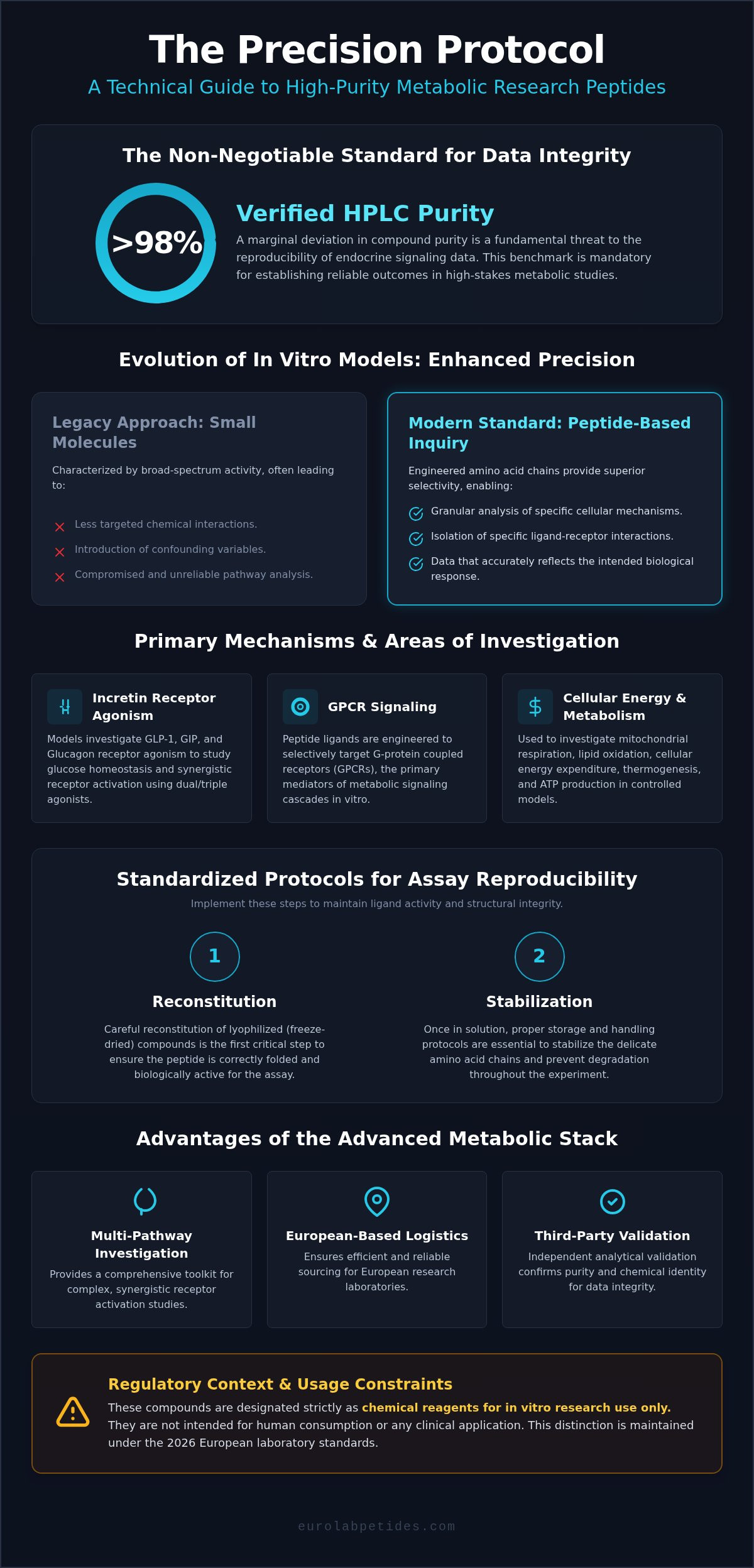
Metabolic research peptides are synthetic amino acid chains engineered to modulate or mimic specific biochemical signaling pathways within controlled in vitro environments. To understand what are peptides in a foundational sense, one must view them as high-precision ligands characterized by their sequence length and secondary structures. In recent years, laboratory models have transitioned from broad-spectrum small molecule research to peptide-based inquiry. This shift is driven by the superior selectivity of peptides, which allows for a more granular analysis of cellular mechanisms without the confounding variables often introduced by less targeted chemical compounds.
The primary utility of metabolic research peptides lies in their capacity to map the intricate architecture of endocrine pathways. These compounds are essential for investigating glucose homeostasis, lipid oxidation, and mitochondrial respiration. By utilizing ligands with a verified chemical identity, researchers can isolate specific receptor interactions, ensuring that the empirical data reflects the intended biological response. This level of precision is mandatory for establishing reproducible data in high-stakes metabolic studies where even minor impurities can lead to significant assay variance.
The Scope of In Vitro Metabolic Inquiry
Modern laboratory protocols utilize these peptides to investigate cellular energy expenditure and the nuances of thermogenesis. Researchers often employ these tools in models designed to observe mitochondrial uncoupling and ATP production. They also play a critical role in endocrine disruptor studies, where they serve as standardized controls for hormone signaling research. Most of these applications focus on the interaction between the peptide ligand and G-protein coupled receptors (GPCRs), which are the primary mediators of metabolic signaling. Mapping these interactions requires compounds that maintain their structural integrity throughout the duration of the assay.
Regulatory Context for Research Peptides in 2026
The regulatory environment in 2026 maintains a strict distinction between pharmaceutical agents and laboratory-grade chemicals. While the EMA guideline EMA/CHMP/CVMP/QWP/367182/2025, which took effect on June 1, 2026, established new manufacturing standards for synthetic peptides intended for clinical use, it doesn’t apply to materials designated for in vitro research. Compliance with European laboratory standards necessitates that these compounds are treated as chemical reagents. It’s a non-negotiable constraint that these materials are not for human consumption or clinical application. Validation through third-party High-Performance Liquid Chromatography (HPLC) remains the industry benchmark, typically requiring a minimum 98% purity to ensure data integrity and laboratory safety.
Primary Mechanisms: From Incretin Mimetics to Mitochondrial Signaling
Metabolic research peptides operate through highly specific binding affinities that trigger distinct intracellular cascades. These ligands are engineered to target G-protein coupled receptors (GPCRs) with high selectivity, allowing for the precise modulation of metabolic signaling in vitro. The primary focus of modern endocrine inquiry revolves around incretin mimetics, growth hormone secretagogues, and mitochondrial-derived signaling molecules. By utilizing these biochemical tools, researchers can isolate specific variables in glucose homeostasis and cellular energy expenditure without the interference of non-specific chemical interactions.
Incretin Receptor Agonism in Laboratory Models
Incretin mimetics represent a significant advancement in the study of metabolic signaling. Research models frequently investigate the agonism of Glucagon-Like Peptide-1 (GLP-1), Glucose-Dependent Insulinotropic Polypeptide (GIP), and Glucagon receptors. Dual and triple agonists, such as Retatrutide, provide complex frameworks for studying synergistic receptor activation. Molecular modeling of GLP-1 receptor binding demonstrates a structured interaction with the receptor’s extracellular domain, which initiates cAMP production and downstream insulinotropic signaling. Additionally, compounds like Tesofensine are utilized to investigate the metabolic implications of triple monoamine reuptake inhibition, offering a distinct mechanistic perspective on energy balance and neurotransmitter regulation.
Mitochondrial Function and Cellular Energetics
Mitochondrial-derived peptides (MDPs) are a specialized class of signaling molecules encoded within the mitochondrial genome. MOTS-c is particularly critical in this domain, acting as a regulator of nuclear gene expression and metabolic homeostasis. In skeletal muscle research, Estrogen-Related Receptor (ERR) agonists like SLU-PP-332 are employed to investigate metabolic pathways typically activated by physical exertion. These “exercise mimetics” facilitate the analysis of mitochondrial biogenesis and oxidative capacity in vitro. Such investigations are foundational for broader longevity research and the refinement of cellular vitality models. For investigators requiring a comprehensive tool for multi-pathway analysis, utilizing an Advanced Metabolic Stack ensures that all components meet standardized analytical benchmarks.
Growth hormone secretagogues like Ipamorelin and CJC-1295 are also vital for examining the somatotropic axis. Ipamorelin acts as a selective ghrelin receptor agonist, while CJC-1295 functions as a GHRH analog. Their application in cellular models allows for the detailed analysis of growth hormone secretion patterns and subsequent metabolic responses. The high-stakes nature of this research demands that every compound maintains its structural integrity throughout the assay, emphasizing the need for rigorous analytical validation.
Evaluating Peptide Purity and Analytical Standards
The reproducibility of in vitro metabolic models is fundamentally contingent upon the chemical purity of the ligands employed. Within the specialized field of endocrinology and mitochondrial study, a purity threshold of >98% is established as the non-negotiable benchmark. Deviations from this standard introduce uncharacterized variables that can lead to erroneous data regarding ligand-receptor affinity and downstream signaling. For metabolic research peptides, ensuring that the observed biological effect is solely attributable to the target sequence requires rigorous analytical validation.
High-Performance Liquid Chromatography (HPLC) serves as the primary methodology for defining chemical identity and quantifying purity levels. This process involves the separation of the peptide from synthesis-related impurities based on hydrophobic interactions. Complementary to this, Mass Spectrometry (MS) is utilized to verify the molecular weight and sequence accuracy of the compound. By comparing the mass-to-charge ratio of the sample against the theoretical molecular weight, researchers can confirm that the peptide has been synthesized correctly without truncated sequences or amino acid substitutions.
Independent third-party validation is a critical component of this analytical framework. It serves to mitigate supplier bias by providing an objective, external metric of quality. Relying on internal synthesis reports alone is insufficient for high-stakes professional inquiry. Reputable suppliers provide a comprehensive Certificate of Analysis (CoA) for every batch, ensuring that the technical specifications are verifiable and transparent.
Interpreting HPLC and MS Data Sheets
Chromatography reports must be scrutinized for peak resolution and baseline stability. A single, sharp peak with minimal baseline noise indicates a homogeneous sample, whereas secondary peaks or broad shoulders suggest the presence of closely related impurities or peptide degradation. In MS analysis, the alignment of theoretical vs. observed mass is paramount. Any significant deviation indicates a failure in sequence integrity. Raw data transparency, including the full chromatogram and mass spectrum, is a standard requirement for ensuring laboratory data integrity.
Contaminant Screening and Quality Assurance
Comprehensive quality assurance extends beyond sequence purity to include the screening for endotoxins, residual solvents, and heavy metals. Residual trifluoroacetic acid (TFA) or other solvents used during the synthesis and purification process can interfere with sensitive in vitro metabolic signaling assays. These contaminants often induce non-specific cellular responses that skew results. EuroLab utilizes a multi-level quality protocol where every compound is subjected to independent laboratory testing. This rigorous approach ensures that all materials, including the Advanced Metabolic Stack, meet the precise requirements of modern metabolic research.
Laboratory Handling: Reconstitution and Stability Protocols
The preservation of biochemical activity in metabolic research peptides is strictly dependent on adherence to standardized laboratory handling protocols. Most synthetic peptides are supplied in a lyophilized state to ensure maximum structural stability during transit and storage. Once the vial’s seal is breached, the risk of degradation increases significantly, necessitating precise reconstitution techniques to maintain the integrity of in vitro assays. Failure to observe these standards often results in the loss of ligand potency and the generation of unreliable signaling data.
Reconstitution Best Practices for Researchers
Selecting the correct solvent is the first critical step in the reconstitution process. Bacteriostatic water, containing 0.9% benzyl alcohol, is commonly utilized for its ability to inhibit bacterial growth in multi-use vials. Sterile saline may be preferred for specific assays where physiological pH and osmotic balance are paramount. Researchers must calculate molar concentrations with extreme precision, as even minor volume errors can skew dose-response data in metabolic signaling studies. For a detailed technical workflow, consult our peptide reconstitution guide.
Mechanical stress is a frequently overlooked factor in peptide degradation. Vials shouldn’t be shaken; instead, a gentle swirling motion is required to dissolve the lyophilized cake. Shaking can induce shear stress, leading to the unfolding of the peptide’s secondary structure and subsequent loss of biological activity. If a compound fails to dissolve readily, slight adjustments to the solvent’s pH may be necessary, though this must be done with caution to avoid irreversible denaturation of the metabolic research peptides.
Long-Term Stability and Storage Parameters
Long-term stability is best maintained through temperature-controlled environments. While lyophilized peptides are stable at room temperature for short durations, they’re best stored at -20°C or -80°C for extended periods. Once reconstituted, the solution’s shelf life is drastically reduced. To minimize the damaging effects of repeated freeze-thaw cycles, the reconstituted solution should be divided into single-use aliquots. Researchers should monitor for visual signs of degradation, such as color changes, the formation of precipitates, or unexpected solubility shifts. Ensuring these protocols are followed protects the validity of your experimental data. To maintain these rigorous standards in your lab, you can buy metabolic research peptides that have been validated through independent third-party analysis.
The role of lyophilization in preserving peptide secondary structure cannot be overstated. This process removes water through sublimation, which prevents the hydrolytic degradation that occurs in aqueous environments. By keeping the peptide in a solid, anhydrous state, the chemical bonds remain stable until the moment of use. Laboratory data integrity depends on this stability, as any structural change to the ligand will alter its receptor binding affinity and the resulting metabolic signaling cascades.
Sourcing High-Purity Metabolic Peptides for European Research
Sourcing metabolic research peptides within the European Union provides distinct logistical advantages that directly impact the integrity of in vitro studies. Regional sourcing eliminates the complexities of international customs delays and import controls that often compromise the chain of custody for temperature-sensitive ligands. European-based logistics ensure that lyophilized compounds are transported under controlled conditions, preserving the secondary structure required for accurate receptor binding. Transparency in the synthesis process, followed by rigorous third-party verification, is the only method to ensure that laboratory reagents meet the necessary analytical benchmarks for professional inquiry.
The EuroLab Advantage in Metabolic Research
EuroLab’s commitment to scientific rigor is demonstrated through its specialized focus on growth hormone secretagogue research, particularly involving Ipamorelin. Access to high-purity compounds like SLU-PP-332 and Retatrutide allows researchers to conduct complex multi-pathway investigations with confidence in their chemical identity. By aligning with European laboratory standards and chemical handling protocols, the sourcing process remains compliant with regional expectations for technical excellence. The reliability of localized shipping protocols minimizes transit durations, which is a critical factor in maintaining the stability of delicate amino acid chains before they reach the laboratory environment.
Establishing a Reliable Research Partnership
Technical support and data transparency are the cornerstones of a professional research partnership. When integrating metabolic research peptides into long-term study designs, researchers require access to raw analytical data, including full chromatograms and mass spectra. This level of accountability ensures that every batch is a verifiable metric of quality rather than a commercial claim. Establishing this baseline of trust allows for the seamless execution of longitudinal assays where consistency across different production lots is mandatory for data reproducibility. Meticulous documentation and formal certifications project a persona of radical honesty that is essential in the specialized chemical synthesis space.
For investigators focused on comprehensive endocrine or mitochondrial modeling, the selection of validated tools is essential. You should review the Advanced Metabolic Stack for your laboratory requirements to ensure that your multi-pathway analysis is supported by the highest available purity benchmarks. This methodical approach to sourcing respects the intelligence of the professional user, moving from objective validation to reliable delivery. By prioritizing empirical results over anecdotal evidence, the sourcing process becomes a standardized component of the research workflow, ensuring that laboratory data integrity remains uncompromised by supplier-related variables.
Advancing Analytical Precision in Metabolic Modeling
The evolution of metabolic modeling requires an uncompromising approach to ligand selection and laboratory handling. As established throughout this technical overview, the reproducibility of endocrine signaling data is fundamentally tied to the chemical integrity and sequence accuracy of the compounds used. By prioritizing analytical standards such as >98% purity and adhering to standardized reconstitution protocols, researchers ensure their findings remain robust and verifiable. Utilizing metabolic research peptides that are supported by independent third-party validation effectively mitigates the risks of assay variance and non-specific cellular responses.
EuroLab remains a dedicated partner in this high-stakes field, providing compounds designed strictly for professional laboratory use. Our European-based logistics and localized technical support ensure that your research materials arrive with their structural integrity intact, avoiding the hazards associated with long-distance transit and customs delays. Maintaining this level of precision is essential for the continued advancement of endocrine and mitochondrial science. We invite you to integrate these validated tools into your next study design to achieve superior data integrity.
Secure High-Purity Metabolic Peptides for Your Research Laboratory
Frequently Asked Questions
What is the primary function of metabolic peptides in research?
Metabolic peptides serve as high-precision ligands designed to modulate signaling pathways within in vitro models. They allow for the targeted investigation of glucose homeostasis, lipid metabolism, and mitochondrial respiration with superior selectivity compared to small molecules. By interacting with specific G-protein coupled receptors, these amino acid chains facilitate the mapping of complex endocrine networks. This biochemical precision is necessary for researchers to isolate variables in cellular energy expenditure and signaling cascades.
How should metabolic peptides be stored to maintain chemical stability?
Lyophilized compounds must be stored at -20°C or -80°C to ensure long-term chemical stability and prevent hydrolytic degradation. While stable at room temperature for short durations during transit, extended exposure to thermal stress compromises the peptide’s secondary structure. Once reconstituted, the resulting solution is significantly more fragile. It’s essential to aliquot the solution into single-use vials to avoid repeated freeze-thaw cycles, which can lead to peptide denaturation and loss of activity.
Why is HPLC testing essential for metabolic research peptides?
High-Performance Liquid Chromatography is the industry standard for verifying the purity and chemical identity of metabolic research peptides. This analytical method separates the target peptide from synthesis-related impurities, ensuring the compound meets the non-negotiable 98% purity benchmark. Without HPLC validation, researchers risk introducing uncharacterized variables into their assays. Verifiable chromatography data ensures that observed biological effects are attributable solely to the intended peptide sequence, maintaining laboratory data integrity.
Are metabolic research peptides intended for human use?
No, these compounds are strictly for in vitro research and laboratory development only. They’re not intended for human consumption, clinical applications, or diagnostic purposes. All materials are designated as research-grade chemicals to ensure compliance with European laboratory standards. Utilizing these peptides outside of a controlled professional environment is a violation of safety protocols. EuroLab doesn’t provide medical advice or pharmaceutical agents, focusing exclusively on providing tools for scientific inquiry.
What solvents are recommended for reconstituting lyophilized peptides?
Bacteriostatic water and sterile saline are the primary solvents utilized for the reconstitution of lyophilized peptides. Bacteriostatic water is frequently selected for its 0.9% benzyl alcohol content, which effectively inhibits microbial growth during the study period. Sterile saline may be required for specific assays where maintaining a precise physiological pH is paramount. Researchers must use a gentle swirling motion during dissolution to avoid shear stress, which can damage the delicate peptide bonds.
What is the difference between MOTS-c and traditional metabolic peptides?
MOTS-c is a mitochondrial-derived peptide encoded within the mitochondrial genome, whereas traditional metabolic peptides are usually synthetic analogs of nuclear-encoded hormones. MOTS-c functions as a signaling link that regulates nuclear gene expression and metabolic homeostasis. Traditional peptides typically target membrane-bound receptors to initiate secondary messenger cascades. Both classes are essential for investigating cellular energetics, but they operate through distinct genetic origins and different intracellular signaling pathways within research models.
How does third-party testing ensure research data reproducibility?
Independent third-party testing provides an objective verification of a compound’s purity, which is critical for the reproducibility of scientific data. By employing an external laboratory to conduct HPLC and Mass Spectrometry, supplier bias is effectively eliminated. This validation confirms that the chemical identity matches the theoretical specifications. Consistent purity across different batches allows for the accurate comparison of results in longitudinal studies, ensuring that experimental outcomes aren’t skewed by inconsistent reagent quality.
Can I purchase metabolic research stacks for in vitro studies?
Yes, specialized tools like the Advanced Metabolic Stack are available for multi-pathway investigation in laboratory settings. These stacks are engineered to provide a comprehensive set of ligands for studying complex endocrine networks and mitochondrial function. Every component within these stacks is subjected to the same rigorous third-party validation and 98% purity benchmarks as individual compounds. This ensures that all materials used in metabolic research peptides studies meet the precise requirements for professional laboratory applications.
