

The implementation of the June 1, 2026, EMA guidelines has fundamentally redefined the landscape for synthetic peptides for inflammation research, shifting the requirement from simple synthesis to rigorous, multi-level characterization. Within the specialized community, the primary challenge remains ensuring that biochemical tools provide the stability and precision necessary for replicable data. It’s often found that inconsistent purity and the technical ambiguity between the KPV tripeptide and its parent molecule, alpha-MSH, compromise the integrity of inflammatory signaling studies.
This technical review offers an authoritative analysis of KPV, focusing on its role as a surgical modulator of inflammatory signaling. It provides a detailed investigation of the tripeptide’s nomenclature and structure while clarifying its specific interaction with the NF-kB pathway. This analysis will examine KPV’s function within contemporary research models and establish the 99%+ purity benchmarks required to meet current European standards. The following sections outline the biochemical mechanisms and the logistical frameworks that ensure these research chemicals maintain their integrity from synthesis to laboratory application.
Key Takeaways
- Understand why it’s critical to differentiate the KPV tripeptide from full-length alpha-MSH to maintain strict experimental control.
- Evaluate the role of KPV in modulating the NF-kB pathway, demonstrating its precision within the broader category of peptides for inflammation research.
- Identify the biochemical mechanisms that allow KPV to utilize PepT1 transporters in specialized gut and skin inflammatory models.
- Establish evidence-based protocols for reconstitution and storage to ensure 24-month stability for lyophilized research samples.
- Master sourcing criteria for European research by prioritizing third-party HPLC/MS validation and 99%+ purity benchmarks.
Biochemical Structure and Nomenclature of KPV
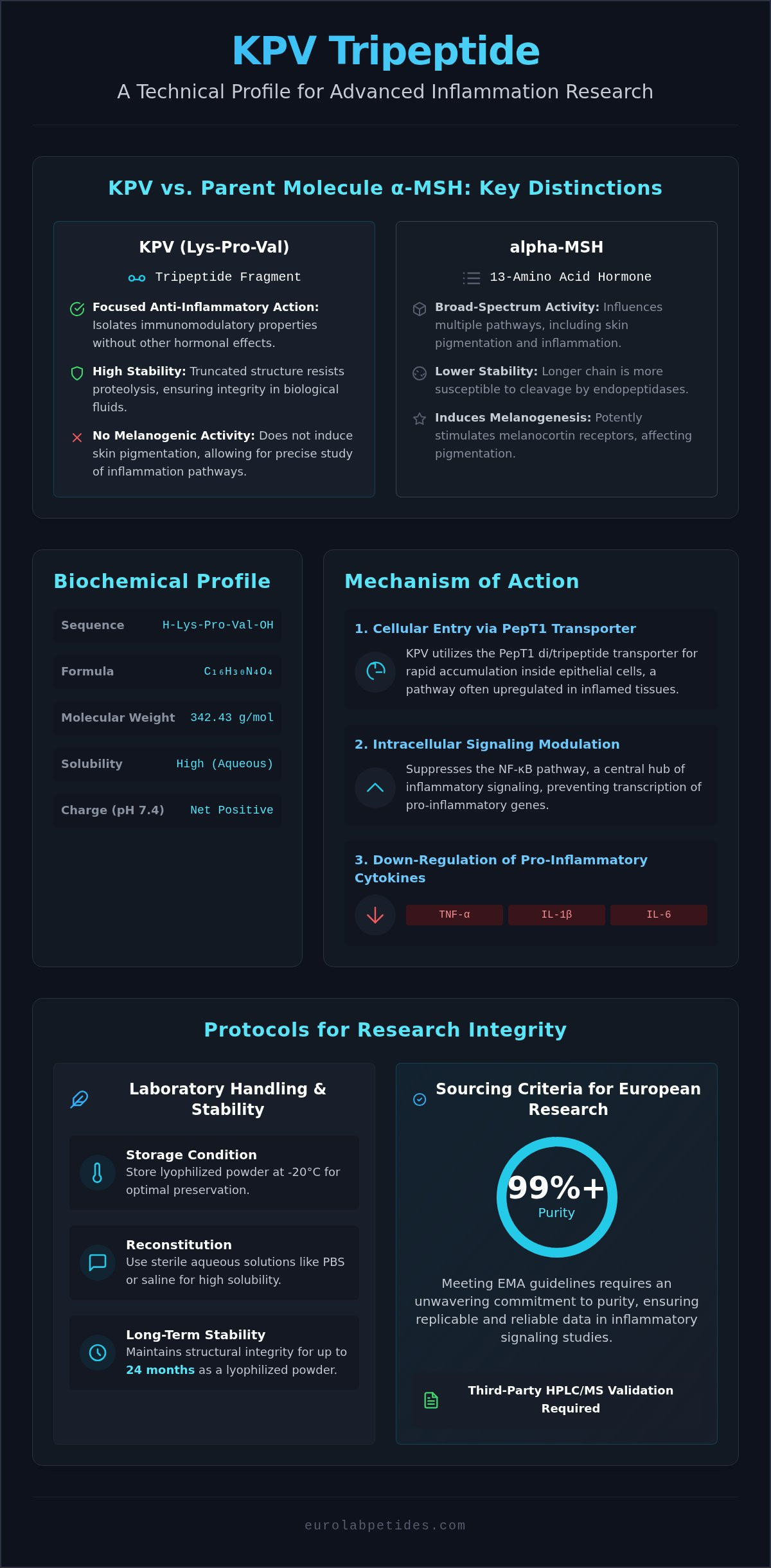
KPV represents a specific tripeptide sequence consisting of the amino acids Lysine (K), Proline (P), and Valine (V). Within the specialized field of peptides for inflammation research, this molecule is identified by the chemical formula C16H30N4O4 and a molecular weight of approximately 342.43 g/mol. These precise metrics are essential for laboratory identification and the verification of 99%+ purity benchmarks through high-performance liquid chromatography (HPLC). The KPV tripeptide is recognized for its high stability in various research media, a characteristic that stems from its truncated structural configuration.
The alpha-MSH Relationship
The structural evolution of KPV is rooted in its relationship with alpha-Melanocyte-Stimulating Hormone (alpha-MSH). It’s derived as the C-terminal fragment of this 13-amino acid parent hormone, specifically corresponding to residues 11 through 13. While alpha-MSH is a potent melanocortin that influences skin pigmentation, KPV retains the anti-inflammatory properties of the parent molecule without inducing melanogenic activity. This distinction is critical for in-vitro models where researchers aim to isolate signaling modulation from pigmentary side effects. The tripeptide structure resists proteolysis more effectively than longer peptide chains. Because it contains fewer cleavage sites for endopeptidases, KPV remains stable in biological fluids where larger proteins would rapidly degrade. The lysine residue at the N-terminus is structurally significant, as it facilitates specific receptor binding and influences the molecule’s interaction with intracellular signaling targets.
Physicochemical Properties in Research
Understanding the physicochemical profile of KPV is necessary for accurate experimental design. The molecule exhibits high solubility in aqueous solutions, such as sterile saline or phosphate-buffered saline (PBS), making it an ideal candidate for diverse laboratory preparations. At a physiological pH of approximately 7.4, KPV maintains a net positive charge due to the protonated epsilon-amino group of the lysine side chain. This charge distribution influences how the peptide interacts with negatively charged cellular membranes and transport proteins. KPV is a non-steroidal signaling modulator for research.
Technical specifications for standardized research include:
- Amino Acid Sequence: H-Lys-Pro-Val-OH
- Molecular Identification: Verified via Mass Spectrometry (MS) for exact mass matching.
- Solubility: Optimized for aqueous media; limited solubility in non-polar organic solvents.
- Stability Profile: Maintains structural integrity for up to 24 months when stored as a lyophilized powder at -20°C.
These properties ensure that KPV functions as a reliable tool in inflammatory research models, providing a level of precision that larger, less stable melanocortins cannot match. The absence of aromatic amino acids also results in a unique UV absorption profile, which is a key metric for analysts during the quality assurance process.
Mechanisms of Action in Inflammatory Signaling
KPV functions as a potent immunomodulator by targeting specific signaling nodes within the inflammatory cascade. Its activity is characterized by the significant down-regulation of pro-inflammatory cytokines, including TNF-alpha, IL-1beta, and IL-6, which are critical markers in cellular models. In tissue-based research, this modulation is often quantified through the reduction of myeloperoxidase (MPO) activity, providing an objective metric for neutrophilic infiltration. As a prominent tool among peptides for inflammation research, KPV’s efficacy is largely dependent on its ability to bypass extracellular degradation and interact directly with intracellular targets.
The PepT1 Transport Pathway
The cellular entry of KPV is primarily mediated by PepT1 (SLC15A1), a high-capacity di/tripeptide transporter located on the apical membrane of epithelial cells. Unlike larger peptides that require complex receptor-mediated endocytosis, KPV utilizes this specialized pathway for rapid intracellular accumulation. Research regarding PepT1-Mediated Tripeptide KPV Uptake indicates that this transporter is frequently upregulated during inflammatory states, particularly in intestinal and cutaneous models. This upregulation enhances the peptide’s bioavailability in compromised tissues, making it a critical subject for gastrointestinal studies where metabolic stability is a prerequisite for successful research outcomes.
Nuclear Factor-kappaB Suppression
The primary intracellular target of KPV is the Nuclear Factor-kappaB (NF-kB) signaling pathway, a master regulator of the immune response. In stimulated cellular models, KPV has been shown to prevent the translocation of the p65 subunit into the nucleus. By sequestering p65 within the cytoplasm, the peptide effectively halts the transcription of genes associated with the inflammatory response. This suppression directly contributes to the reduction of oxidative stress markers in vitro, as the production of reactive oxygen species (ROS) is consistently linked to NF-kB activation. KPV functions through the competitive inhibition of inflammatory ligands by occupying specific binding domains or transporter sites.
Beyond cytokine suppression, KPV influences the broader redox balance within the cellular environment. By modulating these intracellular signaling cascades, it limits the expression of inducible nitric oxide synthase (iNOS) and other markers of oxidative damage. For investigators analyzing the components of a Recovery Research Stack, these mechanisms provide a robust, data-driven framework for evaluating peptide efficacy in high-stakes precision environments. The structural simplicity of the tripeptide ensures that these interactions remain highly predictable across various experimental media.
Primary Research Applications: Gut and Skin Models
KPV’s utility within the field of peptides for inflammation research is defined by its high degree of organ-system specificity, particularly in the gastrointestinal tract and the integumentary system. Unlike systemic steroids that exert broad immunosuppressive effects, KPV provides a surgical approach to modulating localized inflammatory responses. This specificity is a result of the high expression of PepT1 transporters in these tissues, which facilitates the intracellular accumulation of the tripeptide during active inflammatory states. By focusing on these localized barriers, researchers can isolate the biochemical variables that drive tissue-specific recovery.
Intestinal Inflammation Models
In models of Inflammatory Bowel Disease (IBD), KPV is frequently investigated for its ability to mitigate histological damage. Researchers utilizing dextran sulfate sodium (DSS)-induced colitis models have observed that KPV administration correlates with the preservation of the intestinal epithelial barrier. This preservation is often quantified by the maintenance of tight junction proteins, specifically zonula occludens-1 (ZO-1) and occludin, which prevent the translocation of luminal antigens. Quantitative analysis of mucosal tissue consistently reveals a reduction in pro-inflammatory cytokine expression, reinforcing the peptide’s role as a stabilizer of gut homeostasis in laboratory inquiry.
Dermatological and Antimicrobial Inquiry
The application of KPV extends to cutaneous research, where it serves as a tool for investigating wound healing and antimicrobial responses. In studies involving Staphylococcus aureus-induced inflammation, KPV has demonstrated the capacity to limit the inflammatory cascade without compromising the host’s innate ability to clear the pathogen. It’s also utilized in models of hypertrophic scarring to study the modulation of collagen synthesis. By regulating the balance of Type I and Type III collagen, KPV offers a pathway for investigating the prevention of fibrotic tissue formation in research environments. This makes it a primary candidate for topical formulation research in skin barrier studies.
Research inquiries often evaluate KPV as a critical component of the Recovery Research Stack. When combined with bpc 157, KPV may exhibit synergistic effects on tissue repair, as the two molecules target different phases of the inflammatory and proliferative cycles. This combination is a frequent subject of study for investigators focused on multifactorial recovery models. The objective data provided by certificates of analysis (COAs) ensures that these applications are conducted with the 99%+ purity necessary for high-stakes precision research, meeting the rigorous demands of the specialized community.
Laboratory Handling, Stability, and Reconstitution
Maintaining the structural integrity of KPV is paramount for ensuring the reproducibility of data in peptides for inflammation research. Lyophilized peptides are inherently stable, yet their biochemical properties are sensitive to environmental variables such as temperature, light, and moisture. Rigorous adherence to standardized handling protocols prevents the aggregation or degradation of the Lysine-Proline-Valine sequence, which would otherwise lead to inconsistent experimental results and the loss of sensitive laboratory resources. Precision in the preparation phase is just as critical as the accuracy of the experimental model itself.
Storage and Stability Protocols
For long-term preservation, lyophilized KPV must be stored at -20°C. Under these conditions, the peptide maintains a stable shelf-life of 24 months, provided the vial remains hermetically sealed to prevent desiccation. Short-term storage of the lyophilized powder at 4°C is acceptable for periods not exceeding four weeks. Vials should be protected from direct light exposure, as UV radiation can induce photochemical reactions that compromise the amino acid side chains. Once reconstituted and stored at 4°C, KPV maintains optimal stability for a period of approximately 7 to 10 days before significant degradation of the peptide chain may occur. To maintain maximum potency, it’s recommended to aliquot the reconstituted solution into single-use volumes to avoid repeated freeze-thaw cycles, which are known to cause mechanical stress and peptide denaturation.
Reconstitution Guidelines
The reconstitution process requires high-stakes precision to ensure the resulting solution is both sterile and chemically accurate. Bacteriostatic Water or sterile 0.9% saline are the preferred diluents for most in-vitro and in-vivo research models. When introducing the solvent, the liquid should be directed against the side of the vial rather than directly onto the lyophilized cake to minimize foam formation. Researchers should employ a gentle swirling motion until the powder is completely dissolved. Vigorous agitation or vortexing must be avoided, as the resulting shear forces can disrupt the peptide bonds. For investigators requiring exact molarity, the use of a peptide reconstitution calculator is essential for calculating concentrations based on specific research dosages. Visual inspection is the final stage of the protocol; the solution must be clear and free of particulate matter or opalescence before use in any experimental assay.
Reliable results start with the highest quality raw materials. For researchers seeking 99%+ purity benchmarks and comprehensive COA documentation, you can source research-grade KPV through our specialized European logistics network. Ensuring these handling standards are met is the first step in achieving the surgical precision required for advanced inflammatory signaling studies.
Sourcing High-Purity KPV for European Research
The integrity of data in peptides for inflammation research is inextricably linked to the chemical purity of the reagents utilized. As the European peptide synthesis market is projected to reach USD 1.7 billion in 2026, the prevalence of low-grade materials has increased, necessitating stricter verification protocols. Researchers prioritize 99%+ purity benchmarks to ensure that observed cellular responses are a direct result of the Lysine-Proline-Valine sequence rather than residual solvents or manufacturing by-products. EuroLab Peptides addresses this requirement through a multi-level quality control framework that prioritizes objective, verifiable metrics over anecdotal performance claims.
Quality Assurance Benchmarks
A Certificate of Analysis (COA) serves as the primary document for assessing the suitability of a peptide batch. High-performance liquid chromatography (HPLC) is employed to determine the chemical purity, while Mass Spectrometry (MS) confirms the molecular weight and identity of the tripeptide. These tests are essential for identifying common impurities, such as trifluoroacetic acid (TFA) salts, residual heavy metals, or truncated peptide sequences resulting from incomplete synthesis cycles. Peer-reviewed research increasingly demands independent laboratory verification to eliminate variables associated with reagent contamination. Transparency in COA documentation allows investigators to verify that every vial meets the rigorous standards required for high-stakes precision inquiry.
Procurement in the European Market
Navigating the logistics of research chemicals within Europe requires a sophisticated understanding of regional regulatory compliance. The implementation of the EMA’s “Guideline on the development and manufacture of synthetic peptides” on June 1, 2026, has established more rigorous standards for characterization and impurity control. This regulatory shift favors suppliers who maintain localized logistics and can guarantee the stability of temperature-sensitive lyophilized powders during transit. Shipping protocols must account for the fragile nature of the peptide chain, utilizing specialized packaging to prevent desiccation and light exposure. For a detailed analysis of sourcing requirements, researchers should consult the guide on how to buy research peptides to ensure adherence to 2026 laboratory standards.
EuroLab Peptides functions as a meticulous partner in the chemical synthesis space by providing research-grade KPV that is strictly for laboratory use. By integrating third-party HPLC/MS validation into the procurement cycle, the brand ensures that the specialized community has access to elite tools for serious professional inquiry. This commitment to radical honesty and empirical validation positions KPV as a reliable component of the Recovery Research Stack, supporting the advancement of contemporary inflammatory research models across Europe. The focus remains on providing the objective data necessary for reproducible, high-precision science.
Advancing Precision in Inflammatory Signaling Models
The technical review of KPV clarifies its role as a stable, targeted modulator within the broader spectrum of peptides for inflammation research. Its reliance on the PepT1 transport system and subsequent inhibition of NF-kB translocation provides a surgical mechanism for investigating localized inflammatory responses in gut and skin models. These biochemical interactions require the highest level of reagent integrity to ensure that experimental outcomes aren’t compromised by synthesis impurities or degradation. As the 2026 EMA guidelines mandate stricter characterization, the focus on molecular identity becomes paramount for all contemporary laboratory inquiries.
Accessing 99%+ purity benchmarks is a non-negotiable standard for professional inquiry. You can View High-Purity KPV for Research at EuroLab Peptides, where every batch is third-party HPLC/MS verified. Our European shipping and support infrastructure ensures that sensitive chemicals maintain their specified stability from our laboratory to yours. By prioritizing these objective metrics, researchers can integrate KPV into a Recovery Research Stack with full confidence in its biochemical performance. Establishing these rigorous standards for research chemicals is the foundation for reproducible and authoritative research.
Frequently Asked Questions
What is the primary difference between KPV and alpha-MSH in a lab setting?
KPV is the C-terminal tripeptide fragment of the 13-amino acid hormone alpha-MSH. In laboratory settings, KPV lacks the melanogenic activity of the parent molecule, which allows researchers to isolate anti-inflammatory signaling from pigment-inducing side effects. The smaller tripeptide structure demonstrates superior resistance to proteolytic degradation compared to full-length alpha-MSH. This increased stability ensures more consistent results during in-vitro assays where larger proteins might rapidly lose their structural integrity.
Is KPV peptide stable for oral administration in animal models?
KPV demonstrates high stability for oral administration research, particularly in gastrointestinal models. Its resistance to gastric proteases is attributed to its simplified tripeptide structure. Cellular entry is mediated by the PepT1 transporter, which is often upregulated during active inflammation. This allows for effective intracellular accumulation in the gut without the rapid degradation typical of larger peptides for inflammation research, making it a reliable tool for studying DSS-induced colitis models.
What is the recommended reconstitution solvent for KPV research?
Bacteriostatic Water or sterile 0.9% saline are the standardized solvents for KPV reconstitution in research. The choice of diluent depends on the specific requirements of the experimental model and the intended duration of use. For studies involving sensitive cell cultures, phosphate-buffered saline (PBS) may be utilized to maintain physiological pH. It’s critical to direct the solvent against the vial wall to prevent mechanical stress and potential peptide denaturation during the mixing process.
How does KPV modulate the NF-kappaB signaling pathway?
KPV modulates the NF-kB pathway by preventing the translocation of the p65 subunit from the cytoplasm to the nucleus. By sequestering this protein, the peptide halts the transcription of pro-inflammatory genes. This mechanism results in a quantifiable reduction in the expression of cytokines such as TNF-alpha and IL-6. This surgical approach to signaling modulation allows investigators to analyze specific nodes in the inflammatory cascade without the systemic disruption caused by non-specific modulators.
Can KPV be used in antimicrobial research against S. aureus?
KPV is utilized in antimicrobial research to investigate its ability to modulate Staphylococcus aureus-induced inflammatory responses. In these laboratory models, the peptide has been shown to limit neutrophilic infiltration, often measured by myeloperoxidase (MPO) activity, while maintaining the host cell’s innate clearance mechanisms. Unlike traditional antibiotics, KPV is researched for its immunomodulatory role in preventing the excessive tissue damage associated with localized bacterial infections, particularly in cutaneous barrier research models.
What is the typical purity level required for KPV in peer-reviewed studies?
Peer-reviewed studies generally require a minimum purity benchmark of 98%, though 99%+ is the industry standard for high-precision analytical research. Utilizing high-purity peptides for inflammation research ensures that experimental data isn’t skewed by residual solvents, TFA salts, or truncated synthesis by-products. Researchers must verify these levels through third-party HPLC and Mass Spectrometry validation. Comprehensive COA documentation is a prerequisite for establishing the reproducibility and credibility of laboratory results in professional publications.
What are the storage requirements for KPV to prevent degradation?
Lyophilized KPV requires storage at -20°C for long-term stability, which maintains the peptide’s integrity for up to 24 months. For short-term laboratory use, the powder may be kept at 4°C for up to four weeks. Once reconstituted, the solution must be refrigerated at 4°C and used within 7 to 10 days. Vials should be protected from light and moisture. Avoiding repeated freeze-thaw cycles is essential to prevent the mechanical denaturation of the peptide chain.
Is KPV peptide legally available for research purposes in Europe in 2026?
KPV remains legally available across Europe strictly for laboratory research purposes as of August 2026. Sourcing must comply with the EMA guidelines that took effect on June 1, 2026, which enforce higher standards for characterization and impurity control. It’s unlawful to market or distribute KPV for human consumption. Researchers must ensure their suppliers provide full technical validation and comply with regional distribution standards for research chemicals to ensure the integrity of their laboratory inquiries.
