

Precision in molecular biology isn’t a luxury; it’s a fundamental requirement for reproducible data. For researchers investigating the epitalon peptide, the transition from theoretical telomerase activation to quantifiable in-vitro results often hinges on the analytical purity of the synthetic tetrapeptide. You’ve likely felt the frustration of navigating conflicting stability reports and the lack of third-party verified sourcing within the European market. These variables introduce unacceptable noise into high-stakes cellular aging studies.
This technical review provides a consolidated analysis of the Ala-Glu-Asp-Gly mechanism, offering a standardized framework for laboratory protocols. We’ll examine the latest 2026 stability data for lyophilized sequences and the critical role of HPLC and mass spectrometry in ensuring research-grade integrity. By prioritizing empirical metrics over anecdotal claims, this guide establishes a rigorous foundation for evaluating Epitalon’s role in telomere length modulation. It provides a clear pathway to securing high-purity materials for European research facilities dedicated to longevity and vitality research.
Key Takeaways
- Analyze the biochemical mechanism of telomerase gene (TERT) expression and its specific role in telomere elongation within cellular models.
- Establish standardized laboratory protocols for epitalon peptide reconstitution and storage to ensure molecular stability during longitudinal in-vitro studies.
- Review foundational longitudinal data from the St. Petersburg Institute of Bioregulation regarding life extension outcomes in Drosophila and rodent populations.
- Identify the critical analytical metrics, including HPLC and Mass Spectrometry, necessary to verify 99% purity benchmarks for research-grade materials.
- Understand the regulatory influence of synthetic tetrapeptides on melatonin synthesis and the subsequent impact on circadian rhythm research frameworks.
What is Epitalon Peptide? Chemical Structure and Identification
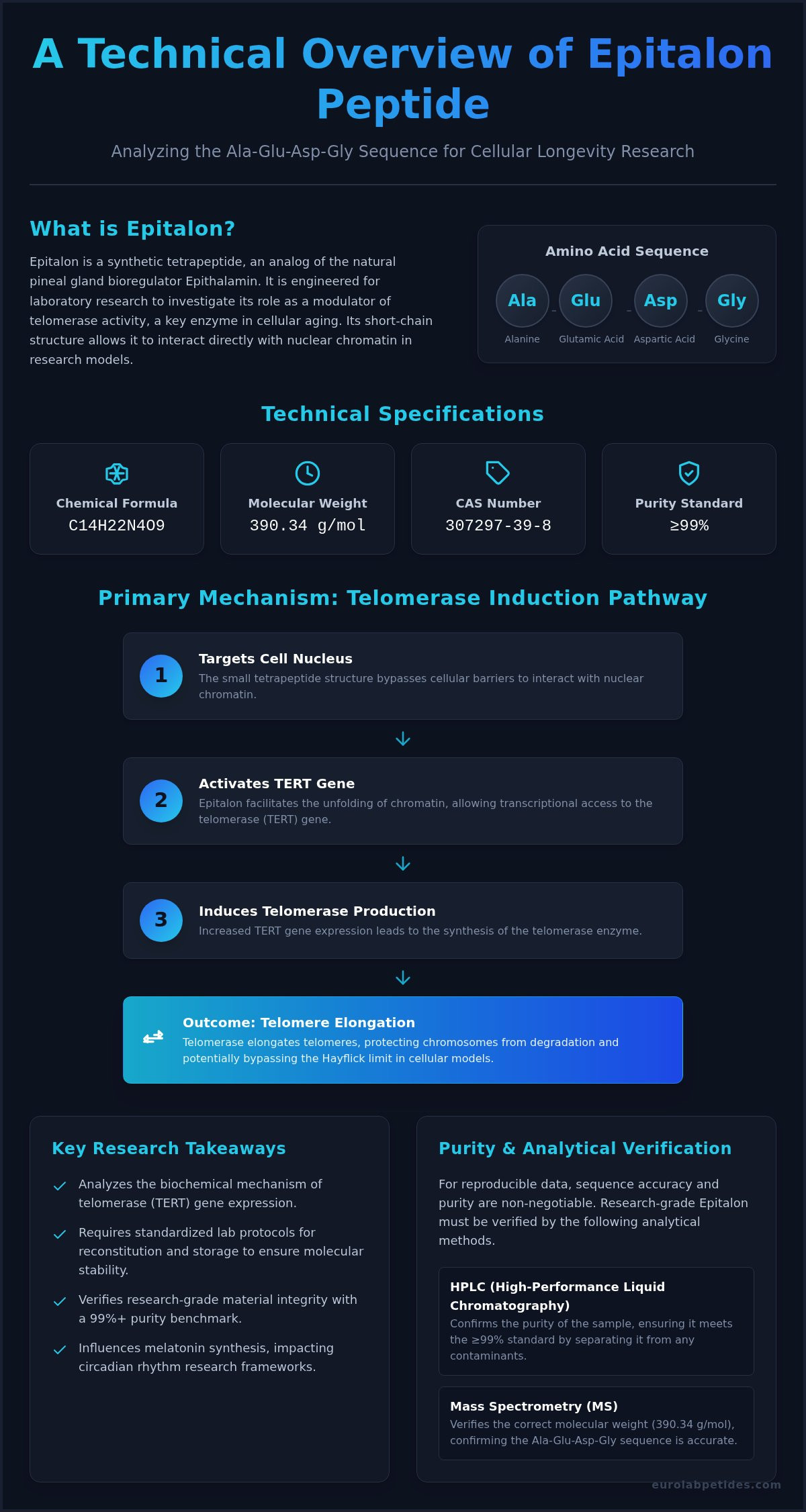
The Epitalon peptide is defined as a synthetic tetrapeptide consisting of the amino acid sequence L-alanyl-L-glutamyl-L-asparagyl-glycine. It’s identified by the molecular formula C14H22N4O9 and possesses a calculated molecular mass of 390.34 g/mol. This molecule was originally developed as a synthetic analog of epithalamin, a peptide bioregulator naturally produced in the pineal gland. Its role in laboratory research is centered on its ability to act as a modulator of telomerase activity. As a short-chain peptide, it’s capable of bypassing cellular barriers that often impede larger proteins, allowing for direct interaction with nuclear chromatin in various research models.
Nomenclature and Synonyms in Scientific Literature
Precision in nomenclature is vital for the integrity of longevity research. While the terms Epitalon and Epithalon refer to the same synthetic tetrapeptide, they’re often confused with Epithalamin, which is the natural bovine pineal extract. Epithalamin contains a complex mixture of peptides, whereas the synthetic version is a purified, single-sequence molecule. Researchers should also be aware of technical identifiers such as CAS number 307297-39-8 to ensure they’re sourcing the correct chemical entity. Common misspellings or commercial trade names can lead to sourcing errors, which is why analytical verification is a non-negotiable standard in European-based logistics. Establishing the correct identity of the epitalon peptide is the first step in ensuring reproducible results in laboratory development.
The Ala-Glu-Asp-Gly Sequence Explained
The biochemical profile of the epitalon peptide is determined by its specific amino acid composition: Alanine, Glutamic Acid, Aspartic Acid, and Glycine. This precise arrangement allows the molecule to engage in site-specific interactions within the cell nucleus. The inherent peptide bond stability of this specific sequence provides the necessary resistance to enzymatic degradation within cellular models. Sequence accuracy is the primary factor in determining the success of telomerase expression studies. Any variation in the L-isomer configuration or amino acid order will result in a failure to activate the TERT gene. High-purity sourcing, verified by HPLC and Mass Spectrometry, is the only way to guarantee that the Ala-Glu-Asp-Gly sequence matches the required specifications for specialized research inquiry.
Technical specifications for the tetrapeptide include:
- Chemical Formula: C14H22N4O9
- Molecular Weight: 390.34 g/mol
- Sequence: Ala-Glu-Asp-Gly
- CAS Number: 307297-39-8
- Purity Standard: 99%+ (HPLC/MS verified)
Primary Mechanisms: Telomerase Activation and Pineal Regulation
The biological efficacy of the epitalon peptide is primarily attributed to its capacity for epigenetic modulation. It doesn’t merely supplement cellular components; it acts as a signaling molecule that targets the telomerase gene (TERT) promoter region. By facilitating the unfolding of condensed chromatin, the peptide allows for increased transcriptional accessibility to specific genetic sequences. This interaction is fundamental to the observed reduction in lipid peroxidation and the subsequent neutralization of reactive oxygen species within cellular studies. These antioxidant properties are not the result of direct scavenging but are instead a consequence of improved cellular metabolic efficiency and genomic stability.
The Telomerase Induction Pathway
Epitalon stimualtes telomerase activity, representing a significant departure from exogenous enzymatic therapies. By inducing the expression of the TERT gene, the peptide enables the elongation of telomeres, effectively bypassing the Hayflick limit in human fibroblast models. Observations of cell division extension suggest that the peptide provides a mechanism for maintaining genomic integrity over prolonged periods. Unlike non-specific telomerase activators, the tetrapeptide sequence Ala-Glu-Asp-Gly exhibits high specificity for chromatin structures involved in cellular senescence. This precision ensures that the induction of telomerase is regulated within physiological parameters, preventing the genomic instability often associated with uncontrolled enzymatic activation. Researchers must utilize verified materials to ensure these ligand-receptor interactions remain consistent across longitudinal studies.
Circadian Rhythm and Melatonin Secretion
Beyond telomere modulation, the peptide exerts regulatory control over the pineal gland’s secretory patterns. Aging animal models demonstrate a characteristic decline in melatonin production, which disrupts the suprachiasmatic nucleus (SCN) and compromises circadian stability. Epitalon has been shown to restore night-time melatonin peaks to levels observed in younger cohorts. This restoration of pineal function suggests a synergistic potential when integrated into a longevity research stack. The stabilization of the SCN regulation cycle provides a more robust physiological framework for evaluating cellular repair mechanisms in in-vitro environments. When the circadian rhythm is optimized, the baseline for measuring other metabolic interventions becomes significantly more reliable.
The objective data suggests that Epitalon functions as a systemic bioregulator rather than a localized antioxidant. Its influence on the epigenetic landscape provides a verifiable metric for assessing biological age in laboratory settings. For institutions conducting these high-precision studies, securing research-grade chemical sourcing is essential for maintaining experimental integrity and achieving reproducible outcomes in 2026 research cycles.
Experimental Observations in Longevity and Cellular Models
Vladimir Khavinson’s foundational research at the St. Petersburg Institute of Bioregulation established the epitalon peptide as a primary subject in peptide bioregulation. These studies focused on the tetrapeptide’s capacity to induce telomerase activity and stabilize genetic structures. Experimental data from Drosophila and various rodent populations consistently demonstrate a significant delay in age-associated physiological decline. Beyond simple lifespan extension, these models provide insights into the reduction of lipid peroxidation and the preservation of immune function during senescence. The data suggests that the peptide acts as a specific ligand, interacting with chromatin to modulate gene expression related to cellular vitality.
In-Vitro Studies on Human Somatic Cells
Observations in human fetal fibroblast cultures indicate that exposure to Epitalon facilitates telomere lengthening and a subsequent increase in the number of cell divisions. Senescent cells typically exhibit distinct morphological changes, such as increased size and granular cytoplasm; however, post-exposure cultures show a reversion toward a more youthful, proliferative phenotype. In these in-vitro models, the peptide is typically utilized within a concentration range of 0.01 µg/mL to 10 µg/mL to elicit measurable biological responses. This dosage-dependent interaction provides a verifiable metric for assessing the peptide’s efficacy in reversing cellular senescence markers. Researchers have noted that the stabilization of these cell lines is critical for longitudinal studies involving telomerase induction.
Animal Model Longevity Outcomes
Statistical analysis of long-term animal studies reveals a distinct impact on both mean and maximum lifespan. In rodent populations, the administration of the epitalon peptide has been associated with a reduction in the incidence of spontaneous tumors, suggesting a role in oncogenesis suppression. These results are consistent across multiple species, including rats, mice, and monkeys, where researchers observed a stabilization of biomarkers such as antioxidant enzyme activity and melatonin secretion. The delay of age-related biomarkers in these diverse models reinforces the peptide’s standing as a robust tool for longevity research. These findings underscore the necessity for high-purity, analytical-grade materials to ensure experimental reproducibility in modern laboratory settings. When maximum lifespan is extended in these models, it typically correlates with a significant reduction in age-specific mortality rates.
Technical Specifications for Laboratory Reconstitution and Storage
Maintaining the molecular integrity of the epitalon peptide requires strict adherence to specific thermodynamic and chemical parameters. While the lyophilized powder exhibits significant stability at room temperature during transit, its transition to an aqueous state for in-vitro research introduces vulnerabilities. Protocols that aren’t strictly followed often lead to rapid peptide degradation. The choice of solvent is the primary determinant of post-reconstitution shelf-life. Bacteriostatic water, containing 0.9% benzyl alcohol, is the preferred diluent for multi-use vials because it effectively inhibits microbial proliferation. Sterile 0.9% sodium chloride is an alternative for studies where preservatives might interfere with cellular signaling, though it requires immediate use or much shorter storage durations.
Reconstitution Protocols for Researchers
Precision during reconstitution prevents the mechanical denaturation of the tetrapeptide sequence. Researchers should allow the vial to reach room temperature before introducing the solvent to prevent moisture condensation. The liquid must be aimed at the vial wall rather than directly onto the lyophilized cake to minimize impact force. Instead of vortexing or aggressive agitation, a gentle swirling motion is required until the solution is completely clear. For accurate molarity, utilizing a peptide reconstitution calculator ensures that experimental concentrations remain consistent across different batches. It’s essential to maintain this level of accuracy when evaluating the TERT gene promoter response in high-stakes laboratory development.
Stability and Storage Parameters
Storage temperatures dictate the long-term viability of the epitalon peptide. Lyophilized powder should be archived at -20°C for standard research cycles, while -80°C is recommended for longitudinal archiving exceeding 24 months. Once reconstituted, the solution must be refrigerated at 4°C and used within 7 to 14 days to avoid hydrolytic degradation. Repeated freeze-thaw cycles are detrimental. They induce mechanical stress on the peptide bonds, so aliquoting the solution into single-use doses is a mandatory protocol. Light sensitivity can also catalyze oxidative processes, making the use of amber vials or opaque storage containers a requirement for maintaining analytical purity. For reliable results, researchers should only use verified European laboratory supplies that meet these rigorous storage standards.
Evaluating Epitalon Purity and Sourcing for Scientific Inquiry
Analytical validation is the cornerstone of experimental reliability. For the epitalon peptide, High-Performance Liquid Chromatography (HPLC) and Mass Spectrometry (MS) serve as the dual pillars of quality assurance. HPLC provides a quantitative measure of chemical purity by separating the tetrapeptide from synthesis contaminants, while MS confirms the exact molecular identity by verifying the mass-to-charge ratio. Research outcomes in telomerase activation are highly sensitive to impurities; even a 1% variance in purity can introduce significant biochemical noise. A third-party Certificate of Analysis (COA) is therefore a mandatory requirement for any institutional study to ensure the sequence matches the Ala-Glu-Asp-Gly specification without deviation.
Low-cost suppliers often omit these rigorous testing phases, relying instead on batch-level generalizations that don’t account for individual vial variance. Identifying red flags, such as the absence of timestamped HPLC chromatograms or vague purity claims without empirical data, is essential for maintaining research integrity. EuroLab Peptides addresses these risks through a multi-level protocol that subjects every batch to both internal and independent laboratory scrutiny. This methodology ensures that the products are elite tools for serious professional inquiry, where quality is presented as a verifiable metric rather than a marketing assertion.
The EuroLab Quality Standard
Transparency is maintained by providing researchers with direct access to independent lab results for every acquisition. This proof-first approach ensures that the 99%+ purity benchmark is a verifiable metric. The logistical advantages of sourcing high-purity research peptides within Europe include reduced transit times and specialized handling that preserves the molecular stability of the lyophilized powder. By centralizing manufacturing and distribution within regional regulatory frameworks, the risks associated with global supply chains are effectively mitigated. This precision suggests that the business understands the rigorous demands of the specialized community it serves.
Compliance and Ethical Research
All materials are designated strictly for Research Use Only and are intended for in-vitro applications or laboratory development. This classification is a non-negotiable standard that aligns with institutional procurement requirements and ethical research practices. Documentation provided with each shipment supports the rigorous auditing needs of specialized scientific communities. As the field of longevity science evolves, the epitalon peptide remains a vital tool for exploring the limits of cellular senescence. Its continued utility depends entirely on the availability of high-purity sequences that allow for the precise, reproducible modulation of the TERT gene. By prioritizing scientific accuracy over hyperbole, researchers can establish a standardized foundation for future breakthroughs in peptide bioregulation.
Advancing Telomerase Research with Analytical Precision
The epitalon peptide represents a specialized tool for investigating cellular senescence and telomerase gene regulation in modern molecular biology. Success in these high-stakes studies depends on the precision of the Ala-Glu-Asp-Gly sequence and the maintenance of analytical purity through HPLC and mass spectrometry. Standardized protocols for reconstitution and storage are essential for ensuring that experimental noise doesn’t compromise longitudinal data. By prioritizing empirical validation over anecdotal evidence, researchers can establish a more reliable framework for evaluating the mechanisms of telomere modulation.
For institutions requiring absolute sequence integrity, EuroLab Peptides offers research-grade materials that meet the most rigorous technical benchmarks. Every batch is subjected to a multi-level quality control process, featuring third-party HPLC/MS verified results to guarantee 99%+ purity. We provide temperature-controlled European shipping to ensure that lyophilized compounds maintain their stability from synthesis to the laboratory. Access High-Purity Epitalon for Your Research at EuroLab Peptides and proceed with your scientific inquiry with total confidence in your chemical sourcing.
Frequently Asked Questions
Is Epitalon peptide safe for human consumption?
Epitalon peptide is strictly prohibited for human consumption and is designated for in-vitro laboratory research only. Its safety profile hasn’t been established in Western clinical trials, and it lacks FDA approval for therapeutic use. As of August 2026, the FDA hasn’t issued a final determination regarding its use in compounding, despite recommendations from the Pharmacy Compounding Advisory Committee. All procurement must adhere to institutional standards for chemical handling and experimental development.
What is the primary mechanism of action for Epitalon in research?
The primary mechanism of action involves the induction of telomerase activity through the modulation of the TERT gene promoter region. By promoting the transition of chromatin from a condensed state to an active state, the peptide enables the elongation of telomeres in various cellular models. This epigenetic regulation also extends to the pineal gland, where it facilitates the restoration of melatonin secretion patterns and stabilizes circadian rhythm models in aged subjects.
How should lyophilized Epitalon be stored for maximum stability?
Maximum stability for lyophilized powder is achieved through storage at -20°C or -80°C for long-term archiving. While the molecule is relatively stable at room temperature for brief transit periods, prolonged exposure to heat or light will catalyze degradation. Once the peptide is reconstituted into an aqueous solution, it must be refrigerated at 4°C and utilized within a 14-day window. Amber vials are recommended to prevent potential photo-oxidation of the sequence.
What is the difference between Epitalon and Epithalamin?
Epitalon is a synthetic tetrapeptide with the specific sequence Ala-Glu-Asp-Gly, whereas Epithalamin is a natural extract derived from the bovine pineal gland. While Epithalamin contains a complex mixture of various peptide bioregulators, the synthetic version is a purified, single-entity molecule. This distinction is critical for research reproducibility, as synthetic sequences provide a consistent molar concentration that natural extracts can’t achieve. Most modern longevity research utilizes the purified synthetic sequence for precise results.
How do researchers reconstitute Epitalon for in-vitro studies?
Researchers typically reconstitute the peptide using bacteriostatic water or sterile 0.9% sodium chloride, depending on the requirements of the in-vitro model. The solvent should be introduced slowly along the side of the vial to minimize mechanical stress on the lyophilized cake. Aggressive agitation or vortexing must be avoided; instead, a gentle swirling motion is employed until the solution reaches complete clarity. Precision in concentration is often managed through the use of standardized reconstitution calculators.
What purity level is required for Epitalon in peer-reviewed research?
Peer-reviewed research typically requires a purity level of 99% or higher, as verified by High-Performance Liquid Chromatography (HPLC) and Mass Spectrometry (MS). Contaminants or synthesis byproducts in lower-grade materials can interfere with cellular signaling and introduce confounding variables into telomerase expression data. Verification through a third-party Certificate of Analysis (COA) ensures that the molecular identity and purity benchmarks meet the rigorous demands of the international scientific community and regional regulatory standards.
Can Epitalon be used in combination with other peptides like BPC-157?
The epitalon peptide is frequently utilized alongside other sequences, such as BPC-157, within complex research stacks. These combinations allow for the simultaneous investigation of multiple biological pathways, including telomerase induction and angiogenic repair mechanisms. While such stacks are common in longevity and vitality research models, each component must be independently verified for purity to ensure that the interactions observed are the result of the peptides themselves rather than synthesis contaminants or impurities.
What are the reported side effects of Epitalon in animal models?
Reported observations in animal models, specifically rodent and Drosophila populations, indicate a low toxicity profile for the tetrapeptide Ala-Glu-Asp-Gly. Foundational research suggests that the peptide doesn’t induce significant adverse effects when administered within established experimental parameters. Researchers must monitor for physiological changes such as altered melatonin peaks or changes in spontaneous tumor incidence. These metrics are the primary focus for assessing the peptide’s systemic biological impact in longitudinal studies and cellular models.
