

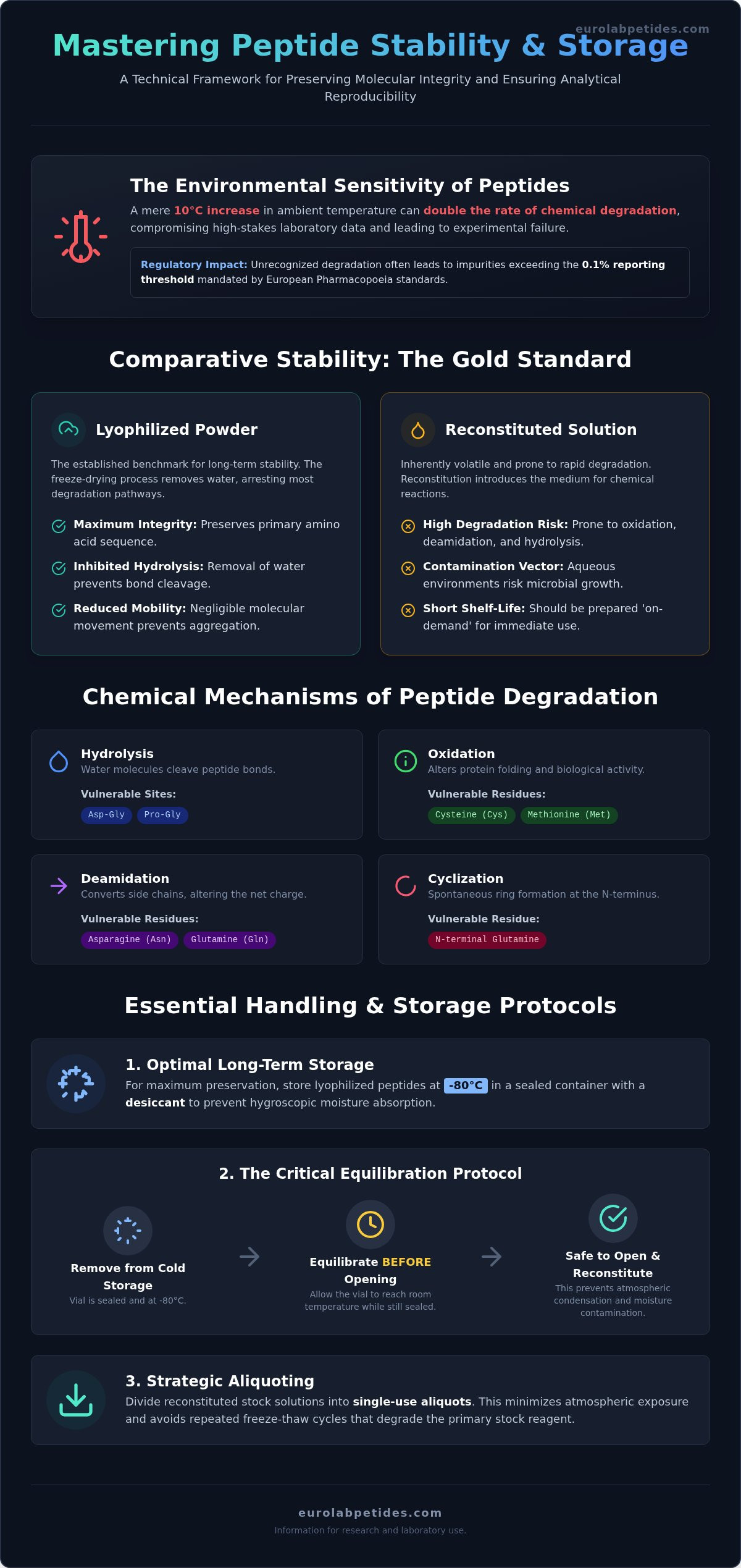
A 10°C increase in ambient temperature can double the rate of chemical degradation for most synthetic sequences, potentially compromising the validity of high-stakes laboratory data. Within the rigorous framework of 2026 research integrity, mastering peptide stability and storage is a fundamental requirement for analytical reproducibility. Researchers frequently encounter experimental failures linked to unrecognized oxidation or moisture-induced hydrolysis, particularly when vials are opened without proper thermal equilibration. These environmental sensitivities often lead to impurities that exceed the 0.1% reporting threshold mandated by current European Pharmacopoeia standards.
You’ll find that maintaining peptide sequence integrity requires a precise combination of environmental controls and sequence-specific knowledge. This technical framework provides the analytical protocols necessary to preserve molecular structure and establish a standardized laboratory SOP. We’ll examine the impact of specific amino acid residues on stability, the necessity of -80°C storage for long-term preservation, and precise aliquoting techniques designed to minimize reagent waste in professional laboratory settings.
Key Takeaways
- Identify sequence-specific vulnerabilities, such as hydrolysis at Asp-Gly sites, to predict and mitigate chemical degradation during laboratory workflows.
- Establish why lyophilized powder remains the benchmark for peptide stability and storage compared to the rapid degradation observed in reconstituted solutions.
- Implement rigorous environmental controls using desiccants and -80°C storage to prevent hygroscopic moisture absorption and preserve molecular structure.
- Execute the ‘Equilibration Protocol’ to eliminate atmospheric condensation risks during the transition of vials from cold storage to active research environments.
- Adopt strategic aliquoting techniques to minimize atmospheric exposure and maintain the analytical integrity of stock reagents over longitudinal studies.
Chemical Mechanisms of Peptide Degradation in Research
Peptide stability is defined by the maintenance of the primary amino acid sequence and the preservation of higher-order secondary structures over a defined temporal period. In laboratory settings, peptide stability and storage protocols are designed to mitigate the kinetic energy that drives degradative pathways. Chemical degradation involves the modification of the peptide through the formation or cleavage of covalent bonds. Hydrolysis represents a primary pathway where water molecules facilitate the cleavage of peptide bonds, a process often categorized under non-enzymatic proteolytic degradation. Vulnerability is significantly elevated at specific motifs, particularly Asp-Gly or Pro-Gly sites, where the lack of side-chain bulk allows for easier nucleophilic attack.
Oxidation pathways primarily target sulfur-containing residues such as Cysteine and Methionine. The formation of unintended disulfide bridges or methionine sulfoxide can fundamentally alter the peptide’s folding and biological activity. Similarly, deamidation of Asparagine and Glutamine residues results in the conversion of these side chains into carboxylic acids. This transformation not only alters the chemical identity of the molecule but also shifts its overall net charge, which is readily detectable via high-resolution analytical methods like ESI-MS.
Sequence-Specific Vulnerabilities
The risk profile of a research compound is dictated by its primary sequence. Sequences containing multiple Cys or Met residues are classified as high-risk due to their susceptibility to atmospheric oxygen and trace metal contaminants. Additionally, N-terminal Glutamine residues exhibit a propensity for spontaneous cyclization into pyroglutamate, especially when exposed to acidic conditions. The rate of these sequence-specific chemical transformations is heavily dependent on the pH of the environment. Most peptides exhibit optimal stability within a narrow pH range, often near their isoelectric point, where the net charge minimizes reactive interactions.
Physical Stability vs. Chemical Stability
A critical distinction must be made between physical and chemical stability. Physical instability is characterized by peptide aggregation or precipitation, where the primary sequence remains intact but the solubility and secondary structure are compromised. Chemical instability involves irreversible covalent bond cleavage or modification. Lyophilization is the preferred stabilization method because it removes water, which is the primary reactant in hydrolysis and a major facilitator of molecular mobility. Understanding these structural fundamentals is essential when determining what are peptides and how they behave in vitro. High-purity lyophilized reagents are therefore central to maintaining peptide stability and storage standards in 2026 research workflows.
Comparative Stability: Lyophilized Powder vs. Solution
In 2026, lyophilized powder remains the established benchmark for ensuring peptide stability and storage integrity. The freeze-drying process effectively arrests most chemical degradation pathways by removing the aqueous medium required for hydrolysis and reducing molecular mobility to negligible levels. In contrast, reconstituted peptides exhibit inherent volatility. Once a peptide is introduced to a liquid phase, the kinetic energy of the system increases, facilitating molecular interactions that lead to oxidation, deamidation, and aggregation. Experimental protocols must prioritize ‘on-demand’ reconstitution to ensure that the analytical profile of the reagent matches the manufacturer’s specification at the moment of application.
The choice of solvent significantly influences solution-phase longevity. While sterile deionized water is often used for initial solubilization, it lacks the buffering capacity of Phosphate-Buffered Saline (PBS). However, PBS can accelerate certain degradation pathways or interfere with downstream analytical techniques like Mass Spectrometry. For researchers requiring the highest level of stability, utilizing high-purity lyophilized reagents ensures that the primary sequence is preserved until the precise moment of research use.
The Risks of Solution Phase Storage
Storing peptides in solution introduces multiple vectors for experimental failure. Aqueous environments are prone to microbial contamination if non-sterile handling occurs, which can lead to rapid enzymatic degradation by bacterial proteases. Additionally, repeated freeze-thaw cycles impose severe mechanical stress on the peptide structure. As ice crystals form and melt, the resulting changes in local concentration and micro-environment pH can induce irreversible denaturation. Research indicates that the rate of aggregation is concentration-dependent; higher concentrations often promote intermolecular interactions that lead to the formation of insoluble fibrils or precipitates.
Shelf-Life Benchmarks in 2026
Current 2026 benchmarks indicate that lyophilized peptides maintain stability for 2-3 years when stored at -20°C. For longitudinal studies extending beyond this window, storage at -80°C is required to virtually eliminate thermal degradation. Once reconstituted, the stability window narrows significantly. Most peptides in solution remain viable for 30-60 days at 2-8°C, though specific sequences may show significant degradation within 14 days. To ensure maximum experimental consistency, researchers should adhere to the ’24-hour rule’, where peptides are reconstituted and utilized within a single diurnal cycle to avoid the accumulation of degradation products that might skew analytical results.
Optimizing Laboratory Storage Conditions
Stringent control of environmental parameters serves as the secondary defense for peptide stability and storage. While storage at -20°C is often acceptable for short-term archiving up to 2-3 years, longitudinal research necessitates -80°C to minimize residual molecular vibration. Empirical data indicates that a 10°C increase in storage temperature can double the rate of chemical degradation. For high-value reagents, the displacement of atmospheric oxygen within the vial using inert gases like argon or nitrogen is a standard requirement. These gases provide a protective blanket that prevents the oxidation of sensitive residues like methionine and cysteine, which were identified as primary degradation targets in earlier sections.
Photostability is a frequently overlooked variable in laboratory settings. Exposure to UV light can catalyze photodegradation, reducing the potency of certain therapeutic peptides by 15-25% within a 48-hour window. Reagents should be stored in amber vials or wrapped in foil to prevent light-induced cleavage of the peptide backbone. Maintaining these rigorous standards ensures that the analytical integrity of the compound remains within the 98% purity threshold required for research-grade materials in 2026.
Moisture Control and Desiccation
Peptides are highly hygroscopic, meaning they readily absorb moisture from the surrounding atmosphere. If left unchecked, this can lead to deliquescence, a state where the lyophilized powder absorbs enough water to form a liquid solution, triggering immediate hydrolysis. Laboratory-grade desiccants, such as silica gel with color indicators or 4Å molecular sieves, must be present within the secondary storage container. Digital hygrometers are utilized to provide real-time monitoring of humidity levels, ensuring that storage units remain below critical moisture thresholds throughout the product lifecycle.
Vial Selection and Integrity
The choice of vial material is determined by the concentration of the peptide solution. For low-concentration samples, polypropylene vials are superior to glass because peptides frequently exhibit non-specific adsorption to glass surfaces, which significantly reduces the effective concentration of the reagent. Vials must be equipped with airtight screw caps and integrated O-rings to maintain a hermetic seal against atmospheric ingress. Systematic labeling protocols are essential for research integrity; every vial should clearly display the batch number, synthesis date, and any reconstitution history to facilitate accurate tracking during longitudinal studies.
Handling Protocols to Prevent Sequence Contamination
Precise handling protocols are the final determinant of peptide stability and storage success. The ‘Equilibration Protocol’ is a mandatory procedural step for all lyophilized reagents. Vials removed from -20°C or -80°C storage must reach ambient room temperature before the seal is breached. Failure to adhere to this requirement creates a condensation trap, where atmospheric moisture precipitates directly onto the cold, hygroscopic powder. This moisture acts as a primary reactant for immediate hydrolysis, compromising the peptide’s primary sequence before reconstitution even begins.
Analytical vigilance is required to detect degradation prior to experimental initiation. In 2026, researchers utilize High-Performance Liquid Chromatography (HPLC) and Mass Spectrometry (MS) to verify batch integrity. Baseline shifts or the emergence of secondary peaks in an HPLC chromatogram indicate the presence of truncated sequences or degradation products. In Mass Spectrometry, peak broadening or unexpected mass shifts, such as a +16 Da increase signifying oxidation, serve as definitive evidence of chemical compromise. Sterile handling techniques, including the use of filtered tips and laminar flow hoods, are non-negotiable for in-vitro research to prevent microbial proteolytic degradation.
The Reconstitution SOP
Reconstitution must follow a standardized laboratory SOP to ensure molecular integrity. Vials should be placed in a desiccator and allowed to equilibrate for a minimum of 30-60 minutes. Solvent selection is dictated by the peptide’s hydrophobicity and hydropathy index. While many sequences are soluble in sterile deionized water, hydrophobic peptides may require initial solubilization in dilute acetic acid or DMSO. Gentle swirling of the vial is required to facilitate dissolution, as vigorous vortexing can induce mechanical shear stress and promote peptide aggregation.
Aliquoting for Experimental Efficiency
Aliquoting is the most effective strategy for minimizing the frequency of stock vial exposure to atmospheric oxygen and moisture. Researchers should calculate aliquot volumes to match specific single-use experimental needs, thereby eliminating the necessity for repeated freeze-thaw cycles. Flash-freezing these aliquots in liquid nitrogen before transferring them to -80°C storage preserves the kinetic state of the solution. To maintain these rigorous analytical standards from the outset, researchers should buy research peptides that are accompanied by comprehensive third-party verification. Implementing these handling protocols ensures that the high-purity reagents utilized in your laboratory remain consistent with their original synthesis specifications.
EuroLab Standards: Preserving Integrity from Synthesis to Delivery
EuroLab Peptides implements a multi-level quality protocol designed to eliminate degradation before the reagent reaches the researcher’s bench. This methodology begins with high-vacuum lyophilization, a critical synthesis phase that utilizes primary and secondary drying cycles to reduce residual moisture to negligible levels. By removing water, which acts as the primary reactant for hydrolysis discussed in earlier sections, the physical and chemical integrity of the peptide is secured. Our ‘proof-first’ model mandates that every batch is accompanied by specific stability data, ensuring that peptide stability and storage metrics meet the 98% purity benchmark required for 2026 analytical standards.
The transition from synthesis to delivery is governed by a rigorous cold-chain management system. In-vitro research reagents are susceptible to thermal degradation if exposed to ambient conditions during transit. Consequently, our synthesis workflow integrates stability testing into the final quality assurance phase, validating that the lyophilized cake remains structurally intact under simulated transport conditions. This commitment to objective data ensures that the researcher receives a product with a verified analytical baseline. Every batch is subjected to independent third-party laboratory verification to confirm that synthesis specifications are maintained throughout the supply chain.
Climate-Controlled European Logistics
Logistics within the European Union are managed through a climate-controlled infrastructure to minimize transit-time temperature fluctuations. Specialized packaging standards are utilized to maintain sub-zero environments throughout the delivery cycle, typically employing insulated shipping containers and high-capacity thermal stabilizers. These measures protect the lyophilized powder from thermal excursions that could otherwise initiate the sequence-specific vulnerabilities identified in our handling protocols. Our adherence to regional regulatory compliance serves as a shorthand for reliability in a market often complicated by international quality variances.
Analytical Validation of Stability
Post-lyophilization integrity is verified through Electrospray Ionization Mass Spectrometry (ESI-MS). This high-resolution technique detects even minor degradation products, providing a definitive analytical profile of the compound’s mass-to-charge ratio. In accordance with 2026 European standards, any impurities exceeding the 0.1% threshold are documented and reported. Every Certificate of Analysis (CoA) provides transparent reporting on moisture content and residual solvents, allowing researchers to account for these variables in their experimental designs. Maintaining absolute transparency regarding these metrics is essential for research integrity and the reproducibility of laboratory development. View our 2026 stability-tested research peptides to secure high-purity reagents for your laboratory development.
Advancing Analytical Precision in 2026 Laboratory Research
Maintaining the structural integrity of synthetic sequences requires a rigorous commitment to environmental control and standardized handling protocols. The evidence demonstrates that peptide stability and storage is not merely a matter of refrigeration; it’s a complex interplay of moisture desiccation, sequence-specific vulnerability, and thermal regulation. By prioritizing -80°C storage and implementing the ‘Equilibration Protocol’, researchers can effectively mitigate the risks of hydrolysis and oxidation that frequently compromise longitudinal data.
EuroLab Peptides supports these high-stakes requirements through specialized high-purity lyophilized reagents and climate-controlled European logistics. Every batch undergoes independent laboratory verification to ensure that the chemical profile remains consistent from synthesis to delivery. This objective, data-driven approach provides the absolute security necessary for serious professional inquiry.
It’s the meticulous adherence to these protocols that distinguishes successful research from experimental failure. View our 2026 Third-Party Testing Reports to verify the analytical excellence of your research materials. Establishing these standards today ensures the integrity of your future experimental outcomes.
Frequently Asked Questions
How long can lyophilized peptides be stored at room temperature?
Lyophilized peptides remain stable at room temperature for several weeks during transit or short-term laboratory handling. However, for 2026 research integrity, exposure to ambient temperatures should be minimized to prevent the initiation of slow degradative processes. Long-term stability is only guaranteed when reagents are transferred to -20°C or -80°C environments immediately upon receipt. Prolonged room temperature storage can compromise sensitive residues, leading to impurities that exceed the 0.1% reporting threshold.
What is the best solvent for reconstituting highly hydrophobic peptides?
Dilute acetic acid at concentrations of 1% to 10% or Dimethyl Sulfoxide (DMSO) are the preferred solvents for highly hydrophobic sequences. While sterile water is the standard for hydrophilic peptides, hydrophobic residues frequently aggregate in aqueous media without these additives. DMSO should be used at the lowest concentration possible to avoid interference with downstream in-vitro assays. Once initial solubilization is achieved, the solution can be further diluted with standard buffers like PBS for experimental use.
Why is it critical to warm a peptide vial before opening it?
Warming a vial to room temperature prevents the “condensation trap” effect, where atmospheric moisture precipitates onto the cold powder. Because lyophilized peptides are highly hygroscopic, they absorb this moisture instantly, triggering immediate hydrolysis and reducing overall peptide stability and storage life. Vials must be allowed to equilibrate in a desiccator for 30 to 60 minutes. This protocol ensures that the internal environment remains dry when the hermetic seal is finally breached.
Can I store reconstituted peptides in a standard laboratory fridge?
Reconstituted peptides can be stored in a 2-8°C laboratory fridge for short-term use, typically between 30 and 60 days. Stability in the liquid phase is significantly lower than in lyophilized form because molecular mobility facilitates oxidation and deamidation. For maximum experimental consistency, researchers often follow the ’24-hour rule’ for critical assays. If a solution must be kept longer, it should be aliquoted and stored at -20°C to avoid repeated temperature fluctuations.
What are the most common visual signs of peptide degradation?
Visual indicators of degradation are often subtle and less reliable than analytical methods like HPLC or ESI-MS. The transformation of a crisp, white lyophilized cake into a waxy or yellowish substance, known as deliquescence, indicates significant moisture absorption and hydrolysis. In solution, the emergence of turbidity or visible precipitates suggests peptide aggregation. Because many degradative changes are invisible to the naked eye, independent third-party laboratory verification remains the only definitive metric for purity.
How do freeze-thaw cycles affect the stability of research peptides?
Repeated freeze-thaw cycles induce mechanical shear stress and localized pH shifts as the solvent undergoes phase transitions. These fluctuations can lead to irreversible denaturation or aggregation of the peptide chain. To maintain peptide stability and storage integrity, stock solutions must be aliquoted into single-use volumes. This practice ensures that each sample experiences only one thaw cycle, preserving the analytical baseline of the reagent for subsequent experimental applications and longitudinal studies.
Does the presence of TFA impact the long-term shelf life of a peptide?
Residual Trifluoroacetic acid (TFA) from the synthesis process can impact long-term stability by maintaining an acidic micro-environment within the vial. While TFA is a common counter-ion used to improve solubility, its presence can accelerate certain acid-catalyzed degradation pathways over several years. For sensitive longitudinal research, researchers may opt for acetate or chloride salt exchanges. These alternatives minimize potential chemical interference and enhance the shelf life of the compound in long-term storage.
Is -80°C significantly better than -20°C for peptide storage?
Storage at -80°C is superior for longitudinal research exceeding two years because it virtually arrests all molecular vibration and chemical kinetics. While -20°C is sufficient for the short-term archiving of most lyophilized reagents, the lower temperature of an ultra-low freezer provides an additional layer of security against slow oxidation. Empirical data suggests that maintaining -80°C is the preferred standard for preserving the primary sequence integrity of high-value, research-grade peptides in 2026 laboratory settings.
