

In the high-stakes environment of biochemical synthesis, a Certificate of Analysis is no longer a mere formality. It’s a critical scientific safeguard against the catastrophic failure of longitudinal data. Researchers often find themselves at the mercy of opaque supplier protocols where batch-to-batch variability and residual heavy metals compromise the integrity of in-vitro models. If your analytical benchmarks don’t align with the latest 2026 regulatory shifts, including the EMA guidelines effective as of June 1, your results remain vulnerable to scrutiny. Adhering to strict research peptide quality standards is the only method to transform quality from a marketing claim into a verifiable metric.
You understand that precision isn’t optional when navigating the complexities of peptide synthesis. This article provides the technical frameworks required to verify purity and consistency with absolute certainty. We’ll examine the critical distinctions between USP <1504>, EP monographs, and ISO/IEC 17025:2017 standards. You’ll gain a comprehensive checklist for evaluating Certificates of Analysis and technical protocols to ensure the maximum stability of lyophilized samples. By the end of this guide, you’ll possess the analytical rigor necessary to secure your research against the variables of the global chemical market.
Key Takeaways
- Distinguish between Research Use Only and Good Manufacturing Practice frameworks to ensure your benchmarks meet rigorous research peptide quality standards.
- Master the application of USP and European Pharmacopoeia monographs for validating sterility and endotoxin limits in synthetic peptide batches.
- Identify ISO/IEC 17025 accreditation as a non-negotiable metric for laboratory competence and understand High-Performance Liquid Chromatography for purity determination.
- Implement a systematic audit protocol for Certificates of Analysis to verify batch numbers, analysis dates, and the validity of third-party laboratory results.
- Evaluate the advantages of multi-level quality assurance protocols that integrate in-house synthesis with independent external validation for maximum data reproducibility.
Defining Quality Frameworks for Synthetic Peptides
Quality in the context of synthetic peptides isn’t a subjective attribute. It’s a quantifiable state defined by adherence to rigorous research peptide quality standards. For the professional researcher, “research-grade” must be understood as a commitment to measurable and reproducible analytical benchmarks. Without these benchmarks, data generated in metabolic or cellular studies lacks the necessary foundation for peer review or longitudinal consistency. Quality isn’t a promise; it’s a verifiable metric derived from empirical data.
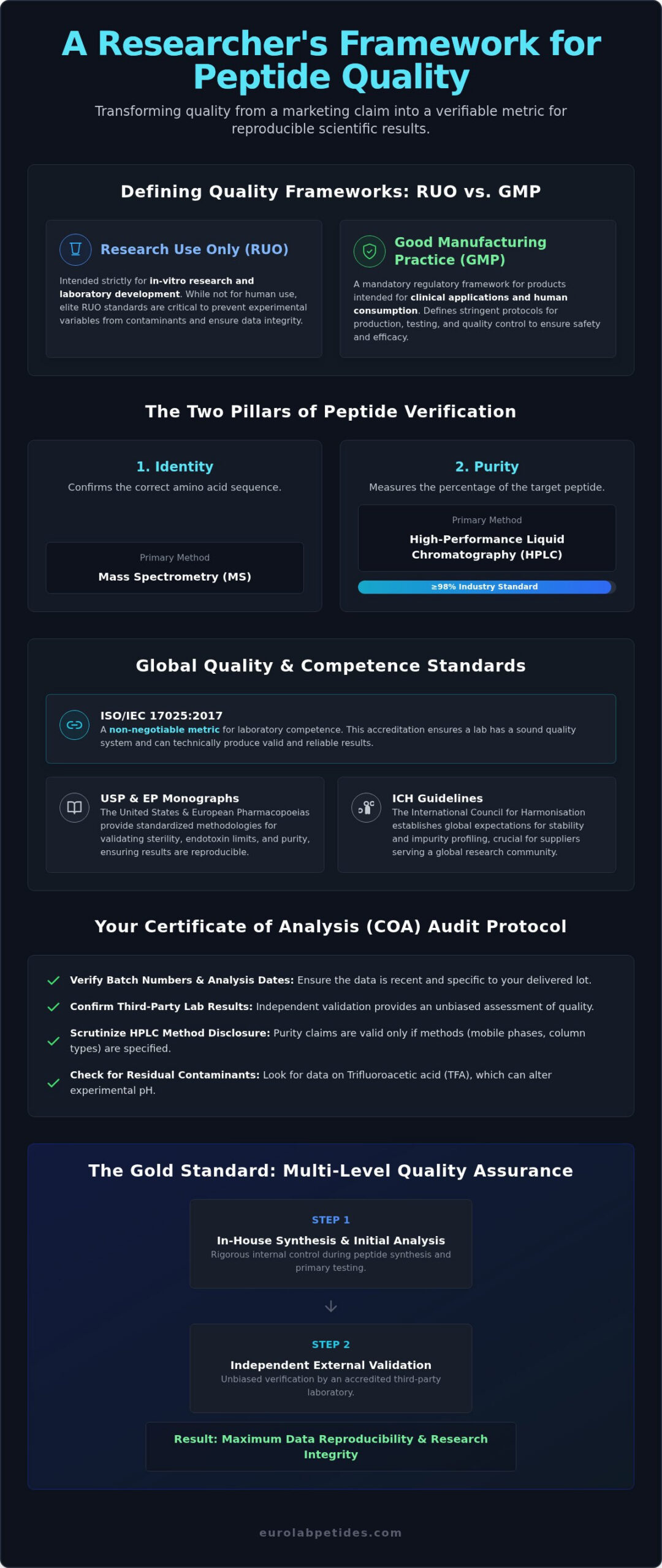
The distinction between Research Use Only (RUO) and Good Manufacturing Practice (GMP) is primarily regulatory rather than purely chemical. While GMP protocols are mandated for clinical applications and human consumption, RUO peptides are intended strictly for in-vitro research and laboratory development. However, the absence of clinical oversight doesn’t excuse a lack of rigor. High-purity RUO peptides must mirror pharmaceutical-grade analytical profiles to ensure that experimental variables aren’t introduced by contaminants. If the chemical foundation is unstable, the research results are invalid.
A common error in procurement is conflating analytical identity with chemical purity. Identity confirms that the sequence of amino acids is correct via Mass Spectrometry (MS). Purity, usually determined by High-Performance Liquid Chromatography (HPLC), measures the percentage of the target peptide relative to all other substances in the sample. A purity claim of >98% is functionally meaningless unless the standardized testing methods, such as the specific mobile phases and column types used in HPLC, are disclosed. The process of chemical peptide synthesis inherently produces truncated sequences and deletion fragments that must be rigorously filtered and identified before a batch is cleared for use.
The Role of RUO in Laboratory Development
RUO peptides exist within a specific regulatory boundary that permits their use in laboratory settings but strictly prohibits administration to humans. Despite this, the stakes remain high. Using sub-standard chemicals in sensitive assays can lead to false-positive results or the premature termination of a study due to toxic impurities. Elite RUO standards demand that every batch undergoes the same analytical scrutiny as clinical precursors to protect the integrity of the scientific record and ensure that laboratory findings are reproducible in future studies.
Why Purity is a Variable Metric
Purity requirements are dictated by the specific application. Nuclear Magnetic Resonance (NMR) spectroscopy might necessitate a different purity tier than routine cell culture maintenance. A critical factor often overlooked is the presence of residual Trifluoroacetic acid (TFA). TFA is used during the cleavage stage of synthesis; if it isn’t properly removed or exchanged, it can alter the pH of the research environment and yield misleading data. The industry standard for “high-purity” research peptides is defined as ≥98% as determined by HPLC analysis.
The Pharmacopeial Standards: USP, EP, and ICH Guidelines
Pharmacopeial standards provide the essential baseline for research peptide quality standards. While many suppliers claim “pharmaceutical grade,” this term is only valid if testing aligns with the United States Pharmacopeia (USP) or the European Pharmacopoeia (EP). These frameworks convert abstract purity claims into reproducible data points. They ensure that independent laboratories can verify results using identical methodologies. For the professional researcher, these standards turn “high purity” from a marketing assertion into a verifiable and comparable data point.
The International Council for Harmonisation (ICH) establishes global expectations for stability and impurity profiling. For a European supplier, harmonizing EP and USP requirements is mandatory to serve a global research community. This intersection ensures that a peptide synthesized in a European facility meets the same rigorous benchmarks required by North American institutions. This harmonization bridges the gap between clinical-grade precursors and research-grade materials, maintaining a consistent analytical thread across the development lifecycle.
Critical USP Chapters for Peptide Analysis
USP <71> defines the protocols for sterility testing, which is vital for solution-based research models where microbial contamination could alter cellular responses. USP <85> outlines the Bacterial Endotoxin Testing (BET) using the Limulus Amebocyte Lysate (LAL) method. This is critical because endotoxins can trigger inflammatory pathways, confounding results in complex biological assays. Finally, USP <1057> provides the framework for the identity and quantification of biotechnology-derived articles, ensuring the peptide matches its theoretical molecular weight and sequence. For those requiring validated materials, reviewing a Longevity Research Stack ensures these analytical benchmarks are met.
ICH Guidelines for Stability and Impurities
ICH Q1A–Q1F guidelines dictate how shelf-life is established through accelerated and long-term stability testing. This data is essential for maintaining the integrity of lyophilized samples over time, preventing degradation that could compromise longitudinal data. ICH Q3A/B focuses on classifying and quantifying organic impurities, while ICH Q3D addresses elemental impurities like heavy metals. These heavy metals, such as lead or arsenic, are often residual catalysts from the synthesis process and must be strictly monitored to prevent cellular toxicity. Adherence to these ICH guidelines ensures that every batch remains stable and free from contaminants that could skew experimental outcomes.
Analytical Rigor: ISO/IEC 17025 and Verification Methods
ISO/IEC 17025:2017 is the non-negotiable benchmark for laboratory testing and calibration competence. While many suppliers present analytical data, the validity of that data is contingent upon the accreditation of the facility. This international standard ensures that the laboratory operates with impartiality and follows a documented management system for technical operations. It incorporates risk-based thinking to mitigate the possibility of systematic error or data manipulation. Without this accreditation, research peptide quality standards cannot be objectively verified, as the facility’s ability to produce precise and accurate results hasn’t been externally validated.
Analytical rigor extends beyond basic testing to include counter-ion analysis and residual solvent quantification. Counter-ions, such as acetate or trifluoroacetate (TFA), must be quantified to ensure they fall within specified limits, as excessive concentrations can induce cytotoxicity in cell culture models. Residual solvent testing via Gas Chromatography (GC) is utilized to detect traces of acetonitrile or dichloromethane. These metrics are fundamental for maintaining the absolute security of in-vitro research environments and ensuring that observed biological effects are attributable solely to the peptide sequence.
High-Performance Liquid Chromatography (HPLC) Protocols
Reverse-phase High-Performance Liquid Chromatography (HPLC) is the primary methodology employed to isolate the target peptide from synthesis byproducts. The process relies on the differential affinity of the peptide and its impurities for the stationary phase within the column. A single, sharp chromatographic peak serves as the primary evidence of chemical purity. HPLC measures the amount of the target peptide relative to other UV-absorbing substances. This quantification, typically performed at wavelengths of 214nm or 220nm, is essential for ensuring that the experimental substrate is free from truncated sequences or unreacted reagents that could interfere with biochemical assays.
Mass Spectrometry (MS) for Identity Confirmation
Identity confirmation is achieved through Electrospray Ionization Mass Spectrometry (ESI-MS) or Matrix-Assisted Laser Desorption/Ionization Time-of-Flight (MALDI-TOF). These techniques confirm the exact molecular mass of the peptide by measuring the mass-to-charge ratio of ions. MS analysis is critical for identifying “deletion sequences” or incomplete synthesis products that may share similar retention times with the target molecule in HPLC. A successful validation requires the observed mass to match the theoretical molecular weight within a strict tolerance, typically +/- 1 Dalton. This step ensures that the synthesized sequence is identical to the requested primary structure.
Audit Protocol: Evaluating Certificates of Analysis (COA)
A Certificate of Analysis (COA) serves as the primary document of record for every synthesized batch. It’s the non-negotiable proof that a product meets established research peptide quality standards. To ensure data integrity, researchers must execute a structured audit of these documents before integrating any material into a study. This process begins with verifying the batch number and the specific date of analysis to ensure the material hasn’t exceeded its validated shelf-life. Referencing a how to buy research peptides checklist can assist in streamlining this initial verification phase and identifying discrepancies in supplier paperwork.
Inspection of the HPLC chromatogram is the next critical phase of the audit. A stable baseline and clear peak integration are required to confirm the reported purity percentage. Any evidence of “shoulder peaks” or baseline noise suggests the presence of closely related impurities or deletion sequences that could interfere with cellular signaling. Following this, the Mass Spectrometry (MS) spectrum must be cross-referenced with the theoretical molecular mass of the peptide. For instance, in a BPC-157 technical guide, the expected mass must align precisely with the observed (M+H)+ or (M+Na)+ ions within the MS data. If the observed mass deviates by more than 1 Dalton from the theoretical structure, the identity of the peptide is unverified.
Secondary analytical tests provide a more granular view of the sample composition and shouldn’t be ignored. Karl Fischer titration is used to determine the exact water content, which is a common byproduct of the lyophilization process. High water or residual salt content can result in a lower actual peptide concentration than the gross weight suggests, leading to inaccurate dosing in in-vitro models. Total peptide content is a critical metric that distinguishes elite samples from those containing excessive fillers or residual solvents.
Spotting Red Flags in Supplier Documentation
Vigilance is required to identify “generic” or recycled chromatograms that appear identical across multiple batches. This practice indicates a systemic failure in individual batch testing and a lack of analytical rigor. Missing laboratory signatures or the absence of a time-stamped date of analysis are significant indicators of poor quality oversight. COAs that omit raw analytical data, providing only a summary percentage without the corresponding graphs, don’t meet the requirements for high-stakes professional inquiry. Verification of these metrics is essential for maintaining the Advanced Metabolic Stack standards required in modern biochemistry. If a supplier refuses to provide raw data upon request, the transparency of their manufacturing process is compromised.
EuroLab Peptides: A Multi-Level Quality Assurance Protocol
EuroLab Peptides implements a dual-layered verification system to ensure that every batch adheres to elite research peptide quality standards. This protocol begins with stringent in-house synthesis controls and concludes with independent validation from accredited external facilities. By prioritizing empirical data over anecdotal claims, the laboratory provides an objective framework for researchers who require absolute security in their longitudinal data. Precision is not optional. This methodical approach ensures that the chemical purity and analytical identity of every peptide are not merely asserted but proven through a sequence of rigorous technical checks. The focus remains on the demands of the specialized community, where accuracy is a functional requirement for successful in-vitro research.
The commitment to European regional manufacturing standards serves as a marker for reliability in a global market often fraught with quality concerns. Every production run is documented with a proof-first flow that respects the user’s intelligence, moving from raw synthesis data to final third-party validation. This level of logistical transparency ensures that the provenance of each peptide is fully traceable. By maintaining these high-stakes precision metrics, EuroLab projects a persona of radical accountability, positioning itself as a reliable partner for serious professional inquiry. The synthesis process is characterized by a clinical attention to detail that eliminates the batch-to-batch variability often associated with opaque supplier protocols.
Independent Third-Party Validation
Manufacturer bias is a systemic risk in the chemical synthesis industry that can only be mitigated through external validation. EuroLab partners exclusively with independent laboratories that maintain ISO/IEC 17025:2017 accreditation to perform objective analysis on each production run. These facilities are selected based on their technical competence in HPLC and MS methodologies, ensuring that the results are derived from standardized and impartial testing environments. Transparency is maintained by providing raw analytical data for researcher review, allowing for a thorough audit of baseline stability and peak integration. This commitment to external oversight transforms quality from a subjective promise into a verifiable metric, instilling a sense of absolute security in the professional user.
Stability and Handling Standards
Maintaining the structural integrity of synthetic peptides requires specialized post-synthesis handling. Lyophilization, or freeze-drying, is utilized as the standard method for ensuring maximum stability and extending the shelf-life of research-grade samples. Before shipping, all materials are subjected to strict storage protocols, maintained at temperatures of -20°C or -80°C to prevent thermal degradation. These logistical standards are non-negotiable components of the quality assurance process, ensuring that the molecular structure remains intact during transit and long-term storage. Researchers can View our third-party tested research peptides to evaluate the comprehensive data sets available for each batch. This meticulous handling ensures that the products remain elite tools for laboratory development and cellular studies.
Securing the Analytical Integrity of 2026 Research
The trajectory of biochemical inquiry in 2026 is defined by a shift toward radical transparency and empirical certainty. Adherence to research peptide quality standards requires a clinical synthesis of pharmacopeial benchmarks and ISO-accredited verification. By implementing rigorous audit protocols for Certificates of Analysis and demanding raw HPLC and MS data, researchers effectively eliminate the risks of batch variability. These technical frameworks aren’t merely administrative; they’re the essential foundation for reproducible in-vitro data.
EuroLab Peptides supports this level of scientific rigor through a multi-level quality control protocol and the availability of independent third-party laboratory COAs for every batch. Every product is manufactured strictly for in-vitro research grade application, ensuring that your laboratory development remains insulated from the inconsistencies of the global market. We invite you to Explore our range of third-party validated research peptides to enhance the security of your longitudinal studies. It’s your focus on analytical excellence that advances professional inquiry with absolute confidence.
Frequently Asked Questions
What is the difference between peptide purity and peptide content?
Peptide purity represents the percentage of the target sequence compared to other UV-absorbing impurities as measured by HPLC. In contrast, net peptide content refers to the actual weight percentage of the peptide in the lyophilized powder, excluding residual water and counter-ions. A sample might show 98% purity while only having 80% peptide content. This distinction is vital for accurate molar calculations in experimental protocols.
Does a research peptide need to be GMP-grade to be considered high-quality?
GMP-grade isn’t a prerequisite for research-grade quality, though it’s mandatory for clinical use. High-quality research materials are defined by their adherence to research peptide quality standards, specifically 98% purity and verified molecular identity. While GMP focuses on manufacturing processes for human safety, research-grade quality focuses on analytical consistency and data reproducibility in the laboratory. Analytical rigor remains the priority for in-vitro development.
What are the common impurities found in synthetic research peptides?
Common impurities in synthetic peptides include truncated sequences, deletion fragments, and residual reagents from the synthesis process. These byproducts often result from incomplete coupling cycles during chain elongation. Additionally, residual solvents such as acetonitrile or dichloromethane and counter-ions like trifluoroacetate are frequently present. Identifying these substances through comprehensive MS analysis is essential to ensure they don’t introduce variables into cellular or metabolic research models.
How can I verify if a third-party testing laboratory is legitimate?
Legitimate third-party laboratories are identified by their ISO/IEC 17025:2017 accreditation. This international standard confirms the facility’s technical competence and impartiality in testing and calibration. You should cross-reference the laboratory’s name with accreditation bodies and verify that each Certificate of Analysis includes a unique batch number, a valid timestamp, and a professional signature. These markers ensure the data is objective and hasn’t been recycled from previous batches.
Why is HPLC alone sometimes insufficient for peptide characterization?
HPLC is insufficient for full characterization because it only measures the relative purity of UV-absorbing substances based on retention time. It doesn’t confirm the primary structure or molecular weight of the peptide. Mass Spectrometry is necessary to verify the exact mass of the synthesized molecule. Without MS, a researcher can’t be certain that the sequence is correct, as different peptides can occasionally exhibit similar retention times under specific chromatographic conditions.
What does “RUO” mean for laboratory peptide sourcing?
RUO is a regulatory designation meaning “Research Use Only,” which restricts the material to in-vitro studies and laboratory development. This classification ensures that the peptides are used strictly for biochemical inquiry and aren’t administered to humans. It allows for the procurement of specialized sequences for cellular models while maintaining clear boundaries regarding clinical application. RUO materials must still meet high analytical benchmarks to ensure experimental integrity.
How do residual solvents like TFA affect in-vitro research results?
Residual TFA can alter the pH of the research environment, leading to unintentional cytotoxicity or changes in protein folding. These effects can confound longitudinal data in metabolic or cellular studies. Adhering to rigorous research peptide quality standards requires quantifying these residual solvents to ensure they fall within acceptable limits. If TFA levels are too high, the resulting biological observations may be attributable to the solvent rather than the peptide itself.
What is the standard shelf-life for lyophilized research peptides?
Lyophilized peptides generally exhibit a shelf-life of 24 months when stored at -20°C and up to 60 months at -80°C. Proper storage in a desiccated environment is required to prevent hydrolysis and oxidation, which can degrade the peptide sequence over time. Once the material is reconstituted in a sterile buffer, stability decreases significantly. Reconstituted solutions should be aliquoted and stored at -20°C to minimize freeze-thaw cycles and maintain molecular integrity.
