

The integrity of in-vitro myogenesis studies depends entirely on the verifiable purity of the chemical catalysts employed, yet many laboratories continue to operate with compounds that lack comprehensive analytical validation. Achieving reproducible results in cellular hypertrophy models requires more than just high-level hypothesis; it demands access to reagents that meet a purity threshold of ≥99% as verified by independent HPLC and LC-MS testing. It’s understood that the lack of technical documentation on peptide synergy often complicates the transition from theoretical modeling to empirical data collection.
This technical profile provides a comprehensive scientific overview of the Muscle Research Stack, detailing the specific biochemical pathways and rigorous laboratory protocols required for professional inquiry. You’ll gain a deeper understanding of how growth hormone secretagogues and tissue repair agents function within a stacked environment to modulate cellular growth mechanisms. We’ll examine the necessary standards for reconstitution and handling that ensure the stability of your research-grade compounds throughout the duration of your study, providing the empirical foundation needed to establish standardized laboratory benchmarks.
Key Takeaways
- Distinguish research-grade peptide combinations from consumer products through a rigorous focus on cellular signaling and in-vitro applications.
- Evaluate the biochemical synergy of the Muscle Research Stack, focusing on how combined secretagogues modulate the growth hormone axis in laboratory models.
- Master standardized reconstitution techniques to preserve the stability and bioactivity of lyophilized compounds during long-term research cycles.
- Utilize independent third-party Certificates of Analysis (COA) to verify chemical purity and ensure the reproducibility of experimental data.
- Navigate the European regulatory framework for research peptides to secure compliant, high-purity materials for specialized biotech inquiry.
Understanding the Muscle Research Stack in Laboratory Settings
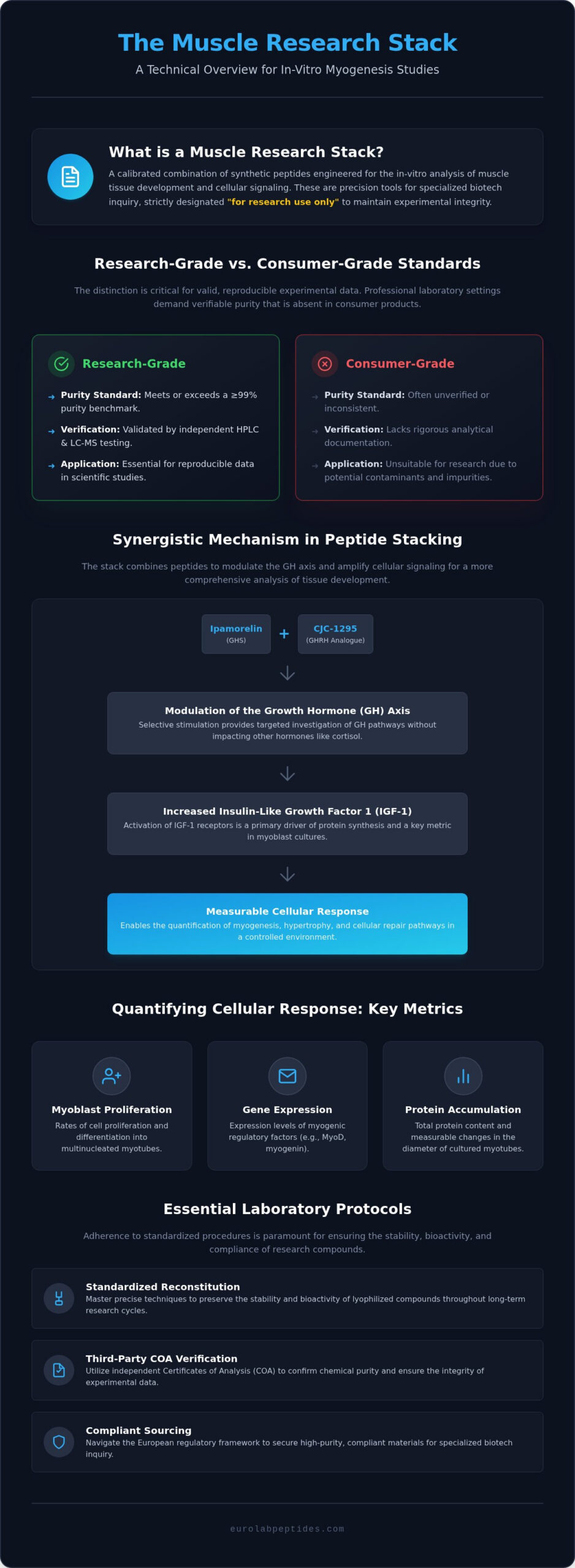
A Muscle Research Stack is defined as a calibrated combination of synthetic peptides engineered specifically for the in-vitro analysis of muscle tissue development and cellular signaling. These stacks are not consumer products; they’re precision tools designed for specialized biotech inquiry. In professional environments, strict adherence to the “for research only” designation is a non-negotiable standard. This ensures that all investigations into cellular growth mechanisms are conducted within the boundaries of established laboratory safety and regulatory compliance. By isolating these compounds from consumer contexts, researchers maintain the integrity of their experimental environments.
The primary objectives within this field of research involve the study of myogenesis, hypertrophy, and cellular repair pathways. By utilizing a multi-peptide approach, researchers observe how different signaling molecules interact simultaneously within a culture. This provides a more comprehensive view of tissue development than single-compound assays can offer. It’s the synergy between these compounds that allows for the mapping of complex biochemical responses in preclinical models.
The Role of Peptides in Myogenesis Models
Researchers employ specific peptide sequences to investigate the activation of satellite cells, which are the primary precursors to muscle fiber formation. This process, known as Myogenesis, is a critical focus for understanding how tissue responds to external stimuli at a molecular level. The use of a standardized Muscle Research Stack allows for the consistent modulation of these pathways across multiple experimental cycles. Standardized chemical synthesis is essential for longitudinal studies to ensure that data remains reproducible and free from variables introduced by batch-to-batch inconsistency. Key metrics for quantifying cellular response in these models include:
- Rates of myoblast proliferation and differentiation into multinucleated myotubes.
- Quantifiable expression levels of myogenic regulatory factors such as MyoD and myogenin.
- Total protein accumulation and changes in the diameter of cultured myotubes.
Research-Grade vs. Consumer-Grade Standards
The necessity of high-purity reagents can’t be overstated in a professional laboratory setting. While consumer-grade products often lack rigorous testing, research-grade peptides must meet a purity benchmark of ≥99% to ensure valid experimental data. This quality is verified through objective analytical methods like High-Performance Liquid Chromatography (HPLC) and Mass Spectrometry (LC-MS). Anecdotal claims from fitness communities are entirely irrelevant to biochemical research because they lack empirical validation and controlled variables. For a deep dive into the molecular signaling of specific compounds, practitioners should consult the Ipamorelin technical profile. This level of technical rigor ensures that the resulting data is a true reflection of the peptide’s biochemical influence rather than the result of structural impurities or contaminants.
Primary Peptide Components for Muscle Tissue Investigation
The primary utility of the Muscle Research Stack lies in its ability to target diverse signaling pathways within the in-vitro myogenesis process. Unlike herbal extracts or anabolic supplements, these peptide combinations are selected for their high-precision interaction with specific receptors. Growth Hormone Secretagogues (GHS) and Growth Hormone Releasing Peptides (GHRPs) are foundational to these models. They provide the necessary stimuli to investigate insulin-like growth factor (IGF-1) pathways, which are critical for observing cellular signaling in muscle tissue cultures. Research indicates that the activation of IGF-1 receptors is a primary driver of protein synthesis in myoblast cultures, making it a central metric for evaluating the efficacy of stacked compounds.
Growth Hormone Secretagogues (GHS) in Laboratory Inquiry
Ipamorelin is frequently utilized as a selective secretagogue because it stimulates growth hormone release without significantly impacting cortisol or prolactin levels. This selectivity allows researchers to isolate the GH axis with high specificity. CJC-1295 is often paired with Ipamorelin to investigate the effects of prolonged half-life on GHRH receptor affinity. By utilizing a tetrasubstituted peptide structure, CJC-1295 remains stable for extended observation periods, allowing for the study of sustained signaling pulses. Sermorelin serves as a foundational tool for pituitary axis research, providing a consistent baseline for measuring endogenous signaling responses in controlled environments. These compounds are essential for mapping the complex feedback loops that regulate tissue hypertrophy in preclinical models.
Peptides for Cellular Repair and Proliferation
Tissue repair agents are integral to the Muscle Research Stack, offering a way to study the transition from inflammatory response to tissue regeneration. BPC-157, a stable gastric pentadecapeptide, is studied for its potential role in modulating the muscle-to-tendon healing process. Research models focus on its ability to enhance the expression of growth factor receptors and promote angiogenesis. TB-500, a synthetic version of the active region of Thymosin Beta-4, is analyzed for its role in actin sequestration and cellular migration. It’s often used to investigate how actin-binding proteins influence the structural integrity of developing myotubes. When these repair agents are stacked with growth-oriented secretagogues, they create a synergistic environment. This synergy allows for the investigation of complementary pathways, where the proliferative stimulus of GHS compounds is balanced by the regenerative signaling of repair peptides. For laboratories requiring verified purity for these inquiries, EuroLab Peptides provides the necessary analytical documentation to support high-stakes research.
Synergistic Mechanisms in Peptide Stacking Models
In laboratory inquiry, synergy is defined as the potentiation of biological signaling where the combined effect of multiple agents exceeds the sum of their individual contributions. Within a Muscle Research Stack, this interaction is carefully engineered to avoid receptor saturation while maximizing complementary pathway activation. Researchers observe that single-agent protocols often reach a plateau in signaling amplitude; however, multi-agent stacks bypass these limitations by engaging distinct receptor populations simultaneously. This approach mirrors complex physiological environments, providing a more accurate model for studying tissue development. Quantifying these synergistic effects requires rigorous data collection, typically involving Western blot analysis or ELISA assays to verify that the observed growth is a result of specific pathway activation.
GHRH and GHRP Interaction: A Research Perspective
The co-administration of Ipamorelin (a GHRP) and CJC-1295 (a GHRH) is a standard protocol for investigating the GH axis in cellular models. Ipamorelin functions by mimicking ghrelin and binding to the Growth Hormone Secretagogue Receptor (GHSR), which triggers a rhythmic release pulse. Conversely, CJC-1295 binds to the GHRH receptor, amplifying the magnitude of that pulse. A critical component of this synergy is the inhibition of somatostatin, the peptide responsible for halting GH release. By suppressing this inhibitory signal, the stack allows for a significantly higher signaling amplitude than either compound could achieve alone. This “Pulse” methodology is often contrasted with “Bleed” models, where continuous background elevation is studied to observe long-term receptor desensitization and its impact on signaling efficiency.
Metabolic Pathway Regulation in Tissue Studies
Advanced research often focuses on the chemical induction of myogenic stem cells and the subsequent modulation of protein synthesis pathways. The Muscle Research Stack serves as a catalyst for investigating the Mammalian Target of Rapamycin (mTOR) pathway, a primary regulator of cellular growth and hypertrophy. By monitoring phosphorylation levels of downstream targets like p70S6K, researchers can quantify the rate of protein synthesis in response to peptide stimuli. This data is essential for understanding how exogenous peptides drive the maturation of myoblasts into functional myotubes.
In addition to direct myogenic effects, these stacks are utilized to study secondary metabolic shifts. This includes the investigation of nitrogen retention metrics, which serve as a proxy for anabolic efficiency in cellular models. Researchers also analyze the impact of these compounds on glucose metabolism and lipid oxidation, mapping how peptide-induced signaling alters the metabolic profile of cultured cells. By isolating these variables, the laboratory can establish a clear biochemical profile of the stack’s influence on the overall metabolic environment of the tissue culture.
Laboratory Protocols for Handling and Reconstitution
The reproducibility of in-vitro data relies on the meticulous execution of handling and reconstitution protocols. When utilizing a Muscle Research Stack, researchers must implement standardized procedures to prevent peptide degradation and ensure the chemical integrity of the multi-agent system. Cross-contamination in multi-peptide experiments is a significant risk factor that can be mitigated through the use of dedicated pipetting equipment and aseptic technique within a laminar flow hood. Every step, from the initial unboxing to the final application in cellular cultures, must be documented to maintain the rigor of the experimental model.
Lyophilization is the gold standard for maintaining peptide stability by removing moisture through sublimation under vacuum conditions. This process results in a stable, porous cake that preserves the structural integrity of the peptide sequence for long-term research. In its lyophilized state, a Muscle Research Stack is significantly less susceptible to proteolytic degradation compared to peptides in aqueous solution. This stability is critical for longitudinal studies where batch consistency is paramount.
Reconstitution Methodology for Researchers
Selecting the appropriate solvent is the first critical decision in the reconstitution process. Bacteriostatic water, which contains 0.9% benzyl alcohol, is typically preferred for multi-use vials to inhibit bacterial growth. However, for specific in-vitro applications where benzyl alcohol might interfere with cellular viability or signaling pathways, sterile 0.9% saline is often the necessary alternative. Researchers must calculate precise concentrations based on the molar mass of each peptide within the stack to ensure that the final media concentration matches the intended experimental parameters. It’s recommended to allow the solvent to flow gently down the side of the glass vial rather than directly onto the lyophilized powder to avoid mechanical stress and foaming.
Storage and Stability in Laboratory Environments
Maintaining cold-chain integrity is essential for preserving the bioactivity of reconstituted peptides. For short-term use, vials should be stored at 2°C to 8°C. For long-term preservation, lyophilized peptides are best maintained at -20°C or -80°C to prevent gradual hydrolysis. Light exposure and physical agitation are known to accelerate the degradation of delicate peptide bonds; therefore, vials should be stored in opaque containers and handled with minimal vibration. Researchers seeking to establish high-purity sourcing protocols should consult our guide on how to buy research peptides for comprehensive details on purity and laboratory standards. To ensure the highest levels of precision in your next study, you can source verified research stacks that meet these rigorous technical requirements.
Sourcing High-Purity Research Stacks in Europe
Sourcing a Muscle Research Stack in the current 2026 regulatory climate requires a transition from retail-focused acquisition to analytical procurement. In Europe, the legal framework defined by Directive 2001/83/EC and the Human Medicines Regulations 2012 mandates that these compounds are explicitly labeled for in-vitro use and carry no therapeutic claims. Identifying reputable suppliers involves evaluating their multi-level quality control processes rather than relying on anecdotal marketing guarantees. EuroLab Peptides operates with a commitment to objective data, ensuring that every batch is subjected to external validation before it enters the supply chain. This transparency is essential for researchers who must justify the chemical integrity of their reagents in peer-reviewed contexts.
Verifying Purity Through Analytical Chemistry
High-Performance Liquid Chromatography (HPLC) is employed as the primary metric for verifying peptide identity and purity. This methodology separates chemical components within a sample, allowing for the quantification of the target peptide against potential impurities, with a non-negotiable benchmark of ≥ 99% purity. Mass Spectrometry (MS) is simultaneously utilized to ensure the precise molecular weight of the compound, confirming that the chemical synthesis aligns with the theoretical sequence. Independent, third-party validation is mandatory for serious professional inquiry; in-house testing results are often viewed with skepticism in the scientific community due to the potential for bias. By demanding external Certificates of Analysis (COA) for every Muscle Research Stack, laboratories protect the validity of their longitudinal studies.
Logistical Reliability and Compliance
Regional manufacturing and distribution within Europe offer significant advantages for maintaining consistent supply chains and avoiding the logistical volatility often associated with international sourcing. As of August 2026, the European Medicines Agency (EMA) has increased its scrutiny of peptide distribution, making compliance with localized regulatory standards a critical factor for laboratory procurement. Sourcing within the region ensures that transit times are minimized, which is vital for preserving the cold-chain integrity required for peptide stability. Professionals can buy research peptides Europe from sources that prioritize scientific rigor and provide transparent access to analytical data. This methodical approach to sourcing guarantees that the reagents meet the high-stakes precision required by the specialized research community.
Advancing In-Vitro Myogenesis Through Analytical Precision
The establishment of reproducible benchmarks in muscle tissue research necessitates a transition from observational modeling to rigorous biochemical inquiry. By integrating synergistic peptide pathways, researchers can effectively map the complex signaling networks that drive cellular hypertrophy and repair. The utility of the Muscle Research Stack is defined by its ability to modulate these pathways with high specificity, provided that the reagents meet the absolute purity standards required for professional laboratory applications. It’s essential to maintain this level of technical rigor to ensure that experimental data remains valid across multiple cycles.
Reliability in this specialized field is achieved only through the application of standardized reconstitution protocols and the verification of chemical identity via independent third-party HPLC and MS analysis. Accessing high-purity compounds within a regional European supply chain ensures both logistical consistency and regulatory compliance for ongoing longitudinal studies. You can secure high-purity Muscle Research Stacks for your laboratory inquiry at EuroLab Peptides, where a multi-level quality control protocol guarantees the analytical excellence required for high-stakes biotech inquiry. We look forward to supporting the precision and integrity of your next research phase.
Frequently Asked Questions
What is a muscle research stack used for in a laboratory?
A Muscle Research Stack is utilized to investigate the biochemical pathways governing muscle tissue development and repair in controlled laboratory environments. These combinations allow researchers to observe synergistic effects between signaling molecules, such as growth hormone secretagogues and tissue repair agents. By applying these stacks to in-vitro cultures, laboratories can map the complex interactions involved in myoblast proliferation and differentiation, providing empirical data for preclinical hypertrophy models.
Are these peptides intended for human consumption or athletic performance?
No, these peptides are strictly for in-vitro research and laboratory development only. They’re not intended for human consumption, medical use, or the enhancement of athletic performance. Every compound is categorized as a research chemical, meaning it’s designated for use in specialized professional settings. Adhering to this classification is a non-negotiable standard to ensure that all investigations remain within the boundaries of established safety and regulatory protocols for chemical synthesis.
Which peptides are typically found in a muscle research stack?
A standard Muscle Research Stack typically includes a combination of growth hormone secretagogues and tissue repair agents. Common components include Ipamorelin for selective signaling, CJC-1295 for extended receptor affinity, and BPC-157 for investigating regenerative mechanisms. Other agents like TB-500 may be included to study actin sequestration. This specific blend is engineered to target multiple, complementary pathways within muscle tissue cultures, allowing for a comprehensive analysis of cellular growth and structural integrity.
How should research stacks be stored to maintain biochemical integrity?
Lyophilized peptides should be stored in a temperature-controlled environment, ideally at -20°C or -80°C for long-term preservation. Once reconstituted, vials must be kept at 2°C to 8°C and used within a specified timeframe to prevent hydrolysis. Protection from light exposure and minimal physical agitation are also critical to prevent the degradation of delicate peptide bonds. Maintaining these strict storage parameters ensures that the chemical potency and stability of the research compounds remain consistent throughout the study.
What is the importance of third-party testing for muscle research peptides?
Independent third-party testing provides objective verification of chemical purity and molecular identity, which is essential for data reproducibility. Researchers must demand Certificates of Analysis (COA) that utilize High-Performance Liquid Chromatography (HPLC) and Mass Spectrometry (MS) to confirm that reagents meet a purity benchmark of ≥99%. Without this external validation, experimental results can be compromised by structural impurities or batch-to-batch inconsistencies, undermining the scientific integrity of the entire longitudinal research project.
Can different peptides in a stack be reconstituted together?
While peptides are often studied as part of a stack, they’re typically reconstituted in separate vials to maintain precise concentration control and prevent premature cross-reactivity. Each compound may require a specific solvent volume to reach the target molarity for the experimental media. Reconstituting them individually allows researchers to adjust the ratios of each agent within the culture environment accurately. This methodical approach ensures that the observed synergistic effects result from controlled interactions rather than unregulated chemical reactions.
What are the legal requirements for purchasing research peptides in Europe?
In Europe, the purchase of synthetic peptides for laboratory use is permitted under frameworks like Directive 2001/83/EC, provided they’re explicitly labeled “not for human consumption.” Reputable suppliers must comply with regional regulations and localized logistics to ensure reliable delivery. It’s the responsibility of the researcher to verify that their procurement aligns with national laws and institutional safety standards. All transactions are conducted with the understanding that these materials are elite tools for professional biotech inquiry only.
How do researchers measure the efficacy of a muscle research stack in vitro?
Efficacy is measured through quantifiable metrics such as the rate of myoblast differentiation into multinucleated myotubes and the expression of myogenic regulatory factors. Analytical techniques like Western blot or ELISA are used to monitor the activation of protein synthesis pathways, specifically the mTOR pathway. Researchers also track changes in total protein accumulation and myotube diameter. These empirical results allow for the objective assessment of how the peptide stack influences the developmental profile of the muscle tissue culture.
