

A 24-week Phase 2b clinical trial involving 536 participants failed to show a statistically significant difference in weight loss for AOD-9604, yet this peptide remains a primary focus in modern metabolic biochemistry. For many investigators, the disconnect between these large-scale human trials and the compelling data from obese Zucker rat models, which showed a weight gain reduction of over 50 percent, creates a complex landscape for AOD-9604 research. It’s common to feel a sense of ambiguity when clinical outcomes don’t mirror the high-precision results seen in controlled in-vitro environments.
This technical examination provides a definitive analysis of the C-terminal fragment’s molecular structure, specifically the Tyr-hGH 177-191 sequence. We’ll clarify the biochemical mechanisms that allow for lipolysis without the systemic interference of IGF-1 or negative impacts on insulin sensitivity. You’ll gain a comprehensive understanding of the compound’s antilipogenic properties and the standardized handling protocols necessary to preserve its 1815.1 g/mol molecular integrity. The following sections detail the analytical benchmarks and storage requirements essential for ensuring reproducible data in high-stakes laboratory settings.
Key Takeaways
- Identify the precise molecular structure of the Tyr-hGH 177-191 fragment and understand how the added N-terminal tyrosine preserves peptide stability during in-vitro study.
- Differentiate between lipolytic and antilipogenic mechanisms by examining the fragment’s interaction with β3-adrenergic receptors in specialized adipose models.
- Evaluate the historical data of AOD-9604 research, providing a technical comparison between successful preclinical rodent trials and the complexities of Phase 2b human study results.
- Investigate secondary research potential in tissue repair, specifically focusing on chondrocyte regeneration and the biochemical synergy observed when combined with other fragments like BPC-157.
- Establish critical laboratory handling protocols, from selecting the correct reconstitution media to verifying batch purity through standardized HPLC and MS analytical metrics.
Chemical Identity of AOD-9604: Structure and Molecular Profile
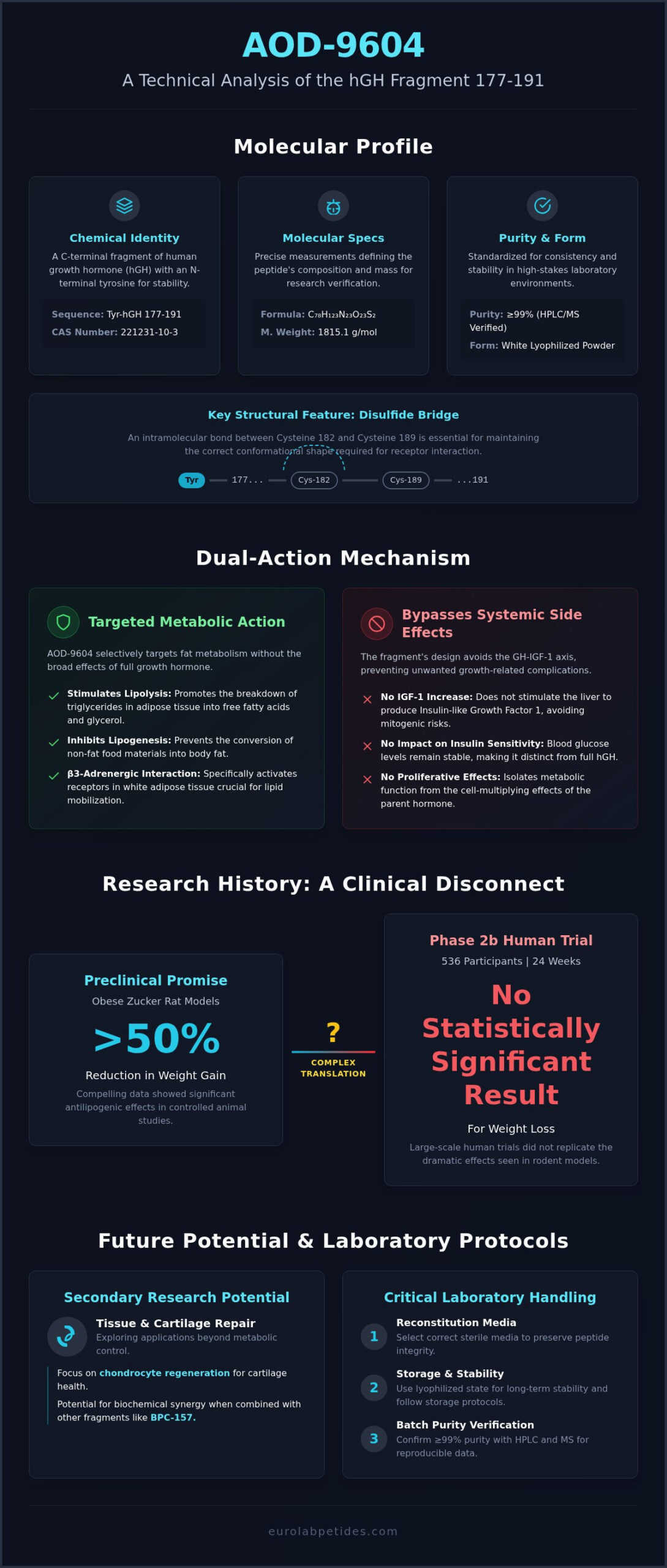
AOD-9604 is a synthetic peptide analog derived from the C-terminal region of the human growth hormone (hGH). It focuses specifically on the sequence of amino acids 177-191. This fragment is modified by the addition of an N-terminal tyrosine residue; this structural adjustment is critical for enhancing metabolic stability and resistance to enzymatic degradation in aqueous environments. The compound possesses a molecular weight of approximately 1815.1 g/mol and is defined by the chemical formula C78H123N23O23S2. Unlike the full-length 191-amino acid human growth hormone, AOD-9604 is engineered to isolate specific metabolic functions from the hormone’s broader systemic growth-promoting activities.
The Significance of the 177-191 Sequence
The C-terminus is established in biochemical literature as the primary domain responsible for modulating lipid metabolism. By isolating this sequence, researchers can study lipolytic pathways without the proliferative effects typically associated with the N-terminus of hGH. This distinction is critical in AOD-9604 research because it avoids the induction of insulin-like growth factor 1 (IGF-1). High IGF-1 levels are often linked to unwanted cellular proliferation and decreased insulin sensitivity, which are common side effects of full-length hGH administration. When compared to other hGH fragments, the 177-191 sequence demonstrates a high degree of specificity for adipocyte modulation. This AOD-9604 overview confirms that the fragment maintains the fat-reducing properties of the parent hormone while discarding its mitogenic characteristics. This specificity allows for the exploration of weight management mechanisms without the metabolic trade-offs seen in broader hormonal studies.
Molecular Identification and Cataloging
For precise laboratory reference, the compound is cataloged under CAS Number 221231-10-3. It’s produced as a white lyophilized powder, a physical state that ensures long-term stability during transport and storage. This lyophilization process removes moisture while preserving the peptide’s delicate structure, though it necessitates specialized reconstitution protocols to maintain molecular integrity. A defining structural feature of the peptide is the disulfide bridge formed between cysteine residues 182 and 189. This intramolecular bond is essential for maintaining the correct conformational shape required for receptor interaction. Every batch utilized in AOD-9604 research must undergo rigorous verification through HPLC and mass spectrometry to confirm this specific amino acid sequence (Tyr-hGH 177-191). These analytical metrics ensure that the disulfide linkage is intact and that the peptide purity meets the ≥99% threshold required for reproducible in-vitro results.
Mechanisms of Action: Lipolysis and Adipocyte Modulation
The primary function of AOD-9604 involves the targeted stimulation of lipolysis and the simultaneous inhibition of lipogenesis within adipose tissue. Unlike non-selective metabolic stimulants, this fragment interacts specifically with β3-adrenergic receptors. These receptors are densely populated in white adipose tissue and play a critical role in mediating catecholamine-induced thermogenesis and lipid mobilization. By activating these pathways, the peptide facilitates the hydrolysis of triglycerides into free fatty acids and glycerol. This targeted approach is essential for investigators focusing on metabolic syndrome models, as it addresses the underlying mechanics of fat storage without disrupting broader endocrine functions.
Bypassing the GH-IGF-1 Axis
A significant advantage identified in AOD-9604 research is the compound’s inability to elevate systemic insulin-like growth factor-1 (IGF-1) levels. Full-length human growth hormone (hGH) induces IGF-1 through hepatic signaling, which can lead to adverse effects like organomegaly or impaired glucose tolerance. Because AOD-9604 lacks the N-terminal sequences required for growth-promoting receptor binding, it isolates the metabolic benefits of hGH from its mitogenic risks. Experimental observations consistently show that blood glucose levels remain stable during study, even in models of glucose intolerance. This makes the peptide a safer tool for isolating metabolic pathways in long-term studies compared to full hGH. It’s particularly useful in projects focused on buying research peptides that don’t interfere with glycemic control.
Enzymatic Modulation in Fat Cells
The molecular efficacy of the fragment is further evidenced by its modulation of key enzymes. Detailed analysis of the AOD-9604 molecular profile reveals how it enhances the activity of hormone-sensitive lipase (HSL). HSL is the rate-limiting enzyme for the mobilization of stored fats. Concurrently, the peptide inhibits acetyl-CoA carboxylase, which is the primary enzyme responsible for the synthesis of new fatty acids (lipogenesis). In-vitro adipocyte cultures treated with the fragment show significantly increased lipid oxidation rates. In preclinical studies using obese Zucker rats, these enzymatic shifts contributed to a reduction in weight gain exceeding 50 percent compared to control groups. This dual-action mechanism-accelerating breakdown while preventing new storage-distinguishes the fragment from simple thermogenic agents. The absence of IGF-1 interference ensures that observations remain focused on lipid-specific pathways without the confounding variables of systemic cellular proliferation.
AOD-9604 Research History: From Rodent Success to Phase 2b Challenges
The historical trajectory of AOD-9604 research is defined by a significant contrast between early laboratory successes and later clinical complexities. Initial investigations focused on the compound’s ability to replicate the lipolytic effects of hGH without inducing systemic growth. These studies established a foundation for metabolic inquiry that continues to influence modern in-vitro protocols. While other growth hormone secretagogues like ipamorelin act by stimulating the ghrelin receptor to release endogenous GH, AOD-9604 functions as a direct analog of the C-terminal fragment, bypassing the pituitary entirely. This fundamental difference in mechanism is why the fragment remains a specialized tool for isolating lipid-specific pathways.
Preclinical Efficacy in Obese Rodent Models
Early chronic treatment data in Zucker rats provided the most compelling evidence for the fragment’s lipolytic potential. In these models, a 500 µg/kg oral dose resulted in a greater than 50% reduction in weight gain. These investigations demonstrated clear reductions in abdominal fat mass and significant improvements in lipid profiles. Researchers established precise dosage-response curves, confirming that the fragment maintained its structural integrity and metabolic activity across various administration routes. These results suggested that the disulfide bridge between residues 182 and 189 was sufficient to facilitate receptor interaction and drive lipid mobilization in rodent adipocytes. The data from these rodent models provided the empirical basis for moving into large-scale human investigations.
Analyzing the Translation Gap
The transition from rodent success to human application culminated in the pivotal 24-week Phase 2b clinical trial, known as Study META180. This investigation involved 536 participants and sought to validate the weight loss efficacy observed in earlier models. However, the trial failed to demonstrate a statistically significant difference in weight loss compared to a placebo. This discrepancy between short-term metabolic activity and long-term outcomes has become a central focus of contemporary AOD-9604 research.
Several hypotheses explain this translation gap. Metabolic rate differences between species play a critical role; rodents possess a much higher surface-area-to-volume ratio and a higher density of β3-adrenergic receptors compared to humans. These physiological variations mean that while the biochemical mechanism remains sound in-vitro, the systemic rate of lipolysis in human subjects may not reach the threshold required for significant weight reduction over a 24-week period. For researchers, these findings underscore the importance of using the fragment to study specific cellular pathways rather than expecting broad systemic outcomes in complex biological systems.
Secondary Research: Cartilage Regeneration and Tissue Repair
While the primary focus of most AOD-9604 research has traditionally centered on adipose modulation, its secondary application in musculoskeletal recovery is expanding. Unlike the lipolytic actions discussed previously, this direction investigates the fragment’s anabolic signaling in non-vascularized tissue. This shift in biochemical inquiry allows investigators to explore structural repair in joint environments where full-length growth hormone might be contraindicated due to its systemic mitogenic risks. By isolating the C-terminal fragment, researchers can study regenerative pathways without the potential for unwanted cellular proliferation in non-target organs.
Chondrogenic Potential in In-Vitro Models
In-vitro models demonstrate that AOD-9604 stimulates the differentiation of mesenchymal stem cells into mature chondrocytes. This differentiation is essential for the formation of hyaline cartilage, which is the specific tissue type that degrades in chronic injury models. Data from animal studies suggest that intra-articular application promotes proteoglycan synthesis and collagen type II production, both of which are critical for maintaining joint elasticity. The fragment’s ability to reduce protease activity in joint fluid effectively slows the enzymatic degradation of the cartilage matrix. These markers indicate a potential for structural stabilization in damaged joints. Quantifying the reduction of inflammatory markers like IL-1β and TNF-α in connective tissue remains a priority for researchers seeking to define its anti-inflammatory profile in joint models.
Synergy in Tissue Repair Stacks
The efficacy of the fragment is frequently evaluated within multi-peptide stacks to assess synergistic outcomes. Studying AOD-9604 alongside BPC-157 allows researchers to observe simultaneous improvements in angiogenesis and chondrocyte proliferation. While AOD-9604 targets the metabolic health of the chondrocytes, BPC-157 facilitates the underlying vascular repair. In tendon-to-bone healing models, investigators often compare the fragment’s performance against TB-500. While TB-500 excels in migratory cell signaling, AOD-9604 provides a more targeted influence on the structural integrity of the cartilage itself. Combining these with GHRH analogs allows for the isolation of localized growth signaling on accelerated repair. For those advancing this field, EuroLab Peptides provides verified tools for Tissue Repair & Recovery Research, supported by full analytical documentation.
Future directions for musculoskeletal AOD-9604 research involve defining the exact signaling pathways that trigger collagen expression. These investigations require high-purity compounds to ensure that results aren’t confounded by manufacturing impurities or degraded peptide fragments. By focusing on the biochemical mechanics of the C-terminal fragment, the scientific community can better understand how localized metabolic modulation influences long-term tissue repair outcomes.
Laboratory Handling: Reconstitution, Stability, and Purity
The transition from theoretical modeling to empirical AOD-9604 research requires a rigorous adherence to standardized handling protocols. Maintaining the structural integrity of the Tyr-hGH 177-191 fragment is essential for ensuring that in-vitro observations remain reproducible and free from confounding variables. Investigators must prioritize analytical documentation, specifically third-party HPLC and Mass Spectrometry (MS) data, to confirm a purity threshold of ≥99%. This level of precision is necessary because even minor manufacturing impurities can disrupt the disulfide bridge between cysteine residues 182 and 189, effectively neutralizing the peptide’s lipolytic activity. When buying research peptides, professional users should verify that the compound is supplied in a lyophilized state, which is the most stable format for transit and long-term storage.
Stability is a critical factor in maintaining the peptide’s 1815.1 g/mol molecular profile. In its lyophilized form, AOD-9604 should be stored at -20°C for long-term preservation. European-based logistics and climate-controlled distribution channels are utilized to prevent thermal degradation during the shipping process. Once the vial’s vacuum seal is compromised for reconstitution, the compound’s susceptibility to enzymatic and environmental breakdown increases significantly.
Reconstitution and Solvent Compatibility
Reconstitution should be performed using either sterile bacteriostatic water or phosphate-buffered saline (PBS), depending on the specific requirements of the in-vitro assay. Bacteriostatic water is preferred for studies requiring multiple samplings from a single vial due to its antimicrobial properties. Conversely, PBS is often selected for cell culture applications to maintain physiological pH and osmotic balance. Concentration ranges typically fall between 1 mg/mL and 5 mg/mL to facilitate accurate pipetting and dilution. It’s vital to manage pH sensitivity during this process, as extreme deviations can lead to peptide aggregation or irreversible precipitation. Reconstituted AOD-9604 remains stable for up to 14 days when stored at a constant temperature of 4°C.
Analytical Verification and Quality Control
Interpreting an HPLC chromatogram is a fundamental skill in AOD-9604 research. A high-purity batch will display a single, sharp peak with a retention time consistent with the C-terminal fragment’s hydrophobic profile. The presence of “shoulder” peaks or secondary signals often indicates the presence of degradation products, such as deamidated or oxidized peptide variants. These impurities are common in poorly synthesized C-terminal fragments and can significantly skew metabolic data. The EuroLab Peptides multi-level quality control protocol ensures that every batch is accompanied by a Certificate of Analysis (COA), providing a verifiable metric of excellence. This proof-first approach respects the intelligence of the specialized community, ensuring that laboratory resources are focused on data collection rather than troubleshooting compound instability.
Advancing Metabolic Inquiry with High-Precision hGH Fragments
AOD-9604 research remains a vital field for investigators seeking to isolate the lipolytic properties of human growth hormone from its systemic mitogenic effects. By utilizing the Tyr-hGH 177-191 sequence, researchers can study targeted adipocyte modulation and chondrogenic regeneration without the metabolic interference of IGF-1. The historical data from Study META180 underscores the importance of focusing on precise biochemical pathways in controlled environments rather than broad clinical endpoints. Maintaining the molecular integrity of the disulfide bridge between residues 182 and 189 is the defining factor in achieving reproducible in-vitro results.
EuroLab Peptides ensures this level of scientific rigor by providing research-grade fragments with third-party HPLC and Mass Spectrometry verification. Every batch is guaranteed to meet a purity threshold of ≥99% and is supplied in a lyophilized state to preserve stability during transit. Our European-based laboratory standards and climate-controlled logistics provide a secure foundation for advanced metabolic inquiry. We’re committed to supporting the specialized community with the analytical documentation required for elite professional study.
View Analytical Data and Source AOD-9604 for Research
Frequently Asked Questions
What is the primary mechanism of action for AOD-9604 in research?
The primary mechanism involves the targeted stimulation of lipolysis and the concurrent inhibition of lipogenesis. This activity is mediated through the activation of β3-adrenergic receptors in adipose tissue models. By facilitating the hydrolysis of triglycerides into free fatty acids and glycerol, the fragment allows for the isolation of metabolic pathways. Researchers utilize this compound to observe lipid mobilization without the confounding variables associated with systemic growth signaling or mitogenic cellular proliferation.
Does AOD-9604 increase IGF-1 levels in laboratory models?
AOD-9604 does not elevate systemic IGF-1 levels in laboratory models. Because the peptide is a truncated analog of the C-terminal fragment, it lacks the specific N-terminal residues required for hepatic growth signaling. This characteristic is a central advantage in AOD-9604 research; it enables the study of lipid metabolism without the side effects of organomegaly or reduced insulin sensitivity often observed with full-length human growth hormone.
How does AOD-9604 differ from full-length human growth hormone?
Full-length human growth hormone is a 191-amino acid protein with broad systemic effects, whereas AOD-9604 is a synthetic 16-amino acid fragment. It consists of the Tyr-hGH 177-191 sequence, specifically engineered to isolate the metabolic properties of the parent hormone. While hGH promotes both growth and fat metabolism, this fragment focuses exclusively on adipocyte modulation. This truncation ensures that the compound does not influence bone growth or cellular proliferation during in-vitro assays.
What are the recommended storage conditions for lyophilized AOD-9604?
Lyophilized AOD-9604 should be stored in a freezer at -20°C to maintain long-term molecular stability. Exposure to room temperature should be minimized to prevent peptide degradation. Once the vial is reconstituted, the solution must be kept refrigerated at 4°C. Under these refrigerated conditions, the peptide remains stable for approximately 14 days. Proper storage protocols are essential to preserve the disulfide bridge between cysteine residues 182 and 189.
Is AOD-9604 effective for cartilage repair research?
Emerging evidence suggests the peptide has significant potential for cartilage repair research. In-vitro models indicate that the fragment stimulates mesenchymal stem cell differentiation into chondrocytes and promotes the synthesis of proteoglycans. These markers are critical for the regeneration of hyaline cartilage in animal injury models. Investigators also observe a reduction in inflammatory markers like IL-1β within damaged connective tissue, suggesting a role in structural stabilization and matrix preservation.
Why did AOD-9604 fail its Phase 2b clinical trials?
The 24-week Phase 2b clinical trial, known as Study META180, failed because it did not meet the primary endpoint of statistically significant weight loss compared to a placebo. While preclinical rodent models showed a weight gain reduction of over 50 percent, these results did not translate to the 536 human participants. Differences in metabolic rates and β3-adrenergic receptor density between species are often cited as the primary reasons for this discrepancy in AOD-9604 research.
What solvents are best for AOD-9604 reconstitution?
Sterile bacteriostatic water and phosphate-buffered saline (PBS) are the most compatible solvents for reconstitution. Bacteriostatic water contains benzyl alcohol, which preserves the solution for multiple samplings from a single vial. PBS is typically used in cell culture applications to maintain a physiological pH and prevent peptide aggregation. Researchers should avoid vigorous agitation during mixing; instead, a gentle swirling motion is recommended to preserve the delicate 1815.1 g/mol molecular structure.
Is AOD-9604 intended for human consumption or clinical use?
No, AOD-9604 is not intended for human consumption, clinical use, or as a pharmaceutical product. It is sold strictly for in-vitro research and laboratory development purposes only. EuroLab Peptides does not provide medical advice or dosage guidelines for humans. All compounds are research-grade chemicals meant for use by trained professionals in a controlled environment. Every batch is verified through HPLC and mass spectrometry to ensure it meets rigorous laboratory standards.
