

The June 2026 EMA guidelines now mandate reporting for any synthetic peptide impurity exceeding 0.1%, a threshold that renders traditional, less sensitive testing protocols obsolete for high-stakes research. The inconsistency of batches and the difficulty of interpreting complex HPLC/MS reports present significant risks to the reproducibility of experimental data. To mitigate these variables, a deep understanding of modern peptide purity analysis methods is required. This article provides a rigorous examination of the analytical methodologies used to verify the chemical purity and structural integrity of synthetic research peptides.
It’s essential to establish a verifiable metric for quality when navigating the complexities of specialized biochemistry. This framework is provided to facilitate the evaluation of peptide quality with precision, specifically focusing on the critical distinction between chromatographic purity and net peptide content. By the conclusion of this technical overview, a reliable sourcing protocol will be established, prioritizing empirical validation over anecdotal claims. We examine the specific roles of RP-HPLC and mass spectrometry in identifying impurities, ensuring your laboratory maintains the highest standards of objective, standardized excellence consistent with European manufacturing rigor.
Key Takeaways
- Distinguish between chromatographic purity and total mass to ensure experimental reproducibility in high-stakes research environments.
- Master the technical application of peptide purity analysis methods like RP-HPLC to isolate target sequences from synthesis-related impurities using C18 or C8 columns.
- Recognize why molecular weight confirmation via ESI or MALDI-TOF mass spectrometry is a non-negotiable requirement for verifying structural identity.
- Evaluate Net Peptide Content (NPC) to accurately account for residual water and counter-ions that impact the actual molar concentration of lyophilized materials.
- Implement a rigorous sourcing protocol that prioritizes independent third-party laboratory validation and batch-specific analytical reporting over anecdotal quality claims.
Analytical Benchmarks: Defining Peptide Purity in Research
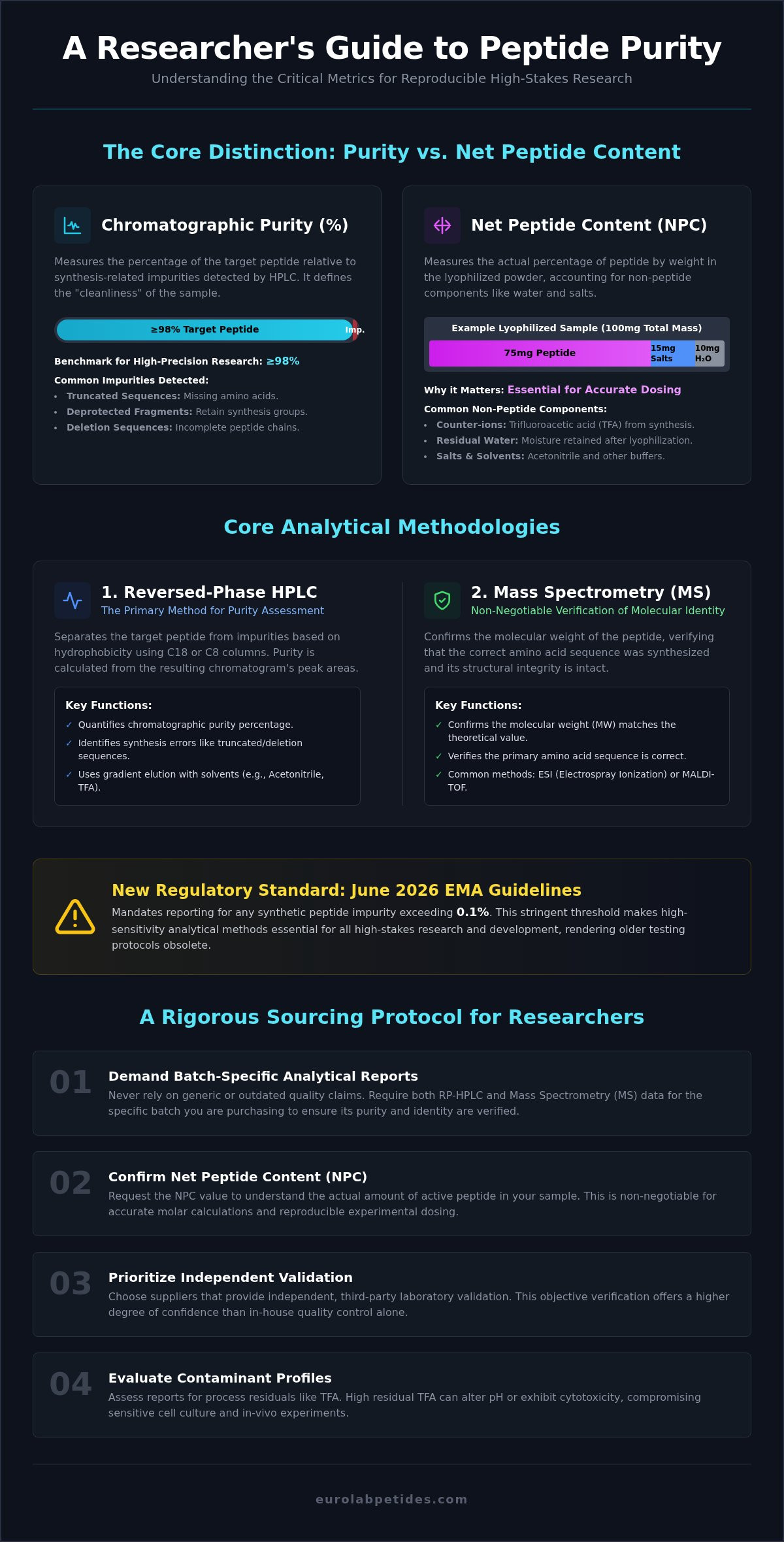
In the context of synthetic chemistry, purity is a quantifiable metric of identity and cleanliness. It isn’t a vague descriptor. Chromatographic purity is defined as the area percentage of the target peptide peak relative to the total area of all peaks detected via UV absorbance, typically at wavelengths of 214 nm or 220 nm. For high-precision in-vitro research, a benchmark of ≥98% purity is the established standard. Utilizing rigorous peptide purity analysis methods ensures that experimental results aren’t compromised by synthesis-related artifacts. Common impurities include truncated sequences, where specific amino acids are missing from the chain, or deprotected fragments that retain chemical groups from the synthesis process. These contaminants introduce confounding variables in cellular signaling and metabolic studies, potentially leading to data that lacks reproducibility or triggers unintended off-target effects.
Chemical vs. Biological Purity
It’s critical to distinguish between chemical byproducts and biological contaminants. While HPLC measures chemical integrity, it doesn’t typically detect endotoxins, pyrogens, or microbial presence. Trifluoroacetic acid (TFA) is the standard counter-ion used during solid-phase peptide synthesis (SPPS). If it isn’t properly exchanged or monitored, residual TFA can alter the pH of the culture media or exhibit direct cytotoxicity in sensitive cell lines. Residual salts and solvents like acetonitrile also influence peptide stability and solubility. These are vital factors for long-term storage and consistent dosing. Accurate identification of these components often involves specialized techniques. For instance, Peptide-mass fingerprinting provides a secondary layer of validation by confirming the identity of the primary sequence through mass analysis of its fragments.
Purity Requirements for Specific Research Fields
Research involving longevity and vitality models demands exceptional purity to avoid late-stage experimental failure due to cumulative toxicity from trace solvents. In tissue repair and recovery studies, where inflammatory markers are often measured, even minor impurities can trigger non-specific immune responses that mask the actual effects of the peptide. Cognitive function research requires a baseline of high structural integrity to ensure specific binding at neural receptors. When performing peptide purity analysis methods, the focus remains on eliminating truncated sequences that might act as competitive inhibitors. Establishing these benchmarks early in the procurement process allows researchers to maintain a “proof-first” methodology, ensuring that the chemical tools match the sophistication of the inquiry.
RP-HPLC: The Primary Methodology for Purity Assessment
Reversed-Phase High-Performance Liquid Chromatography (RP-HPLC) remains the foundational technique among peptide purity analysis methods. It operates through the hydrophobic interaction between peptide molecules and the stationary phase of a chromatography column. Most analytical protocols utilize C18 or C8 silica-based columns. C18 columns provide maximum retention for smaller, less hydrophobic peptides, while C8 columns are often selected for larger sequences to reduce the risk of irreversible binding. The separation process relies on a gradient elution, typically involving an aqueous mobile phase and an organic solvent like acetonitrile, both acidified with trifluoroacetic acid (TFA) to improve peak shape and resolution.
Interpreting the resulting chromatogram is the primary means of quantifying purity. The area under the curve (AUC) for the main peak is measured against the total area of all detected peaks. This ratio provides the percentage of chromatographic purity. High-stakes research demands a clear baseline and sharp peak resolution to ensure that minor contaminants aren’t masked by the primary signal. Utilizing a precise gradient is essential for detecting closely related impurities that might otherwise co-elute with the target sequence.
Detecting Truncated and Deletion Sequences
HPLC is particularly effective at identifying truncated and deletion sequences. These common synthesis errors occur when an amino acid is either missing or fails to couple correctly. Because these variants possess different hydrophobic properties than the target peptide, they elute at different retention times. However, HPLC has limitations when dealing with diastereomers or D-amino acid substitutions, which may exhibit nearly identical retention profiles. While HPLC separates these components based on hydrophobicity, it doesn’t provide structural confirmation. This necessitates the use of an advanced mass spectrometry protocol to verify that the separated fraction matches the expected molecular identity and mass.
Interpreting the Certificate of Analysis (COA)
A rigorous Certificate of Analysis must include the raw HPLC trace for independent verification. Researchers should scrutinize the report for baseline noise versus significant impurity peaks. A professional HPLC report should always specify the wavelength, typically 214nm or 220nm, used for detection. These wavelengths are chosen because they correspond to the absorbance of the peptide bond. If a report lacks this specification, the purity data cannot be considered definitive. For those conducting tissue repair and recovery research, ensuring that the COA reflects batch-specific testing is a critical step in maintaining experimental integrity. This level of transparency allows for the absolute security required in professional laboratory environments.
Mass Spectrometry: Confirming Molecular Integrity and Identity
While the previous section established the role of High-Performance Liquid Chromatography (HPLC) in separating impurities, it’s vital to recognize that chromatographic data alone doesn’t confirm molecular identity. A peak at a specific retention time merely indicates that a hydrophobic substance has eluted. Mass Spectrometry (MS) provides the necessary empirical evidence to verify that the substance is indeed the target peptide. By measuring the mass-to-charge (m/z) ratio, researchers can determine if the observed molecular weight aligns with the theoretical mass calculated from the amino acid sequence. This step is a cornerstone of rigorous peptide purity analysis methods, as it exposes synthesis errors that HPLC might overlook, such as amino acid substitutions or incorrect sequence orientations.
Two primary ionization techniques dominate the field: Electrospray Ionization (ESI) and Matrix-Assisted Laser Desorption/Ionization (MALDI-TOF). While MALDI is efficient for large proteins, ESI is the preferred standard for synthetic research peptides. It allows for the detection of multiple charge states, which provides a higher degree of confidence in the mass assignment. MS data effectively identifies post-translational modifications or unintended chemical additions, ensuring the structural integrity of the compound is preserved before laboratory application.
ESI-MS for Synthetic Peptide Validation
ESI-MS facilitates the validation of synthetic sequences through multi-charge state analysis. When a peptide is ionized, it often carries multiple protons, resulting in a series of peaks on the mass spectrum, such as [M+H]+ and [M+2H]2+. This distribution acts as a fingerprint for the molecule. Accuracy thresholds for research-grade materials typically require the observed mass to be within 0.1% of the theoretical value. This precision is essential for detecting incomplete deprotection. For example, a residual protecting group like Trityl or Pbf would result in a significant, predictable mass shift, immediately flagging a batch as sub-standard despite a seemingly clean HPLC trace.
Peptide Mapping and Fragmentation
For complex sequences or those requiring specific structural features, tandem mass spectrometry (MS/MS) is employed. This process involves fragmenting the peptide into smaller ions to confirm the primary sequence order, a technique often referred to as peptide mapping. It’s particularly useful for verifying the presence of disulfide bonds, which are critical for the biological activity of many peptides used in tissue repair and recovery models. Understanding the structural nuances within the BPC-157 technical guide highlights how precise sequence arrangement dictates the pentadecapeptide’s stability. By integrating MS/MS into peptide purity analysis methods, the risk of research contamination due to structural isomers is virtually eliminated, providing the absolute security necessary for advanced metabolic and cellular signaling studies.
Quantitative Analysis: Net Peptide Content vs. Purity
A common misconception in laboratory procurement is the conflation of chromatographic purity with Net Peptide Content (NPC). While peptide purity analysis methods such as RP-HPLC determine the ratio of the target sequence to other peptide impurities, they don’t account for non-peptide components. A lyophilized peptide cake is not composed entirely of the peptide itself. Instead, it typically contains residual water and counter-ions, such as trifluoroacetic acid (TFA) or acetate, which are necessary for maintaining stability and solubility during the synthesis and purification stages.
A report indicating 98% purity signifies that 98% of the peptide material present is the correct sequence. It doesn’t mean that 98% of the total vial weight is peptide. In practice, the NPC for synthetic research peptides usually ranges between 70% and 90%. If a researcher reconstitutes a 10mg vial assuming a 1:1 weight-to-peptide ratio, the resulting molar concentration will be lower than intended. This discrepancy has profound implications for precise laboratory dosing and the reproducibility of cellular signaling data. Establishing the NPC is a prerequisite for any rigorous quantitative study.
Amino Acid Analysis (AAA)
Amino acid analysis is the destructive hydrolysis of a peptide to quantify individual amino acid ratios. This methodology provides the most accurate assessment of absolute peptide concentration by breaking the peptide bonds and measuring the resulting free amino acids via ion-exchange or reversed-phase chromatography. When compared with UV spectrophotometry, AAA offers superior precision because it isn’t influenced by the absorbance of non-peptide impurities. It’s the gold standard for verifying the actual amount of proteinaceous material within a sample, ensuring that the empirical data matches the theoretical specifications provided by the manufacturer.
The Role of Karl Fischer Titration
Quantifying residual moisture is equally critical for ensuring long-term stability. Karl Fischer titration is the primary analytical technique used to measure water content in lyophilized powders. Because peptides are hygroscopic, they naturally attract atmospheric moisture, which can catalyze degradation pathways like hydrolysis or deamidation. High water content significantly reduces the shelf-life of research materials. Adhering to a strict guide on storing lyophilized peptides is necessary to prevent moisture-induced degradation after the vial has been unsealed. For researchers requiring the highest level of analytical transparency, EuroLab Peptides provides batch-specific NPC data to facilitate exact molar calculations. Explore our Advanced Metabolic Stack for materials validated through these rigorous quantitative protocols.
EuroLab Peptides’ Multi-Level Quality Protocol
EuroLab Peptides implements a multi-level quality control protocol that prioritizes objective data over marketing assertions. This systematic approach ensures that every batch undergoes rigorous verification before it enters the supply chain. While many suppliers rely on generic reports or outdated documentation, our commitment to batch-specific HPLC and MS verification provides researchers with the empirical certainty required for high-stakes laboratory work. Utilizing these advanced peptide purity analysis methods allows for the detection of trace impurities that could otherwise compromise the integrity of cellular signaling or metabolic studies.
Transparency is treated as a non-negotiable metric. Each product is accompanied by verifiable analytical data, allowing the user to confirm the chemical purity and structural identity of the material. This rigorous standard is maintained across all high-value research stacks, including the Longevity Research Stack and the Advanced Metabolic Stack. By providing this level of detail, we establish a baseline of absolute security for the professional community. It’s our belief that quality must be presented as a verifiable metric, not a marketing claim.
Independent Laboratory Standards
The reliance on in-house testing alone creates an inherent risk of bias that is unacceptable in professional research environments. EuroLab Peptides utilizes independent third-party laboratory validation to ensure that all results are accurate and impartial. These external facilities employ standardized peptide purity analysis methods to verify our internal findings, creating a “proof-first” validation sequence. This commitment to external oversight is paired with the security of European-based logistics, ensuring that regional regulatory compliance is met at every stage of the supply chain. For those seeking to establish a reliable procurement framework, our guide on how to buy research peptides safely in Europe provides a comprehensive overview of these laboratory standards and sourcing protocols.
Stringent Sourcing for Research Excellence
Maintaining the integrity of peptides for longevity, muscle, and metabolic research requires a refusal to accept anecdotal quality evidence. The EuroLab Peptides signature is characterized by an unwavering reliance on technical analysis. Whether a project involves the Recovery Research Stack or specific agents like SLU-PP-332, the quality is presented as a verifiable metric. We understand that the sophisticated demands of the specialized community require tools of elite precision. Rigorous analysis is the only metric that matters in professional inquiry. By providing batch-specific evidence of purity and identity, we serve as a meticulous and reliable partner for the most demanding research applications. This approach minimizes the risk of research contamination and ensures that experimental outcomes are driven by the peptide sequence rather than unintended chemical artifacts.
Securing Experimental Integrity Through Precise Methodology
Experimental success in specialized biochemistry depends on the absolute verification of chemical tools. This technical overview has established that peptide purity analysis methods must extend beyond simple chromatographic area percentages. A rigorous protocol requires the synergistic application of RP-HPLC for impurity separation and mass spectrometry for structural confirmation. Distinguishing between chromatographic purity and net peptide content is essential for accurate molar calculations. It’s the only way to ensure reproducible laboratory dosing. These metrics provide the empirical foundation necessary to eliminate confounding variables in cellular signaling and metabolic studies.
EuroLab Peptides remains committed to a multi-level quality control protocol that utilizes independent laboratory validation for every batch. By prioritizing verifiable analytical metrics over anecdotal evidence, we ensure that specialized in-vitro research grade materials meet the highest standards of objective excellence. We invite you to view our range of third-party tested research peptides to secure the precision required for your next inquiry. Maintaining these high-stakes standards facilitates a transparent, reliable partnership for the global research community. Your pursuit of scientific excellence is supported by our commitment to radical honesty and sophisticated chemical synthesis.
Frequently Asked Questions
What is the difference between peptide purity and net peptide content?
Peptide purity refers to the percentage of the target peptide relative to other peptide-based impurities as measured by HPLC. In contrast, net peptide content indicates the actual weight of the peptide in a lyophilized vial, accounting for non-peptide components like residual water and counter-ions like TFA. Understanding this distinction is vital for researchers using peptide purity analysis methods to calculate precise molar concentrations for in-vitro experiments.
Why is RP-HPLC considered the gold standard for peptide analysis?
Reversed-Phase High-Performance Liquid Chromatography (RP-HPLC) is the gold standard because it provides exceptional resolution for separating peptide chains based on hydrophobicity. By utilizing C18 or C8 columns, it allows for the precise quantification of the target sequence against synthesis-related artifacts. The resulting chromatogram offers a verifiable metric of purity through Area Under Curve (AUC) calculations, ensuring that the material meets the rigorous demands of professional scientific inquiry.
How does mass spectrometry confirm the identity of a peptide?
Mass spectrometry confirms identity by determining the precise molecular weight of the peptide through its mass-to-charge (m/z) ratio. This empirical data is compared against the theoretical mass of the intended amino acid sequence. Techniques like Electrospray Ionization (ESI) allow for high-stakes precision, detecting even minor mass shifts caused by incomplete deprotection or incorrect amino acid substitutions. This ensures structural integrity before the commencement of any laboratory development protocols.
What are the most common impurities found in synthetic peptides?
Synthetic peptides frequently contain impurities such as truncated sequences, where the chain is incomplete, or deletion sequences missing specific amino acids. Deprotected fragments and residual solvents from the synthesis process, like acetonitrile or trifluoroacetic acid (TFA), are also common. These contaminants are identified through rigorous peptide purity analysis methods to prevent confounding variables in sensitive research models, such as those involving tissue repair or cognitive function.
Is a 95% purity level sufficient for in-vitro research applications?
While a 95% purity level may be acceptable for initial screening, high-precision in-vitro research typically requires ≥98% purity. Lower purity levels increase the risk of off-target effects and data inconsistency due to the presence of truncated fragments. For studies involving cellular signaling or metabolic pathways, the higher benchmark is a non-negotiable standard to ensure that observed biological responses are attributable solely to the target peptide sequence.
How should I interpret the HPLC chromatogram on a Certificate of Analysis?
Interpreting an HPLC chromatogram involves identifying the primary peak and calculating its area relative to the total area of all detected signals. A professional trace should show a stable baseline with minimal noise and clearly resolved impurity peaks. It’s critical to verify the detection wavelength, which is typically 214nm or 220nm. Any significant peaks outside the main retention time indicate contaminants that could compromise the reproducibility of your experimental data.
Why does EuroLab Peptides emphasize independent third-party testing?
EuroLab Peptides prioritizes independent third-party validation to eliminate the inherent bias of in-house testing. External laboratory verification provides an objective, standardized metric of quality that ensures radical honesty and accountability. This multi-level protocol guarantees that every batch meets specific numerical benchmarks for purity and identity. It instills a sense of absolute security for researchers who require verifiable analytical metrics for high-stakes laboratory development and specialized metabolic inquiries.
Can impurities in research peptides affect the results of longevity studies?
Impurities can significantly alter the outcomes of longevity and vitality research by inducing cellular stress or non-specific inflammatory responses. Trace chemical byproducts or residual solvents often confound the measurement of metabolic markers, masking the true biological activity of the peptide. Utilizing materials with verified structural integrity ensures that the experimental data remains accurate. This level of precision is essential for maintaining the sophisticated standards required in the specialized professional community.
