
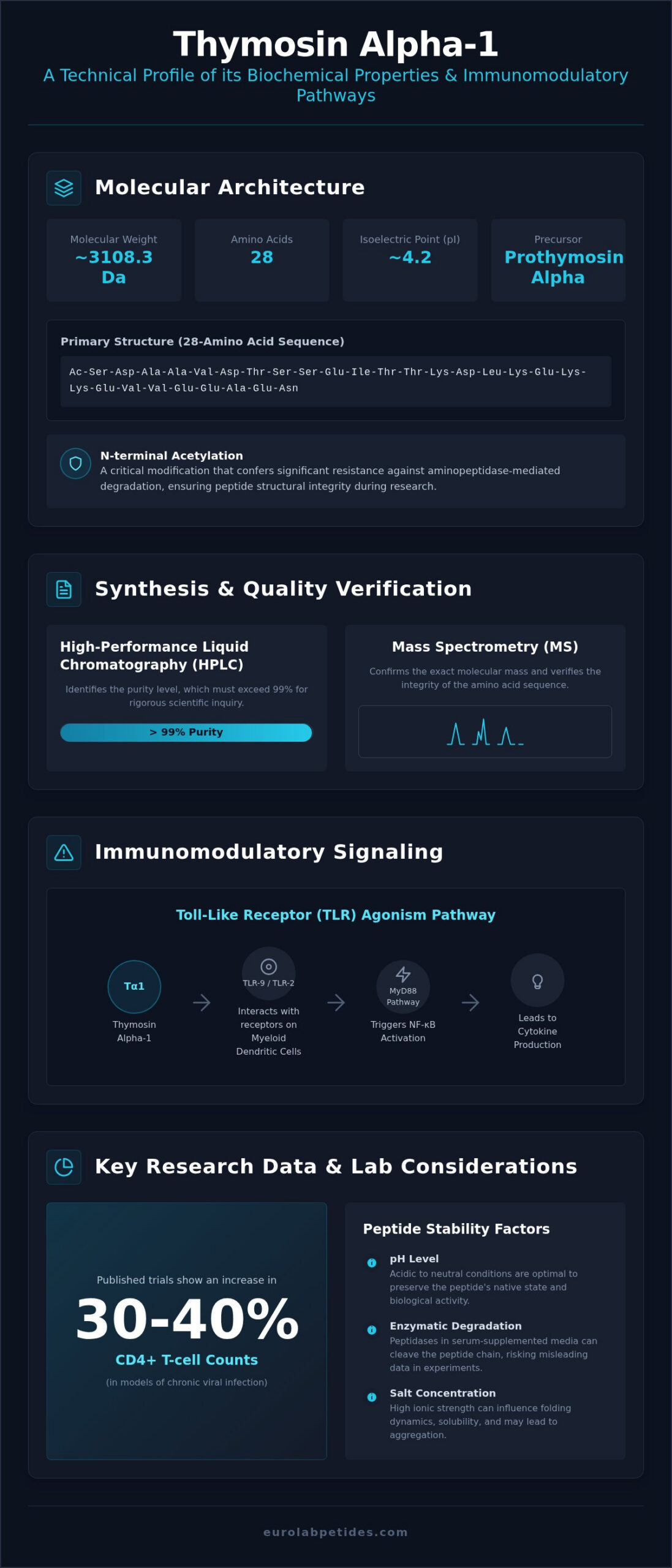
Published clinical trials show that Thymosin Alpha-1 can increase CD4+ T-cell counts by 30 to 40 percent in models of chronic viral infection, yet the utility of any Thymosin Alpha-1 research remains entirely dependent on the structural integrity of its 28 amino acid sequence. You’ve likely encountered the frustration of conflicting data regarding cytokine expression levels or the inherent instability of peptides during long-term laboratory storage. These variables often stem from inconsistent purity standards and improper handling protocols that compromise molecular morphology. Analytical precision is non-negotiable when investigating pleiotropic modulators that interact with Toll-like receptors and specific intracellular signaling cascades.
This technical profile delivers a rigorous scientific examination of Thymosin Alpha-1 biochemical properties and its complex immune-modulatory pathways. We’ll provide a comprehensive understanding of Tα1 signaling mechanisms while establishing a standardized laboratory reconstitution protocol to ensure peptide stability. By the conclusion, you’ll possess the analytical framework necessary to verify sourcing through HPLC and Mass Spectrometry, ensuring your inquiry meets the highest metrics of scientific precision. This guide prioritizes verifiable metrics and objective data to support the rigorous demands of the specialized research community.
Key Takeaways
- Identify the structural specifications of the 28-amino acid sequence and its origin as an N-terminally acetylated peptide derived from Prothymosin Alpha.
- Analyze the pleiotropic signaling pathways that drive T-cell maturation and MHC upregulation within current Thymosin Alpha-1 research models.
- Evaluate the biochemical role of Tα1 in modulating the tumor microenvironment and viral replication cycles during in-vitro investigations.
- Implement standardized laboratory reconstitution protocols to maintain peptide stability and ensure precise molarity for cellular assay concentrations.
- Establish rigorous quality benchmarks using HPLC and Mass Spectrometry to verify reagent purity and eliminate the risk of residual solvent contamination.
Molecular Architecture and Chemical Properties of Thymosin Alpha-1
Thymosin Alpha-1 (Tα1) is defined as a highly acidic, N-terminally acetylated peptide consisting of a specific 28-amino acid sequence. It’s derived from the proteolytic cleavage of the 113-amino acid precursor, Prothymosin Alpha, which is primarily localized within the nucleus of mammalian cells. The primary structure follows the sequence: Ac-Ser-Asp-Ala-Ala-Val-Asp-Thr-Ser-Ser-Glu-Ile-Thr-Thr-Lys-Asp-Leu-Lys-Glu-Lys-Lys-Glu-Val-Val-Glu-Glu-Ala-Glu-Asn. For analytical identification, the molecular weight is calculated at approximately 3108.3 Daltons, with an isoelectric point (pI) of roughly 4.2. This Thymosin α1 overview highlights its historical discovery and biochemical relevance in thymic research. The N-terminal acetylation isn’t merely a structural feature; it’s a critical modification that confers significant resistance against aminopeptidase-mediated degradation. This modification ensures the peptide maintains its intended conformation during Thymosin Alpha-1 research involving receptor binding assays and intracellular signaling studies.
Synthesis and Characterization of Research-Grade Tα1
High-purity Tα1 is typically produced using Fmoc-based Solid-phase peptide synthesis (SPPS). This methodical approach allows for the precise assembly of the 28-amino acid chain with high yields. During the purification phase, the removal of residual trifluoroacetic acid (TFA) is essential. TFA is a common byproduct of the cleavage process, but its presence can interfere with delicate cellular assays due to inherent cytotoxicity and its ability to alter local pH. Verification of the final reagent is achieved through High-Performance Liquid Chromatography (HPLC) and Mass Spectrometry (MS). HPLC identifies the purity level, which must exceed 99% for rigorous inquiry, while MS confirms the exact molecular mass and sequence integrity. These analytical metrics provide the objective data required to validate that the synthesized product matches the theoretical chemical profile without contamination from truncated sequences or residual solvents.
Structural Stability in Aqueous Environments
In aqueous environments, Tα1 exhibits significant conformational flexibility. It lacks a well-defined secondary structure in pure water, but it’s known to adopt alpha-helical structures when interacting with hydrophobic environments or specific ligands. Stability is highly dependent on the pH of the buffer system; acidic to neutral conditions generally preserve the peptide’s native state. Researchers must account for rapid enzymatic degradation in vitro. Peptidases present in serum-supplemented media can cleave the peptide chain, potentially leading to misleading data in longitudinal experiments. Salt concentration also influences the folding dynamics and solubility of the peptide. High ionic strength may lead to aggregation or altered signaling outcomes in laboratory models. Precise control over the reconstitution environment is necessary to ensure the peptide remains biologically active and structurally intact throughout the duration of the study.
Mechanisms of Action: Immunomodulatory Signaling in Cellular Models
The immunomodulatory capacity of Thymosin Alpha-1 is primarily realized through its role as a toll-like receptor (TLR) agonist. Specifically, Tα1 interacts with TLR-9 and potentially TLR-2 in myeloid dendritic cells. This interaction triggers the MyD88-dependent signaling pathway, leading to the activation of nuclear factor kappa B (NF-κB) and subsequent cytokine production. Within thymic research models, the peptide facilitates the maturation of terminal deoxynucleotidyl transferase (TdT) negative medullary thymocytes into immunocompetent T-cells. This differentiation is critical for establishing a balanced immune response in vitro. For those conducting Thymosin Alpha-1 research, verifying the biochemical integrity of the peptide is paramount to observing these specific receptor interactions accurately.
Upregulation of Major Histocompatibility Complex (MHC) Class I and II expression is another hallmark of Tα1 activity. By increasing the density of these surface markers, the peptide enhances the antigen-presenting capabilities of cells within experimental cultures. This mechanism is frequently explored in models of viral evasion where MHC expression is typically suppressed by the pathogen. Additionally, Tα1 modulates Natural Killer (NK) cell activity. In-vitro studies demonstrate increased NK cell-mediated cytotoxicity and enhanced recruitment to targeted cellular sites, suggesting a pleiotropic effect on the innate immune system.
Cytokine Modulation and Gene Expression
Tα1 promotes a shift toward a Th1-polarized immune response in various cellular environments. This is evidenced by the stimulated production of Interleukin-2 (IL-2), Interferon-gamma (IFN-γ), and Interleukin-12 (IL-12). Conversely, research settings often observe a downregulation of pro-inflammatory Th2 responses, including IL-4 and IL-10. This Thymosin alpha 1 scientific review details how these shifts are quantified across different laboratory settings. Quantitative PCR (qPCR) remains the standard methodology for assessing gene expression changes in peptide-treated cultures, providing empirical data on transcript levels following precise exposure intervals.
DNA Repair and Anti-Apoptotic Effects
Thymosin Alpha-1 research extends into the investigation of cellular stress response pathways and the preservation of DNA integrity. The peptide exhibits anti-apoptotic properties by interacting with p53 and related cell-cycle regulation proteins. In laboratory models, Tα1 has been shown to reduce oxidative damage by modulating antioxidant enzyme activity. This cytoprotective effect is particularly relevant in studies involving radiation-induced cellular stress or chemically induced oxidative toxicity. By stabilizing mitochondrial membrane potential, the peptide helps mitigate the activation of caspase cascades, thereby preserving cellular viability under adverse experimental conditions.
Research Applications: Oncology, Virology, and Longevity Models
Current Thymosin Alpha-1 research focuses heavily on its application within specialized cellular models to evaluate its potential as a pleiotropic modulator. In oncology research, investigations center on the peptide’s ability to alter the tumor microenvironment (TME) in vitro. Experiments typically analyze how Tα1 influences the maturation of dendritic cells and the suppression of myeloid-derived suppressor cells (MDSCs) within a simulated malignant environment. By modulating these cellular populations, researchers aim to understand the mechanisms that might overcome tumor-induced immunosuppression. These studies require analytical-grade reagents to ensure that observed changes in cell surface marker expression are attributable solely to the peptide’s primary sequence. It’s essential that researchers don’t overlook the importance of reagent purity when establishing these complex cellular assays.
Viral Pathogenesis and Replicative Studies
In-vitro models of viral pathogenesis utilize Tα1 to study interference with viral entry and replication cycles. Research involving Hepatitis B and HIV models often measures changes in viral titers following precise peptide titration. Establishing baseline metrics for these antiviral assays is critical for determining the half-maximal inhibitory concentration (IC50) in various cell lines. This Thymosin Alpha-1 Mechanisms and Clinical Applications Review provides a comprehensive data set for comparing laboratory findings with established biochemical benchmarks. By quantifying the reduction in viral protein synthesis, investigators can map the inhibitory pathways activated by Tα1 exposure in controlled environments. Scientific accuracy in these models depends on the use of HPLC-verified sequences to avoid data skewing from truncated peptide fragments.
Longevity and Cellular Senescence Research
Addressing immunosenescence is a primary objective in contemporary longevity studies. Laboratory models of cellular aging investigate the impact of Tα1 on telomere maintenance and overall cellular vitality. Researchers often utilize Tα1 as a core component of a broader longevity research stack to observe synergistic effects with other bioregulators. Establishing accurate dose-response curves is essential for senescence-focused in-vitro models, as it allows for the identification of optimal concentrations that promote DNA repair without inducing cytotoxicity. These studies frequently measure markers of senescence-associated secretory phenotypes (SASP) to evaluate the peptide’s role in mitigating age-related cellular decline. The objective nature of this inquiry relies on the use of mass spectrometry-verified peptides to maintain experimental reproducibility across different laboratory lots. Precise quantification of gene expression changes ensures that the resulting data remains valid for high-stakes professional inquiry.
Laboratory Protocol: Reconstitution, Stability, and Handling
Maintaining aseptic conditions is paramount when handling lyophilized Thymosin Alpha-1 to prevent microbial contamination that could invalidate experimental data. Before beginning any Thymosin Alpha-1 research, the molecular weight of approximately 3108.3 Daltons must be used to calculate molarity for specific cellular assay concentrations. Calculating the precise molar concentration involves dividing the mass of the peptide by its molecular weight and the desired volume of the solvent. Selecting the correct solvent is a critical variable in this process. While sterile deionized water is often sufficient for initial dissolution, phosphate-buffered saline (PBS) is preferred for maintaining physiological pH during in-vitro applications. Successful dissolution is characterized by a clear, colorless solution free of visible particulates or opalescence. The presence of any turbidity indicates incomplete solubility or peptide aggregation, which requires immediate troubleshooting before proceeding with the assay.
Step-by-Step Reconstitution for Researchers
The lyophilized vial must be equilibrated to room temperature for at least 20 to 30 minutes before the seal is removed. This prevents moisture condensation within the vial, which can lead to peptide degradation. Once the solvent is introduced, a gentle swirling motion is employed until the powder is fully dissolved. Vigorous vortexing is avoided as it can disrupt the secondary structure of the 28-amino acid chain and induce foaming. To preserve the integrity of the reagent, the solution is immediately divided into single-use aliquots. This protocol effectively eliminates repeated freeze-thaw cycles, which are known to cause significant proteolytic cleavage and loss of biological activity. Adhering to these rigorous standards ensures that research outcomes are based on a consistent, high-purity reagent. For researchers requiring verified analytical-grade materials, you can source analytical-grade Tα1 to ensure baseline experimental security.
Storage and Degradation Mitigation
Long-term stability of the lyophilized powder is best maintained at -20°C. Under these conditions, the peptide remains stable for approximately 24 months, provided the seal remains intact. Once reconstituted, Tα1 is stored under refrigerated conditions at 2 to 8°C for a maximum of 7 to 10 days. Beyond this window, the risk of enzymatic degradation and molecular instability increases. Protection from UV-induced photodegradation is also mandatory; vials should be stored in dark environments or wrapped in foil. These storage parameters are essential for maintaining the structural integrity of the peptide sequence, particularly during longitudinal studies. Any deviations from these temperature and light requirements can lead to peptide deamidation or oxidation, which alters the biochemical properties and reproducibility of the research inquiry.
Sourcing Analytical-Grade Thymosin Alpha-1 for Rigorous Inquiry
Analytical precision in Thymosin Alpha-1 research is contingent upon the absolute elimination of biochemical variables introduced by sub-standard reagents. Non-analytical grade peptides frequently harbor residual solvents, such as trifluoroacetic acid (TFA), or inorganic salts that alter the pH of cellular environments and skew experimental data. These impurities, alongside truncated peptide sequences, can interfere with receptor binding assays and signaling pathway analysis. High-Performance Liquid Chromatography (HPLC) and Mass Spectrometry (MS) are non-negotiable validation tools used to confirm both the purity and the identity of the 28-amino acid sequence. Reviewing lot-specific Certificates of Analysis (COA) is a mandatory prerequisite for any rigorous inquiry, as these documents provide empirical evidence of the product’s chemical profile. For a detailed breakdown of these metrics, see our guide to buying research peptides for quality benchmarks.
EuroLab Peptides: Multi-Level Quality Protocol
EuroLab Peptides implements a multi-tiered validation strategy to ensure that every batch meets the stringent requirements of the scientific community. Every lot undergoes independent third-party laboratory verification, where purity benchmarks must exceed 99% to be cleared for distribution. This level of refinement is critical for sensitive in-vitro models used in Thymosin Alpha-1 research, where even trace impurities can trigger non-specific cellular responses or compromise mitochondrial membrane potential. Standardized transparency is maintained through the inclusion of detailed chromatograms and mass spectra in the documentation provided to researchers. By prioritizing verifiable data and external validation over anecdotal evidence, the protocol instills absolute security in the professional user. This commitment to moral consistency and technical excellence positions the products as elite tools for serious professional inquiry.
European Logistics and Research Stability
Peptide integrity is further protected through optimized European logistics designed to minimize transit times and ensure regional regulatory compliance. Rapid delivery across the region reduces the duration of exposure to ambient conditions, which is essential for maintaining the structural stability of lyophilized Tα1. Secure, temperature-stable packaging is utilized for all high-value research chemicals to mitigate the risk of thermal degradation during transport. This localized approach ensures that reagents arrive at the laboratory in their optimal state, ready for the reconstitution and handling protocols established in earlier sections. You can secure high-purity Thymosin Alpha-1 for your laboratory at EuroLab Peptides, ensuring that your inquiry is supported by elite tools synthesized under the highest regional manufacturing standards.
Advancing Analytical Precision in Peptide Inquiry
The structural complexity of the 28-amino acid sequence requires a methodical approach to both synthesis and laboratory handling. Successful Thymosin Alpha-1 research relies on the absolute stability of the peptide during in-vitro assays; minor deviations in pH or temperature can lead to rapid molecular degradation. By adhering to standardized reconstitution protocols and utilizing HPLC-verified reagents, it’s possible to ensure that experimental data remains reproducible and accurately reflects the biochemical potential of the Tα1 molecule.
Maintaining 99%+ purity is the baseline for high-stakes professional inquiry. EuroLab Peptides provides the necessary verification through third-party HPLC/MS analysis and lot-specific documentation. This commitment to technical excellence allows for the precise execution of oncology, virology, and longevity models without the interference of residual solvents or contaminants. You are invited to Order Research-Grade Thymosin Alpha-1 from EuroLab Peptides to secure analytical-grade tools for your laboratory. Secure European distribution ensures the integrity of your reagents from synthesis to delivery. We look forward to supporting your next phase of rigorous scientific discovery.
Frequently Asked Questions
What is the difference between Thymosin Alpha-1 and Prothymosin Alpha?
Thymosin Alpha-1 is a specific 28-amino acid peptide fragment cleaved from the N-terminal region of Prothymosin Alpha, which is a larger 113-amino acid precursor protein. While Prothymosin Alpha is primarily localized in the nucleus and involved in chromatin remodeling, Tα1 is a highly acidic peptide that exhibits potent immunomodulatory properties. Researchers must distinguish between the precursor and the active fragment to ensure the correct molecular signaling is observed during laboratory investigations.
Is Thymosin Alpha-1 stable at room temperature during shipping?
Lyophilized Tα1 powder exhibits high structural stability and can withstand ambient temperatures during short-term transit without significant degradation. However, prolonged exposure to heat can compromise the peptide’s secondary structure. EuroLab Peptides utilizes optimized European logistics to minimize transit durations, ensuring that the reagent’s integrity is maintained from the point of synthesis to the laboratory. Once received, the vial should be immediately transferred to a temperature-controlled environment for long-term preservation.
What solvent is recommended for reconstituting Tα1 in an in-vitro assay?
Sterile deionized water or Phosphate-Buffered Saline (PBS) are the primary solvents recommended for reconstituting Tα1. While sterile water is sufficient for initial dissolution, PBS is often preferred for in-vitro assays because it maintains a stable physiological pH, which is critical for preserving peptide conformation. Researchers should avoid using solvents with high salt concentrations or extreme pH values, as these can induce aggregation or interfere with subsequent cellular signaling measurements.
How do I verify the purity of a Thymosin Alpha-1 research reagent?
Purity verification for Thymosin Alpha-1 research reagents requires High-Performance Liquid Chromatography (HPLC) and Mass Spectrometry (MS). HPLC provides a chromatogram to identify the percentage of the target peptide relative to impurities, while MS confirms the exact molecular mass and sequence integrity. Every batch should be accompanied by a lot-specific Certificate of Analysis (COA) from an independent third-party laboratory to ensure the reagent meets the 99% purity benchmark required for precise inquiry.
Can Thymosin Alpha-1 be used in combination with BPC-157 in research models?
BPC-157 and Thymosin Alpha-1 are frequently utilized together in poly-peptide research models to investigate synergistic effects on tissue recovery and immune response. While BPC-157 is primarily studied for its angiogenic and cytoprotective roles in tissue repair, Tα1 is focused on T-cell maturation and cytokine modulation. These bioregulators are often combined in a recovery research stack to observe how simultaneous signaling pathways influence cellular repair mechanisms within controlled in-vitro environments.
What is the recommended storage temperature for lyophilized Tα1 powder?
For long-term stability, lyophilized Tα1 powder must be stored at -20°C. Under these conditions, the peptide remains chemically stable for up to 24 months. It’s essential to keep the vial sealed and protected from moisture to prevent hydrolysis. Once the peptide is reconstituted into a solution, the shelf life is significantly reduced, and it must be stored at 2 to 8°C for no more than 10 days to avoid enzymatic degradation.
Does Thymosin Alpha-1 require specific pH conditions for stability in solution?
Yes, Tα1 requires specific pH conditions for optimal stability in aqueous solution. The peptide is highly acidic and maintains its structural integrity best in environments ranging from pH 4.0 to 7.4. Exposure to highly alkaline conditions can lead to deamidation or irreversible conformational changes that alter its binding affinity to Toll-like receptors. Utilizing a buffered solvent like PBS helps maintain the necessary pH balance during the duration of cellular assays.
Is Thymosin Alpha-1 intended for human consumption or clinical use?
No, Thymosin Alpha-1 is strictly intended for in-vitro research and laboratory development purposes only. It is not approved for human consumption, medical treatment, or clinical use. All products supplied by EuroLab Peptides are sold exclusively as research chemicals for scientific inquiry within a controlled laboratory setting. Researchers are responsible for adhering to all local regulatory guidelines regarding the handling and disposal of these specialized biochemical reagents.
