
While traditional neurobiology often prioritizes G-protein coupled receptor pathways, the tripeptide Pinealon (Glu-Asp-Arg) represents a distinct shift toward direct epigenetic modulation within the nucleus. For investigators, the primary obstacle isn’t a lack of interest but rather a research landscape saturated with marketing hyperbole and inconsistent analytical specifications. We understand that establishing a reproducible experimental model requires absolute technical precision and a refusal to rely on anecdotal evidence.
This 2026 technical reference provides a rigorous scientific analysis of Pinealon for central nervous system studies, specifically examining its role as a transcriptional bioregulator that interacts with core histone proteins to modulate gene expression. You’ll gain a detailed understanding of its biochemical mechanisms, its documented 84 mg/mL aqueous solubility limit, and the 98% to 99% analytical purity benchmarks required for valid in-vitro research. We conclude by establishing standardized protocols for reconstitution and storage; this ensures that laboratory work is grounded in verifiable metrics and objective data rather than commercial conjecture.
Key Takeaways
- Identify the tripeptide sequence Glu-Asp-Arg and its unique role as an epigenetic bioregulator capable of direct DNA interaction within the cell nucleus.
- Evaluate the efficacy of Pinealon for central nervous system studies regarding neuroprotection against oxidative stress and the downregulation of pro-apoptotic markers.
- Distinguish the biochemical mechanisms of tripeptide bioregulators from receptor-mediated heptapeptides like Semax to improve comparative research accuracy.
- Implement standardized laboratory protocols for reconstitution and storage that respect the 84 mg/mL aqueous solubility limit and prevent hydrolytic breakdown.
- Verify analytical purity through RP-HPLC and mass spectrometry to ensure experimental reproducibility and eliminate risks associated with non-certified research materials.
Biochemical Profile and Mechanism of Pinealon (Glu-Asp-Arg)
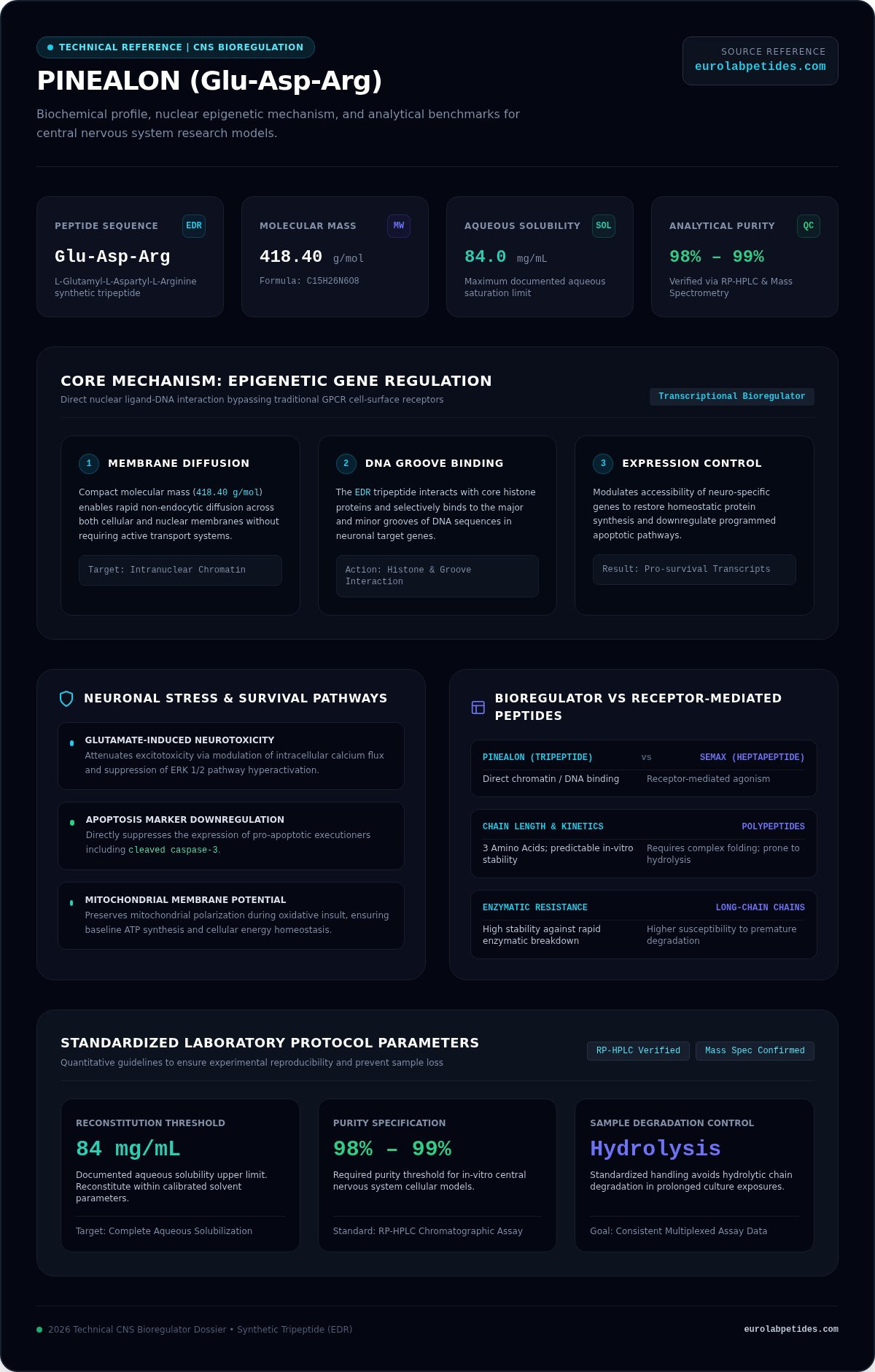
Pinealon is a synthetic tripeptide defined by the sequence L-Glutamyl-L-Aspartyl-L-Arginine (Glu-Asp-Arg). Its molecular formula, C15H26N6O8, reflects a structure optimized for high-stakes laboratory precision. With a molecular weight of 418.40 g/mol, it’s considerably smaller than many other studied neuropeptides. This compact molecular mass is a critical factor in its bioavailability, as it allows for efficient diffusion across cellular and nuclear membranes. According to the Pinealon tripeptide profile, this molecule is classified as a short-chain bioregulator, a category distinguished by high stability and resistance to enzymatic degradation. In the execution of Pinealon for central nervous system studies, investigators rely on this structural integrity to ensure consistent data across multiplexed assays.
The Role of Tripeptides in Bioregulation
Peptide bioregulators function through tissue-specific mechanisms that differ fundamentally from traditional receptor agonism. The Glu-Asp-Arg sequence is specifically mapped to target protein synthesis within neuronal tissues. While larger polypeptide chains often require complex folding to maintain biological activity, tripeptides like Pinealon operate via a direct ligand-DNA interaction. This simplicity provides a verifiable metric for quality control, as the purity of the synthetic sequence can be confirmed through reverse-phase high-performance liquid chromatography (RP-HPLC) and mass spectrometry. Researchers prioritize these short chains because they offer predictable kinetic profiles in cell culture models, where larger proteins might be subject to premature hydrolytic breakdown.
Gene Expression Modulation in CNS Tissues
The core mechanism of Pinealon for central nervous system studies involves the epigenetic regulation of neuro-specific protein expression. Unlike traditional nootropics that may focus on neurotransmitter levels, Pinealon interacts directly with chromatin to influence the transcriptional landscape. Laboratory models demonstrate that the EDR sequence binds to specific sequences in the major and minor grooves of DNA, effectively modulating the accessibility of genes involved in cellular resilience. This includes the downregulation of markers associated with programmed cell death, such as cleaved caspase-3. In a 2026 research context, Pinealon’s primary epigenetic function is defined as the sequence-specific modulation of neuronal gene expression to mitigate oxidative damage and restore homeostatic protein synthesis. This mechanism allows for a high degree of precision in investigating neuroprotective pathways without the systemic variability often seen in larger, non-specific peptide structures.
Applications of Pinealon in Neuroprotection and Cognitive Research
Pinealon’s utility in specialized neurological models is primarily defined by its capacity to mitigate biochemical stressors that compromise neuronal integrity. Current research focuses on how the EDR tripeptide functions as a buffer against environmental and metabolic challenges. By stabilizing the transcriptional environment, Pinealon allows for more consistent observations in Pinealon for central nervous system studies, particularly those investigating cellular resilience and long-term viability in aging tissues. Its role extends beyond simple protection; it’s increasingly examined as a tool for mapping the intersection between epigenetic regulation and synaptic plasticity.
Neuroprotection and Cellular Survival
In-vitro assays demonstrate that Pinealon attenuates glutamate-induced neurotoxicity by modulating intracellular calcium flux and suppressing the hyperactivation of the ERK 1/2 pathway. These mechanisms are vital for maintaining mitochondrial function within neuronal cells. When cells are subjected to oxidative stress, Pinealon helps preserve the mitochondrial membrane potential, which is a critical metric for ATP synthesis and overall cellular energy homeostatis. For investigators in longevity research, this makes Pinealon a valuable asset for studying cellular repair models. It doesn’t just prevent damage; it supports the underlying machinery required for recovery after metabolic insult. This data-driven approach to neuroprotection provides a baseline for evaluating how short-chain peptides influence survival markers like cleaved caspase-3 and other pro-apoptotic indicators.
Circadian Rhythm and Melatonin Synthesis
A significant area of inquiry involves Pinealon’s specific interaction with pineal gland tissue. Unlike exogenous melatonin, which provides a transient increase in hormone levels, Pinealon acts as a bioregulator to stimulate endogenous melatonin production. This distinction is critical for sleep-wake cycle laboratory studies. Research indicates that the tripeptide facilitates the synthesis of serotonin and its subsequent conversion to melatonin by modulating the expression of relevant enzymes. By restoring the rhythmic activity of the pineal gland in research subjects, investigators can better analyze the systemic effects of circadian synchronization on CNS health. For those designing high-precision protocols, utilizing a Cognitive Research Stack that includes high-purity Pinealon ensures that these delicate biological rhythms are accurately represented in the data.
Cognitive function maintenance research frequently utilizes Pinealon to study synaptic plasticity in aging models. The tripeptide’s ability to cross the blood-brain barrier and the nuclear envelope allows it to influence the expression of neurotrophic factors directly. This interaction helps maintain the density of dendritic spines and supports neurotransmitter balance, particularly in the cortex and hippocampus. By providing a stable chemical environment, Pinealon enables researchers to isolate the variables that contribute to cognitive decline and identify the specific pathways where epigenetic intervention is most effective.
Comparative Analysis: Pinealon vs. Semax and Epitalon
Analysis of Pinealon for central nervous system studies requires a clear distinction between short-chain bioregulators and larger synthetic neuropeptides. While Pinealon (Glu-Asp-Arg) is a tripeptide with a molecular mass of 418.40 Da, Semax is a heptapeptide (Met-Glu-His-Phe-Pro-Gly-Pro) weighing 750.8 Da. This structural difference dictates their primary modes of action. Semax operates as an ACTH 4-10 analogue, primarily stimulating brain-derived neurotrophic factor (BDNF) and TrkB phosphorylation through receptor-mediated signaling. In contrast, Pinealon bypasses traditional receptor cascades to interact directly with the chromatin structure. This divergence makes Pinealon a more specific tool for investigating long-term epigenetic shifts rather than rapid, transient neurotrophic surges.
Target tissue specificity also varies significantly between these molecules. Semax provides global CNS modulation, affecting dopaminergic and serotonergic systems across multiple brain regions. Pinealon, while active in cortical and cerebellar tissues, maintains a high affinity for the pineal gland, where it regulates endogenous melatonin synthesis. This specificity makes it an essential component of a cognitive research stack designed to study the intersection of circadian rhythms and cognitive resilience in laboratory models.
Pinealon vs. Epitalon
Both Pinealon and Epitalon (Ala-Glu-Asp-Gly) are identified as bioregulators originally derived from pineal gland extracts. However, their research objectives are distinct. Epitalon is primarily utilized in studies involving telomerase activation and cell cycle regulation. Pinealon’s role is broader in terms of general CNS protein synthesis and neuroprotection against oxidative stressors like glutamate. Investigators select Pinealon when the focus is on mitochondrial stability and transcriptional regulation of neuro-specific proteins, whereas Epitalon remains the standard for longevity models focusing on chromosomal integrity.
Synergistic Research Models
Modern neurobiology often employs multi-pathway analysis by combining sequence-specific bioregulators. Stacking Pinealon with Epitalon or Semax allows researchers to observe the interplay between epigenetic modulation, telomerase activity, and neurotrophic signaling. This multiplexed approach is vital for understanding complex neurological phenotypes that a single peptide can’t fully address. For a deeper look at how these molecules are categorized in laboratory settings, see our guide on Epitalon research applications. By utilizing high-purity sources, laboratories ensure that the observed synergy results from the intended molecular interactions rather than contaminants or degradation byproducts.
Laboratory Methodology: Reconstitution and Handling of Pinealon
The maintenance of molecular integrity is the primary requirement for successful Pinealon for central nervous system studies. Because Pinealon is supplied as a lyophilized tripeptide salt, it’s highly stable in its solid state but requires specific environmental controls once introduced into an aqueous environment. Standardized handling ensures that the data derived from in-vitro assays remains free from variables introduced by peptide degradation or hydrolytic breakdown. Precision is mandatory. Every step in the handling process must prioritize the preservation of the Glu-Asp-Arg sequence to ensure experimental reproducibility.
Storage and Stability Protocols
Long-term preservation of lyophilized Pinealon requires a temperature of -20°C. Under these conditions, the tripeptide maintains its analytical purity for up to 24 months if protected from light and moisture. Once reconstituted, the solution’s stability window narrows significantly. It’s recommended to store the liquid peptide at 2°C to 8°C and utilize it within 14 to 30 days. Repeated freeze-thaw cycles are strictly contraindicated. These cycles induce mechanical stress on the peptide bonds, leading to a loss of biological activity. Exposure to UV light and ambient air should be minimized to prevent oxidative degradation, which can alter the molecular weight and subsequent binding affinity in cellular models.
Reconstitution Best Practices
Reconstitution begins with calculating the required concentration based on the specific assay design. Pinealon exhibits a high aqueous solubility limit of approximately 84 mg/mL. It’s freely soluble in sterile water or bacteriostatic water, but it remains nearly insoluble in organic solvents like DMSO or ethanol. This profile is a critical distinction for researchers accustomed to working with lipophilic compounds. To ensure your laboratory utilizes only the highest analytical standards, you can buy research-grade peptides from a source that provides third-party batch validation.
To prepare the solution, the diluent should be added slowly along the side of the vial to avoid mechanical agitation. Swirl the vial gently until the powder is completely dissolved. Never shake the vial. For cell culture work, aseptic technique is mandatory. This includes the use of 0.22 μm PVDF or PES filters to ensure the solution is free from microbial contaminants. Precision in concentration is achieved through calibrated micropipetting. If a study requires multiple dosages, create a concentrated stock solution and dilute it immediately before application to the neuronal culture. This methodical approach preserves the tripeptide’s structure and ensures that the results of your CNS research are both accurate and reproducible.
Sourcing High-Purity Pinealon for In-Vitro Research
Establishing a reliable supply chain for Pinealon for central nervous system studies is as vital as the experimental design itself. Analytical purity isn’t a subjective claim; it’s a verifiable metric determined through reverse-phase high-performance liquid chromatography (RP-HPLC) and mass spectrometry (LC-MS). Without these benchmarks, investigators risk introducing unknown variables, such as trifluoroacetic acid (TFA) residues or truncated peptide sequences, which can skew neuro-specific protein expression data. In the high-stakes environment of CNS research, sourcing from a transparent partner ensures that the tripeptide salt behaves exactly as documented in the literature.
Quality Assurance Benchmarks
A formal Certificate of Analysis (COA) must provide more than a simple percentage. It should include the chromatogram and mass spectra to confirm the molecular weight matches the theoretical 418.40 Da of the Glu-Asp-Arg sequence. Identifying common contaminants, such as residual solvents or endotoxins (ideally <0.05 EU/mg), is essential for neuronal culture survival. Batch-to-batch consistency is particularly critical for longitudinal studies where even minor variations in purity can lead to statistically significant deviations in results. Relying on non-certified suppliers often leads to inconsistent peptide concentrations, which compromises the integrity of the entire research model and wastes valuable institutional resources.
EuroLab Peptides Quality Standards
EuroLab Peptides adheres to a multi-level quality protocol that ensures every batch meets a minimum 99% purity threshold. Our synthesis process is validated through external laboratory testing, providing an objective layer of accountability for the professional user. For institutions within Europe, localized logistics and regional manufacturing standards offer a shorthand for reliability, reducing the risks associated with global supply chain instability and long transit times that could affect lyophilized stability during the shipping process.
Secure, light-protected packaging is utilized to maintain the tripeptide’s molecular structure during transit. This commitment to precision supports the rigorous demands of the specialized scientific community. You can View Pinealon and other cognitive research peptides within our catalog to ensure your laboratory is equipped with elite tools for serious professional inquiry. All products are strictly for in-vitro research and laboratory development only; they aren’t for human consumption and don’t constitute medical advice.
Advancing Epigenetic Precision in Neurological Research
The role of Pinealon (Glu-Asp-Arg) in modern neurobiology is defined by its capacity to bypass traditional receptor pathways for direct genomic interaction. Establishing a reliable experimental model requires strict adherence to the 84 mg/mL aqueous solubility limit and the maintenance of lyophilized storage at -20°C. These technical parameters ensure that Pinealon for central nervous system studies yields reproducible data regarding neuroprotection and circadian rhythm synchronization. By isolating the epigenetic mechanisms of the EDR sequence, researchers can more accurately map the intersection of transcriptional regulation and synaptic plasticity in aging models.
Professional investigators must prioritize verifiable metrics over anecdotal claims to maintain the integrity of longitudinal studies. EuroLab Peptides facilitates this through a multi-level quality protocol and specialized European logistics, ensuring that each batch is third-party tested for 99%+ purity. These materials are strictly for laboratory research use and in-vitro development only. Explore high-purity Pinealon for your research at EuroLab Peptides and advance your laboratory’s inquiry into the fundamental mechanisms of cellular resilience.
Frequently Asked Questions
What is the primary mechanism of Pinealon in CNS studies?
Pinealon operates through the direct epigenetic modulation of neuronal gene expression. The tripeptide sequence Glu-Asp-Arg interacts with the chromatin structure within the cell nucleus to influence protein synthesis. This mechanism is distinct from traditional receptor-based signaling. By regulating transcriptional pathways, researchers use Pinealon for central nervous system studies to observe shifts in cellular resilience and the downregulation of pro-apoptotic markers like cleaved caspase-3 in laboratory models.
How does Pinealon differ from Semax in neurological research?
The structural and functional differences between these peptides are significant. Pinealon is a tripeptide (418.40 Da) that interacts with DNA, while Semax is a heptapeptide (750.8 Da) that acts as an ACTH analogue. Semax primarily triggers the rapid stimulation of brain-derived neurotrophic factor (BDNF) via receptor cascades. Pinealon provides a more targeted epigenetic bioregulation of specific CNS tissues, making it a specialized tool for longitudinal studies on transcriptional stability.
What is the recommended storage temperature for lyophilized Pinealon?
Lyophilized Pinealon must be stored at -20°C for long-term preservation of its molecular integrity. Under these conditions, the tripeptide remains stable for up to 24 months if protected from light and moisture. Once reconstituted, the solution should be refrigerated at 2°C to 8°C and utilized within a 14 to 30-day window. Repeated freeze-thaw cycles are strictly contraindicated as they induce mechanical stress that leads to the hydrolytic breakdown of the peptide bonds.
Is Pinealon suitable for human clinical use?
No, Pinealon isn’t suitable for human or veterinary clinical applications. EuroLab Peptides provides this tripeptide strictly for in-vitro research and laboratory development purposes only. It’s not FDA-approved, it isn’t on the USP/NF formulary, and it shouldn’t be used as a bulk drug substance for pharmacy compounding. All technical data provided is intended for institutional investigators and shouldn’t be interpreted as medical advice or used for any form of human consumption.
Why is Pinealon considered a bioregulator rather than a traditional nootropic?
Pinealon is classified as a bioregulator because it modulates the expression of neuro-specific proteins at the transcriptional level. Traditional nootropics typically focus on the transient manipulation of neurotransmitter levels or receptor sensitivity. As a short-chain peptide, Pinealon interacts with the major and minor grooves of DNA to restore homeostatic protein synthesis. This epigenetic function allows researchers to study long-term cellular repair mechanisms rather than the short-term cognitive shifts associated with conventional agents.
Can Pinealon be used alongside Epitalon in research models?
Yes, Pinealon is frequently combined with Epitalon in multiplexed research models to analyze synergistic pathways. While Epitalon focuses on telomerase activation and chromosomal integrity, Pinealon targets general CNS protein synthesis and mitochondrial stability. Combining these bioregulators allows investigators to observe how different epigenetic triggers influence neuronal survival and circadian synchronization. This approach is common in a Cognitive Research Stack where researchers seek to map the interaction between distinct peptide-mediated transcriptional signatures.
What solvents are best for reconstituting Pinealon?
Sterile water or bacteriostatic water are the recommended solvents for reconstituting Pinealon. The tripeptide exhibits a high aqueous solubility limit of approximately 84 mg/mL, ensuring complete dissolution for in-vitro applications. It’s important to note that Pinealon is nearly insoluble in organic solvents such as DMSO or ethanol. Researchers should introduce the diluent slowly along the side of the vial and swirl gently to avoid mechanical agitation, which can compromise the peptide’s structural integrity.
How does Pinealon influence the pineal gland in laboratory settings?
In laboratory settings, Pinealon stimulates the endogenous synthesis of melatonin within pineal gland tissue. It facilitates the conversion of serotonin to melatonin by modulating the expression of relevant enzymes involved in the circadian cycle. This bioregulatory action is utilized in Pinealon for central nervous system studies to investigate the synchronization of biological rhythms. Unlike exogenous hormone administration, Pinealon allows for the observation of natural rhythmic activity and its subsequent impact on overall CNS homeostasis.
