

What if a peptide’s high purity result tells you less than you think? Peptide purity testing methods produce evidence that depends on what was measured. A chromatographic purity percentage does not, by itself, confirm a peptide’s identity, quantity, or suitability for a particular experiment.
That distinction matters when a certificate of analysis presents a single number without enough context to evaluate the batch. HPLC can help assess purity, while mass spectrometry can provide evidence about molecular mass and identity. Neither result should be read in isolation or treated as a guarantee of research performance.
This guide explains what common analytical methods measure, where their limitations lie, and how to assess whether a report supports your intended in-vitro research. You’ll also learn which batch-specific details to check, including method information, test dates, and laboratory identification. EuroLab Peptides describes a quality-control approach that includes in-house and independent third-party testing for purity and consistency. As with any supplier, the useful evidence is the documentation available for the specific batch.
Key Takeaways
- Choose peptide purity testing methods according to the question being assessed. Results are meaningful only within the method’s scope and conditions.
- Read a certificate of analysis systematically. Check that its sample and batch identifiers, test date, method, and reported results are clear.
- Keep supplier, batch, and analytical report details with research records to make results easier to interpret and reproduce.
- Assess supplier testing claims by looking for evidence tied to the specific batch, and note any gaps that could affect your research question.
What Does Peptide Purity Testing Measure, and What Does It Not Prove?
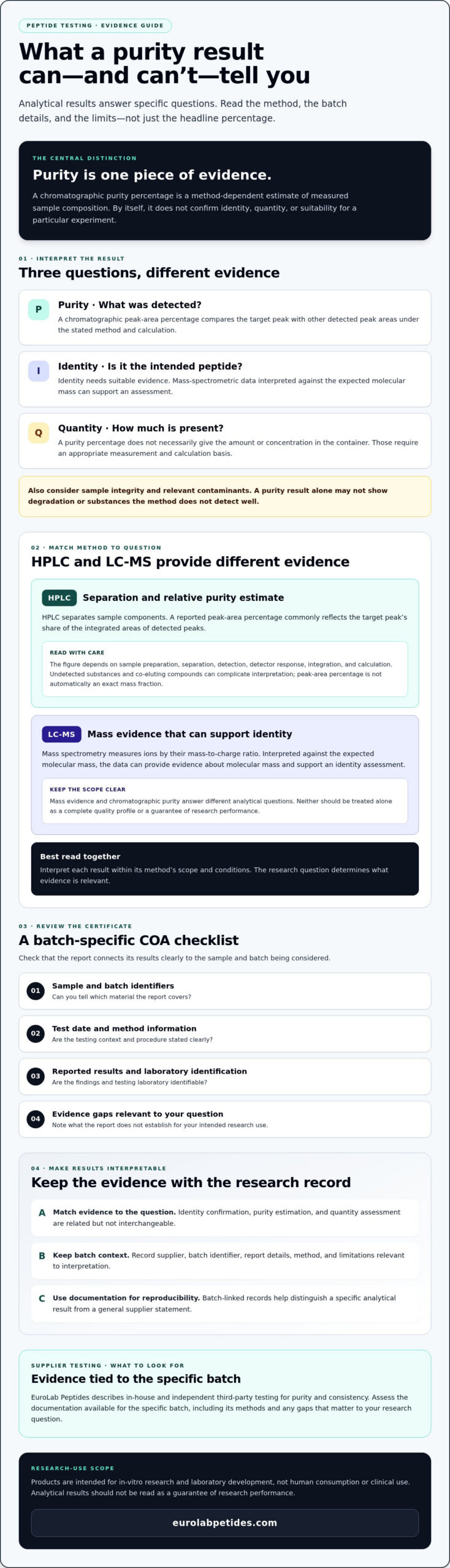
A reported purity percentage is an analytical result, not a complete verdict on a peptide batch. It estimates the proportion of detected material attributed to the target under a particular method’s conditions. The result depends on how the sample is prepared, separated, detected, and calculated. Interpret it alongside the method details rather than treating it as an absolute measure of overall quality.
Quotable definition: Analytical purity is a method-dependent estimate of the measured sample composition. Overall product quality also depends on identity, quantity, sample integrity, and whether the available evidence fits the intended research use.
Purity, identity, and content are separate analytical questions
In a chromatographic test, the sample’s components are separated, and the target’s signal is compared with other detected signals. For example, a chromatographic peak-area percentage reflects the target peak’s share of the measured peak area under the stated conditions. It may not account for substances the method does not detect well, and compounds that co-elute can complicate interpretation. High-performance liquid chromatography (HPLC) describes the separation technique, but the reported result still depends on the specific procedure and calculation.
Purity does not establish that the detected compound is the intended peptide. Identity requires suitable evidence, such as mass-spectrometric data interpreted against the expected molecular mass. Nor does a purity percentage necessarily tell you how much peptide is in the container. Quantity or concentration requires an appropriate measurement and basis for calculation. Sample integrity is another question: a result may not, on its own, show whether the material has degraded or whether other relevant contaminants are present.
These distinctions matter because a single value can look conclusive while answering only one analytical question. Choose peptide purity testing methods to match the evidence needed, rather than treating them as a complete quality profile.
Why testing context matters for research data
Material characterization supports reproducibility by making clear what was tested and what evidence informed the experiment. The appropriate analytical evidence depends on the research question. Identity confirmation, purity estimation, and quantity assessment are related, but they are not interchangeable. A purity result alone cannot establish that a batch is suitable for every assay or explain unexpected results.
Record the supplier, batch identifier, report details, method, and any limitations relevant to interpretation. This documentation helps distinguish a batch-specific analytical result from a general supplier statement. For background on the molecules being characterized, see this guide to what peptides are. EuroLab Peptides describes in-house and independent third-party testing for purity and consistency. Researchers should assess the evidence and method details available for the specific batch. Its products are intended for in-vitro research and laboratory development, not human consumption or clinical use.
How Do HPLC and LC-MS Peptide Purity Testing Methods Work?
HPLC and LC-MS provide different kinds of analytical evidence. Reversed-phase high-performance liquid chromatography separates components in a sample and can estimate relative purity from the resulting chromatogram. Mass spectrometry measures ions by their mass-to-charge ratio, providing evidence that can support an assessment of molecular mass and identity. Because the methods have different strengths and limitations, their results are more informative when interpreted together than when either is treated as a complete quality profile.
What reversed-phase HPLC can show
In reversed-phase HPLC, compounds interact differently with a nonpolar stationary phase and a more polar mobile phase. As the mobile-phase composition changes, compounds travel through the column at different rates and appear as peaks in the chromatogram. A reported purity percentage commonly reflects the target peak’s area relative to the integrated areas of detected peaks. The figure depends on the method, detector response, integration settings, and calculation used.
Peak-area percentages are not automatically equivalent to exact mass fractions. Different compounds may produce different detector responses, and the method may not detect every impurity. If two components elute together, co-elution can make them appear as one peak. A clear chromatogram and stated calculation are important context for interpreting a reported percentage.
What LC-MS can add to the analysis
In LC-MS, liquid chromatography separates components before they enter a mass spectrometer. The instrument detects ions and measures their mass-to-charge ratios. The resulting data can be compared with the expected molecular mass of the peptide. This supports an identity assessment, but mass agreement alone does not prove every structural feature or distinguish all compounds with similar or identical masses. Additional fragmentation data or other suitable evidence may be needed, depending on the question.
Mass spectrometry is not a universal impurity-quantification method. Some substances may ionize poorly or respond differently, so their signals cannot necessarily be compared directly with the peptide’s signal. Orthogonal testing, where evidence comes from methods based on different analytical principles, can strengthen a conclusion. It does not guarantee that all possible impurities or sample issues have been ruled out.
Together, HPLC and LC-MS can provide complementary evidence about chromatographic composition and molecular mass, but neither result alone establishes complete sample quality or suitability for every assay. Assess these peptide purity testing methods by their documented conditions, results, and relevance to the research question. Researchers can also examine the available materials from EuroLab Peptides and check which batch-specific analytical details are provided.
How to Read a Peptide Certificate of Analysis Without Overlooking Gaps
A certificate of analysis (COA) is useful only when you can connect its reported results to the material being evaluated. Review it as a traceability and evidence document, not as a standalone guarantee. A supplier’s summary of testing is not the same as an analytical report issued by a named laboratory, and even a laboratory report needs enough detail to interpret its scope.
Which report details support traceability?
Start with the sample identity and follow the record through the report. Check for:
- Sample and batch identifiers: Confirm that the identifiers on the report match the material under review. A product name alone may not establish a batch link.
- Laboratory identity and report details: Look for the testing organization’s name and a report identifier or other information that allows the document’s source to be checked.
- Analysis date and method: Confirm when testing occurred and which analytical procedure was used. A method name without relevant conditions may not explain how the result was generated.
- Results and units: Check what was measured and how the result is expressed. A percentage, concentration, and mass value answer different questions.
Claims about accreditation, chain of custody, or report authenticity require their own verification. Do not infer accreditation from technical formatting or the presence of a laboratory name. If these details are not shown, treat them as questions to clarify, not as proof of misconduct.
How to interpret purity values and chromatograms
A headline purity percentage is easier to assess when the COA identifies its calculation basis and includes supporting chromatographic data. If a chromatogram is provided, check whether peaks are labeled, the target peak is identified, and the integration or calculation basis is described. The report may not include every detail needed for a full technical review, but missing context limits what you can conclude from the number.
An unexplained percentage is incomplete evidence, not evidence of wrongdoing. Different methods, detectors, and calculation conditions can yield results that are not directly comparable. Avoid ranking batches by percentages alone when the underlying procedures differ. Instead, note the method and its stated limitations, then assess whether the evidence addresses the question relevant to your work.
For broader sourcing considerations, see this guide on how to buy research peptides. Apply the same careful review to any supplier’s testing claims: request or verify batch-specific documentation, and distinguish general quality statements from results traceable to a sample. This context is essential when comparing peptide purity testing methods and deciding what a COA can support.
How to Use Purity Testing Evidence in a Reproducible Research Workflow
Analytical evidence is most useful when it stays connected to the material used in an experiment. Build that connection before the study begins: select a batch, retain its identifying information, review the available testing documentation, and record what the results can and cannot establish. This creates a traceable record if findings need to be reviewed, repeated, or reported.
Document the material and analytical evidence
For each batch, record the peptide identifier, supplier, batch reference, and the version or date of the report reviewed. Capture the stated test method, result and units, analysis date, and any limitations or missing details relevant to your research question. If documentation is updated, retain the version used when the material was selected rather than silently replacing it.
- Before the experiment: Link the batch identifier on the material to the identifier in the analytical documentation. Note any mismatch or uncertainty.
- During the experiment: Reference the same identifier in sample logs and study records so the tested material remains traceable through data collection.
- When reporting: Describe the characterization evidence and its limits in the methods or supporting records, following your institution’s recordkeeping and publication requirements.
Requirements can differ by institution, study, or publication. Verify which standards apply to your work instead of assuming that one documentation format satisfies every requirement.
Keep purity claims within the evidence
Purity testing characterizes material; it does not replace experimental controls. A purity result does not establish biological activity, safety, or clinical suitability. Those conclusions are not supplied by a chromatographic percentage or identity result. Keep material-quality evidence distinct from controls that assess the assay itself, and interpret biological findings using the study design and data.
If a report does not clarify its method, batch connection, or calculation basis, document that uncertainty. Do not turn an unresolved gap into a confident claim. In a manuscript, describe the evidence actually reviewed and avoid implying that a result proves more than the analysis supports. The appropriate peptide purity testing methods depend on the research question, while the workflow should preserve enough detail for others to understand the material’s analytical context. All discussion here applies to in-vitro research and laboratory development, not human consumption or clinical use.
Quotable principle: Traceable batch records make analytical evidence interpretable and give researchers a stronger basis for reproducing and evaluating results.
EuroLab Peptides’ research offerings are available at EuroLab Peptides research offerings. Review the batch-specific documentation and method details relevant to your planned in-vitro work.
How to Evaluate a Supplier’s Peptide Testing Process
A supplier’s testing description is most useful when it explains what was tested, why the method was selected, and what conclusions the result can support. A broad claim of “third-party tested” does not show whether the analysis applies to the batch under consideration or answers the research question. Evaluate the evidence, not just the label.
Questions to ask about supplier testing
Use these questions to assess whether a testing process is transparent enough to evaluate:
- Which methods are used, and what does each measure? Ask whether the stated analysis addresses purity, identity, quantity, or another property. Peptide purity testing methods have different capabilities and limitations, so a method name without its purpose provides limited context.
- Can the results be tied to the batch? Check whether the documentation identifies the tested material and batch, rather than presenting a general example or an undated quality statement.
- Who performed the analysis? Look for the laboratory’s identity and clarify whether the result is a supplier statement or a report attributed to an independent laboratory.
- What supports formal claims? Verify statements about accreditation, analytical validation, chain of custody, and testing frequency. Do not assume these based on a logo, certificate format, or general description.
If a detail is not available, record it as an unresolved question. Missing information does not automatically demonstrate a problem, but it limits what can be concluded about the testing process. Request method details and batch-linked documentation where available, then assess whether the evidence is relevant to your intended in-vitro work.
What EuroLab Peptides says about quality control
EuroLab Peptides describes a multi-level quality-control process that includes in-house and independent third-party laboratory testing, with a stated focus on purity and consistency. The available information here does not establish which specific analytical methods are used, whether reports are linked to individual batches, or the identity or accreditation status of a testing laboratory. Do not assume those details. Researchers should review the documentation available for the relevant batch and verify claims that matter to their study.
This distinction keeps supplier evaluation evidence-based: a described testing process offers useful context, while a batch-specific report can provide evidence for a particular sample when its scope and source are clear. Neither substitutes for evaluating whether the analytical results support the study’s requirements. EuroLab Peptides’ products are for in-vitro research and laboratory development, not human consumption or clinical use.
Review the company’s research-grade offering at EuroLab Peptides’ research-grade offering and assess the available quality-control information against your documentation needs.
Make Analytical Evidence Part of Your Research Record
A purity percentage is most useful when read in context. HPLC and mass spectrometry address different analytical questions, while a certificate of analysis helps only when its method, results, date, and connection to the relevant batch are clear. Treat peptide purity testing methods as evidence with a defined scope, not as a standalone guarantee of identity, quantity, or experimental suitability.
For reproducible work, document the supplier, batch identifier, report details, and any limitations alongside your study records. This keeps material characterization distinct from experimental controls and biological interpretation.
EuroLab Peptides describes a multi-level quality-control process involving in-house and independent third-party testing for purity and consistency. Its products are supplied strictly for in-vitro research and laboratory development, not human consumption or clinical use. Review the available information and determine whether it meets your research requirements: Review EuroLab Peptides’ research-grade offering.
Clear records and carefully interpreted evidence give your research a more transparent foundation. Apply these checks consistently as you plan your next study.
Frequently Asked Questions
What is the most reliable method for testing peptide purity?
No single method is universally most reliable; the best choice depends on what must be established. Chromatographic analysis, such as HPLC, can estimate relative purity under defined conditions, while mass spectrometry can provide molecular-mass evidence relevant to identity. Using complementary methods can strengthen characterization, but their value depends on method quality, sample traceability, and the research question. Review the methods and limitations, not only the reported percentage.
Can HPLC confirm a peptide’s identity?
HPLC alone generally cannot confirm peptide identity. It separates compounds based on their interactions with the column and mobile phase, producing a retention profile that can be compared with an appropriate reference under the same conditions. A matching retention time is supportive evidence, not definitive identification by itself. To assess identity, review complementary evidence, such as mass-spectrometric data, and check that the analysis is tied to the sample or batch being evaluated.
Does LC-MS measure peptide purity or identity?
LC-MS primarily provides evidence about molecular mass and supports an identity assessment, while liquid chromatography separates components before mass analysis. It may reveal signals associated with other components, but mass-spectrometric signal intensity does not automatically quantify every impurity. Compounds can ionize differently or be poorly detected. For purity estimation, review a suitable chromatographic method and its calculation basis. The peptide purity testing methods selected should match the specific property the study needs to assess.
What should a peptide certificate of analysis include?
A useful certificate of analysis should identify the material and batch, show the analysis date, name the analytical method, and report results with units or a clear calculation basis. Laboratory identity and supporting data, such as a chromatogram or mass result when applicable, provide context beyond a headline percentage. Check whether the document identifies who performed the test and distinguishes measured results from general supplier statements. Missing detail limits interpretation but does not alone prove misconduct.
How can I verify that a peptide test report matches its batch?
Compare the batch or sample identifier on the report with the identifier on the material’s packaging and accompanying records. Check that the peptide description, report date, and any sample reference are consistent. If identifiers differ or are not shown, ask the supplier to explain the linkage and whether the laboratory can verify the report. Keep the response and the version of the document reviewed with your study records so the material’s analytical evidence remains traceable.
Is a high HPLC purity percentage enough to establish peptide quality?
No. A high HPLC purity percentage describes a result under the stated method and calculation conditions; it does not independently establish identity, quantity, sample integrity, or suitability for a particular assay. Detection limits, co-elution, and compounds that respond differently to the detector can affect interpretation. Evaluate the method details and relevant complementary evidence, then decide whether they address your research requirements. Do not treat a single percentage as a complete quality profile.
Can purity testing alone make laboratory data publishable?
No. Purity testing can support transparent material characterization, but publication readiness also depends on study design, appropriate controls, methods reporting, data quality, and the journal’s or institution’s requirements. Describe the batch, analytical evidence, and unresolved limitations accurately; do not infer biological activity or research validity from a purity result. EuroLab Peptides supplies products strictly for in-vitro research and laboratory development, not human consumption or clinical use. Verify applicable reporting standards for your study.
