

Could the solvent that dissolves one peptide compromise another? That is the key question when reconstituting peptides with acetic acid. Solvent choice depends on the specific peptide and research protocol, not a universal rule. Acetic acid may be considered for some peptides with solubility challenges, but using it without checking compatibility can affect sample integrity or downstream analysis.
When instructions conflict, compare what they were written for. A solvent recommendation developed for one sequence, formulation, or assay may not apply to another. This guide explains how peptide properties affect solvent choice, what to look for in a relevant protocol, and how to assess material identity, sample preparation, and the planned analytical workflow for in-vitro research.
The goal is a decision supported by peptide-specific documentation, not a one-size-fits-all recipe. EuroLab Peptides supplies research-grade materials for in-vitro research and laboratory development, with in-house and independent third-party testing as part of its quality-control process for purity and consistency. All guidance here concerns laboratory research only. It does not apply to human consumption or clinical use.
Key Takeaways
- Reconstituting peptides with acetic acid is a protocol-dependent choice. Assess compatibility for the specific peptide and research purpose.
- Consider peptide sequence and ionizable groups when evaluating solubility. Visible dissolution does not establish chemical stability or assay suitability.
- Compare acetic acid, aqueous buffers, and other solvents against the research objective, available compatibility evidence, and downstream analytical constraints.
- When reviewing a published protocol, check that it identifies the peptide, purpose, analytical endpoint, and rationale for the solvent.
- Supplier testing can inform material quality assessment, but it does not establish that a solvent is suitable for a particular assay.
What Does Reconstituting Peptides with Acetic Acid Mean in Research?
Reconstitution is the preparation of a peptide sample in a solvent for a defined laboratory purpose, such as an in-vitro assay or analytical evaluation. It is different from peptide synthesis, which creates the peptide chain, and purification, which separates the target material from other components. Reconstitution is a sample-preparation step after synthesis. The appropriate solvent depends on the peptide, the study design, and what the downstream analysis requires.
This distinction matters because peptides are short chains of amino acids, and differences in sequence and chemical properties can affect how a peptide behaves in solution. This article addresses in-vitro research only. It does not describe preparation for administration or clinical use.
What role can acetic acid have in peptide research?
Acetic acid is one solvent option used in some research protocols, not a default medium for every peptide. Solubility can vary with sequence, charge, and experimental conditions, so results for one peptide do not establish compatibility for another. A sample that appears to dissolve may still be unstable or unsuitable for the planned assay.
For reconstituting peptides with acetic acid, the decision is not simply whether the solvent produces a solution. Check whether the protocol supports its use for the specific material, and whether the solvent could interfere with the measurement or change sample behavior.
Why injection-oriented instructions don’t answer this question
Instructions written for injectable products address a different context from laboratory analytical preparation. They may be intended for administration rather than compatibility with a particular in-vitro method. A solvent mentioned in an injection-oriented guide is not, on that basis alone, validated for an analytical workflow.
Assess solvent suitability against the peptide’s identity and the research method. A useful protocol makes clear what material it covers, what the experiment measures, and why the solvent is appropriate for that endpoint. For background on peptide structure and terminology, see this comprehensive guide to peptides for researchers.
How Peptide Chemistry Influences Acetic-Acid Compatibility
Solubility depends on how a peptide’s chemical features interact with its surrounding solution. Amino-acid composition, the distribution of ionizable groups, and experimental conditions can all influence whether a peptide disperses, remains in solution, or forms aggregates. Acetic acid’s properties matter too. PubChem’s Acetic Acid properties provides reference information about the solvent, but does not establish compatibility with a particular peptide or assay.
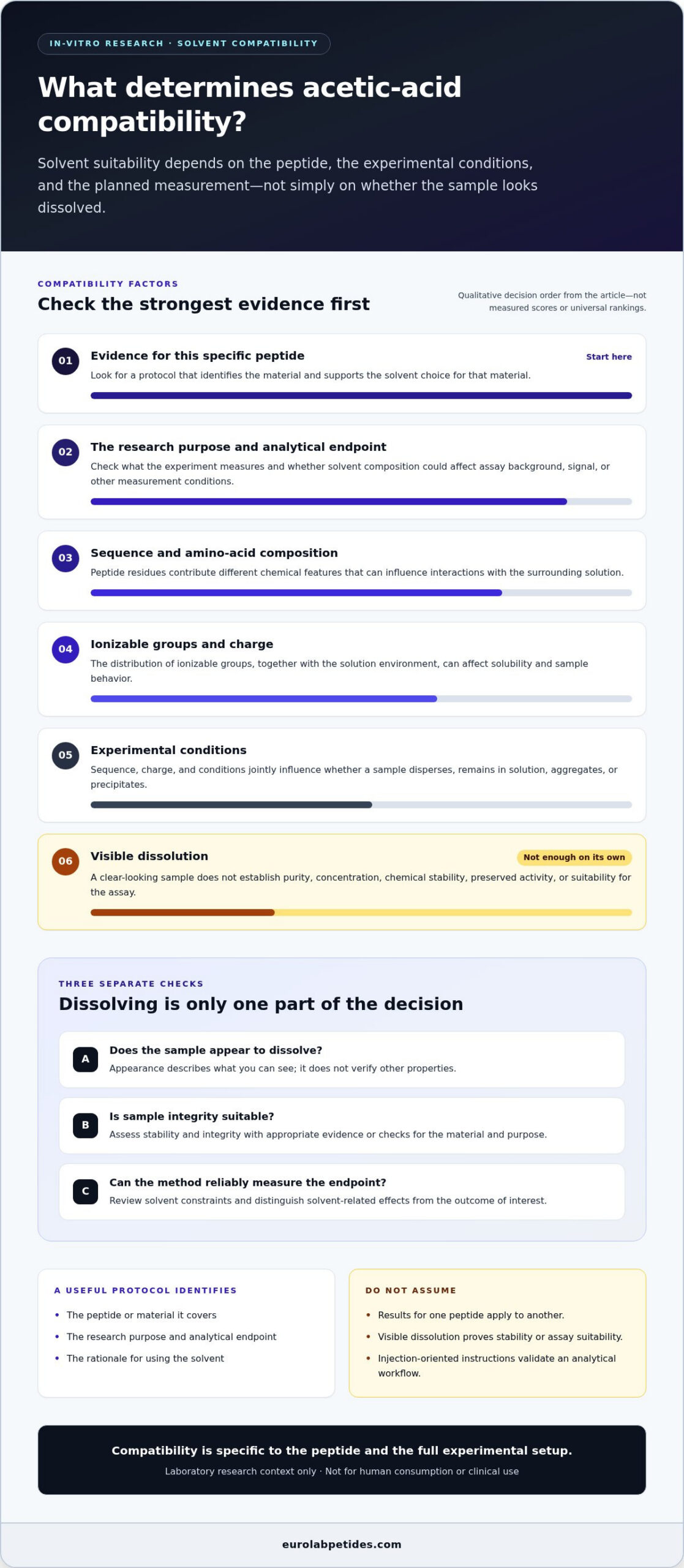
Solvent compatibility cannot be generalized across peptides because sequence, charge, and experimental conditions jointly influence solubility and sample behavior. Evidence supporting a solvent for one material should not automatically be applied to another, even if both are peptides.
Sequence, charge, and solubility are related but distinct
Peptide residues contribute different chemical features, including groups that may ionize depending on the solution environment. These features affect interactions between the peptide and solvent, as well as interactions among peptide molecules. Depending on the material and conditions, a sample may dissolve incompletely, aggregate, or precipitate. Without evidence for the specific material and conditions, assigning a particular solubility behavior to a named peptide would be speculative.
Visible dissolution tells you only how the sample looks. A clear solution does not establish purity, concentration, chemical stability, or preserved activity. Those are separate questions requiring appropriate analytical or experimental checks. When reconstituting peptides with acetic acid, distinguish among three observations: whether the sample appears to dissolve, whether its integrity remains suitable, and whether the intended method can reliably measure the endpoint.
Why assay conditions matter as much as dissolution
A solvent can affect the measurement as well as the sample. Depending on the method, solvent composition may influence assay background, signal, or other measurement conditions. If the solvent’s effects are not accounted for, they may be confused with a change attributed to the peptide.
Before laboratory work, review the study method and relevant safety documentation. Identify any solvent constraints in the assay and how solvent-related effects will be distinguished from the outcome of interest. Compatibility belongs to the full experimental setup, not just the sample’s visible appearance in a vial.
Acetic Acid or Another Solvent? Compare Options by Research Objective
Solvent selection is a method-matching decision, not a ranking in which one option works best for every peptide. For reconstituting peptides with acetic acid, look for evidence that connects the specific material to the intended in-vitro experiment and analytical endpoint. A solvent suitable for one workflow may introduce incompatibilities in another.
| Solvent option | Research objective | Compatibility evidence | Assay constraints and documentation |
|---|---|---|---|
| Acetic acid | Consider only where a validated method or relevant evidence supports its use for the peptide under study. | Look for evidence tied to the exact peptide or closely matched material and experimental conditions. | Assess whether the solvent affects the assay or downstream measurement. Record the method and rationale. |
| Aqueous buffer | May be appropriate when the research method requires a defined aqueous environment. | Confirm the peptide’s behavior and the buffer’s suitability under the study conditions. | Check whether buffer components or conditions affect the analytical endpoint. Document the method used. |
| Another solvent | May be considered when supported by peptide-specific evidence and the experimental design. | Establish that the solvent is compatible with the material and intended sample preparation. | Review assay sensitivity, matrix requirements, and downstream measurement constraints. Record supporting sources. |
When should a researcher investigate acetic acid as an option?
Start with primary literature and validated methods for the exact peptide, or for a similar material when the basis for comparison is clear. Check the solvent rationale, experimental conditions, and analytical endpoint rather than relying on a brief instruction separated from its study context. Then compare those conditions with the intended in-vitro assay. A published method is evidence to evaluate, not automatic validation for a different peptide, sample matrix, or workflow.
What can make another solvent more appropriate?
Assay sensitivity, the required sample matrix, and compatibility with downstream measurements may favor an aqueous buffer or another documented option. For example, the method may require a particular solution environment, while the measurement system may be sensitive to solvent composition. Let the method’s requirements guide the comparison.
Keep sample preparation distinct from synthesis chemistry. A reagent used to build or process a peptide during synthesis is not automatically suitable for preparing that peptide for an assay. Compare options against the research objective and record the supporting evidence. For more context on evaluating material identity and quality, see this guide to sourcing and laboratory standards.
How to Evaluate a Published Peptide Reconstitution Protocol
A protocol is useful when its evidence matches both the material and the experiment. Before following instructions for reconstituting peptides with acetic acid, establish what was studied, why the solvent was selected, and whether the method’s conditions suit the planned in-vitro workflow. Transferring a protocol requires evidence that the material, solvent conditions, and analytical method are compatible.
Check the source, material identity, and experimental purpose
Give more weight to peer-reviewed methods and validated laboratory protocols than to anonymous forum instructions. Compare the protocol’s peptide identity and relevant material characteristics with the sample being studied. A shared name alone does not establish that materials or experimental conditions are equivalent.
Check that the method was developed for in-vitro research and identifies its purpose and analytical endpoint. If those details or the solvent rationale are missing, key compatibility questions remain unanswered.
Review documentation, safety, and interpretation limits
Before laboratory work, consult the applicable safety data sheet and institutional procedures. Check whether the protocol specifies conditions relevant to the assay, including the sample matrix and downstream measurement. Missing details, a mismatch with assay requirements, or an unsupported leap from one peptide or workflow to another are reasons to pause and look for stronger evidence rather than fill gaps by assumption.
Keep a record of the source, lot identification, solvent rationale, and method references. This supports traceability and helps distinguish what the protocol establishes from what still requires validation.
- Source: Is the method peer-reviewed or otherwise validated?
- Material: Does it identify the peptide and provide a relevant basis for comparison with the sample?
- Purpose: Is the research objective and analytical endpoint clear?
- Compatibility: Are solvent conditions consistent with the intended assay and sample matrix?
- Documentation: Are safety references, method conditions, and limitations recorded?
Appearance or a vendor description alone cannot establish sample purity or biological activity. Treat those as separate questions that require appropriate evidence. For in-vitro research and laboratory development, review EuroLab Peptides’ research-grade peptide materials alongside the documentation relevant to your study.
Research-Grade Peptide Quality and Responsible Next Steps
Material quality and solvent compatibility are related, but they answer different questions. Supplier testing can inform the evaluation of a peptide’s purity or consistency when relevant analytical documentation is available. It cannot establish that acetic acid or another solvent is appropriate for a particular assay. That decision depends on the peptide, research objective, and validated method.
What quality documentation can and cannot establish
Documentation is most useful when its scope is clear. Review what material it covers and what its findings support. Do not infer more than the record establishes. A purity assessment, for example, does not show that a prepared sample will meet every downstream assay requirement, and supplier testing does not validate an experimental protocol.
EuroLab Peptides uses a multi-level quality-control process that includes in-house and independent third-party laboratory testing for purity and consistency. These checks contribute to material evaluation, but do not replace study-specific validation. Interpret any certificate or analytical document according to its stated scope and the material it identifies, without assuming methods or results that it does not report.
Keep research handling within the stated scope
Peptides supplied by EuroLab Peptides are for in-vitro research and laboratory development only. They are not intended for human consumption or clinical use. For laboratory handling, follow institutional procedures and the applicable safety documentation for the material and solvents involved.
Keep the evidence trail clear: material documentation informs sample assessment, while the study protocol and assay data address solvent suitability and experimental performance. This distinction matters when reconstituting peptides with acetic acid, because supplier quality controls cannot establish compatibility with every research method.
For research-grade materials intended for in-vitro work, explore EuroLab Peptides research-grade offerings.
Make Solvent Decisions with Evidence
Acetic acid is a protocol-dependent option, not a universal reconstitution medium. Its suitability depends on the peptide’s characteristics, the research objective, and the analytical method. A sample that appears dissolved is not necessarily stable, pure, or appropriate for a specific assay.
For reconstituting peptides with acetic acid, prioritize evidence that identifies the material, explains the solvent rationale, and matches the intended in-vitro workflow. Evaluate published protocols before applying them to another material or method. Supplier quality documentation can inform material assessment, but it does not validate a solvent choice or assay.
EuroLab Peptides’ multi-level quality-control process includes in-house and independent third-party laboratory testing for purity and consistency. Its research-grade peptides are intended for in-vitro research and laboratory development only, not human consumption or clinical use.
Explore EuroLab Peptides’ research-grade offerings for materials intended for in-vitro research and laboratory development.
Frequently Asked Questions
Is acetic acid suitable for reconstituting every peptide?
No. Compatibility depends on the peptide’s chemical characteristics and the research method, including assay conditions. A solvent that dissolves one material may not suit another peptide or produce a sample compatible with a particular measurement. For reconstituting peptides with acetic acid, consult literature or validated protocols relevant to the specific material and in-vitro application rather than applying a general solvent recommendation.
Can acetic acid affect downstream peptide research results?
Yes, depending on the assay and experimental conditions. Solvent composition may affect the sample matrix, measurement background, or interpretation of a result. That does not mean acetic acid is always incompatible; it means solvent effects must be considered in the method. Review assay documentation and relevant validated protocols, and account for the solvent when interpreting results so its effects are not mistaken for the outcome being studied.
How do researchers determine which solvent is appropriate for a peptide?
Researchers assess peptide identity, experimental purpose, relevant published or validated methods, and compatibility with the planned assay. They also review applicable safety documentation and institutional laboratory procedures. A general online recipe cannot establish suitability for a different peptide or workflow. Record the solvent rationale and method references in the study documentation so the basis for the choice and its limitations remain clear.
What happens if a peptide does not dissolve completely?
Incomplete dissolution can make sample composition uncertain and complicate interpretation. Visible clarity alone does not establish concentration, purity, or activity. Do not improvise a solvent change or assume another protocol will work for the material. Consult method-specific evidence and laboratory procedures to determine how to handle the issue within the study. Any investigation should remain within the intended in-vitro research scope.
Is acetic-acid reconstitution guidance the same as injectable preparation instructions?
No. Laboratory sample preparation for in-vitro research is not interchangeable with instructions intended for administration. Solvent selection and method requirements depend on the research purpose and validated protocol, not injection-oriented guidance. This article addresses laboratory research only. EuroLab Peptides supplies research-grade materials for in-vitro research and laboratory development; its products are not intended for human consumption or clinical use.
Does a certificate of analysis prove that a solvent is suitable?
No. A certificate or other analytical document may provide information about the tested material, depending on its scope, but it does not validate a solvent for every assay. Researchers must assess compatibility with the method and experimental requirements separately. Do not infer solvent suitability from a general purity statement or the appearance of a prepared sample. Interpret quality documentation according to what it specifically reports.
