

A shipment’s route can matter more than the fact that it contains research peptides. When ordering research peptides in Europe, a parcel moving within the EU may follow a different process from one entering from outside it. Destination-specific rules can also affect which paperwork applies. Before placing an order, it helps to know the dispatch point, destination and route, since incomplete or inconsistent shipment details can complicate processing.
This guide explains how to assess a shipment route, review order and transport documents, and find current guidance from the destination country’s official customs authority. It also clarifies an important distinction: product-quality evidence, such as a Certificate of Analysis, supports assessment of the material but doesn’t replace customs or transport paperwork. EuroLab Peptides describes in-house and independent third-party laboratory testing for products intended strictly for in-vitro research and laboratory development. Customs requirements aren’t identical across Europe, and quality documentation doesn’t guarantee border clearance.
Key Takeaways
- When ordering research peptides in Europe, assess the shipment route first. Customs paperwork can depend on whether goods cross a relevant customs border.
- Compare the order confirmation, invoice, parcel description and recipient details so shipment information is consistent.
- Use the destination’s official customs authority to verify current requirements rather than assuming rules are identical across Europe.
- Keep customs and transport records separate from product-quality documents. A Certificate of Analysis serves a different purpose from shipment paperwork.
- EuroLab Peptides describes in-house and independent third-party testing for research-grade peptides intended strictly for in-vitro research and laboratory development.
Ordering Research Peptides in Europe: When Can Customs Declarations Apply?
When ordering research peptides in Europe, start by mapping the shipment: where it is dispatched from, where it is going and whether it crosses a customs border. A customs declaration is information submitted to customs about goods crossing a relevant border. It helps authorities identify the goods and assess how the shipment should be processed. The applicable procedure depends on the route and relevant rules, so the word “Europe” alone doesn’t determine the paperwork.
What does a customs declaration do?
A declaration communicates shipment information for customs assessment and processing. Depending on the transaction, it may describe the goods, their quantity and the parties involved. For a general explanation of the term and its purpose, see What is a Customs Declaration?
A declaration isn’t the same as an order confirmation or a carrier tracking record. The confirmation records the purchase, while tracking shows transport progress. Neither necessarily serves as a customs declaration. The buyer also doesn’t always submit the declaration personally. Responsibility can vary by transaction, route and parties involved, so don’t assume that either the buyer or seller handles every step.
Does every European peptide order cross a customs border?
No. A shipment moving between locations within the EU customs territory may follow a different process from one entering that territory from elsewhere. Europe and the European Union aren’t interchangeable terms: a European destination can sit outside the EU, and some routes or territories may have distinct customs arrangements. The shipment’s origin, destination, transit route and product classification can all affect the procedures that apply.
Consider two broad scenarios: a parcel moving between EU member states, and a parcel arriving in the EU customs territory from a non-EU location. Don’t treat these routes as equivalent. A research-use description, by itself, doesn’t establish the customs treatment of a substance. Classification and destination-specific rules may be relevant, and a general checklist can’t determine the outcome for every peptide or shipment.
Before placing an order, identify the dispatch location and destination, then verify current requirements with the destination’s official customs authority. Find out whether the route crosses a relevant customs border and which party is responsible for any declaration. This guide covers research procurement logistics only. The products discussed are intended strictly for in-vitro research and laboratory development, not human use, treatment or medical advice.
Research Peptide Shipment Documents: What Each Record Is For
Shipment records serve different purposes. Commercial records document the transaction, transport records follow the parcel, customs information supports border processing where applicable, and product-quality records describe analytical results. They aren’t interchangeable, and not every order or route will involve every document below.
| Document or record | Typical purpose | What to verify |
|---|---|---|
| Commercial invoice | Records transaction and shipment details for review. | Description, quantity, seller, recipient and declared transaction information; required fields and format depend on the route and relevant authority. |
| Transport record | Identifies or tracks the parcel through the carrier’s network. | Recipient and shipment details match the order and other paperwork. |
| Customs declaration | Provides shipment information for customs processing when applicable. | Whether one is required, who submits it and what information it needs depend on the route and applicable procedures. |
| Safety Data Sheet (SDS) | Communicates relevant safety information about a substance. | Check destination and carrier guidance for whether it is needed and any applicable format or language requirements. |
| Certificate of Analysis (COA) | Reports analytical results for a specified batch, when provided. | Confirm that the batch identification corresponds to the material being reviewed. |
Commercial invoice and shipment details
An invoice commonly identifies the item, quantity, seller, recipient and transaction information. Required fields and formats can vary, so use the relevant destination-authority and carrier guidance rather than assuming one template fits every shipment.
Before dispatch, compare the order confirmation with the invoice and parcel description. Check that the product wording and quantity align, and that shipper and recipient details are consistent. Resolve discrepancies before shipment where possible. Matching records make a review more straightforward, but they don’t determine customs treatment or guarantee clearance.
Certificate of analysis and research-use information
A COA is a quality record, not a transport or customs document. When supplied, it reports analytical results associated with a specified batch. Research-use information describes the intended research context, but neither that label nor analytical results constitute customs clearance. When ordering research peptides in Europe, it is essential to review all sourcing and quality considerations. For broader sourcing and quality guidelines, read how to buy research peptides.
EuroLab Peptides describes in-house and independent third-party laboratory testing for research-grade peptides intended strictly for in-vitro research and laboratory development. To explore the supplier’s research-grade peptide information, visit EuroLab Peptides research materials.
Intra-EU vs. Non-EU Orders: Compare the Route Before Ordering
When ordering research peptides in Europe, compare the shipment’s actual route, not just the supplier’s location or the destination’s name. A parcel moving within the EU customs territory can follow a different customs process from one entering it from outside. The exact treatment depends on the route, applicable territory, goods classification and current destination rules.
| Route | Customs questions to consider | What to verify |
|---|---|---|
| Within the EU customs territory | Does the parcel remain within that territory from dispatch to delivery, or does the route involve another customs territory? | Actual dispatch point, any transit through another territory, and whether other tax, product or transport requirements apply. |
| Entering the EU customs territory from outside | Could an import declaration or additional customs review apply? | Destination-specific procedures, classification, declared value, and which party is responsible for import steps. |
Orders moving within the EU customs territory
An intra-EU shipment may differ from an import that crosses an external customs border. That distinction doesn’t establish that every other tax, product or transport requirement is absent. Special territorial arrangements and the parcel’s precise route can also affect how the shipment should be assessed.
Confirm the dispatch point and route rather than inferring them from a supplier’s brand location or general description. A business based in Europe doesn’t, by itself, prove where a particular parcel is dispatched from.
Shipments entering Europe from outside the EU
A shipment entering the EU customs territory from elsewhere may be subject to import procedures, declarations or additional review. Assess the relevant goods classification, declared transaction value and importer responsibilities against the rules that apply to the destination. Don’t assume a product description or research-use statement determines the customs outcome.
Check current instructions from the destination’s official customs authority. A general European rule can’t settle every country- or route-specific question.
Use this short decision path before ordering:
- Identify the parcel’s actual dispatch origin.
- Confirm the destination and whether the route crosses a customs border or special territory.
- Review carrier information about the planned shipment route.
- Use official destination guidance to determine applicable procedures and responsibilities.
This route-first check focuses document review on the shipment that will actually move, rather than assuming all European orders follow the same process.
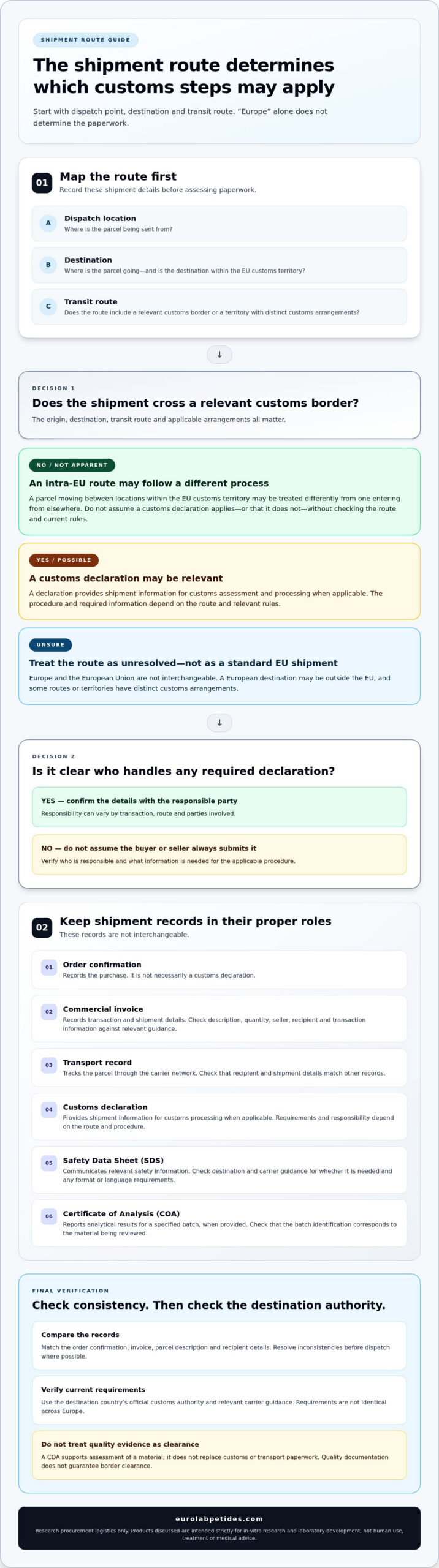
Before Ordering Research Peptides: A Customs Paperwork Checklist
A document review before checkout can help you spot missing or mismatched shipment information while there’s still time to resolve it. Use these five checks when ordering research peptides in Europe. The checklist supports preparation, but it can’t determine customs outcomes or replace current destination-specific guidance.
- Identify the route. Confirm the dispatch country and destination country, then review the likely carrier route. Don’t infer the parcel’s origin from a supplier’s regional branding. The actual dispatch point and any transit through other customs territories may affect which process applies.
- Check official destination rules. Consult the relevant customs authority for current import guidance, including information applicable to the research-chemical category. Requirements can depend on the destination and shipment circumstances, so avoid relying on a general European assumption.
- Review the order details. Compare the order confirmation, invoice, parcel description and recipient information. Check that product description, quantity, seller or shipper, and recipient details are accurate and consistent. Verify required document formats and fields against official and carrier guidance.
- Retain the records. Keep copies of the order confirmation, invoice, carrier information and any product-quality documents provided. The records have different purposes, but together they can help you answer a question about the transaction or identify which information needs clarification.
- Monitor the shipment. Follow carrier updates and read any request for additional information promptly. Tracking can signal a parcel’s progress, but it isn’t a customs declaration and doesn’t establish that clearance is complete.
What to do if a carrier requests more information
Read the notice carefully and identify the specific document or data field requested, such as an invoice detail or recipient information. Compare the request with your order records, then respond through the carrier’s official process using accurate information. Don’t guess at a classification or alter a description to fit a requested field.
If the question concerns classification, admissibility or the customs treatment of the goods, consult the relevant customs authority or a qualified adviser. A carrier can clarify its own request or process, but questions of official customs treatment should go to the appropriate authority.
Clearance decisions and timing depend on the authorities involved and the circumstances of the shipment. Accurate records support review, but they can’t guarantee a particular decision or delivery date.
For in-vitro research and laboratory development, explore EuroLab Peptides research-grade peptides.
Ordering from EuroLab Peptides: Quality Records, Research Use, and Next Steps
EuroLab Peptides is a Europe-based supplier of research-grade peptides. Its stated multi-level quality-control process includes in-house and independent third-party laboratory testing. These measures support product-quality review, while customs decisions depend on the shipment route, applicable procedures and relevant authorities. Supplier location or testing evidence alone doesn’t establish where a parcel is dispatched from or how it will be treated at a border.
How quality documentation supports research procurement
When batch-specific analytical information is provided, it can help researchers assess the reported characteristics of the batch under review. Match any batch reference on the quality record to the material it describes, and keep the record with your procurement documentation. It serves a different purpose from an invoice, transport record or customs declaration.
Analytical results don’t guarantee customs acceptance, clearance or a particular research outcome. They also don’t change the stated scope of the products: EuroLab Peptides’ products are intended strictly for in-vitro research and laboratory development, not human consumption or clinical use. For foundational terminology, consult the guide to peptides for researchers.
A clear next step for European research buyers
Before completing an order, bring the procurement and route checks together. Confirm the actual dispatch point, destination and likely route. Review current destination-specific guidance from the relevant official customs authority, then compare the order confirmation, invoice, parcel description, recipient details and available product documentation for accuracy and consistency.
This final review helps identify unanswered paperwork questions before purchase, without assuming that routes across Europe follow identical procedures. Keep customs and transport documents distinct from analytical records, and use official guidance for requirements that depend on the destination or shipment circumstances.
Explore EuroLab Peptides to review research-grade peptide options for in-vitro laboratory work.
Make Your Next Research Order with Clear Documentation
When ordering research peptides in Europe, start with the shipment route. The dispatch origin, destination and applicable customs territory help determine which procedures may apply. Verify current requirements with the destination’s official customs authority rather than assuming every European route is the same.
Next, check that the order confirmation, invoice, parcel description and recipient details are consistent. Keep customs and transport records separate from product-quality documents. A Certificate of Analysis can support review of batch-specific analytical information, but it doesn’t replace customs paperwork or guarantee clearance.
EuroLab Peptides is a Europe-based research-grade peptide supplier. Its stated multi-level quality process includes in-house and independent third-party laboratory testing. Products are intended strictly for in-vitro research and laboratory development, not human consumption or clinical use. This quality information supports product review, while shipment decisions depend on the route, circumstances and relevant authorities.
Review your route, destination guidance, order records and product documentation before purchasing. Explore EuroLab Peptides and take your next research procurement step with clear information in hand.
Frequently Asked Questions
Do research peptide orders within the EU need a customs declaration?
Generally, a shipment moving wholly within the EU customs territory isn’t treated like an import entering from outside it, so a customs declaration may not apply. The actual route and applicable territory matter: special territorial arrangements or a route passing through another customs territory can affect the process. When ordering research peptides in Europe, verify the dispatch point and route rather than relying only on the seller’s location.
What documents may accompany a research peptide shipment?
Documents may include a commercial invoice, carrier transport information, customs information where applicable, and product records such as a Safety Data Sheet or Certificate of Analysis. Not every shipment requires every document. Requirements depend on the route, destination, carrier and relevant authority. Compare the product description, quantity, seller and recipient details across the records, then consult official destination guidance for required formats or fields.
Is a certificate of analysis the same as a customs declaration?
No. A Certificate of Analysis reports analytical results for a specified batch, when provided, and supports product-quality review. A customs declaration supplies shipment information for customs processing when required. The records serve different purposes. A COA doesn’t replace an invoice or declaration, establish customs treatment, or guarantee that a shipment will be accepted or cleared.
Can a research peptide shipment be delayed at customs?
Yes. A shipment may take longer if authorities require further review or information, or if shipment details need clarification. Delays and decisions depend on the route, documentation, product classification and circumstances of the specific parcel. A carrier notice should identify the information or document requested; respond through its official process using accurate records. Neither a tracking update nor product-quality documentation guarantees a clearance decision or delivery date.
How do I check customs requirements for research chemicals in my country?
Start with the destination country’s official customs authority and review current guidance relevant to the shipment route and substance. Check whether the information addresses import procedures, classification, declared transaction details and who may be responsible for submitting documents. If classification or admissibility remains unclear, consult the authority or a qualified adviser. Rules can differ by destination, so don’t assume one European country’s process applies everywhere.
Does ordering from a European supplier mean there will be no customs paperwork?
No. A supplier’s European base doesn’t establish the parcel’s actual dispatch origin or route. A shipment moving within the EU customs territory may follow a different process from one entering it from outside, and Europe isn’t synonymous with the EU. Before ordering, identify where the parcel will be dispatched from, where it is going and whether the route crosses a customs border. Then verify destination-specific requirements.
Are research peptides intended for human consumption or clinical use?
No. EuroLab Peptides’ products are intended strictly for in-vitro research and laboratory development. They aren’t intended for human consumption or clinical use, and product information shouldn’t be interpreted as medical advice or a treatment recommendation. Research-use positioning and analytical records describe the supplier’s stated scope and product-quality information; they don’t determine customs requirements or guarantee that a particular shipment will receive clearance.
