

A “research-grade” label alone doesn’t establish whether a material meets your laboratory’s requirements. Effective non-clinical research material sourcing starts with a defined use, written specifications, and relevant documentation. Compare suppliers against those criteria, not broad claims or price alone.
Batch information and quality records can help support a purchasing decision, but the evidence that matters depends on the work. This guide offers a practical framework for setting requirements, comparing supplier claims, and reviewing documentation for in-vitro research and laboratory development.
Direct material purchasing is different from outsourcing a study to a contract research organization (CRO). Research-grade materials should also not be confused with GMP-grade materials intended for clinical trials or manufacturing. EuroLab Peptides supplies research-grade peptides for in-vitro research and laboratory development, with quality control that includes in-house and independent third-party laboratory testing. Its products are not intended for human consumption or clinical use.
Key Takeaways
- Define the intended in-vitro research use and write down laboratory requirements before comparing suppliers.
- Assess identity, stated specifications, batch traceability, and supporting records. A certificate of analysis alone does not establish suitability for every research purpose.
- Distinguish direct material purchasing from CRO services, which involve study design or execution. Compare sourcing routes by their role and the records they provide.
- Use a repeatable sourcing workflow: define the need, set criteria, review evidence, compare options, and document the decision.
- EuroLab Peptides uses in-house and independent third-party testing as part of its quality-control approach for research-grade peptides intended for in-vitro research and laboratory development, not human consumption or clinical use.
What Non-Clinical Research Material Sourcing Covers, and What It Does Not
Non-clinical research material sourcing is the process of identifying, evaluating, and purchasing materials for laboratory research outside clinical use. A material is an input to a defined research activity, such as an in-vitro assay or laboratory development project. Start with the intended research use, then assess whether the available evidence matches the project’s requirements. A supplier label alone is not enough to make that determination.
Procurement, study services, and clinical supply serve different needs. A material supplier may sell research inputs without designing or conducting the experiments that use them. Similarly, a research-grade designation does not make a material suitable for clinical trials, commercial manufacturing, or human use. This guide focuses on defining a purchasing need, reviewing supplier evidence, and assessing material fit for a non-clinical project.
Research materials, CRO services, and clinical supply are different categories
Research materials are inputs used in laboratory work. Depending on the project, these may include peptides or other compounds used in an in-vitro model or laboratory development workflow. A contract research organization (CRO), by contrast, provides contracted research services, which may include designing or conducting studies. A CRO and a material supplier can have separate roles in the same research program.
Clinical-trial supply and medical treatment are separate from research-material procurement. Research-grade describes a material’s stated research context; it does not establish clinical-grade status or suitability for people. Good Laboratory Practice (GLP) concerns the organization and conduct of certain non-clinical studies. It is not a grade for a purchased material. For background on study quality principles, see Good Laboratory Practice (GLP).
Start with the research objective and intended setting
Before comparing suppliers, write down the research question, experimental model, and material category. For example, a peptide being considered for an in-vitro assay has a different role from a service provider engaged to execute a study. Specify the laboratory setting and how the material will be used. This keeps comparisons focused on the purchase rather than unrelated questions about clinical supply or outsourced study design.
Translate the research objective into purchasing requirements: the material category, its role in the workflow, and the information your laboratory needs to evaluate it. Researchers new to the category can build foundational context with this comprehensive guide to peptides for researchers. EuroLab Peptides supplies research-grade peptides for in-vitro research and laboratory development. Its materials are not intended for human consumption or clinical use. Material sourcing supports a research project; it does not replace study design or clinical decision-making.
Which Supplier Evidence Matters When Sourcing Research Materials?
Supplier evidence is useful when it answers a specific question about the material and connects that answer to the batch being considered. For non-clinical research material sourcing, define project criteria first, then assess whether the available records address them. A polished certificate or broad quality claim, on its own, does not show that a material is appropriate for a particular experiment.
Review documentation for relevance and traceability
Start with the material’s identity and stated specification. Check whether supporting records identify the same material and clearly correspond to the batch under consideration. A record without a clear material or batch connection may provide context, but it does not show that its results apply to the specific lot you plan to use.
Compare the records with criteria established for your work. Depending on the project, these might include identity information, a stated analytical result, or other documented characteristics. The relevant criteria and analytical methods depend on the research question. Verify details against current product documentation before treating them as requirements or claims.
A certificate of analysis (COA) is a record to review, not universal proof of research suitability. Check what it reports, how it identifies the material and batch, and whether the results address your project’s acceptance criteria. An analytical report documents testing information. It is not regulatory approval, clinical validation, or evidence that a material is suitable for human use.
Interpret quality terminology without overreading claims
Terms such as “research-grade” describe a research-use category; they are not interchangeable with pharmaceutical or clinical grade. Read the label alongside the material description and supporting records. Grade terminology alone does not show that a material meets a separate project specification or clinical supply requirements.
Method names also need context. HPLC or LC-MS may be examples of analytical methods, but do not assume either was used unless the current documentation says so. A method name alone does not establish the material’s identity, quality, or suitability. Consider what the test evaluates, whether results are reported, and whether they relate to the relevant batch and predefined criteria.
For claims of independent or third-party testing, assess the scope: what was tested, whether the record is batch-linked, and what results are available. EuroLab Peptides uses in-house and independent third-party laboratory testing as part of its multi-level quality-control approach. The evidence relevant to a purchasing decision depends on the material and research purpose. For additional context on material selection and handling, consult this guide to sourcing and handling high-purity research peptides.
- Identity: Does the record clearly identify the material?
- Specification: Are the stated characteristics relevant to the project?
- Traceability: Is the documentation linked to the batch being evaluated?
- Results: Can the reported findings be compared with predefined criteria?
Laboratories evaluating peptide inputs for in-vitro research and laboratory development can assess EuroLab Peptides’ research-grade peptides using the same evidence-led framework. These materials are not intended for human consumption or clinical use.
How Do Direct Suppliers, Marketplaces, and CROs Compare?
These routes serve different functions. A direct supplier or marketplace supports material purchasing, while a contract research organization (CRO) provides study services. Compare them by the work you need done, the records available for review, and how each route fits your procurement process. A channel label alone does not establish material quality or research suitability.
Direct supplier
Role: Supplies materials for research use; purchasing is the primary transaction. Documentation access: Product information and available batch records are accessed through the supplier. Workflow: Select the material and purchase it directly. Fit: A practical route when the laboratory has defined its material requirements and will conduct its own research.
Marketplace
Role: Provides a discovery or transaction channel for products from sellers. Documentation access: Listings, record formats, and access processes can differ between sellers. Workflow: Search and compare listings through the platform, then follow its purchasing process. Fit: Useful for discovery when the route supports the buyer’s documentation and traceability needs.
CRO
Role: Provides contracted research services, which may include study design or execution. Documentation access: Study records relate to the contracted work and are distinct from a material supplier’s product or batch evidence. Workflow: Define and contract for a study service. Fit: Relevant when project execution or specialist study capability is needed, rather than for a material purchase alone.
Direct supplier versus marketplace for material purchasing
For either purchasing route, determine how product details and batch-specific records can be accessed and whether the records connect to the material being evaluated. A marketplace may bring together multiple sellers, so documentation formats and purchasing steps can vary by listing. A direct supplier provides a purchase route through that supplier, but the buyer still needs to assess the available information against laboratory requirements.
For non-clinical research material sourcing, the useful comparison is whether the route supports consistent review, traceability, and internal procurement records. Record the seller, material identity, batch reference where available, and documents reviewed in the purchasing file. That makes the decision easier to explain and revisit.
When a CRO is relevant to the sourcing decision
A CRO becomes relevant when the project requires outsourced study planning or execution. Its expertise relates to the contracted study, not automatically to the quality evidence for a separately purchased material. Keep the evaluations distinct: assess study-service capability for the outsourced work and product documentation for the material. A guide to buying research peptides provides further context for material-purchasing considerations.
For laboratories sourcing peptides for in-vitro research and laboratory development, EuroLab Peptides supplies research-grade materials and uses in-house and independent third-party laboratory testing as part of its quality-control approach. EuroLab Peptides’ research-grade peptides are a material-purchasing option, not a substitute for contracted study services. The products are not intended for human consumption or clinical use.
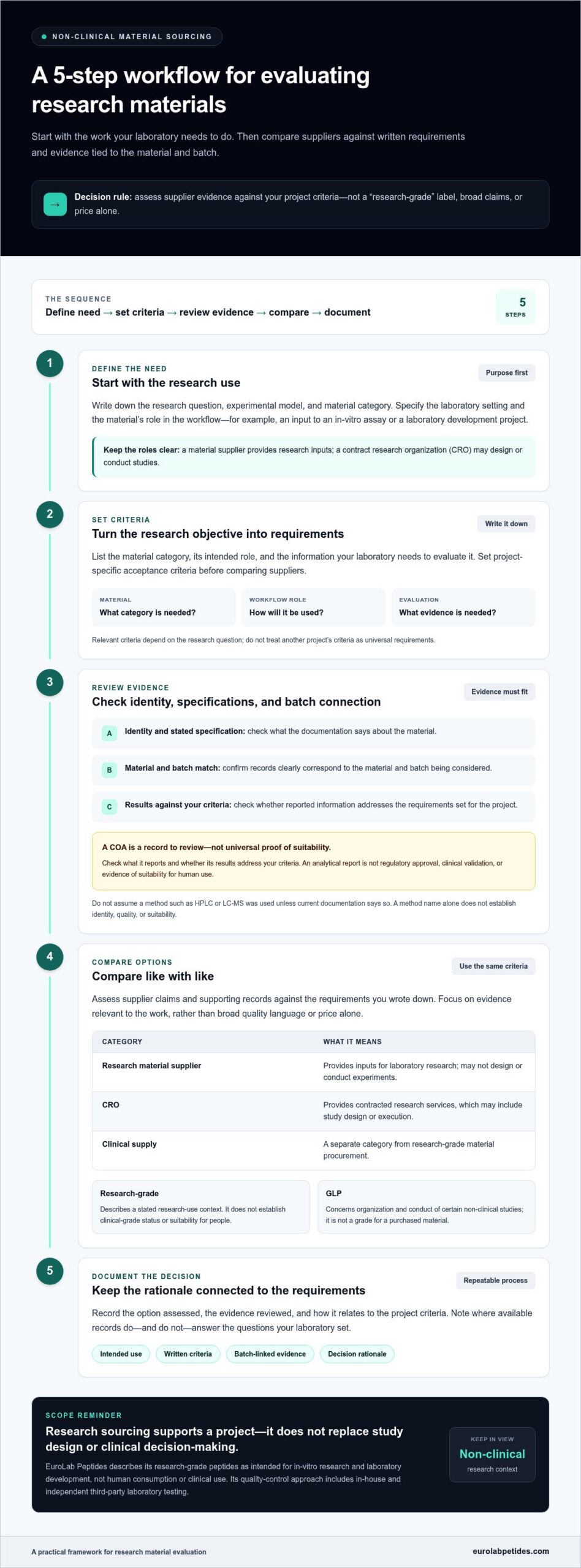
A Practical Qualification Workflow for Non-Clinical Material Sourcing
A repeatable workflow makes non-clinical research material sourcing easier to justify and reproduce. It also prevents convenience, price, or broad supplier claims from replacing project-specific criteria. Use the same sequence for each purchase, adapting the level of review to the laboratory’s procedures and the intended research context.
Translate the research question into sourcing criteria
Start with the research objective, then describe the material needed to support it. Record the material identity, intended non-clinical setting, and any acceptance criteria specified by the project or a validated protocol. Use this written specification as the reference point for supplier evaluation. Do not add technical thresholds just because they appear in a general checklist. Include them only when they are relevant and justified for the work.
Separate essential requirements from preferences. A required material identity or project-defined documentation need belongs in the essential category. Purchasing convenience may matter, but it cannot replace a missing requirement. Making the distinction upfront helps show where trade-offs are possible before comparing supplier claims.
Compare evidence and record the decision
Apply the same criteria to every sourcing option. Compare available product and batch records with the written specification, then note whether each criterion is met, not met, or unresolved. An information gap is not automatically a disqualifier. Record what is missing and decide whether it affects the project or calls for follow-up under the laboratory’s process.
Keep a concise decision record. Include the specification used, supplier information reviewed, document versions, relevant batch references, and the reason for selection. If more than one option meets essential criteria, documented preferences can explain the final choice. If no option meets a critical requirement, pause the purchase rather than weakening the specification without scientific or procedural justification.
- Define the need: Record the research objective, material category, and intended laboratory context.
- Set criteria: Separate project-essential requirements from purchasing preferences.
- Review evidence: Compare available records with the criteria and note gaps.
- Compare options: Use the same specification for every supplier or channel.
- Document and approve: Record the decision, then follow institutional procurement and quality procedures.
Supplier qualification does not replace the laboratory’s own controls. Route procurement approval through the responsible institutional process, particularly if a regulatory or quality-system requirement applies. At receipt, follow established procedures to check that the delivered material and accompanying information correspond to the purchase record. These steps support traceability while allowing for differences in laboratory approval and receipt workflows.
For peptide research, this workflow keeps material selection anchored to defined in-vitro or laboratory-development needs. EuroLab Peptides supplies research-grade peptides for those purposes and uses in-house and independent third-party laboratory testing as part of its quality-control approach. Review EuroLab Peptides’ research-grade peptides alongside your sourcing specification. Products are not intended for human consumption or clinical use.
How EuroLab Peptides Supports Research-Grade Material Sourcing
For laboratories sourcing peptides for in-vitro research and laboratory development, supplier information is most useful when it can be assessed against documented project requirements. EuroLab Peptides is a Europe-based supplier of research-grade peptides. The company supplies research materials and uses in-house and independent third-party laboratory testing as part of its quality-control approach.
These testing layers are part of the company’s quality-control process. They do not replace a laboratory’s assessment of whether product information and records address the intended research use, and they do not establish clinical suitability. EuroLab Peptides’ products are strictly for in-vitro research and laboratory development, not for human consumption or clinical use.
Connect multi-level quality control with buyer evaluation
Use quality-control information as an input to your evaluation, not as a substitute for project criteria. Identify the material needed, then compare the product information and documentation with the laboratory’s written requirements. If testing information is relevant, consider what it covers and whether it supports the decision your team needs to make.
Keep conclusions within the scope of the evidence. Do not infer a testing method, purity value, certification, or batch-level guarantee from a general description of quality control. The appropriate evidence depends on the project and the current documentation for the material. This distinction helps separate a supplier’s stated process from conclusions the laboratory draws during its own review.
Choose a research category aligned with the project
EuroLab Peptides’ research categories include weight management, tissue repair, longevity, and cognitive research. Treat these as broad areas of non-clinical research interest, then identify the material and experimental context relevant to your work. A category label does not establish a particular experimental outcome or determine whether a material fits a laboratory protocol.
For peptide research in this area, weight management research peptide sourcing guidance can help frame material selection in a research context. Research materials support laboratory investigation; they are not instructions or products for treatment or human use.
To apply an evidence-led approach, align the intended in-vitro or laboratory-development use with the material information available, then assess that information against your institution’s requirements. EuroLab Peptides’ in-house and independent third-party testing are part of its stated quality-control approach. The laboratory remains responsible for determining project fit through its own review procedures.
Explore EuroLab Peptides research materials and compare the available information with your laboratory’s documented needs. Products are intended only for in-vitro research and laboratory development, not for human consumption or clinical use.
Make Your Next Sourcing Decision More Deliberate
Each sourcing decision can inform the next one. Use the project to refine your laboratory’s written requirements: note which evidence proved useful, where documentation left questions, and what should be specified earlier in the next purchasing cycle. This creates a consistent basis for non-clinical research material sourcing without assuming that one supplier label or document answers every project’s needs.
Keep the intended setting explicit when evaluating materials. EuroLab Peptides uses in-house and independent third-party laboratory testing as part of its quality-control approach, and its products are strictly for in-vitro research and laboratory development. Assess material information against your laboratory’s requirements and procedures.
Explore EuroLab Peptides research materials as you align your sourcing criteria with your project. A clear specification and careful evidence review can help your team make and document a consistent decision.
Frequently Asked Questions
What is non-clinical research material sourcing?
Non-clinical research material sourcing is selecting and purchasing inputs for laboratory investigations outside clinical use. For example, a team planning a cell-based experiment may purchase a compound directly, while separately commissioning a CRO to run the assay. The purchase covers the material; the contracted service covers defined research work. Keeping those scopes distinct helps assign budgets, responsibilities, and records correctly.
How is a research material supplier different from a CRO?
A research material supplier sells inputs for laboratory work, while a CRO performs contracted research activities. A laboratory purchasing a peptide for its own assay is buying a material. A team hiring an organization to design or conduct that assay is outsourcing study work. These roles can intersect in a project, but evidence about a CRO’s study capabilities does not replace documentation about a purchased material.
What documentation should I review when sourcing research materials?
Review records that connect the stated material identity to the batch under consideration. Depending on the information provided, this may include product information, a certificate of analysis, or a testing report. Check the document date or version, batch identifier, reported results, and whether the information addresses criteria set by your laboratory. Keep copies with purchasing records so the decision can be traced later.
Does research-grade mean a material is suitable for clinical use?
No. Research-grade does not establish that a material is appropriate for clinical trials, medical treatment, or human use. Grade terms describe a product’s stated category, not its equivalence to clinical or pharmaceutical supply requirements. EuroLab Peptides’ products are intended strictly for in-vitro research and laboratory development, not human consumption or clinical use. Keep research purchasing separate from clinical supply decisions.
How can I compare direct suppliers with research marketplaces?
Compare the purchasing process and how product information and batch records are accessed. A direct supplier provides a route to purchase from that supplier. A marketplace can present listings from multiple sellers, potentially with different document formats or access steps. For each option, consider whether your procurement records can identify the seller, material, and relevant batch, and whether the workflow fits your institution’s purchasing controls.
Can third-party testing confirm that a material fits my research requirements?
Third-party testing can provide useful evidence, but it does not automatically confirm project fit. Its value depends on what was tested, which batch the results relate to, and whether the reported information addresses criteria defined for your experiment. A testing claim without scope or batch context may leave questions unanswered. Review the underlying documentation alongside your protocol and laboratory procedures rather than treating the testing label as a universal suitability determination.
What should I define before sourcing materials for an in-vitro study?
Define the research objective, experimental model, and material role before comparing purchasing options. For example, specify whether the material is an input to a particular cell-based workflow, then record its identity and the project-defined acceptance criteria. Separate essential requirements from preferences such as ordering convenience. A written specification gives procurement and laboratory staff a shared reference and helps prevent unsupported technical thresholds from entering the selection process.
