

What if a purchase order clears your university’s internal review but doesn’t match the supplier’s ordering process? For labs purchasing research peptides with purchase orders, approval, payment, and order submission are related but separate steps. A PO may authorize spending internally; whether it supports invoicing or how it must be submitted depends on institutional policy and the supplier’s workflow.
That distinction matters when research timelines depend on complete documentation and accurate order details. Supplier records, product information, quality documentation, funding approvals, and checkout details may all need to align before an order can proceed. Research-use restrictions also matter: peptides supplied by EuroLab Peptides are for in-vitro research and laboratory development only, not for human consumption or clinical use.
This guide explains how to prepare an internally approved PO, which supplier and product records to retain, and how to reduce delays caused by mismatched details. It also covers how to assess quality documentation, including the role of in-house and independent third-party testing, while keeping institutional requirements and research-only use at the center of the purchasing process.
Key Takeaways
- When purchasing research peptides with purchase orders, distinguish internal spending authorization from payment and follow your institution’s procurement workflow.
- Map the process from research need and budget review to approvals, order placement, and record retention, using local policies for roles and thresholds.
- Compare PO, invoice, and card workflows for approval fit, documentation, reconciliation, and processing dependencies.
- Match peptide identity, quantity, institutional reference, and delivery details, and keep relevant supplier and quality records with the purchasing file.
- Assess supplier documentation and quality-control information against the research purpose. EuroLab Peptides products are for in-vitro research and laboratory development only, not human consumption or clinical use.
Why university labs use purchase orders for research peptide procurement
A purchase order (PO) is an institution’s formal purchasing document. It records what the institution intends to buy, from whom, and under which approved terms. A PO is not proof of payment, nor does it mean a supplier has accepted an order. For a foundational overview of the document’s commercial role, see What is a Purchase Order?
For university labs, a PO links a research need to an authorized expenditure. It can identify the funding source, document the requested goods, and give procurement and finance teams a record to review during reconciliation or an audit. The approval sequence depends on institutional policy and the roles assigned to the lab, department, procurement office, and finance staff.
What a purchase order does in laboratory purchasing
A PO documents a purchasing commitment, subject to the institution’s approval rules. The laboratory may define the scientific requirement and confirm the items requested, while procurement reviews supplier or purchasing details and finance verifies budget coding. Different people or systems may handle these tasks. An approved PO establishes internal authorization; it does not set supplier payment terms or confirm that an order has been accepted.
This distinction matters when purchasing research peptides with purchase orders. A lab may have permission to spend from a grant or department account, yet still need to submit the PO through the supplier’s ordering process. Order acceptance and payment follow the relevant supplier workflow. Don’t assume that institutional approval automatically creates an invoice arrangement or changes payment requirements.
Why research-peptide orders need clear purchasing records
Traceable records depend on clear, consistent descriptions. The product identity and quantity on the PO should match the lab’s approved request and the details used to place the order. If a description is ambiguous or quantities differ across records, procurement staff may need to resolve the discrepancy before reconciling the transaction. Keeping the institutional reference and delivery recipient consistent also helps connect the purchase to the right project and receiving location.
Make the research purpose explicit, too. The order documentation should identify the material as intended for laboratory research, not imply clinical, veterinary, or personal use. EuroLab Peptides supplies research-grade peptides for in-vitro research and laboratory development only. Its products are not intended for human consumption or clinical use. Keep this intended-use boundary clear in both purchasing and research records.
Supplier and product documentation gives reviewers context about the source and quality-control approach. EuroLab Peptides uses in-house and independent third-party testing to support product purity and consistency. For broader context on sourcing, documentation, and laboratory standards, consult this research peptide purchasing guide.
The applicable process is shaped by two separate sources: the university’s procurement policy and the supplier’s ordering instructions. Treating them as distinct checkpoints helps prevent confusion between internal authorization, order acceptance, invoicing, and payment.
How a university lab purchase order moves from request to peptide order
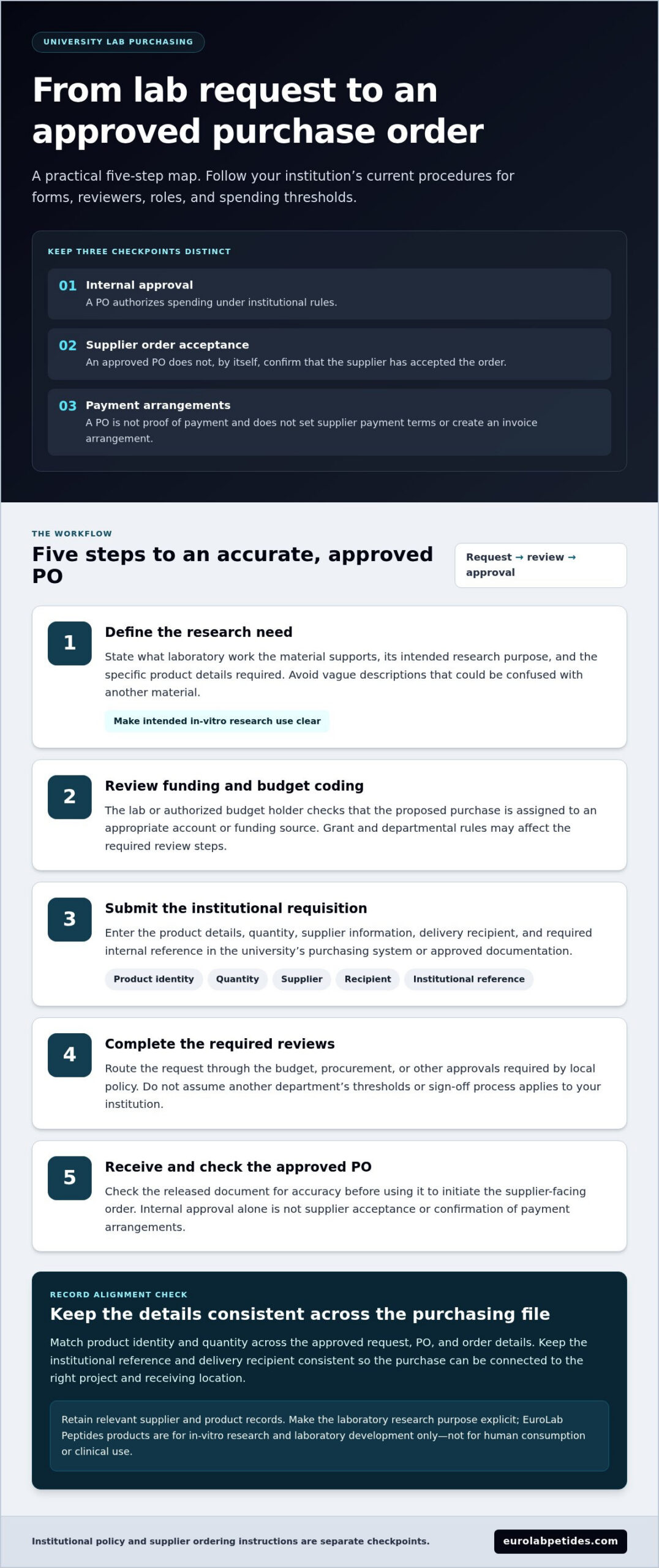
A purchase order reaches a supplier after the institution’s internal purchasing process produces an approved document. Forms, reviewers, approval roles, and spending thresholds vary by university, department, and funding source. Use the sequence below as a practical map, then apply your institution’s current procedures at each stage.
From laboratory request to approved PO
Start by documenting the scientific requirement and intended in-vitro use. Record the product identity and requested quantity clearly so procurement can review the request and the final order can be matched against it.
- Define the research need. Identify the laboratory work the material will support, its intended research purpose, and the specific product details required. Avoid vague descriptions that could be confused with another material.
- Review funding and budget coding. The lab or authorized budget holder checks that the proposed purchase is assigned to an appropriate account or funding source. Grant and departmental rules may affect the required review steps.
- Submit the institutional requisition. Enter the product details, quantity, supplier information, delivery recipient, and required internal reference in the university’s purchasing system or approved documentation.
- Complete required reviews. Route the request through the budget, procurement, or other approvals required by local policy. Don’t assume another department’s thresholds or sign-off process applies to your institution.
- Receive the approved PO. Check the released document for accuracy before using it to initiate the supplier-facing order. Internal approval alone is not supplier acceptance or confirmation of payment arrangements.
From approved PO to documented order
After approval, keep the same details across the institutional record and the order submitted to the supplier. Even small inconsistencies, such as a different quantity or an outdated delivery recipient, can lead to avoidable clarification and reconciliation work.
- Reconcile the details. Compare the approved item description, quantity, institutional reference, recipient, and delivery information with the details prepared for the supplier. Resolve discrepancies through the institution’s process before placing the order.
- Follow the supplier’s ordering workflow. Use the supplier’s stated instructions for placing an order and submitting or applying an approved PO. Supplier acceptance, invoicing, and payment arrangements follow the supplier’s ordering process; institutional PO approval doesn’t establish those terms.
- Retain the transaction record. Keep the approved PO, order confirmation, and relevant supplier and product documentation according to institutional recordkeeping procedures. This creates a traceable link between the research request, authorization, order, and later reconciliation.
This sequence makes purchasing research peptides with purchase orders more manageable by separating internal authorization from supplier order processing. EuroLab Peptides supplies products for in-vitro research and laboratory development only. After mapping your institutional steps, review EuroLab Peptides’ research products as part of your research-material evaluation.
Purchase order, invoice, or card: compare procurement routes before ordering
These routes describe different parts of a purchasing transaction. A purchase order records institutional authorization; an invoice is used in a payment workflow; a card is a payment method. They may be connected, but one does not automatically provide the others. Issuing a PO alone doesn’t mean a supplier has accepted it, agreed to invoice terms, or received payment.
For labs purchasing research peptides with purchase orders, compare the process your institution permits with the supplier’s ordering workflow. The table outlines common distinctions. Actual requirements depend on local policy and the supplier’s stated procedures.
| Route | Approval fit | Documentation needs | Reconciliation | Processing dependencies |
|---|---|---|---|---|
| PO-based procurement | Fits institutions that require an approved purchasing record before committing funds. | Approved PO, accurate item and quantity details, institutional reference, and supporting supplier or product records as required. | Connects the authorized request to the order and subsequent records. | May depend on vendor onboarding, correct PO submission, and supplier acceptance. |
| Invoice workflow | Fits when institutional finance procedures process a supplier invoice for payment. | Invoice plus records required to verify the purchase and route it to the correct account. | Finance matches the invoice to relevant purchasing and receiving records under local procedure. | Requires an applicable invoice arrangement and supplier process; a PO alone doesn’t create them. |
| Direct card checkout | May fit where institutional policy permits card purchases and the transaction has the required approval. | Checkout confirmation, receipt, and internal authorization or expense records, as required locally. | The cardholder or finance team reconciles the transaction through the institution’s process. | Depends on card policy, checkout options, and any required advance approval. |
When a PO-based process fits institutional controls
A PO-based route can suit a lab whose institution requires purchasing to be authorized and documented before an order is placed. Internal readiness and supplier processing are separate checks: vendor onboarding, document submission, or supplier acceptance may still be part of the process after institutional approval. Confirm the sequence against university policy and the supplier’s ordering instructions before treating the order as complete.
How invoice and direct-payment workflows differ
An invoice is part of finance processing, not an automatic consequence of issuing a PO. An applicable invoice workflow and the institution’s controls determine how the document is processed. Direct checkout is different: payment may occur through a card transaction, while approval and reimbursement, if relevant, follow separate institutional rules. Neither route is universally available or preferred.
Choose a route by matching institutional requirements to the supplier’s ordering instructions, rather than assuming a familiar payment method will apply. Keep authorization, order acceptance, and payment records distinct so they are not treated as interchangeable.
University PO checklist: match peptide details, supplier records, and approvals
A complete PO file has two layers: the purchasing fields that authorize and identify the transaction, and supporting records that help reviewers assess the supplier and product. Keeping them separate makes missing information easier to spot without assuming that every university uses the same form or requires the same attachments. Before submission, compare the PO with the approved requisition and your institution’s field and retention requirements.
PO details to reconcile before submission
Use the university’s required descriptions, coding fields, and identifiers. Don’t substitute informal lab shorthand for a required product description. A final comparison across the requisition, PO, and planned order can catch discrepancies before they enter the purchasing record.
- Product identity: Confirm the requested product name matches the approved requisition and is clear enough for procurement review.
- Quantity: Check that the PO quantity matches the approved request and order details. Resolve any difference through institutional procedures before submission.
- Institutional reference: Include the required PO number, account or funding code, and other internal identifiers in their designated fields.
- Delivery recipient: Verify the named recipient and delivery details against the laboratory’s receiving arrangements and institutional records.
- Research purpose: Keep the intended use clear in the purchasing documentation. EuroLab Peptides products are for in-vitro research and laboratory development only, not human consumption or clinical use.
Precise terminology can help make materials easier to identify and review. For background on peptide terminology, see the guide to peptides for researchers.
Supplier and quality records for procurement files
Supporting documentation does not replace PO fields. Supplier records identify the source, while product-quality information can support an internal review of product identity and the supplier’s quality approach. File these separately from the approved purchasing document so reviewers can find each type of information without confusing quality records with spending authorization.
EuroLab Peptides’ quality approach includes in-house and independent third-party laboratory testing to support product purity and consistency. This describes the testing approach; it does not establish a specific test result, certificate, or document for an individual order. Describe only records that were provided for the transaction.
Determine which supplier and product documents your institution requires, then retain them according to its procedures. Requirements and retention rules may differ. A clear file should let an authorized reviewer connect the approved request, PO details, supplier information, and available product-quality documentation.
Use this checklist to prepare a consistent purchasing record, then review EuroLab Peptides’ research products for in-vitro research and laboratory development.
Choose a research-peptide supplier that fits university procurement and research-use requirements
Supplier fit involves more than finding a product that matches a laboratory’s research question. For purchasing research peptides with purchase orders, assess whether the institution’s approval and documentation process aligns with the supplier’s ordering instructions, and whether the product’s stated use and quality information suit the lab’s requirements. A completed internal review does not, on its own, establish supplier acceptance or payment arrangements.
Assess supplier fit using procurement and quality evidence
Consider procurement fit and scientific fit separately. Compare the institution’s required purchasing sequence with the supplier’s ordering instructions, without assuming that a particular PO, invoice, or payment route applies. Then assess the available product information and quality-control context against the laboratory’s research protocol and purchasing records.
EuroLab Peptides is a Europe-based supplier of research-grade peptides. Its quality-control approach includes in-house and independent third-party laboratory testing to support product purity and consistency. This is relevant quality-control information, but it should not be extended into unreported test values, particular certificates, or conclusions about clinical efficacy. Testing information is not evidence of suitability for human use.
- Procurement alignment: Check that the institution’s internal steps and the supplier’s ordering instructions can be followed without treating approval as supplier acceptance.
- Product relevance: Compare the product’s stated identity and research category with the laboratory’s documented experimental requirements.
- Quality context: Consider the stated testing approach as quality-control information, and distinguish it from claims that product records do not support.
- Intended use: Ensure the proposed purchase is consistent with the product’s stated research-use scope and the lab’s institutional requirements.
Complete the purchasing decision responsibly
Before submitting an order, bring the approval, product, and recordkeeping checks together. Confirm that internal authorization is complete under local policy, the item and quantity match the approved request, and institutional references and delivery details are consistent. Identify which supplier and product records the institution requires and retain them according to its procedures.
Research-use scope is a decisive boundary, not a minor label detail. EuroLab Peptides products are supplied strictly for in-vitro research and laboratory development. They are not intended for human consumption or clinical use. Keep that distinction explicit in the purchasing rationale and research documentation; quality-control information does not establish clinical efficacy or authorize human use.
A disciplined decision connects procurement fit, product documentation, stated quality controls, and intended use without conflating them. Use EuroLab Peptides’ product information to assess research-category relevance within that framework. Explore EuroLab Peptides for research-use product information relevant to laboratory development.
Make the next peptide purchase easier to verify
Make your next requisition a repeatable review point for the lab. Before purchasing research peptides with purchase orders, align the purchasing record with the experiment’s documented purpose and your institution’s requirements. This gives procurement and research staff a shared basis for assessing the request while keeping internal authorization distinct from the supplier’s ordering process.
Supplier quality information can inform that review, but interpret it within its stated scope. EuroLab Peptides’ quality-control process includes in-house and independent third-party laboratory testing to support product purity and consistency. Its peptides are intended strictly for in-vitro research and laboratory development, not human consumption or clinical use. Keep those intended-use limits explicit in research planning and purchasing records.
With the institutional process established, evaluate product information against your laboratory’s research category and documentation needs. A clear, evidence-conscious review helps your team move forward with the research purpose in focus.
Frequently Asked Questions
Can a university laboratory purchase research peptides with a purchase order?
Yes, if the institution’s purchasing rules permit the transaction and the supplier’s ordering process supports it. Before preparing the order, determine whether supplier setup or additional internal review is required. For example, a university may need to register a supplier before processing a PO. Institutional approval alone doesn’t confirm that a supplier accepts a PO or has accepted a specific order.
Does issuing a purchase order mean the supplier has been paid?
No. A PO documents purchasing authorization or intent; it isn’t evidence that funds have been transferred. Payment may occur through a separate finance process, such as invoice handling or another institutionally approved method, depending on the applicable arrangements. For reconciliation, keep payment records, such as a processed invoice or transaction record, distinct from the PO and order confirmation.
What information should a university include on a peptide purchase order?
Include the product description and quantity, supplier details, the institution’s required PO or account references, and the correct delivery recipient and destination. Add any required research-purpose description and funding codes in the fields specified by your purchasing system. For example, if a department requires a grant code, enter it in its designated field rather than relying on a note in the product description. Follow local form requirements.
What documents should a lab retain when purchasing research peptides?
Retain the approved requisition and PO, order confirmation, receiving record, and payment documentation generated by the transaction, along with supplier and product information required by institutional procedure. A lab may also file relevant quality records supplied for the purchase. The required record set and retention period are institution-specific, so distinguish documents actually received from those the purchasing policy requires the lab to retain.
Is a certificate of analysis the same as a purchase order?
No. A purchase order is an institutional procurement record; a certificate of analysis (COA), when provided, is product-related analytical documentation. They serve different purposes and aren’t interchangeable. A PO doesn’t verify analytical characteristics, and a COA doesn’t authorize spending or initiate payment. Record each document in the appropriate purchasing or product-quality file, and don’t assume a specific COA is available unless it has been provided.
Are research peptides purchased by university labs intended for human use?
No. University purchasing status doesn’t convert research-use materials into products for human use. EuroLab Peptides products are intended strictly for in-vitro research and laboratory development, not human consumption or clinical use. Keep that boundary clear in protocols, purchasing descriptions, and laboratory records. Research-grade product information should not be interpreted as medical guidance, evidence of clinical efficacy, or authorization for administration to people.
