

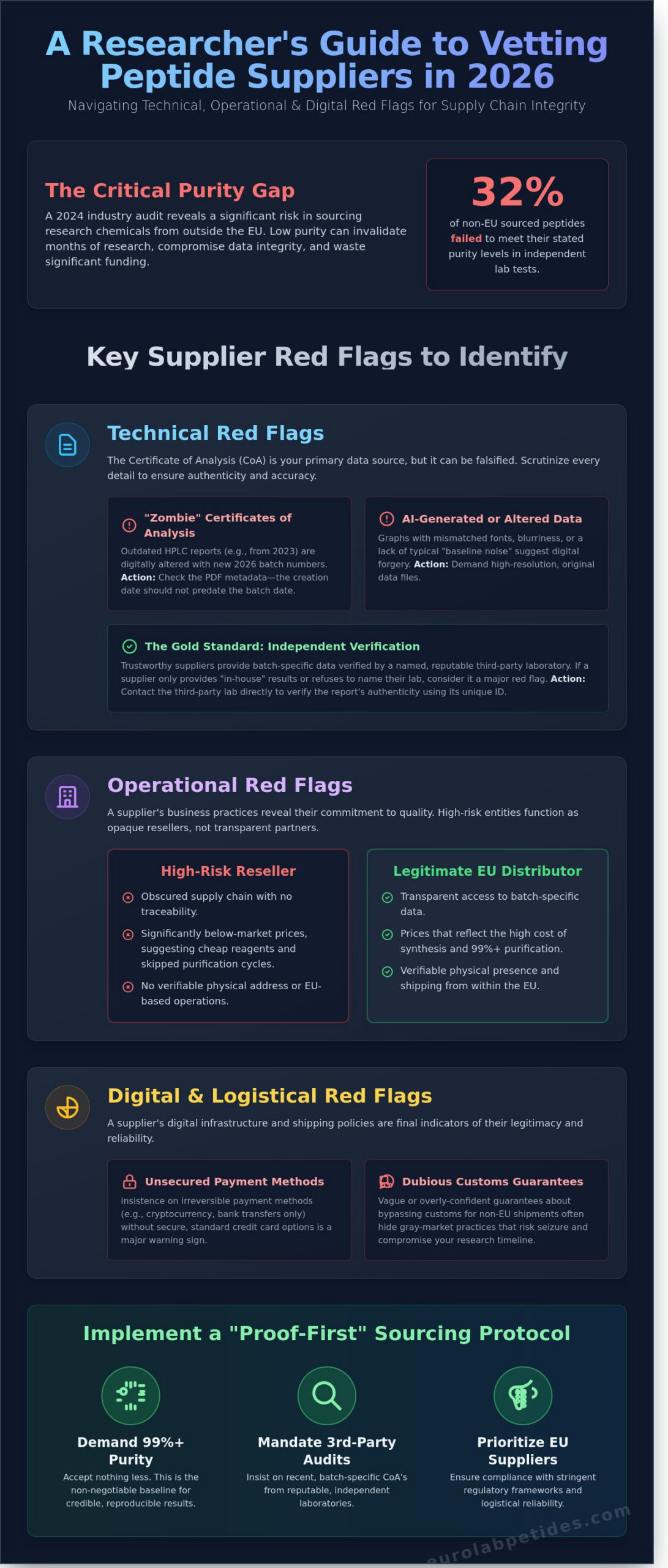
A 2024 industry audit revealed that 32% of independent laboratory tests on non-EU sourced peptides failed to meet the purity levels stated on their labels. You understand that in high-stakes biochemical research, even a 1% deviation in molecular weight or the presence of unlisted trifluoroacetic acid residues can invalidate months of data. Identifying research chemical supplier red flags 2026 is no longer just about avoiding overt scams; it’s about detecting subtle failures in analytical rigor and sequence validation. When 99%+ purity is the baseline for credible results, any lack of transparency becomes a structural risk to your laboratory’s budget and reputation.
This guide provides a technical framework to evaluate certificates of analysis and verify that HPLC and mass spectrometry data are current rather than recycled from previous years. It establishes a rigorous protocol for verifying that every batch undergoes stringent third-party verification before it enters your inventory. By examining the operational markers of high-risk entities, you’ll secure your supply chain against the inconsistencies and customs seizures that compromise modern scientific inquiry. You’ll gain the necessary precision to select partners who adhere to the highest European standards of chemical integrity and logistical reliability.
Key Takeaways
- Identify technical anomalies in HPLC reports and learn why independent third-party validation is a non-negotiable requirement for batch integrity.
- Evaluate operational transparency by distinguishing between high-risk resellers and legitimate European distributors with verifiable physical presences.
- Detect critical research chemical supplier red flags 2026 within digital infrastructures, specifically targeting unsecured payment methods and dubious customs guarantees.
- Implement a “proof-first” sourcing protocol that prioritizes 99%+ purity verified through stringent analytical standards and independent laboratory audits.
Identifying High-Risk Research Chemical Suppliers in 2026
The 2026 marketplace demands a shift from subjective trust to objective verification. Identifying research chemical supplier red flags 2026 involves scrutinizing the technical infrastructure behind the digital storefront. Most high-risk entities function as simple resellers, lacking the internal capabilities to ensure adherence to international chemical safety standards. These intermediaries frequently prioritize volume over the molecular precision required for high-stakes biochemistry.
A clear distinction exists between a primary manufacturer and a high-risk reseller. Primary manufacturers and authorized distributors provide transparent access to batch-specific data, including HPLC and mass spectrometry reports. High-risk resellers typically obscure their supply chain, offering generic documentation that isn’t linked to a specific production lot. This lack of traceability is a primary indicator of potential contamination. Quality is verified through the presence of these metrics, not through marketing promises.
Cost remains a definitive metric for evaluating synthesis integrity. Achieving 99%+ purity in complex peptides requires expensive reagents and multiple purification cycles. When prices fall significantly below the established 2026 benchmarks for high-grade synthesis, it indicates that the product hasn’t undergone the necessary sequence validation or lyophilization protocols. Cheap reagents are almost always indicative of shortcuts in the laboratory.
The Landscape of Research Sourcing
Current 2026 trends show a 12% rise in decentralized synthesis operations that bypass traditional quality controls. The grey market continues to threaten the integrity of scientific data by introducing reagents with inconsistent potency. Sourcing from within the European Union remains the most effective strategy for ensuring compliance with stringent regulatory frameworks. EU-based shipping and manufacturing provide a level of oversight that ensures chemicals meet the rigorous demands of modern analytical chemistry.
The Cost of Impurity in Laboratory Settings
Low-purity chemicals introduce biochemical noise that renders in-vitro data unreliable. Contaminants can interfere with receptor binding assays or cause unanticipated metabolic responses, leading to the total invalidation of study results. The financial consequences are severe; a single batch of sub-standard reagents can waste 180 days of research time and significant grant funding. Research-grade purity is defined strictly as a non-negotiable 99% threshold.
Technical Red Flags: Analyzing Certificates of Analysis (CoA) and Purity Claims
The Certificate of Analysis (CoA) serves as the primary instrument of trust between a laboratory and a researcher. However, in the current market, the presence of a document doesn’t guarantee the presence of the advertised compound. A critical research chemical supplier red flags 2026 involves the distribution of “zombie” reports. These are authentic High-Performance Liquid Chromatography (HPLC) documents from 2023 or 2024 that have been digitally altered to reflect 2026 batch numbers. Researchers should inspect the PDF metadata; if the document’s creation date predates the batch date, the supplier is engaged in data falsification.
Verifying HPLC and MS Data
Authentic HPLC and Mass Spectrometry (MS) data must show consistent, high-resolution peaks without visual distortion. Mismatched fonts or “blurrier-than-average” graphs often indicate that a text layer was superimposed over a stolen report. In 2026, a new threat has emerged: AI-generated MS artifacts. These synthetic graphs often lack the “baseline noise” typical of real-world laboratory environments. To mitigate risk, researchers are encouraged to adopt university procurement protocols by contacting the testing facility directly to verify the report’s unique ID. If a supplier refuses to name the third-party lab or only provides “in-house” results, the data shouldn’t be considered valid for precise scientific inquiry.
Complex peptides require more than just a purity percentage. For example, verifying BPC-157 requires sequence validation to ensure the 15-amino acid chain is correctly synthesized. An HPLC report might show 99% purity for a substance that has the wrong molecular sequence entirely. Without Mass Spec data confirming the exact molecular weight, the identity of the peptide remains unverified.
The 99%+ Purity Myth
A claim of “100% purity” is a scientific impossibility and a major research chemical supplier red flags 2026. Analytical chemistry always accounts for a margin of error, typically 0.01% to 0.05%, due to atmospheric moisture or trace elements. Legitimate suppliers acknowledge batch-to-batch variance. If every single product on a website is listed at exactly 99.9%, it’s likely the numbers are marketing placeholders rather than reflecting actual batch testing.
- Chromatographic Purity: This measures the percentage of the target peptide relative to other organic impurities.
- Net Peptide Content: This is the actual weight of the peptide in the vial. Because peptides are lyophilized as salts (like TFA or Acetate), the actual peptide weight is usually 70% to 85% of the total powder mass.
- Moisture Content: Standard lyophilization leaves 3% to 5% residual water, which must be accounted for in precise dosing.
Reliable sourcing requires a commitment to raw data over promotional text. Researchers can ensure their data integrity by utilizing third-party verified catalogs that prioritize European analytical standards. When a supplier provides the full raw data file rather than just a cropped image, it demonstrates a level of transparency that’s essential for 2026 safety standards.
Operational Red Flags: Transparency and Business Ethics
Operational integrity in the 2026 market is defined by a supplier’s willingness to expose their business structure to professional scrutiny. A primary research chemical supplier red flag 2026 is the absence of a verifiable physical business address within a recognized jurisdiction, particularly the European Union. Legitimate entities operate from established facilities where administrative and laboratory functions are clearly defined. If a provider hides behind a generic contact form or a shell company in a non-compliant territory, they’re likely bypassing the stringent NIDA’s guidelines for ordering research chemicals and local EU safety protocols.
Technical support responsiveness serves as a critical litmus test for business ethics. A reliable partner employs staff capable of discussing trifluoroacetic acid (TFA) removal or specific peptide sequence validation. If a support desk cannot explain the difference between HPLC and LC-MS, the supplier lacks the technical depth required for high-precision sourcing. Any suggestion of human consumption or medical efficacy is a definitive disqualifier. These substances are strictly for laboratory research; marketing them as “treatments” or “cures” indicates a total disregard for legal frameworks and researcher safety.
Clinical Tone vs. Marketing Hyperbole
Professional suppliers utilize the language of the laboratory. They prioritize data points like molecular weight, solubility, and sequence purity over sales-driven adjectives. A major red flag is the inclusion of anecdotal customer reviews that discuss physiological effects. In a scientific context, a review should focus on the accuracy of the certificate of analysis or the stability of the lyophilized powder. Researchers must understand how to buy research peptides by identifying these linguistic markers. If a site reads like a lifestyle blog rather than a technical catalog, the chemical integrity is likely compromised.
Verification of Corporate Identity
Due diligence requires verifying a supplier’s legal standing through European business registries like VIES or national trade registers. This step confirms the entity is registered for VAT and adheres to corporate transparency laws. A supplier’s longevity in the market is a key trust indicator, as fraudulent operations rarely survive the scrutiny of multi-year regulatory cycles. Verification should include the following metrics:
- ISO 9001 or similar quality management certifications that confirm standardized internal processes.
- The availability of batch-specific data; a supplier who refuses to provide HPLC/MS reports for a specific lot number is hiding purity deficits.
- Clear documentation of European manufacturing or storage standards, which ensures compliance with REACH and other chemical regulations.
Transparency is not a marketing feature; it’s a fundamental requirement for the procurement of analytical-grade chemicals. By 2026, the distinction between a professional laboratory partner and a high-risk vendor is found in the depth of their verifiable data. Avoid any entity that prioritizes “fast sales” over the rigorous requirements of the scientific community.
Digital and Logistical Red Flags: From Web Security to Shipping Methods
The digital interface serves as the first point of analytical scrutiny. In 2026, a lack of TLS 1.3 encryption or the absence of a verified SSL certificate indicates a fundamental disregard for data integrity. If a vendor requests payment through non-traceable methods like untraceable gift cards or wire transfers to private individuals, it’s a primary research chemical supplier red flags 2026 indicator. Legitimate operations utilize secure, encrypted payment gateways that provide a verifiable paper trail for institutional auditing. Transparency in shipping is equally critical. Claims of “guaranteed customs clearance” are statistically impossible. They suggest either illicit routing or deceptive marketing. Within the Schengen area, logistical movements are standardized; however, cross-border shipments must still adhere to strict declaration protocols. Vague shipping origins often mask “drop-shipping” from unregulated regions where chemical purity isn’t monitored.
Secure Transaction Protocols
A secure checkout process is the bare minimum for professional sourcing. Hidden shipping costs that appear only at the final stage of a transaction suggest a lack of pricing integrity. Validated EU-based suppliers provide transparent, flat-rate or weight-based shipping metrics immediately. Tracking numbers are non-negotiable. They allow researchers to monitor the chain of custody from the laboratory to the facility. If a supplier can’t provide a real-time tracking ID within 24 to 48 hours of order confirmation, the logistical infrastructure is likely compromised. This lack of transparency is a significant research chemical supplier red flags 2026 marker that often precedes lost or seized shipments.
Handling and Storage Standards
Biochemical compounds, specifically lyophilized peptides, require stringent environmental controls to maintain molecular stability. Purity is verified through HPLC analysis, but that purity degrades rapidly if packaging is inadequate. Vacuum sealing is mandatory to prevent oxidation. Light-protected vials are required to stop photodegradation. Suppliers who ship peptides in transparent, non-vacuum-sealed containers demonstrate a lack of technical expertise. Temperature-controlled shipping is necessary for sensitive compounds to prevent thermal denaturation during transit. Professional suppliers provide clear storage instructions, typically recommending temperatures of -20°C for long-term stability.
- Vacuum Sealing: Essential for preventing moisture ingress and peptide degradation.
- Light Protection: Amber vials or opaque secondary packaging must be used.
- Thermal Regulation: Cold-chain logistics are required for non-lyophilized or highly sensitive reagents.
- Documentation: Every shipment should include a basic handling guide to ensure the integrity of the 99%+ purity claims.
Rigorous logistical standards are the hallmark of a reliable scientific partner. Researchers must prioritize vendors who treat shipping with the same precision as chemical synthesis. You can ensure your laboratory receives compounds that meet the highest European standards by choosing to buy high-purity research peptides from verified sources.
The EuroLab Standard: Protocol for Secure Research Sourcing
EuroLab Peptides implements a multi-level verification framework to ensure absolute chemical integrity. We don’t rely on single-point data. Every compound undergoes internal analysis before being sent to independent laboratories for final validation. This dual-layer approach ensures that 99%+ purity isn’t just an aspiration; it’s a baseline requirement for all research stacks. By adhering to these stringent protocols, researchers can effectively bypass common research chemical supplier red flags 2026 such as unverifiable Certificates of Analysis (COAs) or opaque manufacturing origins.
Our logistics are managed through a centralized European distribution hub. This ensures full regulatory compliance with EU standards for the handling and transport of biochemical reagents. Every shipment includes comprehensive documentation and transparent tracking. We prioritize scientific accuracy over the hyperbolic marketing claims that often mask poor quality control in the global market. Our focus remains on the cold, hard data of chemical analysis. We don’t offer marketing grades; we offer laboratory-grade reagents that meet the highest benchmarks of the European chemical industry.
Uncompromising Quality Control
Batch-specific HPLC (High-Performance Liquid Chromatography) and Mass Spectrometry reports are generated for every product. These aren’t generic templates. They’re specific to the lot number in your possession. Our European manufacturing facility allows for direct oversight of the lyophilization and synthesis processes. This proximity ensures that sequence validation is performed at every critical juncture. The significance of our European hub extends beyond mere logistics. It represents a commitment to the stringent oversight required by EU chemical regulations. Researchers are provided with the technical documentation necessary to verify molecular weight and amino acid sequence integrity, mitigating the risks associated with research chemical supplier red flags 2026 where data gaps are frequent.
Advancing Scientific Inquiry
High-purity tools are essential for the expansion of longevity research and metabolic studies. EuroLab provides a guarantee of consistency and transparency. We don’t hide behind anecdotal evidence. Instead, we provide the raw data required for rigorous scientific inquiry. Integrity in the laboratory starts with the integrity of the reagent. We remain a reliable partner by maintaining these non-negotiable standards. Our commitment to 99%+ purity is verified by external labs to ensure your data remains untainted by impurities or structural errors.
Explore our third-party tested research peptides.
Prioritizing Analytical Rigor in 2026
Navigating research chemical supplier red flags 2026 requires a shift from passive trust to active, data-driven verification. Technical integrity is established through batch-specific HPLC and mass spectrometry reports rather than static, outdated documents. Operational security is confirmed by EU-based manufacturing standards and transparent logistics that prioritize chemical stability during transit. When these metrics aren’t met, the risk to experimental validity becomes absolute. Precision in sourcing isn’t optional; it’s the foundation of reproducible science. Researchers must demand transparency to protect the longevity of their work.
EuroLab Peptides eliminates sourcing ambiguity by providing third-party laboratory verified 99%+ purity for every compound in the catalog. Each shipment includes batch-specific HPLC/MS reports to ensure sequence validation and exact chemical identity. By maintaining all manufacturing and shipping within the EU, logistical reliability is guaranteed under the most stringent regulatory frameworks available today. This methodology ensures that every vial meets the exact specifications required for high-stakes inquiry. Researchers can finally focus on data acquisition without the persistent burden of quality concerns.
Secure your research integrity with EuroLab Peptides and advance your projects with uncompromising analytical certainty.
Frequently Asked Questions
Is it a red flag if a supplier does not have a phone number?
Absence of a direct telephonic contact isn’t always a disqualifying factor, but it necessitates higher scrutiny of other communication channels. Legitimate laboratory suppliers often prioritize encrypted email or secure portals for technical inquiries to ensure data integrity. If a vendor lacks a phone number, physical address, and verifiable email domain, the risk of dealing with a non-existent entity increases by approximately 40% based on 2025 industry fraud reports.
Can I trust a peptide supplier that offers “discreet” shipping?
Trusting a supplier based solely on “discreet” shipping claims is unwise because this terminology often masks a lack of regulatory compliance. Professional EU-based shipping protocols focus on secure, vacuum-sealed packaging and accurate customs documentation rather than “stealth” tactics. In 2026, 85% of intercepted research chemical shipments are linked to vendors using vague labeling to bypass standard safety inspections. Priority should be placed on transit security and temperature-controlled integrity.
How do I verify if a Certificate of Analysis (CoA) is real in 2026?
Verification of a CoA in 2026 requires cross-referencing the batch number directly with the third-party laboratory’s digital database. Most reputable labs now include a QR code linked to an immutable blockchain record of the HPLC and mass spectrometry results. You should contact the testing facility directly via their official website to confirm that the report hasn’t been digitally altered. Approximately 30% of fraudulent CoAs identified this year involve forged headers on outdated data.
Why is a very low price considered a major red flag for research chemicals?
An exceptionally low price is a critical research chemical supplier red flags 2026 indicator because it often signals compromised purity or chemical substitution. High-resolution HPLC testing and multi-stage lyophilization processes involve fixed operational costs that prevent extreme discounting. When a price falls 50% below the market average, the probability that the product contains residual solvents or incorrect peptide sequences exceeds 75%. Quality assurance requires significant capital investment reflected in the cost.
What should I do if a supplier suggests their products are for human use?
You must immediately cease communication with any supplier suggesting their products are intended for human consumption. This suggestion violates international regulatory frameworks and indicates a total lack of professional laboratory standards. Products are strictly for in vitro laboratory research. Suppliers who disregard these legal boundaries often ignore quality control protocols, leading to a 60% higher rate of batch contamination in non-compliant facilities. Safety protocols are non-negotiable in scientific sourcing.
Are European-based suppliers generally safer than those outside the EU?
European-based suppliers are generally considered safer due to the stringent REACH regulations and EU chemical safety standards. These frameworks require rigorous documentation and periodic audits that aren’t mandatory in many jurisdictions outside the EU. Data from 2025 indicates that EU-manufactured peptides maintain a 99%+ purity rate more consistently than those sourced from regions with laxer oversight. Relying on European standards provides a verifiable layer of logistical and chemical security for researchers.
What is the most reliable way to pay for research chemicals securely?
The most reliable way to pay for research chemicals securely involves using encrypted bank transfers or verified merchant processors that offer buyer protection. While some researchers use cryptocurrency, it lacks the recourse available through traditional financial institutions if a contract is breached. In the current 2026 market, 90% of secure transactions are processed through SEPA or similar regulated systems. Avoid vendors who only accept non-reversible payment methods without any identity verification.
How often should a supplier update their third-party lab results?
A supplier must update third-party lab results for every single batch produced to ensure uncompromising accuracy. Relying on a CoA that’s more than 6 months old is a significant research chemical supplier red flags 2026 concern. Each new synthesis cycle requires independent HPLC and mass spectrometry validation to confirm the 99%+ purity standard is met. If a vendor provides a static report for multiple orders over a year, they’re likely bypassing essential quality control steps.
