

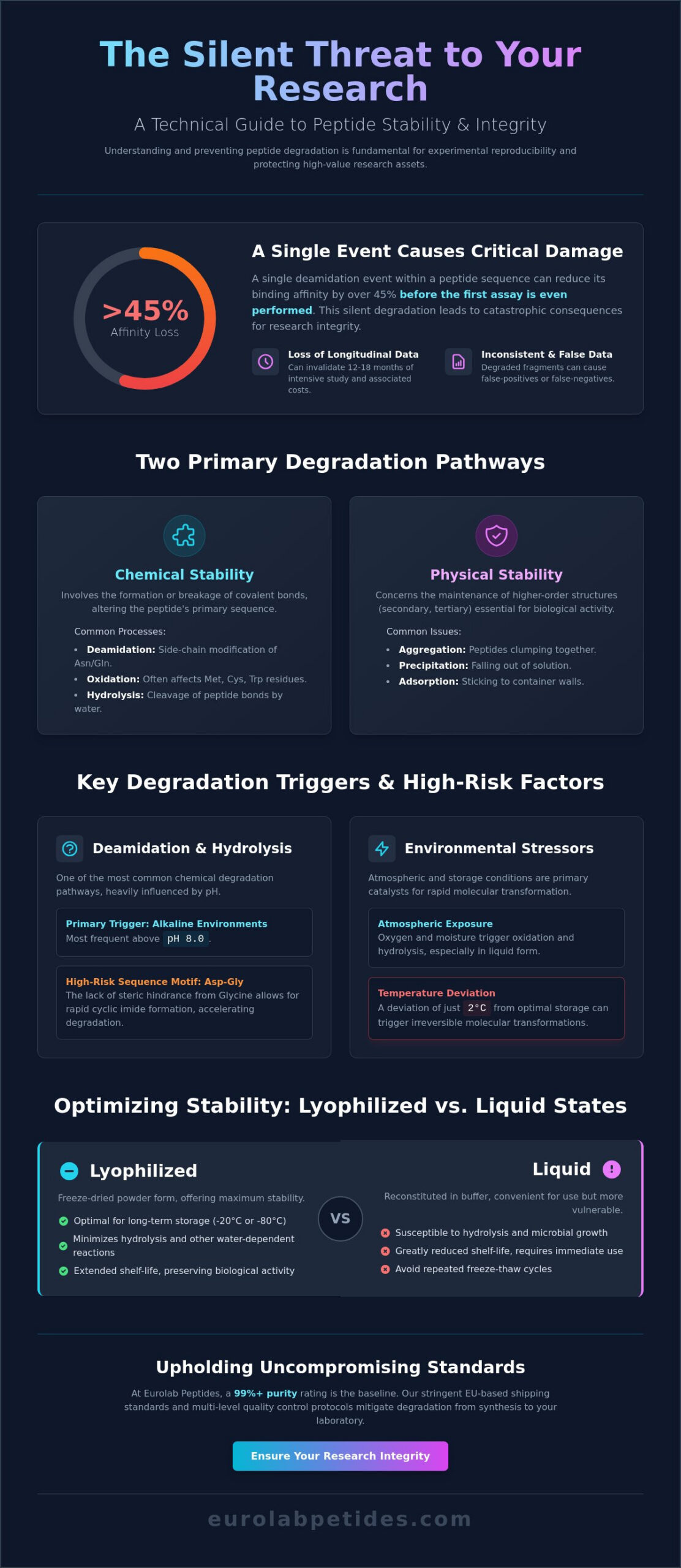
A single deamidation event within a sequence can reduce the binding affinity of a high-purity peptide by over 45% before the researcher even initiates the first assay. This silent degradation often remains undetected without routine HPLC verification, leading to inconsistent data and the financial loss of high-value reagents. For researchers operating in high-stakes laboratory environments, understanding peptide stability issues and solutions is not a secondary concern but a fundamental requirement for experimental reproducibility and adherence to stringent European standards.
It’s an established fact that even a 2-degree Celsius deviation from optimal storage conditions can trigger irreversible molecular transformations. This technical guide provides a rigorous analysis of chemical and physical degradation pathways alongside evidence-based protocols to ensure your research integrity remains uncompromised. We’ll examine the specific molecular triggers of degradation, such as oxidation and hydrolysis, and provide standardized handling procedures to maintain 99%+ purity throughout the entire duration of your research.
Key Takeaways
- Identify the critical correlation between chemical integrity and the reproducibility of in-vitro data to ensure the validity of your experimental results.
- Analyze how sequence-dependent risks and atmospheric exposure contribute to common peptide stability issues and solutions for long-term preservation.
- Evaluate the thermodynamic differences between lyophilized and liquid states to optimize the shelf-life and biological activity of your research materials.
- Establish rigorous, evidence-based protocols for sequence risk assessment and cold-chain management to prevent premature physical aggregation.
- Understand how stringent EU-based shipping standards and multi-level quality control protocols mitigate baseline degradation during logistical transit.
The Criticality of Peptide Stability in Scientific Research
Peptide stability is defined as the capacity of a molecular sequence to maintain its chemical integrity and biological potency under specific environmental conditions over time. Within the laboratory, this stability serves as the fundamental prerequisite for generating reproducible in-vitro data. Without a stable substrate, the validity of any pharmacological or biochemical assay is compromised from the outset. Researchers must view stability not as a static property, but as a dynamic variable influenced by pH, temperature, and concentration.
The scientific community distinguishes between two primary categories of degradation: chemical and physical. Chemical stability involves the formation or breakage of covalent bonds through processes like deamidation, oxidation, or hydrolysis. The inherent peptide bond stability, governed by resonance structures, provides a baseline resistance to degradation, yet it remains susceptible to enzymatic and environmental stressors. Physical stability refers to the maintenance of the peptide’s secondary and tertiary structures. Issues such as aggregation, precipitation, or adsorption to vessel walls often render a sample biologically inactive, even if the primary sequence remains intact.
The economic impact of instability is severe. A failure to address peptide stability issues and solutions early in the experimental design can result in the loss of longitudinal data spanning 12 to 18 months of intensive study. When a peptide degrades mid-study, the financial cost isn’t merely the price of the reagent. It includes the total sum of labor, specialized equipment time, and the significant delay in publication or patent filing. Precision in handling is the only way to protect these investments.
Impact on In-Vitro Research Integrity
Degraded peptide fragments don’t simply become inert; they often become bioactive in unpredictable ways. These breakdown products can bind to non-target receptors, leading to false-positive results that skew the understanding of a peptide’s mechanism of action. Conversely, a reduction in the concentration of the intact peptide due to degradation frequently produces false-negative data. Degradation-induced bias refers to the systematic error introduced into experimental datasets when the observed biological response is triggered by peptide breakdown products rather than the intact parent molecule.
Stability as a Metric of Quality Assurance
At Eurolab Peptides, a 99%+ purity rating is considered the baseline for research-grade materials. However, purity at the point of synthesis doesn’t guarantee longevity. Stability is an ongoing metric of quality assurance that requires rigorous sequence validation and pre-formulation analysis to predict shelf-life effectively. Understanding these variables is essential for any technical workflow, as detailed in our comprehensive guide for researchers. By implementing stringent storage protocols and choosing the correct buffers, scientists can mitigate the most common peptide stability issues and solutions to ensure the absolute integrity of their scientific inquiry.
Primary Chemical Degradation Pathways: Identifying the Issues
Peptide sequences exhibit inherent volatility based on their specific chemical architecture. Atmospheric oxygen and moisture serve as primary triggers for rapid degradation, while pH levels dictate the mechanics of molecular cleavage and rearrangement. Analyzing these factors is essential for resolving the physical stability of peptides, particularly when dealing with sensitive, high-purity sequences. Environmental triggers often catalyze reactions that transform a standardized 99%+ purity sample into a heterogeneous mixture of degradation products within hours if storage protocols are breached.
Hydrolysis and Deamidation Mechanisms
Asparagine (Asn) and Glutamine (Gln) residues undergo deamidation most frequently in alkaline environments, typically above pH 8.0. The process involves a nucleophilic attack on the side-chain amide, resulting in a mixture of isoaspartate and aspartate. The “Asp-Gly” motif is a known high-risk sequence; the lack of steric hindrance from the Glycine residue allows for rapid cyclic imide formation. Identifying these vulnerabilities during the planning phase allows researchers to implement effective peptide stability issues and solutions, such as utilizing acidic buffers to suppress the deamidation rate.
Oxidation and Disulfide Bond Formation
Cysteine (Cys) and Methionine (Met) are the amino acids most vulnerable to environmental oxidation. Thiol deprotonation occurs at pH levels above 7.0, which significantly accelerates the formation of inter-chain disulfide bonds and leads to unwanted aggregation. Methionine residues oxidize to form methionine sulfoxide, a process that can sometimes be reversed using reducing agents. However, the formation of methionine sulfone is an irreversible chemical event that permanently compromises the molecular integrity of the peptide. Maintaining an oxygen-free environment through argon or nitrogen sparging is a non-negotiable requirement for these sensitive compounds.
Racemization and Diketopiperazine Formation
The loss of chiral integrity through racemization reduces receptor binding affinity and can render a peptide biologically inactive. This transition from L-amino acids to D-amino acids often occurs during the synthesis phase but can continue during long-term storage if the temperature is not strictly controlled. Sequences with Proline or Glycine at the second position are particularly vulnerable to N-terminal nitrogen attacks, leading to the formation of diketopiperazines and subsequent chain cleavage. Distinguishing between synthesis-level racemization and storage-level degradation is vital for maintaining the uncompromising purity standards
Physical Stability Challenges: Lyophilized vs. Liquid States
The physical state of a peptide determines its susceptibility to degradation. Lyophilized powders maintained at -20°C exhibit shelf-lives exceeding 24 months, whereas reconstituted solutions often degrade within 7 to 21 days when stored at 4°C. This discrepancy arises from the thermodynamic instability of peptides in aqueous environments. In solution, molecules possess higher kinetic energy, increasing the frequency of collisions that lead to non-covalent aggregation or irreversible precipitation. These interactions are driven by the exposure of hydrophobic residues that would otherwise be shielded in a stable, folded conformation.
Storage temperature must remain strictly below the glass transition temperature (Tg). Below this threshold, the peptide is immobilized in a rigid, glassy matrix that restricts molecular mobility. If temperatures fluctuate during cold chain transport and exceed the Tg, the matrix enters a rubbery state. This transition significantly accelerates chemical degradation pathways by allowing reactive groups to interact. Maintaining a consistent thermal profile is a primary requirement for addressing peptide stability issues and solutions in a laboratory setting.
The Advantages of Lyophilization
Lyophilization removes approximately 99% of residual water through sublimation under vacuum. This process effectively halts hydrolytic and oxidative pathways that compromise sequence integrity. Researchers utilize cryoprotectants, such as mannitol or trehalose, to stabilize the secondary structure during the initial freezing phase. These bulking agents prevent the peptide from unfolding as water is removed. Once dehydrated, the peptide is vacuum-sealed in glass vials. Preventing moisture ingress is critical; even a 2% increase in moisture content can lower the Tg and trigger rapid aggregation.
Risks of Repeated Freeze-Thaw Cycles
Reconstituted samples are exceptionally vulnerable to mechanical stress. Each freeze-thaw cycle generates ice crystals that exert shear forces on delicate peptide chains, potentially disrupting tertiary folding patterns. To mitigate these peptide stability issues and solutions, aliquoting is a mandatory protocol. Dividing the initial solution into single-use volumes prevents the cumulative damage of thermal cycling. For instance, the BPC-157 technical guide details specific handling protocols that ensure maximum recovery and potency during research applications.
- Aliquots should be stored in polypropylene tubes to minimize surface adsorption.
- Use sterile, bacteriostatic water or buffered saline as dictated by the peptide’s isoelectric point.
- Avoid vigorous vortexing, which introduces air-liquid interfaces and promotes denaturation.
By adhering to these stringent handling metrics, researchers ensure that the 99%+ purity verified by HPLC analysis is maintained throughout the duration of the study. Precision in storage is as vital as precision in synthesis.
Strategic Solutions for Maintaining Peptide Integrity
Mitigating peptide stability issues and solutions requires a systematic, five-step technical framework that begins before the synthesis phase. Every sequence possesses unique biochemical vulnerabilities; therefore, researchers should conduct a sequence-based risk assessment to identify motifs prone to deamidation, oxidation, or aggregation. Once synthesized, implementing a rigid cold-chain protocol is mandatory. While lyophilized powders remain stable at -20°C for short-term use, long-term preservation exceeding 180 days requires storage at -80°C to halt molecular kinetic energy effectively.
High-value samples demand additional protection through inert gas sealing. Displacing atmospheric oxygen with Argon or Nitrogen within the vial prevents oxidative degradation of sensitive residues like Methionine or Cysteine. Reconstitution must be standardized using degassed, sterile buffers to eliminate dissolved oxygen that might catalyze side reactions. Finally, purity is verified through periodic HPLC analysis every 90 days to ensure the sample maintains its 99%+ purity profile and hasn’t succumbed to latent degradation pathways.
Optimal Reconstitution Techniques
Success depends on choosing the correct solvent based on the peptide’s isoelectric point. Bacteriostatic water is often sufficient for neutral sequences, but acidic peptides frequently require 1% acetic acid, while basic sequences may need 0.1% ammonium hydroxide for complete dissolution. Researchers must avoid mechanical shear stress. Instead of vortexing, use the “gentle swirl” method to prevent denaturation. The sonication threshold for hydrophobic peptides is defined as the minimum energy input required to disrupt intermolecular aggregates without inducing localized thermal degradation or peptide backbone cleavage.
Advanced Storage Protocols
Managing the “hygroscopic effect” is critical during sample retrieval. Vials must reach room temperature in a desiccator for approximately 30 to 45 minutes before opening; this prevents atmospheric moisture from condensing on the lyophilized powder. Light sensitivity is another factor that compromises integrity. Use amber vials or light-shielded storage boxes to prevent photolysis. Laboratory inventory should follow a strict First-In, First-Out (FIFO) rule to ensure reagents are utilized within their optimal stability window. This methodical approach ensures that experimental data remains reproducible and untainted by chemical artifacts.
To ensure your research utilizes sequences synthesized and handled under these uncompromising standards, explore our range of 99%+ purity peptides verified by independent European laboratories.
EuroLab Peptides’ Uncompromising Standards for Research Stability
EuroLab Peptides implements a multi-level quality control system designed to eliminate baseline degradation before a product ever leaves the facility. Every batch is subjected to independent third-party HPLC and Mass Spectrometry (MS) verification to confirm both molecular identity and purity levels. This rigorous approach addresses the core of peptide stability issues and solutions by ensuring that the initial chemical state is pristine. To prevent container-closure interactions, the laboratory utilizes high-grade Type I borosilicate glass. This specific material is chosen because it resists the leaching of alkaline ions, a common cause of pH shifts that can destabilize sensitive peptide sequences during long-term storage. By maintaining a neutral environment within the vial, the risk of spontaneous hydrolysis is significantly reduced.
European Manufacturing and Rigorous Testing
Adherence to stringent EU chemical standards for research reagents is a non-negotiable aspect of the production cycle. Sequence validation is critical, particularly for complex stacks where the risk of aggregation or misfolding is high. By verifying the amino acid sequence with absolute precision, the structural integrity of the research material is guaranteed. Our laboratory protocols follow standardized European manufacturing practices that prioritize chemical longevity and batch-to-batch consistency. Detailed procurement criteria and laboratory standards are further detailed in our guide on how to buy research peptides. These standards ensure that every reagent meets the high-stakes demands of modern biochemistry and provides a reliable baseline for experimental data.
Logistics and Support for Researchers
Logistics represent a significant variable in the stability equation. EuroLab prioritizes EU-based shipping to maintain cold-chain integrity and minimize the duration of transit stress. Rapid delivery across Europe reduces the window of exposure to environmental fluctuations, such as excessive heat or mechanical vibration, which can compromise the integrity of lyophilized cakes. Beyond delivery, technical support is provided to assist with reconstitution math and solvent compatibility. This service is designed to help researchers avoid common errors in the lab that lead to immediate degradation. Precise protocols for buffer selection and concentration are essential for maintaining the 99%+ purity levels verified at the point of manufacture. Researchers who don’t account for these variables risk losing months of work to avoidable chemical breakdown. Explore our 99%+ purity research catalog to secure high-stability reagents for your next study.
Advancing Scientific Outcomes Through Molecular Precision
The success of any biochemical inquiry depends on the molecular integrity of the compounds utilized. Navigating peptide stability issues and solutions requires a rigorous understanding of degradation pathways like oxidation and deamidation, alongside the physical advantages of lyophilized storage. Researchers shouldn’t overlook how environmental factors compromise sequence validation. It’s essential to prioritize standardized protocols so that experimental data remains reproducible and valid across every trial.
EuroLab Peptides addresses these technical demands by providing compounds where 99%+ purity is verified through HPLC and Mass Spectrometry analysis. Every batch undergoes stringent third-party laboratory verification to confirm sequence accuracy and structural stability. Logistics are managed through secure EU-based shipping with a dedicated cold-chain focus to prevent thermal degradation during transit. By utilizing these verified metrics, laboratories can eliminate variables associated with reagent failure and focus on high-stakes discovery.
Secure your research integrity with EuroLab’s third-party verified peptides
Maintaining uncompromising standards ensures that your scientific breakthroughs are built on a foundation of verifiable precision and absolute chemical reliability.
Frequently Asked Questions
How long do lyophilized peptides remain stable at room temperature?
Lyophilized peptides generally remain stable at ambient temperature (20°C to 25°C) for up to 4 weeks during transit or temporary storage. For long-term integrity exceeding 30 days, samples must be transferred to -20°C or -80°C environments. Exposure to temperatures above 30°C for more than 72 hours can trigger deamidation or oxidation in sequences containing methionine or cysteine residues, compromising the 99%+ purity standard required by Eurolab Peptides.
Can I use a standard freezer for long-term peptide storage?
A standard household freezer is unsuitable for long-term storage because the auto-defrost cycles cause temperature fluctuations of up to 10°C, which facilitates moisture accumulation and peptide degradation. Research-grade, non-frost-free freezers maintained at a constant -20°C are required to preserve chemical integrity. For storage exceeding 12 months, a -80°C ultra-low temperature freezer is the industry standard for maintaining the 99%+ purity verified by our laboratory.
What are the visible signs of peptide degradation in solution?
Visible signs of degradation include the formation of precipitates, increased turbidity, or distinct color changes, such as yellowing in sequences containing tryptophan. However, chemical degradation like hydrolysis often occurs without visual cues, necessitating HPLC analysis to detect purity drops below 95%. If a solution remains cloudy after 5 minutes of sonication, it indicates solubility issues or structural aggregation rather than successful reconstitution of the sample.
Why do some peptides require acetic acid or DMSO for reconstitution?
Hydrophobic peptides containing more than 25% non-polar residues like leucine or valine require organic solvents like DMSO or 10% acetic acid to disrupt intermolecular forces. Using sterile water or PBS alone often results in aggregation. These solvents lower the dielectric constant of the medium, allowing the peptide to reach its monomeric state. Proper solvent selection is a primary component of addressing peptide stability issues and solutions in a laboratory setting.
Is it possible to “rescue” a peptide that has undergone oxidation?
Oxidation of cysteine or methionine residues can sometimes be reversed using reducing agents like 10 mM DTT or TCEP. Treatment with these reagents for 30 to 60 minutes at room temperature can restore the thiol groups to their reduced state. If the peptide has undergone irreversible C-terminal deamidation or significant backbone cleavage, the sample is considered compromised and cannot be restored to its original analytical profile verified by mass spectrometry.
How does light exposure specifically affect peptide bond integrity?
Ultraviolet radiation at wavelengths between 250 nm and 300 nm triggers the photolysis of aromatic amino acids like tyrosine and phenylalanine. This energy absorption leads to the formation of reactive oxygen species, which cause covalent modifications and subsequent peptide chain fragmentation. Samples exposed to direct laboratory lighting for 48 hours can show a 5% to 15% reduction in purity as measured by mass spectrometry, so amber vials are recommended.
What is the maximum recommended time for a reconstituted peptide to sit at 4°C?
Reconstituted peptides shouldn’t remain at 4°C for more than 7 days, as aqueous environments accelerate hydrolysis and microbial growth. Research indicates that even at 4°C, some sequences lose 2% of their purity every 24 hours. To mitigate these peptide stability issues and solutions, researchers should aliquot the solution into single-use volumes and freeze them immediately at -20°C to avoid repeated freeze-thaw cycles.
Do all peptides require the same storage temperature for stability?
No, storage requirements depend on the specific amino acid sequence and the presence of sensitive residues. While most lyophilized peptides are stable at -20°C, those containing asparagine or glutamine are more prone to deamidation and benefit from -80°C storage. Maintaining a consistent temperature is vital; a 5°C deviation can significantly shorten the shelf life of a 99%+ pure sample over a 6 month period, according to European manufacturing standards.
