

A 2021 meta-analysis published in Nature Communications indicates that approximately 50% of preclinical research remains irreproducible, with reagent variability cited as a primary driver. In the high-stakes environment of 2026 research, the reliance on unverified reagents is no longer a viable methodology. It’s understood that the validity of any longitudinal study is contingent upon the chemical integrity of its precursors. Establishing verifiable peptide quality for academic labs is the only defense against the systemic failures of inconsistent batch-to-batch potency and fraudulent documentation.
This clinical guide provides the analytical protocols and sourcing criteria necessary to ensure 99%+ purity across all research cycles. It offers a transparent framework for interpreting mass spectrometry data and identifying the documentation standards required for rigorous peer review. We’ll examine the specific HPLC validation methods and the logistical advantages of partnering with European manufacturers who adhere to stringent EU quality controls. By the conclusion of this overview, the researcher will possess a reliable framework for vetting chemical integrity with uncompromising precision.
Key Takeaways
- Master the analytical validation protocols of HPLC and Mass Spectrometry required to confirm 99%+ purity and precise sequence identity for in-vitro applications.
- Implement a rigorous checklist for evaluating Certificates of Analysis to detect generic documentation and ensure full institutional compliance.
- Optimize experimental reproducibility by understanding the impact of lyophilisation and temperature-controlled EU transit on long-term peptide integrity.
- Establish a standardized sourcing strategy for verifiable peptide quality for academic labs through multi-level third-party audits and stringent synthesis protocols.
The Standard of Verifiable Peptide Quality for Academic Research
Research-grade peptide quality in 2026 is defined by a 99% minimum purity threshold and precise sequence validation. In the context of in-vitro studies, even a 0.5% presence of truncated sequences or residual solvents can compromise the integrity of receptor interaction studies. These contaminants often act as competitive inhibitors or non-specific ligands, leading to skewed binding affinity data and unreliable assay development. Academic labs must account for these variables to ensure that observed biological effects are solely attributable to the target peptide. It’s a technical requirement that separates rigorous inquiry from anecdotal observation.
The process of Chemical peptide synthesis requires stringent control over side reactions to prevent the formation of epimers. For institutional researchers, the burden of proof is significantly higher than for independent practitioners because the data must withstand the scrutiny of peer review and potential replication by competing laboratories. Establishing a Chain of Integrity means every step, from the initial amino acid coupling to the final lyophilization and cold-chain delivery, is documented and verifiable through batch-specific analysis. This transparency is non-negotiable when verifiable peptide quality for academic labs is the baseline for funding and publication.
Reproducibility and the Burden of Proof
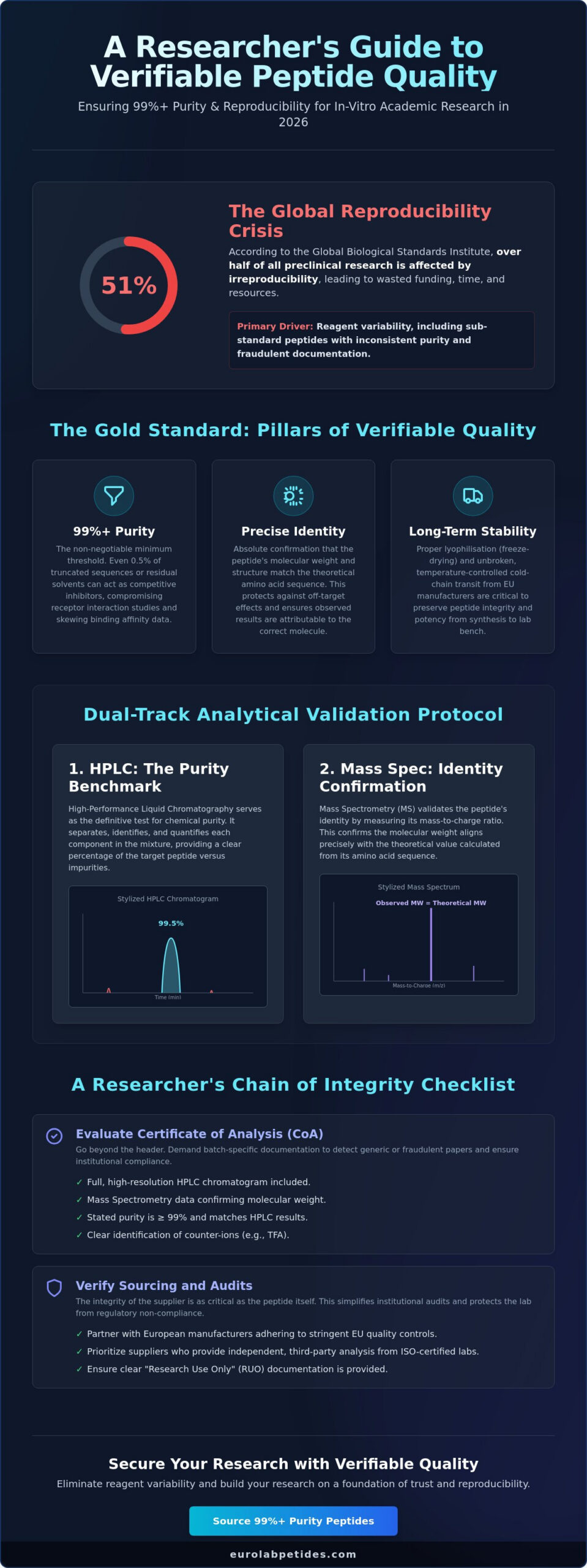
Sub-standard materials are a primary driver of the global reproducibility crisis, which affects approximately 51% of preclinical studies according to data from the Global Biological Standards Institute. Verifiable quality requires high-resolution HPLC chromatograms and Mass Spectrometry (MS) data for every unique batch to ensure the molecular weight aligns with the theoretical sequence. This level of documentation allows PIs to include raw validation data in supplemental materials for publication, protecting the lab’s reputation. Verifiable quality is defined as the absolute intersection of molecular identity, chromatographic purity, and long-term stability.
Institutional Compliance and Ethical Sourcing
University ethics committees and Principal Investigators (PIs) demand rigorous adherence to safety and procurement protocols. Procurement departments require clear documentation that materials are strictly for Research Use Only (RUO) to prevent regulatory non-compliance or misuse. Sourcing from entities that provide transparent certificates of analysis (CoA) simplifies the institutional audit process and ensures that the lab meets European manufacturing standards. Researchers should consult the How to Buy Research Peptides guide to understand the specific logistical requirements and sourcing benchmarks of 2026 laboratory standards. This methodical approach ensures that the chemical tools used in experiments don’t introduce unknown variables into the data set.
Analytical Validation: The Science of HPLC and Mass Spectrometry
Establishing verifiable peptide quality for academic labs requires a dual-track analytical approach. High-Performance Liquid Chromatography (HPLC) serves as the definitive benchmark for determining chemical purity, while Mass Spectrometry (MS) confirms molecular identity. Without these two metrics, a certificate of analysis remains incomplete. Academic research in 2026 demands more than surface-level data; it requires an uncompromising look at the molecular composition of every batch. While a manufacturer might report 99%+ purity, the remaining 1% isn’t an empty variable. It typically consists of residual water, salts, and counter-ions like Trifluoroacetic acid (TFA), which is often used during the cleavage and purification stages of solid-phase peptide synthesis.
Adherence to USP Peptide Quality Standards ensures that these impurities are documented and kept within stringent thresholds. There’s a critical distinction between in-house testing and independent third-party verification. In-house results represent a manufacturer’s internal audit, but third-party analysis by an ISO-certified laboratory provides an objective layer of security. This external validation eliminates the risk of bias, ensuring that the data provided to the researcher is an accurate reflection of the material’s integrity.
Interpreting HPLC Chromatograms
The HPLC chromatogram is a visual map of a sample’s purity. It works by passing the peptide through a stationary phase under high pressure, separating components based on their hydrophobicity. The primary metric is the area under the curve (AUC), where the integration of the main peak relative to total peaks determines the purity percentage. A single peak is the primary indicator of chemical homogeneity. If the chromatogram reveals “shoulders” or secondary peaks, it indicates the presence of truncated sequences or diastereomers. Researchers should look for sharp, symmetrical peaks that demonstrate 99%+ purity, ensuring that experimental variables aren’t compromised by synthesis byproducts.
Sequence Validation via Mass Spectrometry
While HPLC confirms how much of the sample is the target molecule, Mass Spectrometry confirms what that molecule actually is. By measuring the mass-to-charge ratio of ionized particles, MS determines the molecular weight of the peptide with extreme precision. This process is essential for verifying complex chains like BPC-157, where even a single amino acid substitution would alter the theoretical mass and biological function. Sequence validation through fragmentation patterns ensures the primary structure is intact. For labs focused on reproducible data, you can access verified analytical reports to confirm these specifications before beginning a study.
- Theoretical Mass: The calculated weight based on the amino acid sequence.
- Observed Mass: The actual weight measured by the spectrometer.
- Purity Threshold: The minimum acceptable AUC percentage for research-grade materials.
Sequence validation isn’t just a formality; it’s the only way to guarantee that the peptide delivered is the peptide ordered. In an era where reproducibility is under scrutiny, these analytical tools provide the transparency necessary for high-stakes scientific inquiry.
Evaluating Certificates of Analysis (COA) for Institutional Compliance
A Certificate of Analysis (COA) serves as the primary instrument for establishing verifiable peptide quality for academic labs. It isn’t merely a summary; it’s a legal and scientific record of a specific synthesis run. For a COA to meet 2026 institutional compliance standards, it must contain three non-negotiable identifiers: a unique batch number, the exact date of analysis, and the authorized signatures of the analytical department. Reports that lack these details are insufficient for peer-reviewed publication data.
Red flags in documentation often manifest as generic templates. If a report lacks a specific timestamp or uses a “representative” analysis for multiple batches, the data’s integrity is compromised. Academic researchers don’t have the luxury of variable purity in longitudinal studies. Longitudinal research spanning 18 to 24 months requires absolute batch-to-batch traceability. This ensures that any observed biological shifts result from experimental variables rather than chemical inconsistencies between shipments. Cross-referencing third-party results with supplier claims provides a final layer of security, confirming that the 99% purity peak on the HPLC chromatogram corresponds to the actual material in the vial.
Reading the Fine Print of a COA
Precision in dosing requires a clear distinction between net peptide content and gross weight. Gross weight includes the peptide plus residual water and counter-ions. If a vial contains 5mg of gross weight at 80% net peptide content, the actual peptide available is 4mg. This 20% discrepancy can lead to significant under-dosing in quantitative assays. Furthermore, residual solvent analysis is vital for in vitro applications. Concentrations of solvents like acetonitrile exceeding 500 ppm can induce cellular toxicity, skewing results. The type of counter-ion also dictates experimental success. While Trifluoroacetic acid (TFA) is a standard byproduct of synthesis, its presence can inhibit cell growth. Academic researchers often require an exchange to Acetate or HCl to ensure biological compatibility. High-resolution Peptide Analysis at Academic Core Labs provides the mass spectrometry data needed to verify these molecular nuances and confirm sequence identity.
Vetting Third-Party Laboratories
An independent laboratory must maintain ISO/IEC 17025 accreditation to be considered a valid neutral party. This accreditation ensures the lab follows standardized protocols for calibration and testing. Transparency is the hallmark of a reliable partner. Valid reports must feature verifiable contact information, allowing institutional procurement officers to contact the lab directly to confirm the report’s authenticity. This level of scrutiny is essential for maintaining verifiable peptide quality for academic labs. Understanding the fundamental chemistry of these compounds is the first step in effective vetting. Researchers can review the foundational science in our guide on What Are Peptides? to better interpret complex analytical data.
Stability and Storage: Preserving Peptide Integrity In Vitro
The biochemical integrity of a synthetic chain is highly sensitive to environmental variables. Maintaining verifiable peptide quality for academic labs requires a strict adherence to cold-chain logistics and precise storage environments. During EU transit, temperature fluctuations can trigger premature degradation, particularly in sequences prone to oxidation or deamidation. Research indicates that even brief exposure to temperatures above 8°C can initiate the breakdown of sensitive disulfide bonds. To mitigate these risks, Eurolab Peptides utilizes specialized thermal packaging designed to maintain a stable internal climate for up to 72 hours, ensuring the molecular structure remains intact from the laboratory to the end-user.
Storage protocols are dictated by the intended duration of the study. While lyophilized vials remain stable at 4°C for approximately 14 to 21 days, long-term preservation requires significantly lower temperatures. For storage exceeding one month, vials must be kept at -20°C. If the research timeline extends beyond one year, a -80°C environment is mandatory to prevent the slow progression of deamidation. Researchers should avoid frost-free freezers, as the constant temperature cycling facilitates moisture accumulation and potential peptide hydrolysis.
Lyophilisation and Moisture Content
Lyophilisation is the removal of solvent via sublimation under vacuum. This process is the gold standard for stabilizing peptides because it reduces moisture content to less than 3%, a threshold critical for preventing hydrolytic degradation. When moisture levels exceed this limit, the peptide backbone becomes susceptible to cleavage, resulting in a loss of purity that compromises experimental reproducibility. Vacuum-sealing each vial provides an additional layer of atmospheric protection, preventing the ingress of oxygen and water vapor that could catalyze oxidative pathways during long-term storage.
Best Practices for Reconstitution
The transition from a lyophilized cake to a liquid solution is a high-risk phase where mechanical and chemical stress can damage the sample. Choosing the correct solvent is the first step in maintaining integrity. While sterile saline is often used for immediate applications, bacteriostatic water is preferred for multi-use vials due to its ability to inhibit microbial growth. Every sequence has unique solubility requirements; for instance, you can review the Ipamorelin Technical Profile to understand how specific secretagogues behave during reconstitution.
- Solubility Testing: Always begin with a small volume of solvent to ensure the peptide dissolves fully before reaching the target concentration.
- Mechanical Stress: Never vortex a peptide solution. The high-shear forces can disrupt the secondary structure of the molecule. Use a gentle, slow swirling motion instead.
- Aliquoting: Once reconstituted, peptides should be divided into single-use aliquots to avoid repeated freeze-thaw cycles, which are a primary cause of verifiable peptide quality for academic labs being compromised.
Adhering to these stringent handling procedures ensures that the analytical data gathered reflects the true biological activity of the compound. For researchers requiring high-purity sequences backed by rigorous data, you can access our full catalog of third-party verified peptides to secure your laboratory supplies.
EuroLab Peptides: A Peer-Level Partner for European Academic Labs
Achieving verifiable peptide quality for academic labs requires more than standard manufacturing; it demands a rigorous, multi-tiered validation architecture that aligns with the stringent requirements of 2026 European research frameworks. EuroLab Peptides operates as a specialized technical partner, providing the chemical foundation necessary for reproducible data. Every compound is subjected to a three-stage quality protocol: initial synthesis, internal analytical verification, and independent third-party auditing. This process ensures that the integrity of the molecule remains uncompromised from the laboratory bench to the researcher’s facility. We’ve structured our operations to eliminate the ambiguity often found in the global chemical supply chain.
The EuroLab Quality Protocol
Our commitment to precision is defined by uncompromising benchmarks. Each batch must exceed a 99%+ purity threshold, verified through High-Performance Liquid Chromatography (HPLC). Sequence validation is confirmed for every individual batch via specialized mass spectrometry; this ensures the primary structure matches the intended design without exception. Because we manufacture and ship within Europe, transit times are significantly reduced. This logistical efficiency minimizes the risk of peptide degradation often caused by the temperature fluctuations and prolonged handling associated with international customs delays. Our lyophilization processes are specifically optimized to maintain thermodynamic stability during these shortened transit windows.
- 99%+ Purity Benchmarks: We apply stringent analytical standards for all research-grade materials to ensure experimental baseline consistency.
- Mass Spectrometry Validation: Definitive sequence confirmation is performed for every lot, providing absolute certainty of molecular identity.
- EU-Based Logistics: Reliable delivery patterns protect the structural integrity of sensitive sequences by avoiding long-haul shipping stressors.
Partnering for Research Excellence
Lab managers face increasing pressure to provide comprehensive documentation for grant compliance and peer-reviewed publications. We facilitate this by providing batch-specific Certificates of Analysis (COAs) for every researcher, ensuring radical transparency. Our EU-based technical support team consists of specialists capable of addressing complex biochemical inquiries without the delays of time-zone offsets. Whether assisting with bulk procurement for longitudinal studies or providing the precise documentation required for institutional audits, we prioritize the researcher’s need for data-backed certainty. It’s our goal to function as an extension of the laboratory’s own quality control department. You can explore our verifiable research peptide catalog to access tools designed for the highest level of scientific inquiry.
Establishing New Benchmarks for Analytical Precision
The landscape of biochemical research in 2026 demands a transition from anecdotal claims to absolute transparency. Maintaining verifiable peptide quality for academic labs is no longer optional; it’s the foundation of reproducible data. This requires the rigorous application of HPLC and mass spectrometry to validate every sequence before it enters a pipette. When institutional compliance is at stake, a batch-specific Certificate of Analysis provides the necessary evidence of purity and molecular integrity.
EuroLab Peptides delivers this level of scrutiny through 99%+ purity verified by independent HPLC/MS testing. Our logistics network utilizes EU-based shipping to preserve peptide stability during transit, ensuring that your compounds arrive in peak condition. We don’t just supply reagents; we provide the technical documentation required for high-stakes scientific inquiry. It’s time to align your procurement with the uncompromising standards your work deserves.
Secure high-purity peptides for your next study and push the boundaries of your research today.
Frequently Asked Questions
Is third-party testing mandatory for all research-grade peptides?
Third-party testing isn’t legally mandated by regulatory bodies like the EMA for research-grade materials, yet it remains the 2026 industry benchmark for excellence. Academic labs requiring verifiable peptide quality for academic labs prioritize independent validation to ensure experimental reproducibility. Without an external HPLC and MS analysis, the researcher assumes 100% of the risk regarding sequence identity and purity levels.
How do I verify the authenticity of a Certificate of Analysis (COA)?
Authenticity verification requires cross-referencing the unique batch number with the issuing laboratory’s independent database. Every EuroLab COA includes a secure tracking identifier that researchers can validate through our partner facilities. You should examine the HPLC chromatogram for baseline stability and ensure the mass spectrometry data matches the theoretical molecular weight within a 0.1% margin of error.
What is the difference between 95% and 99% peptide purity in a lab setting?
The 4% variance between 95% and 99% purity levels represents a significant concentration of residual salts, moisture, and truncated sequences. In sensitive cell-based assays, these impurities can trigger non-specific biological responses or alter the osmotic pressure of the medium. We maintain a 99%+ purity threshold to eliminate these variables, ensuring that 990mg of every 1g of material is the target peptide sequence.
Can impurities in peptides interfere with HPLC-based assays?
Impurities often interfere with HPLC-based assays by co-eluting with the target peptide; this creates overlapping peaks that mask the true concentration. If an impurity shares a similar hydrophobic profile, it’ll absorb UV light at the 214nm wavelength, providing a false reading of the peptide’s abundance. This analytical interference can compromise the integrity of kinetic studies and quantitative proteomics in any high-stakes research environment.
What are the storage requirements for maintaining peptide stability over 12 months?
Long-term stability over 12 months requires storage in a lyophilized state at -20°C or -80°C within a vacuum-sealed, desiccated container. Peptides are hygroscopic and’ll degrade through hydrolysis if they’re exposed to ambient moisture levels exceeding 5%. For researchers seeking verifiable peptide quality for academic labs, maintaining a strict cold chain is the only way to prevent deamidation or oxidation over a 1-year period.
Why is European-based shipping preferred for academic labs in the EU?
European-based shipping is preferred because it bypasses the complex customs inspections that often cause 14-day delays for non-EU shipments. By shipping from within the Schengen Area, we ensure that temperature-sensitive materials arrive within 48 to 72 hours. This logistical efficiency minimizes the risk of thermal degradation and ensures compliance with the REACH regulation framework for chemical substances across all member states.
Does EuroLab Peptides provide batch-specific mass spectrometry data?
We provide batch-specific mass spectrometry data for every order to confirm the exact molecular weight of the synthesized sequence. Each report includes the Electrospray Ionization (ESI) results, which allow researchers to verify the identity of the molecule against its theoretical mass. This isn’t a representative sample report; it’s the actual data from the specific vial delivered to your laboratory to ensure absolute sequence validation.
What does ‘Net Peptide Content’ mean on a lab report?
Net Peptide Content indicates the actual mass percentage of the peptide sequence within the total lyophilized powder. While the purity might be 99%, the net content is typically between 70% and 85% because the remaining mass consists of counter-ions like TFA and residual water. Researchers must use this metric, rather than the total powder weight, when calculating molar concentrations for precise experimental dosing in the lab.
