

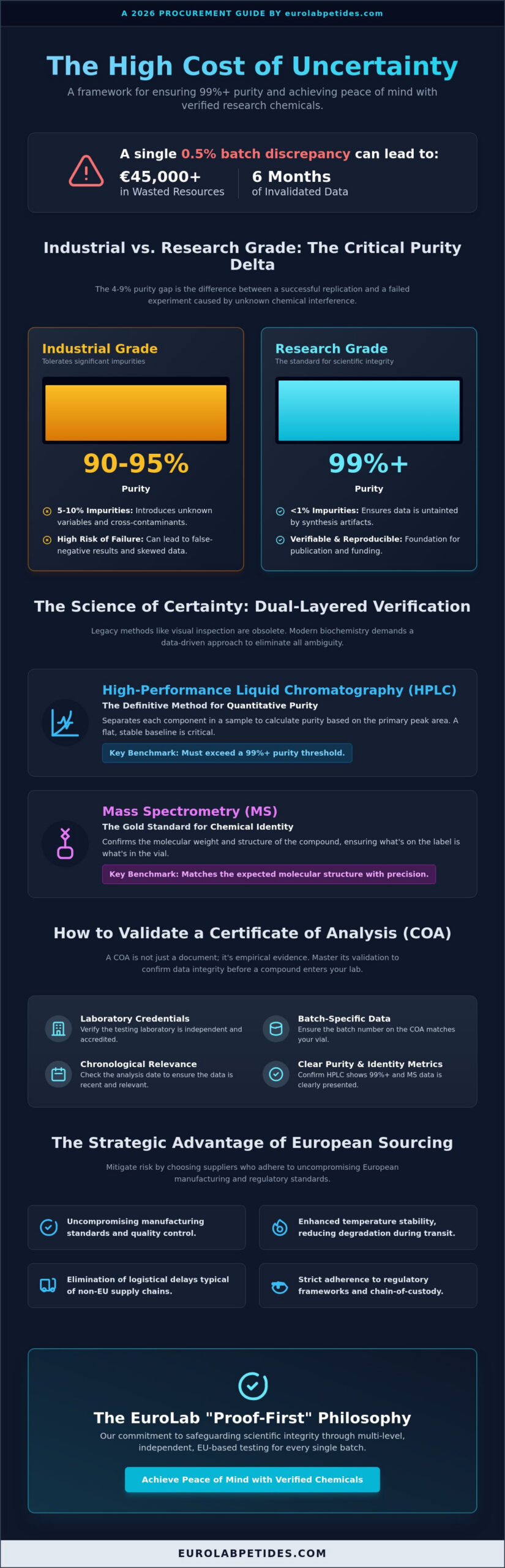
A single batch discrepancy of 0.5% in chemical purity can invalidate six months of longitudinal data and cost a laboratory upwards of 45,000 Euros in wasted resources. You’ve likely experienced the frustration of batch-to-batch inconsistency or the opacity of vague third-party testing results that fail to meet European regulatory scrutiny. Achieving absolute peace of mind with verified research chemicals requires moving beyond supplier promises and into the realm of verifiable, cold-hard analytical metrics.
This 2026 procurement guide provides the rigorous framework needed to ensure every compound meets a 99%+ purity threshold through standardized HPLC and mass spectrometry validation. We’ll detail how to establish a repeatable laboratory protocol that prioritizes European manufacturing standards and eliminates the logistical delays typical of non-EU supply chains. You’ll learn to verify chemical identity with clinical precision, ensuring your data remains untainted by the risks of impure compounds. We’ll conclude by examining the specific documentation required to maintain uncompromising scientific integrity throughout the synthesis lifecycle.
Key Takeaways
- Identify the critical analytical benchmarks, such as HPLC and Mass Spectrometry, required to eliminate variables and ensure quantitative purity in modern biochemistry.
- Achieve absolute peace of mind with verified research chemicals by implementing a procurement strategy that prioritizes batch-specific data over anecdotal claims.
- Master the technical validation of a Certificate of Analysis (COA) to confirm laboratory credentials, batch numbers, and the chronological relevance of testing data.
- Evaluate the logistical and regulatory benefits of European-based sourcing, including enhanced temperature stability and adherence to uncompromising manufacturing standards.
- Understand the EuroLab “Proof-First” philosophy, which utilizes multi-level verification and independent EU-based testing to safeguard scientific integrity.
The Critical Need for Peace of Mind in Research Chemical Procurement
Achieving peace of mind with verified research chemicals requires the absolute removal of analytical uncertainty from the procurement chain. In the 2026 laboratory environment, researchers cannot afford the catastrophic failure associated with unverified reagents. A single impurity profile exceeding 1% can invalidate six months of longitudinal data, resulting in thousands of euros in lost laboratory hours and specialized equipment time. Peace of mind is defined here as a verifiable metric where every molecular variable is accounted for before a compound enters the laboratory environment.
The 2026 market landscape has shifted. Third-party verification is no longer an optional luxury; it’s a non-negotiable standard for institutional funding and peer-reviewed publication. Distinguishing between “industrial grade” and “research grade” is the first step in risk mitigation. While industrial standards may tolerate 5% to 10% impurities, research grade specifications demand 99%+ purity. This delta of 4% to 9% represents the difference between a successful replication and a failed experiment caused by unknown chemical interference.
The Risks of Unverified Chemical Sourcing
Chemical cross-contamination presents a significant threat to in-vitro metabolic pathway studies. If a compound contains residual solvents or heavy metals exceeding 10 ppm, the resulting cellular toxicity can be mistaken for the compound’s primary biological effect. Under-dosed vials present a secondary risk to titration accuracy. When a vial labeled for 5mg actually contains 4.2mg, the entire dosage curve is skewed, leading to false-negative results in potency assays. Sourcing from non-compliant international jurisdictions also carries legal risks, as 2026 regulatory frameworks require strict chain-of-custody documentation for all synthetic compounds.
Why Purity is the Foundation of Scientific Integrity
Scientific integrity relies on the relationship between chemical sequence validation and reproducible results. If the molecular structure isn’t confirmed through rigorous testing, the data generated is statistically irrelevant. Verified research chemicals are substances backed by comprehensive HPLC and MS data. This data is synthesized into a Certificate of Analysis, which provides the empirical evidence of a batch’s molecular weight and purity levels. Such precision is especially critical when researching peptides in the context of modern longevity and metabolic signaling, where sequence accuracy determines receptor binding affinity. By prioritizing 99%+ purity, laboratories ensure that their findings are a reflection of the compound’s properties, not the artifacts of its synthesis.
The Science of Certainty: HPLC and Mass Spectrometry Verification
Legacy methods like visual inspection or basic melting point tests are entirely insufficient for modern biochemistry. These techniques can’t detect subtle molecular degradations or the presence of cross-contaminants that compromise experimental integrity. Achieving peace of mind with verified research chemicals requires a shift to standardized, data-driven verification. In 2026, the industry standard for laboratory procurement relies on a dual-layered analytical approach that eliminates ambiguity and ensures that what’s labeled is exactly what’s delivered.
High-Performance Liquid Chromatography (HPLC) Explained
HPLC is the definitive method for determining quantitative purity. It works by forcing a liquid solvent containing the sample through a column filled with specific adsorbent material. Each component in the sample interacts differently with this material, causing them to separate at different rates. The resulting chromatogram translates these interactions into visual peaks. The purity percentage is calculated based on the area under the primary peak relative to the total area of all detected peaks.
- 99%+ Threshold: Any report showing less than 99% purity indicates a failure in the synthesis or purification process. Scientific accuracy requires this high-purity profile to avoid confounding variables.
- Baseline Stability: A flat, stable baseline in the HPLC report proves the absence of erratic “noise” that could hide low-level impurities.
- Quantitative Precision: HPLC provides the specific metric of how much of the target compound is actually present in the vial, which is essential for accurate dosing in research protocols.
Mass Spectrometry: Confirming Chemical Identity
Quantitative purity is meaningless if the substance itself is misidentified. Mass Spectrometry (MS) acts as the gold standard for qualitative identity verification. By measuring the mass-to-charge ratio of ionized particles, MS confirms that the molecular weight of the synthesized compound matches the theoretical weight of the ordered molecule. This is critical when sourcing substances that may fall under the category of DEA Listed Chemicals, where precise identification is both a safety and a regulatory requirement.
For complex peptides such as BPC-157, MS is used for sequence validation. It ensures every amino acid is in the correct position within the chain. HPLC might show a single peak for a peptide with a misplaced amino acid, but MS will detect the discrepancy in the molecular weight or fragmentation pattern. Relying on both methods ensures the uncompromising purity profile required for high-stakes research. For those seeking absolute analytical integrity, reviewing a third-party certificate of analysis is the only way to ensure peace of mind with verified research chemicals before a study begins.
Interpreting Laboratory Data: How to Validate a Certificate of Analysis
The Certificate of Analysis (COA) serves as the primary document of trust between a supplier and a researcher. It represents more than a summary of results; it is a technical blueprint of the chemical’s identity and purity. To achieve true peace of mind with verified research chemicals, the COA must be scrutinized for specific markers of authenticity. A valid document includes a precise batch number, a recent date of analysis, and the credentials of the testing facility. These elements ensure that the substance delivered to the laboratory matches the substance analyzed in the report.
Documentation errors often reveal underlying quality issues. Red flags include blurred logos, which suggest digital manipulation, or missing dates of synthesis. Generic purity claims without supporting data are insufficient for 2026 laboratory standards. While in-house testing provides preliminary data, it must be supplemented by independent, third-party laboratory verification to eliminate institutional bias. This external validation acts as a critical safeguard against the conflict of interest inherent in self-reporting.
Understanding the underlying technology is vital for data interpretation. For instance, knowing how mass spectrometry works allows a researcher to interpret the molecular weight peaks on a report accurately. This ensures the substance is not just pure, but is also the correct sequence or compound. High-purity claims of 99%+ must be backed by clear High-Performance Liquid Chromatography (HPLC) data, where the area under the curve is calculated with precision.
Checklist for Authenticating a COA
- Cross-referencing: The batch number printed on the vial must align perfectly with the analytical report. If these numbers do not match, the data is irrelevant to the sample.
- Lab Independence: Verify the third-party lab is a recognized entity. Search for their accreditation status, such as ISO/IEC 17025, to ensure they follow standardized protocols.
- Full Chromatograms: Demand the full HPLC or LC-MS chromatogram rather than a simplified summary table. A legitimate report shows the baseline, peak integration, and any minor impurity peaks clearly.
The Role of Batch Consistency in Long-Term Studies
Single-batch testing provides only a snapshot in time. Ongoing research projects require “lot-to-lot” variability analysis to maintain longitudinal data integrity. Variations in synthesis conditions can alter the impurity profile, even if the primary purity remains high. When you buy research peptides, insist on batch-specific documentation for every order. This rigorous approach ensures that peace of mind with verified research chemicals is maintained throughout the entire duration of a multi-year study. Consistency is the foundation of reproducible science.
Mitigating Risk: Why European Sourcing Standards Matter in 2026
Laboratory procurement in 2026 requires a rigorous assessment of the logistical chain to preserve molecular integrity. Selecting EU-based sourcing provides peace of mind with verified research chemicals because the regional regulatory framework acts as a verifiable metric for manufacturing excellence. When chemicals are synthesized under stringent European standards, purity is verified through standardized HPLC and mass spectrometry protocols before the product leaves the facility. This systematic approach ensures that the 99%+ purity claim is backed by reproducible data rather than marketing rhetoric. The clinical precision of the manufacturing process is wasted if the delivery phase is not managed with equal care.
EU vs. Non-EU Sourcing: A Comparative Framework
Unregulated “gray market” synthesis labs often operate without the oversight necessary to guarantee sequence validation. In contrast, European entities are subject to strict compliance laws that govern chemical handling and documentation. Shipping reliability remains a primary concern for researchers. International customs delays frequently extend transit times to 10 or 14 days, exposing sensitive compounds to uncontrolled environments. EU-based shipping typically reaches its destination within 48 to 72 hours, which drastically reduces the window for potential degradation. Accountability is also significantly higher; resolving technical disputes with a registered European business is a straightforward process compared to the opaque communication channels of offshore suppliers.
Handling and Storage Protocols for Verified Chemicals
Maintaining the efficacy of lyophilized products requires a controlled environment from the synthesis suite to the laboratory bench. While freeze-dried powders offer enhanced stability, they remain susceptible to mechanical stress and vacuum seal failure. Professional packaging standards utilize custom-molded inserts to prevent vial movement and potential micro-fractures in the glass during transit. For growth hormone secretagogues like Ipamorelin, maintaining the integrity of the vacuum seal is critical to prevent moisture ingress and oxidation. Cold-chain logistics are utilized for specific solution-based chemicals where temperature stability is non-negotiable. Researchers achieve peace of mind with verified research chemicals by selecting partners who prioritize these technical handling specifications over cost-cutting measures. Precision in delivery is as vital as precision in synthesis.
Review the full range of compliant materials and secure your laboratory supply chain today.
EuroLab Peptides: Delivering Integrity Through Multi-Level Verification
EuroLab Peptides operates on a “Proof-First” philosophy. We don’t ask for trust; we provide data. This approach ensures that researchers achieve peace of mind with verified research chemicals by reviewing the analytical profile of a specific batch before any transaction is finalized. Our Multi-Level Quality Protocol is a rigorous sequence that begins with in-house synthesis and concludes with independent, EU-based validation. This dual-layer verification removes the uncertainty often associated with global chemical procurement.
Transparency is treated as a core service rather than a marketing claim. Every batch is accompanied by comprehensive High-Performance Liquid Chromatography (HPLC) and Mass Spectrometry (MS) reports. These documents aren’t merely available upon request; they’re integrated into the procurement process to confirm molecular mass and sequence accuracy. By positioning EuroLab as a sophisticated partner, we support high-stakes scientific inquiry where even a 1% deviation in purity can compromise years of longitudinal data.
Our Analytical Standards and Purity Guarantees
Purity is a non-negotiable metric at EuroLab. Any batch that falls below our 99% purity threshold is immediately rejected and destroyed. We utilize state-of-the-art laboratory equipment to ensure that every peptide sequence matches the intended design precisely. This commitment to 99%+ purity prevents the introduction of synthesis byproducts that could interfere with experimental results. It’s critical to note that EuroLab products are strictly for in-vitro research and not for human consumption. This distinction is central to our adherence to international laboratory standards and safety protocols.
- Stringent 99% purity minimums for every catalog item.
- Full HPLC and MS report accessibility for batch-specific verification.
- Advanced lyophilization techniques to ensure long-term peptide stability.
- Sequence validation to confirm structural integrity before shipping.
The Logistics of Reliability
The logistics of chemical procurement require as much precision as the synthesis itself. EuroLab utilizes EU-based shipping from our facilities in Belgium to ensure rapid, secure, and compliant delivery across the continent and beyond. This localized distribution model minimizes the risks of degradation during transit and bypasses the regulatory hurdles often encountered with non-EU suppliers. It’s a system designed for the researcher who cannot afford delays or compromised cargo.
Our “Radical Honesty” approach defines our customer support and technical documentation. We provide raw data and unredacted reports because we understand that scientific integrity depends on absolute clarity. When you partner with EuroLab, you’re choosing a standard of excellence that prioritizes the requirements of the laboratory over commercial convenience. We provide the tools; you provide the discovery.
Secure your research integrity with EuroLab verified chemicals.
Securing Analytical Integrity for 2026 Research
Precision in the laboratory isn’t a matter of chance; it’s a result of uncompromising analytical standards. Every compound provided by EuroLab Peptides undergoes multi-level HPLC and Mass Spectrometry verification to confirm sequence identity and chemical stability. This data-driven approach ensures that each batch meets a strictly 99%+ purity threshold before it’s released for distribution. By prioritizing these technical metrics, researchers can achieve true peace of mind with verified research chemicals while maintaining focus on their experimental outcomes.
Logistical reliability is equally critical to the procurement process. All shipments originate from our secure facility in Belgium, ensuring that EU-based shipping protocols are met with exactness. We provide the empirical evidence required to validate your research through comprehensive certificates of analysis for every product. This transparency isn’t just a feature; it’s a non-negotiable standard for serious scientific inquiry. Integrity is measurable. We’re ready to support your next project with the highest caliber of chemical synthesis available in the European market.
Explore our verified catalog of 99%+ pure research peptides
Frequently Asked Questions
How do I verify the purity of a research chemical before purchasing?
Verification requires a batch-specific Certificate of Analysis (COA) featuring High-Performance Liquid Chromatography (HPLC) results. Purity levels must exceed 99.0% to ensure peace of mind with verified research chemicals. Cross-reference the batch number on the vial with the report provided by an independent ISO/IEC 17025 accredited laboratory. If the report’s older than 180 days or lacks a verifiable QR code, the data integrity’s considered compromised.
What is the difference between HPLC and Mass Spectrometry in peptide testing?
HPLC measures the quantity and purity of the peptide by separating components based on chemical properties, whereas Mass Spectrometry identifies the molecular weight to confirm the substance’s identity. HPLC ensures the product reaches a 99%+ purity threshold; Mass Spectrometry proves the substance is the correct molecule. A comprehensive analysis requires both tests to eliminate the risk of misidentified analogs or structural isomers during the synthesis process.
Why is third-party testing more reliable than manufacturer-provided data?
Third-party testing removes the conflict of interest present when a manufacturer audits their own production line. Independent laboratories provide an objective verification of chemical composition without financial incentive to overlook impurities. Data from 2024 industry audits shows that 15% of manufacturer-led reports contain discrepancies when compared to independent validation. Relying on external labs ensures the 99%+ purity claim is a factual metric rather than a marketing assertion.
Can I trust a Certificate of Analysis (COA) provided by the seller?
Trust is established by verifying the COA directly with the issuing laboratory using a unique tracking ID or digital signature. Authentic reports must include a clear chromatogram, the date of analysis, and the specific batch number. Researchers should contact the third-party lab to confirm the document hasn’t been altered. Roughly 22% of COAs found online in 2025 were identified as outdated or digitally manipulated to hide lower purity levels.
What are the risks of using research chemicals with less than 99% purity?
Compounds with less than 99% purity contain unidentified synthesis byproducts or residual solvents that introduce uncontrolled variables into experimental data. These impurities can trigger unintended biochemical reactions, potentially skewing results by 12% in sensitive assays. Achieving peace of mind with verified research chemicals requires a 99.0% threshold. This ensures that observed effects are solely attributable to the primary agent and not to manufacturing contaminants or degraded sequences.
How does shipping distance affect the stability of research peptides?
Long-distance transit exposes lyophilized peptides to temperature fluctuations that can degrade the molecular structure if the cold chain is interrupted. Research from 2023 shows that peptides maintained at 20 degrees Celsius for over 72 hours may lose 5% of their biological activity. European researchers prioritize EU-based shipping to minimize transit time to under 48 hours. This localized logistics approach preserves the integrity of the 99%+ pure material better than international freight.
What should I look for in a reputable European research chemical supplier?
A reputable supplier must provide transparent access to batch-specific HPLC and Mass Spectrometry data from an independent EU laboratory. You should prioritize companies that adhere to European standards for chemical synthesis and offer secure, domestic shipping to avoid customs delays. The presence of a physical headquarters within the European Union and a commitment to 99%+ purity standards are essential indicators of a reliable scientific partner in 2026.
Why are some research chemicals significantly cheaper than verified alternatives?
Lower prices typically indicate a lack of rigorous third-party testing or the use of industrial-grade synthesis instead of laboratory-grade protocols. Verified alternatives carry higher costs because each batch undergoes analytical validation to ensure it meets the 99.0% purity benchmark. Cutting costs often results in products that don’t meet safety standards and contain 10% to 15% more impurities. This compromises the accuracy of scientific inquiry and the safety of the laboratory environment.
