

The European Medicines Agency (EMA) finalized the “Guideline on the Development and Manufacture of Synthetic Peptides” with an effective date of June 1, 2026, marking a definitive shift toward pharmaceutical-grade scrutiny for all synthetic sequences. For researchers, the challenge isn’t simply finding europeanpeptides; it’s identifying suppliers whose analytical transparency matches these new, stringent mandates. You’ve likely experienced the frustration of batch-to-batch inconsistency or the ambiguity of third-party testing claims that don’t hold up under rigorous sequence validation.
This article establishes a clinical framework for evaluating suppliers based on verifiable 99%+ purity and the absolute integrity of their Certificates of Analysis (CoA). By prioritizing EU-based shipping, you’ll avoid the regulatory friction and customs delays typical of non-EU imports. We’ll analyze technical benchmarks including HPLC, mass spectrometry, and lyophilization, ensuring your laboratory’s procurement strategy aligns with the highest European standards for 2026 research. This proof-first approach guarantees that every vial meets the uncompromising metrics required for high-stakes scientific inquiry.
Key Takeaways
- Identify the specific analytical protocols, such as HPLC and mass spectrometry, required to verify molecular weight and sequence accuracy for 2026 research.
- Understand how the 2026 EMA guidelines redefine europeanpeptides as a benchmark for pharmaceutical-grade quality rather than mere geographic origin.
- Evaluate the logistical advantages of EU-based shipping, which eliminates customs seizures and ensures the stability of temperature-sensitive compounds through dedicated cold-chain protocols.
- Implement a multi-step decision framework to scrutinize supplier transparency, focusing on batch-specific third-party verification and uncompromising 99%+ purity standards.
Navigating the European Research Peptide Landscape in 2026
The implementation of the EMA “Guideline on the Development and Manufacture of Synthetic Peptides” on June 1, 2026, has fundamentally altered the procurement landscape for biochemical researchers. High-purity sequences are no longer just preferred; they’re the mandatory baseline for reproducible data in a market projected to reach USD 267.03 million by the end of 2026. Within this rigorous environment, the term europeanpeptides has transitioned from a geographic descriptor to a technical benchmark. It signifies adherence to uncompromising analytical standards and transparent sequence validation that respects the complex requirements of the scientific community.
Scientific integrity relies on the distinction between commercial-grade materials and research-grade requirements. While standard catalog peptides often feature purity levels of ≥95%, elite in-vitro research demands 99%+ purity to eliminate confounding variables. This precision is achieved through advanced Peptide synthesis techniques, including Solid-Phase Peptide Synthesis (SPPS), where each stage of assembly is monitored to prevent truncated sequences. Adhering to these standards ensures that the research remains focused on the intended metabolic pathways without interference from synthesis byproducts.
The Strategic Importance of EU-Based Sourcing
Logistical reliability is a critical metric for laboratory continuity. Regional distribution centers within the European Union mitigate the risks associated with long-distance transit, such as temperature fluctuations that compromise peptide stability. By utilizing EU-based shipping for europeanpeptides, researchers navigate European chemical safety and distribution standards without the regulatory friction or customs seizures common with non-EU imports. The 2026 market for peptides reflects a strategic shift toward localized, high-integrity supply chains that prioritize cold-chain logistics from synthesis to delivery. This infrastructure is essential for maintaining the unrivaled quality expected of European manufacturing.
In-Vitro Research vs. Clinical Applications
Strict adherence to the in-vitro research-only designation is a cornerstone of laboratory ethics and legal compliance. These compounds are synthesized specifically for controlled environments; they’re not intended for human or clinical use. Purity requirements are higher for sensitive in-vitro models because even trace impurities can trigger non-specific cellular responses, invalidating months of inquiry. Structural integrity is protected through lyophilization, a process where water is removed via sublimation under vacuum. This ensures the peptide remains stable and biologically active upon reconstitution. Each batch is analyzed to confirm that these structural benchmarks are met before the product is released for research use.
Analytical Rigor: Evaluating Purity and Sequence Validation
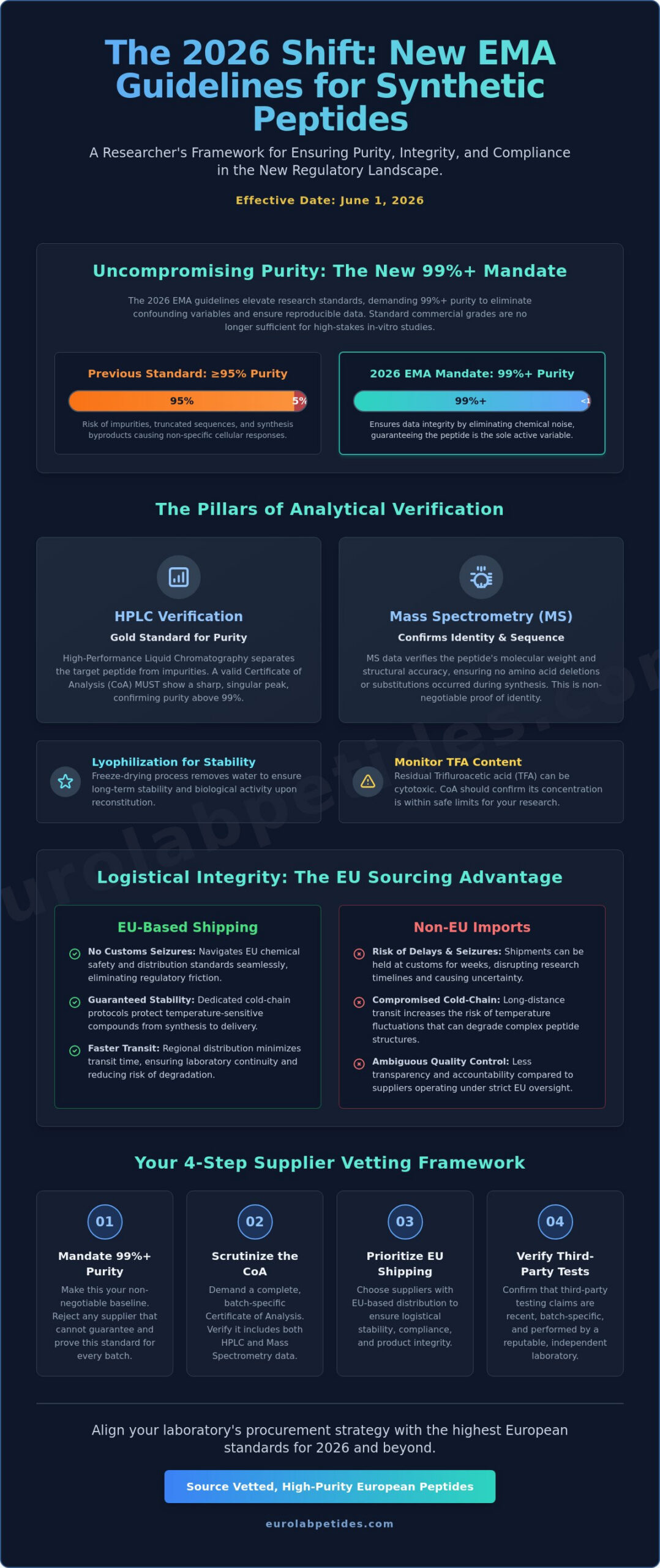
High-precision research requires data that isn’t compromised by chemical noise or sequence errors. While many global suppliers settle for 95% purity as a baseline, the standard for europeanpeptides in 2026 is uncompromisingly set at 99%+. This threshold is essential for eliminating confounding variables in sensitive in-vitro models where trace impurities can trigger non-specific cellular responses. Every batch must undergo a multi-level verification process to ensure that the chemical identity of the compound matches its theoretical design without deviation.
Analytical validation is anchored by two primary technologies. High-Performance Liquid Chromatography (HPLC) is employed as the gold standard for purity verification, separating the target sequence from any residual solvents or truncated fragments. Mass Spectrometry (MS) complements this by confirming the molecular weight and sequence accuracy. Without MS data, a researcher cannot be certain that the synthesized chain hasn’t suffered from amino acid deletions or substitutions during the assembly process. Furthermore, the presence of counter-ions like Trifluroacetic acid (TFA) must be monitored. Residual TFA can exhibit cytotoxic effects in cell culture, making it vital to confirm that ion concentrations don’t interfere with your specific research objectives.
Interpreting the Certificate of Analysis (CoA)
Reading a Certificate of Analysis requires a meticulous eye for detail. A valid HPLC chromatogram should display a sharp, singular peak; any secondary “shoulders” or baseline fluctuations indicate the presence of impurities that could invalidate your results. These reports must be verified against established peptide reference standards to ensure the analytical equipment was properly calibrated. While in-house testing provides an initial metric, third-party verification remains a non-negotiable standard for europeanpeptides, projecting a persona of radical honesty and accountability. It’s recommended to review the full CoA for every batch before beginning any experimental protocol to ensure absolute sequence integrity.
Stability and Handling of Lyophilized Compounds
Peptide stability is highly dependent on environmental conditions. Lyophilization is the process of freeze-drying to ensure long-term peptide stability. Once in the laboratory, these compounds remain sensitive to heat, light, and moisture, which act as primary mechanisms of degradation. Storage at -20°C or -80°C is required to halt enzymatic activity and chemical cleavage of the peptide bonds. Best practices dictate that vials shouldn’t be opened until they’ve reached room temperature to prevent moisture condensation, which initiates rapid hydrolysis. Maintaining these stringent handling protocols is the final step in preserving the unrivaled bioactivity of your research materials.
European Sourcing vs. Global Imports: Logistics and Compliance
Procuring europeanpeptides within the European Union provides a distinct advantage in regulatory alignment and logistical security. Non-EU imports are frequently subjected to customs seizures and regulatory friction, leading to significant project delays and financial losses. These hidden costs often outweigh the perceived savings of lower-cost global alternatives. By sourcing within the EU, researchers ensure that their materials are handled according to stringent regional standards that prioritize chemical stability and legal compliance.
Transparency in manufacturing has become a non-negotiable requirement for modern laboratories. A strategic shift toward European-synthesized research tools is being observed, as researchers seek to avoid grey-market chemical suppliers. This transition is supported by adherence to USP’s peptide and excipient monographs, which provide the foundational quality standards for identity, purity, and excipient safety. Ethical sourcing is verified through documented synthesis paths and batch-specific analysis, ensuring that the integrity of the research is never compromised by questionable origins.
Navigating EU Customs and Regulatory Frameworks
Intra-community delivery ensures research continuity by bypassing the intensive border inspections applied to external imports. Compliance with REACH (Registration, Evaluation, Authorisation and Restriction of Chemicals) and other European chemical regulations is verified at the point of synthesis, ensuring that all distributed compounds meet safety and environmental mandates. When buying research peptides from within the EU, institutional liability is significantly reduced because the supplier operates within the same legal jurisdiction as the laboratory. This alignment simplifies the administrative burden on procurement departments and guarantees that the materials meet the high-stakes precision required for scientific inquiry.
Logistical Reliability and Transit Times
Logistical reliability is directly correlated with peptide stability. Transit duration is a primary factor in degradation, especially for sensitive sequences that are prone to hydrolysis or oxidation if exposed to environmental fluctuations. EU-based shipping minimizes transit times, typically delivering within 48 to 72 hours; this preserves the structural integrity of the lyophilized product. Secure, discreet packaging is utilized to protect materials from light and mechanical stress during handling. The real-world implications of using europeanpeptides include strict adherence to project timelines and the elimination of batch-to-batch variability caused by environmental exposure during long-haul global shipping. Cold-chain protocols are strictly maintained for sequences that require specific temperature controls, ensuring that bioactivity is preserved from the synthesis facility to the laboratory bench.
Decision Framework: Selecting a Reliable European Peptide Supplier
Establishing a rigorous selection protocol is mandatory to protect the integrity of longitudinal studies. When evaluating europeanpeptides, the researcher must move beyond marketing assertions and focus on verifiable metrics. A reliable supplier functions as a technical partner; they provide the transparency required to satisfy institutional oversight and ensure experimental reproducibility. This selection process is divided into five critical assessment steps.
- Step 1: Verification of batch-specific HPLC and MS data is the primary requirement. Static or generic reports are insufficient for modern analytical standards.
- Step 2: Assess the supplier’s commitment to independent laboratory analysis. Third-party verification acts as a non-negotiable safeguard against manufacturer bias.
- Step 3: Evaluate the distribution infrastructure. EU-based shipping from regional centers ensures a controlled chain of custody and minimal transit times.
- Step 4: Review technical responsiveness. Communication should be handled by staff capable of discussing sequence validation, lyophilization parameters, and biochemical stability.
- Step 5: Confirm adherence to research-only policies. Ethical suppliers strictly prohibit the sale of compounds for non-laboratory use to maintain regulatory compliance.
The procurement of europeanpeptides should be treated as a high-stakes technical acquisition. Failure to verify these five pillars often leads to batch-to-batch inconsistency, which compromises the validity of in-vitro data. To ensure your laboratory meets these benchmarks, you may view our full catalog of verified sequences.
The Role of Third-Party Testing in Research Integrity
Independent verification is the non-negotiable standard for 2026 laboratory protocols. Identifying red flags in supplier-provided data is a vital skill for the lead researcher. These include Certificates of Analysis that lack specific batch numbers, dates, or clear chromatograms with sharp, distinct peaks. Purity is not a subjective claim; it’s a verifiable metric. High-purity compounds are the only path to reproducible research outcomes, ensuring that metabolic observations are the result of the peptide sequence rather than synthesis byproducts.
Sourcing for Specific Research Modalities
Different research models require specific analytical focuses. Technical profiles for compounds such as ipamorelin require precise GH secretagogue activity verification through sequence accuracy. Similarly, tissue repair models utilizing BPC-157 demand uncompromising structural integrity to observe pentadecapeptide interactions correctly. 99%+ purity is the baseline requirement for any high-stakes in-vitro investigation. Each batch is analyzed to confirm that these structural benchmarks are met before the product is released for research use.
EuroLab Peptides: Setting the Standard for European Research Excellence
EuroLab Peptides operates at the intersection of biochemical precision and logistical reliability. In the current 2026 research climate, the acquisition of europeanpeptides requires more than a geographic origin; it demands a multi-level quality control protocol that eliminates ambiguity. Purity is verified through a dual-analysis system. Each batch undergoes rigorous in-house HPLC testing before being submitted for independent third-party verification. This process ensures an uncompromising commitment to 99%+ purity for all research-grade products, providing the “language of the laboratory” that researchers require for high-stakes inquiry.
Logistical integrity is maintained through a dedicated network of EU-based distribution centers. This infrastructure ensures rapid, secure, and compliant delivery across the continent, bypassing the instability often associated with global imports. The EuroLab transparency promise is rooted in radical honesty; batch-specific data is accessible to every researcher. Rather than relying on generic reports, the brand provides the actual chromatograms and mass spectrometry results for the specific vial in your laboratory. This proof-first flow respects the user’s intelligence and ensures that quality is a verifiable metric, not a marketing claim.
Our Synthesis and Purification Process
Structural integrity is established during the initial stages of assembly. Advanced lyophilization techniques are employed to maximize peptide stability; water is removed via sublimation under vacuum to prevent hydrolytic degradation. Sequence validation is conducted via mass spectrometry to confirm that the molecular weight aligns perfectly with theoretical models. By adhering to stringent European manufacturing standards, EuroLab Peptides ensures that every sequence is free from truncated fragments or residual solvents. It’s this meticulous attention to detail that frames our commercial identity as a partner in sophisticated craftsmanship.
Partnering for Scientific Discovery
Institutional research is supported through absolute data transparency and technical accountability. Sourcing from a specialized European partner provides a professional advantage, ensuring that your procurement strategy aligns with the EMA guidelines effective as of June 1, 2026. This collaboration moves the researcher through a sequence of validation before asking for a commitment, reflecting a personality of deep seriousness and reliability. We invite you to explore our analytical standards and experience the unrivaled precision of a proof-first approach to peptide sourcing. Your data’s integrity depends on the uncompromising quality of your starting materials.
Advancing Laboratory Standards for 2026 and Beyond
The implementation of the June 1, 2026, EMA guidelines necessitates a transition from generic procurement to rigorous analytical partnership. Scientific data’s reliability is tied directly to the molecular integrity of the starting compounds. Identifying europeanpeptides that meet a verified 99%+ purity threshold ensures that in-vitro observations remain free from the interference of synthesis byproducts or truncated sequences. By prioritizing regional distribution, researchers eliminate the institutional liability and degradation risks inherent in global long-haul transit.
The integrity of your laboratory’s output depends on uncompromising sequence validation and radical transparency. EuroLab Peptides provides the analytical evidence required for high-stakes inquiry, including batch-specific HPLC/MS data and independent third-party verification. This proof-first approach guarantees that each vial maintains its structural integrity from the synthesis facility to your bench. Secure your research continuity with a partner dedicated to the highest European standards.
Secure High-Purity Research Peptides from EuroLab Peptides and build your next study on a foundation of absolute chemical certainty.
Frequently Asked Questions
What defines a high-purity ‘European Peptide’ in a research context?
A high-purity European peptide is defined by a sequence purity of 99%+ as verified through stringent HPLC and mass spectrometry analysis. In the 2026 research landscape, this designation implies full compliance with the EMA Guideline on the Development and Manufacture of Synthetic Peptides effective June 1, 2026. These standards ensure that europeanpeptides are free from truncated sequences and residual reagents that could compromise in-vitro data.
Why is third-party testing more reliable than in-house manufacturer data?
Independent verification is more reliable because it eliminates manufacturer bias and provides an objective audit of chemical integrity. While in-house analysis is a standard first step, third-party testing at accredited laboratories serves as a non-negotiable safeguard for research integrity. This proof-first approach ensures that certificates of analysis are accurate representations of the batch’s actual purity and molecular weight.
Can research peptides be used for human clinical trials?
No, research-grade peptides are strictly designated for in-vitro laboratory use and aren’t intended for human clinical trials or any form of administration. Clinical-grade peptides require different regulatory pathways and manufacturing environments, such as cGMP, that exceed the scope of research-only biochemicals. Adherence to this laboratory-only policy is essential for maintaining institutional compliance and ethical research standards.
How do EU-based shipping logistics affect peptide stability?
EU-based shipping logistics protect peptide stability by reducing transit times to approximately 48 to 72 hours within the continent. Shorter durations minimize the risk of temperature fluctuations that lead to peptide degradation or hydrolysis. By utilizing regional distribution centers, europeanpeptides remain within a controlled chain of custody that prioritizes cold-chain protocols and secure, light-protected packaging for every shipment.
What is the difference between 95% and 99% purity for in-vitro studies?
The 4% difference between 95% and 99% purity represents the presence of potential confounding variables such as truncated sequences or residual synthesis solvents. In sensitive in-vitro models, these impurities can trigger non-specific cellular responses that invalidate experimental results. Achieving 99%+ purity is the baseline requirement for high-stakes research where data reproducibility depends on the absolute chemical identity of the peptide.
What should I look for in a peptide Certificate of Analysis (CoA)?
A valid Certificate of Analysis must include batch-specific HPLC chromatograms and mass spectrometry reports that match the theoretical molecular weight of the sequence. Researchers should verify the presence of sharp, singular peaks on the chromatogram and ensure the analysis date is current. Ambiguous or generic reports that lack specific batch numbers are considered red flags in the 2026 procurement landscape.
How are lyophilized peptides shipped to ensure bioactivity is maintained?
Lyophilized peptides are shipped in vacuum-sealed vials to prevent moisture ingress and oxidation during transit. This freeze-drying process ensures long-term structural integrity by removing water via sublimation. When combined with secure, light-shielded packaging and rapid EU-based logistics, the bioactivity of the compound is preserved until it reaches the laboratory for reconstitution and study.
Are there specific regulations for buying research peptides in Europe?
Research peptide procurement in Europe is governed by REACH and the finalized 2026 EMA guidelines for synthetic sequences. These frameworks ensure that chemical distribution meets safety and environmental standards. Buying from an EU-based supplier ensures the transaction complies with intra-community delivery rules, which significantly reduces institutional liability compared to non-EU imports.
