

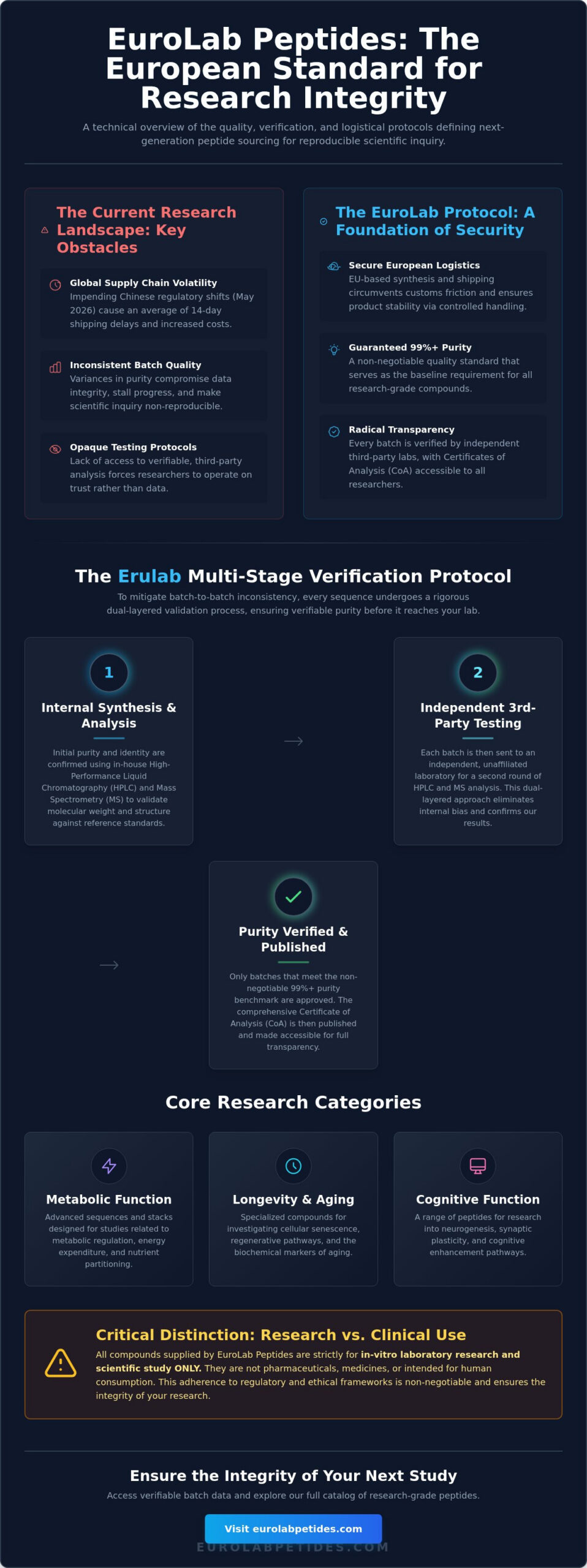
In a global market where China’s May 2026 regulatory shift is currently causing 14-day shipping delays and increased costs, the reliability of a research supply chain is no longer a luxury. Erulab addresses this volatility by enforcing a non-negotiable 99%+ purity standard verified through rigorous third-party analysis. You likely recognize that inconsistent batch quality and opaque testing protocols remain the primary obstacles to reproducible scientific inquiry in the peptide sector. It is a reality that compromises data integrity and stalls progress.
This reference guide provides a clinical examination of the quality protocols, research applications, and sourcing standards of EuroLab Peptides. We’ll detail how the brand utilizes verified HPLC and Mass Spectrometry data to ensure research-grade consistency across every vial. You’ll also learn about the logistical advantages of secure EU-based shipping, which circumvents the customs friction common with non-European suppliers. By the end of this analysis, the methodology behind the Erulab uncompromising manufacturing standards will be fully transparent, establishing a foundation of absolute security for your laboratory requirements.
Key Takeaways
- Identify the components of the multi-stage erulab quality protocol, which integrates internal HPLC analysis with independent third-party verification for every batch.
- Navigate the diverse catalog of research-grade compounds, ranging from advanced metabolic stacks to specialized sequences for longevity and cognitive function studies.
- Examine the logistical advantages of European-based shipping, specifically how localized distribution ensures regulatory compliance and maintains product stability through controlled handling.
- Apply a rigorous selection framework to match specific peptide profiles with your research objectives, ensuring optimal synergy within complex experimental designs.
EuroLab Peptides (Erulab): Defining the European Research Standard
EuroLab Peptides serves as a critical infrastructure provider for institutional and independent laboratories throughout the European Union. In a period characterized by shifting global regulations and supply chain instability, the brand maintains a stable, high-purity repository of biochemical sequences. The term erulab has become a recognized shorthand within the scientific community to identify these specific European-synthesized compounds. By establishing a rigorous framework for Defining the European Research Standard, the organization ensures that researchers access materials that meet the 99%+ purity threshold necessary for reproducible data. Integrity in synthesis is the primary metric by which laboratory success is measured.
Clarifying the erulab nomenclature is a prerequisite for maintaining data accuracy. While digital search environments may occasionally present unrelated software or entertainment entities, the biochemical context refers exclusively to the analytical catalog of EuroLab Peptides. For the 2026 scientific community, this distinction represents a commitment to radical transparency and logistical reliability. As of May 2026, the global market for precision-engineered sequences is projected to reach USD 2.8 billion, a growth driven by the need for suppliers who prioritize cold, hard data over anecdotal evidence. Every sequence provided is a result of meticulous chemical synthesis designed for high-stakes precision.
The Core Mission of EuroLab Peptides
The central objective is the provision of elite tools for serious scientific inquiry. High-stakes research depends on a reliable bridge between chemical synthesis and verifiable data. Every batch undergoes a multi-stage validation process. This includes sequence validation and mass spectrometry to confirm molecular weight and identity. By centralizing manufacturing within the EU, the brand mitigates the risks of international shipping delays and temperature fluctuations. These factors often degrade sensitive lyophilized powders during transit. The mission is defined by uncompromising standards where quality is not a claim but a verifiable metric.
Research vs. Clinical Use: A Critical Distinction
A rigid boundary exists between laboratory investigation and clinical application. It’s essential to recognize that all products are strictly for in-vitro laboratory research and scientific study. They are not pharmaceuticals, medicines, or products for human consumption. This distinction is a cornerstone of regulatory compliance and ethical sourcing. Research-grade materials require higher transparency than generic alternatives. Even a 0.5% variance in purity can compromise the results of a longitudinal study. By adhering to these stringent protocols, researchers ensure their work remains within the legal and ethical frameworks governing the 2026 biochemical sector. There is no room for ambiguity when the integrity of scientific progress is at stake.
Stringent Verification: 99%+ Purity and Third-Party Testing
Scientific reproducibility in 2026 is predicated on the absolute elimination of chemical variance. The erulab Quality Protocol is structured as a multi-level verification system to ensure that every sequence meets a non-negotiable benchmark of 99%+ purity. Unlike generic suppliers that rely on single-point analysis, each batch is subjected to internal validation followed by independent, third-party laboratory testing. This dual-layered approach is designed to mitigate the risks associated with batch-to-batch inconsistency, a common pain point in the current research market. Transparency is maintained through the publication of comprehensive Certificates of Analysis (CoA), which are made accessible to researchers for every procurement.
Adherence to Navigating European Standards requires a level of oversight that transcends basic synthesis. At EuroLab Peptides, integrity is treated as a verifiable metric rather than a marketing claim. The 99%+ purity threshold is not merely a goal but a baseline requirement for all research-grade compounds. Researchers can verify these analytical benchmarks by reviewing the latest batch data, ensuring that their experimental inputs align with the highest European manufacturing specifications.
Analytical Methods: HPLC and Mass Spectrometry
The identity and purity of each sequence are confirmed using High-Performance Liquid Chromatography (HPLC) and Mass Spectrometry. HPLC is utilized to separate the target peptide from any secondary products, ensuring the sequence matches the intended molecular profile. Mass Spectrometry is then employed to detect trace impurities and confirm the exact molecular mass. Sequence validation is conducted to ensure the amino acid arrangement is correct, preventing the use of truncated or incorrect sequences that could compromise in-vitro studies. This rigorous analytical suite provides the technical credibility required for elite scientific inquiry.
Batch Consistency and Lyophilization
Uniformity across different production cycles is achieved through standardized manufacturing conditions and stringent environmental controls. Each batch is analyzed to ensure that the chemical properties remain identical to previous iterations, supporting the integrity of longitudinal research. Stability is further enhanced through advanced lyophilization. Lyophilization is the process of freeze-drying a peptide to remove moisture, thereby preventing degradation and extending the shelf-life of the compound for long-term laboratory storage. This method ensures that the 99%+ purity is preserved from the point of synthesis to the moment of reconstitution.
Core Research Categories: From Longevity to Metabolic Studies
The EuroLab inventory is structured to support specialized inquiry across five primary physiological categories. Each sequence is synthesized to meet the rigorous demands of the 2026 scientific community. The erulab catalog provides a centralized resource for biochemical tools, ensuring that variables related to supplier inconsistency are eliminated from the experimental design. By following European Medicines Agency (EMA) guidelines for analytical control, the brand maintains a repository where every vial corresponds to its declared mass spectrometry profile. This level of precision is particularly evident in the longevity research stack, which integrates multiple sequences to facilitate the study of multifaceted cellular aging processes.
Research applications within these categories depend on the integrity of the chemical sequence. Whether investigating cognitive function or immune system response, the availability of verified HPLC data allows researchers to proceed with absolute security. The catalog isn’t just a list of compounds; it’s a collection of precision-engineered tools designed for serious inquiry. By removing the guesswork from sourcing, erulab allows scientists to focus on the data itself rather than the quality of the substrate.
Weight Management and Metabolic Pathway Research
Investigation into metabolic regulation requires sequences that exhibit high receptor affinity and predictable molecular behavior. SLU-PP-332 has emerged as a significant subject for researchers investigating Estrogen-Related Receptor (ERR) agonism and its influence on oxidative capacity. In parallel, growth hormone secretagogue models like CJC-1295 and Tesamorelin are analyzed for their ability to stimulate endogenous GH release in laboratory environments. Technical data from the Ipamorelin technical profile demonstrates the importance of GHRP-class specificity in growth hormone studies. These compounds are essential for researchers mapping the complex interactions between peptide signaling and metabolic efficiency. The Advanced Metabolic Stack provides a standardized framework for these investigations, ensuring that 99%+ purity is maintained across all combined experimental variables.
Tissue Repair and Recovery Models
The study of cellular repair and inflammation modulation is a core focus for many international laboratories. The pentadecapeptide BPC-157 is widely considered foundational in healing studies due to its documented interactions with the nitric oxide pathway and angiogenic signaling. Researchers often combine this with TB-500 to observe the regulation of actin polymerization and its effects on cellular migration. The inventory also includes KPV, a tripeptide analyzed for its ability to modulate inflammatory cytokines. By utilizing the Recovery Research Stack, scientists can explore the synergy between these repair-focused sequences within a controlled in-vitro setting. Every batch is analyzed to ensure that sequence integrity and lyophilization quality meet the unrivaled standards required for high-stakes recovery research. This methodical approach ensures that the data gathered is both reliable and reproducible.
Navigating European Standards: Logistics and Compliance
Logistical reliability in 2026 is defined by the proximity of the supplier to the destination laboratory. For the erulab network, EU-based shipping is a non-negotiable standard that mitigates the 14-day delays currently observed in transcontinental shipments following the May 2026 regulatory tightening in China. By maintaining inventory within the European Union, EuroLab Peptides eliminates the customs friction and unexpected import duties that often compromise research timelines. This regional focus ensures that the chain of custody remains transparent and that sensitive biochemical sequences are not subjected to prolonged exposure in unregulated port environments. Standard delivery times within Europe are maintained between 1-9 business days, ensuring that research schedules remain predictable.
Compliance with European chemical handling regulations provides a layer of security that non-EU suppliers cannot replicate. Distribution protocols are meticulously designed to maintain the integrity of the 99%+ purity benchmark during transit. Secure, discreet, and efficient handling is prioritized to protect the researcher’s time and resources. You can procure research-grade peptides directly from our European hub to ensure logistical consistency and avoid the volatility of the global supply chain.
Secure Sourcing in the European Market
Regional sourcing is the most effective strategy for reducing the risk of peptide degradation. When sequences travel across shorter distances, they’re less vulnerable to the thermal fluctuations that occur during long-haul freight. EuroLab Peptides operates in strict accordance with EU chemical storage regulations, ensuring that every vial is housed in a temperature-stabilized environment before dispatch. For researchers establishing new laboratory safety protocols, the guide on how to buy research peptides offers a comprehensive framework for maintaining compliance and sourcing integrity. This commitment to secure sourcing is a fundamental component of the 2026 research landscape, where logistical stability is as critical as chemical purity.
Stability and Handling Protocols
Maintaining bioactive integrity requires strict adherence to post-delivery handling procedures. Lyophilized peptides should be stored at -20°C for long-term stability or 2-8°C for immediate research use. Reconstitution must be performed using bacteriostatic water or sterile saline, with a gentle swirling motion to avoid mechanical denaturation of the delicate peptide chain. Inventory management systems should prioritize first-in, first-out (FIFO) rotations to ensure that 99%+ purity is utilized within the optimal shelf-life window. These best practices, combined with erulab manufacturing precision, safeguard the reproducibility of your in-vitro data. Proper inventory documentation, including batch numbers and reconstitution dates, is essential for maintaining the high-stakes precision required in modern biochemistry.
Choosing Your Research Grade Peptides: A Selection Framework
Systematic selection is the final stage of ensuring experimental integrity. The erulab selection framework is designed to align specific molecular profiles with the desired experimental outcomes. Researchers must prioritize sequences that demonstrate uncompromising purity to prevent the introduction of chemical variables into their data. While lower-purity alternatives may appear cost-effective initially, the resource expenditure required to repeat compromised experiments often exceeds the cost of high-grade substrate. A 0.5% impurity level can alter the metabolic pathway investigation, leading to statistically insignificant results. In the context of a global market projected to reach USD 7.0 billion by 2036, the demand for precision is absolute.
Verification of a supplier before procurement is a critical protocol. A definitive checklist includes the verification of a batch-specific Certificate of Analysis and the confirmation of HPLC and Mass Spectrometry data. Researchers should also assess the benefits of EU-based shipping to circumvent the 14-day delays currently impacting non-European logistics due to the May 2026 regulatory shifts. Evidence of sequence validation through independent third-party laboratories remains the gold standard for institutional accountability. This proof-first approach respects the researcher’s time and intelligence by providing the cold, hard data of chemical analysis before any commitment is made.
Stack Selection: Longevity vs. Recovery
Comparing the Advanced Metabolic Stack with the Muscle Research Stack requires an understanding of the primary signaling pathways involved. In metabolic research, sequences like SLU-PP-332 act as primary drivers, while the Muscle Research Stack focuses on the regulation of actin and cellular migration via sequences like TB-500. The simultaneous application of complementary sequences, such as those found in erulab research stacks, allows for the observation of synergistic effects that single-compound studies may fail to capture. Identifying primary versus secondary peptides within a study design ensures that the experimental model remains robust and focused on specific physiological outcomes. This methodology is essential for multifaceted studies where cellular repair and inflammation modulation are analyzed concurrently.
Procurement and Next Steps
Streamlining the procurement process is essential for institutional laboratories managing high-volume research. Bulk research discounts are available for longitudinal studies, providing a predictable cost structure for multi-year projects that require consistent batch quality. Every order is processed through the European hub to ensure regulatory compliance and temperature-controlled handling from synthesis to delivery. You can Secure your research-grade peptides from EuroLab today to maintain the high-stakes precision your laboratory requires. By establishing a partnership with a reliable European manufacturer, researchers ensure that their focus remains on analytical breakthroughs rather than the logistical friction common in the 2026 landscape.
Advancing Scientific Discovery through Precision Synthesis
The integrity of your research data depends on the chemical quality of the substrate utilized. By adhering to a non-negotiable 99%+ purity benchmark, EuroLab Peptides effectively eliminates the chemical variance that often compromises longitudinal studies. The erulab protocol ensures every sequence is verified through independent third-party analysis, providing a level of transparency that meets the Red Dot standard of scientific excellence. Secure EU-based shipping, typically completed within 1-9 business days, maintains the stability of lyophilized sequences through strict temperature control. This localized logistical framework bypasses the 14-day delays and customs friction common in the 2026 global market. It’s a system designed to respect the high-stakes precision required for serious scientific inquiry. Every vial represents a commitment to radical honesty and data-driven results.
Browse the EuroLab Peptides Catalog for High-Purity Research Tools
Your commitment to rigorous inquiry deserves a partner that prioritizes clinical accuracy over marketing claims. We invite you to integrate these precision-engineered tools into your next experimental phase for unrivaled consistency and absolute security.
Frequently Asked Questions
Is EuroLab Peptides (Erulab) a legitimate supplier for research chemicals?
Yes, EuroLab Peptides is a specialized biochemical supplier established to serve the 2026 European scientific community. The organization operates as a legitimate entity by providing 99%+ purity compounds verified through a transparent chain of custody. Every erulab batch is accompanied by a Certificate of Analysis (CoA), ensuring that researchers receive materials that meet stringent European manufacturing standards. This commitment to objective data distinguishes the brand as a reliable partner for institutional and independent laboratories.
Can I buy peptides for human use from EuroLab?
No, all products provided by EuroLab are strictly for in-vitro laboratory research and scientific study. They aren’t intended for human or animal consumption, nor are they pharmaceuticals or medicines. Adherence to these boundaries is a non-negotiable requirement for procurement. Researchers must ensure that their experimental protocols remain within the legal and ethical frameworks governing biochemical investigation in 2026. Sourcing is restricted to those conducting legitimate scientific inquiry.
What does “99%+ purity” actually mean in a laboratory setting?
In an analytical laboratory setting, 99%+ purity indicates that the target peptide sequence constitutes at least 99% of the total peptide content as measured by HPLC. This metric ensures that secondary sequences, truncated fragments, and residual solvents are minimized to negligible levels. High-stakes precision requires this benchmark to prevent chemical variance from influencing experimental outcomes. Even a 1% impurity can introduce uncontrolled variables that compromise the integrity of longitudinal research data.
How does EuroLab Peptides verify the quality of its batches?
Quality is verified through a multi-stage analytical protocol that begins with internal sequence validation. Following synthesis, each batch is subjected to High-Performance Liquid Chromatography (HPLC) and Mass Spectrometry at an independent, third-party laboratory. This dual-layered verification process confirms both the chemical identity and the molecular weight of the compound. By providing accessible lab results for every procurement, erulab maintains a standard of radical honesty and accountability within the biochemical sector.
Does EuroLab ship research peptides to all European countries?
Yes, EuroLab provides secure shipping to all European Union member states and several non-EU European territories. By utilizing an EU-based distribution hub, the organization maintains a standard delivery window of 1-9 business days. This localized logistical framework ensures that temperature-sensitive lyophilized powders aren’t subjected to the 14-day delays currently impacting transcontinental shipments. Researchers are responsible for any customs fees associated with non-EU destinations, though intra-EU transit remains frictionless.
What is the difference between research-grade and pharmaceutical-grade peptides?
The primary difference lies in the regulatory application and intended use of the compound. Research-grade peptides are synthesized specifically for in-vitro scientific inquiry and laboratory investigation, requiring high transparency and analytical verification for data reproducibility. Pharmaceutical-grade peptides are manufactured under different regulatory oversight for clinical use in humans. EuroLab specializes exclusively in research-grade sequences to support the development of biochemical knowledge without entering the pharmaceutical space or providing medical advice.
How should lyophilized peptides be stored upon arrival?
Lyophilized peptides must be stored in a temperature-controlled environment to prevent molecular degradation. Upon arrival, vials should be placed in a freezer at -20°C for long-term stability or a refrigerator at 2-8°C for immediate research applications. It’s critical to keep the compounds away from light and moisture. Once reconstituted, the peptide’s shelf-life is significantly reduced, necessitating immediate use or specialized storage protocols to maintain bioactive integrity during the study.
What are the most common peptides used in longevity research for 2026?
As of May 2026, SLU-PP-332 and the Longevity Research Stack are the most frequently utilized compounds in aging-related studies. Researchers are increasingly investigating the role of Estrogen-Related Receptor (ERR) agonists in metabolic regulation and oxidative capacity. Additionally, sequences like BPC-157 and GHK-Cu, often found in vitality stacks, remain foundational in studies concerning cellular repair and angiogenic signaling. These tools are essential for mapping the complex biochemical pathways associated with cellular senescence and tissue vitality.
