

Could a peptide sequence achieve a 50% to 70% reduction in senescent cell burden across liver and kidney tissues in aged animal models within mere weeks? Empirical data from preclinical studies confirm that the D-retro-inverso configuration of FOXO4-DRI facilitates this specific outcome by resisting rapid proteolytic degradation. For investigators utilizing foxo4-dri for senolytic research, the primary obstacle isn’t just understanding the underlying biology; it’s overcoming the inherent instability of standard L-isoform peptides that frequently leads to inconsistent data sets.
You’re likely aware that maintaining high-stakes precision in longevity research requires chemical tools that don’t degrade before they can successfully disrupt nuclear p53 sequestration. This technical analysis explores the biochemical mechanism of FOXO4-p53 axis disruption and establishes rigorous parameters for standardized laboratory applications. We’ll detail the essential reconstitution protocols and sourcing requirements for 99%+ purity to ensure your research models yield reproducible, verifiable results.
Key Takeaways
- Understand the precise molecular mechanism by which FOXO4-DRI disrupts the endogenous FOXO4-p53 interaction to selectively trigger apoptosis in senescent cells.
- Analyze the structural advantages of the D-retro-inverso isoform, which provides the proteolytic resistance essential when utilizing foxo4-dri for senolytic research in vivo.
- Evaluate specialized research applications for FOXO4-DRI within pathological scarring models and investigations into Leydig cell dysfunction.
- Establish standardized laboratory protocols for the reconstitution and handling of lyophilized peptides to maintain chemical stability and experimental integrity.
- Identify critical sourcing requirements for 99%+ purity to ensure reproducibility and eliminate confounding variables in longevity and vitality research.
Characterizing FOXO4-DRI: A D-Retro-Inverso Peptide for Senolytic Inquiry
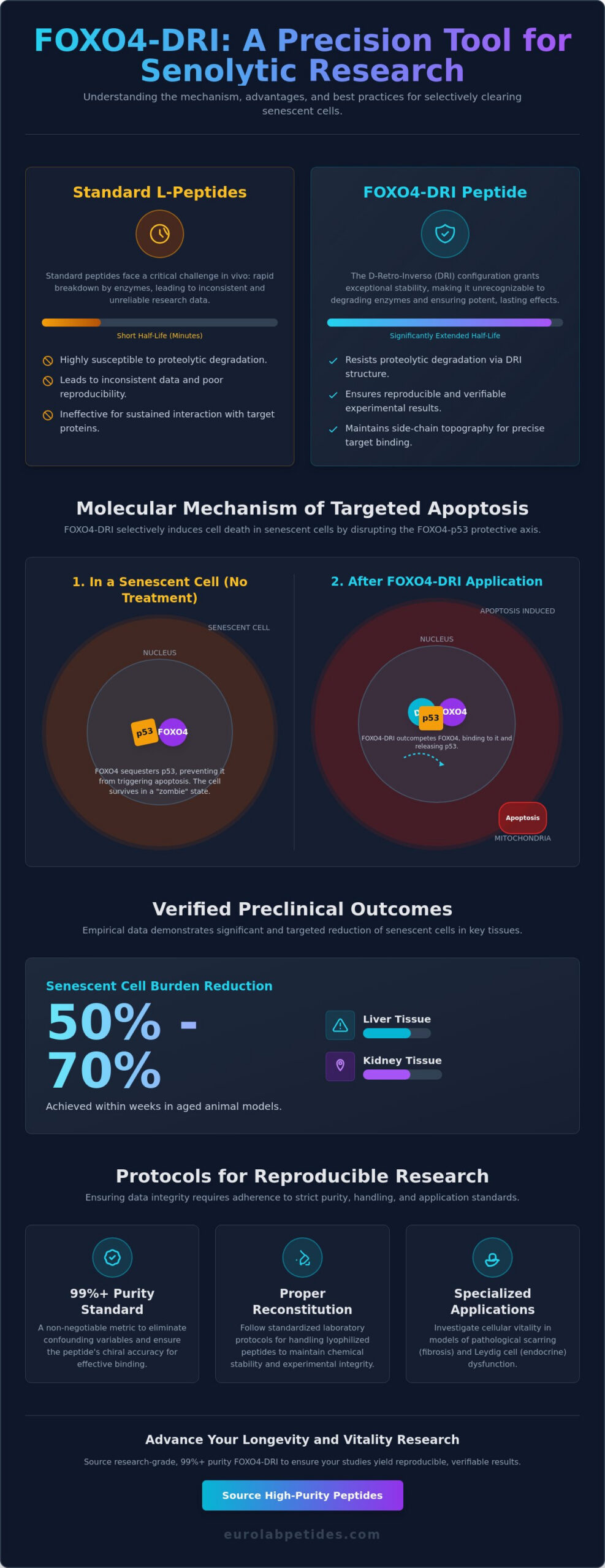
FOXO4-DRI is a synthetic peptide designed to disrupt the viability of senescent cells by targeting specific protein-protein interactions. Unlike standard L-peptides, this compound employs a D-retro-inverso (DRI) configuration to ensure high stability within complex biological environments. The primary objective when utilizing foxo4-dri for senolytic research is the selective induction of apoptosis in cells that have entered a state of permanent growth arrest. This is achieved through molecular mimicry of the FOXO4 protein, specifically the domain responsible for sequestering p53 within the nucleus. By introducing a competing peptide sequence, researchers can effectively release p53, allowing it to migrate to the mitochondria and initiate programmed cell death in senescence-arrested populations while leaving healthy cells unaffected.
The Chemistry of D-Retro-Inverso Isoforms
Standard L-isoform peptides are highly susceptible to proteolytic degradation in laboratory media; they often exhibit a half-life measured in minutes. The DRI modification involves the utilization of D-amino acids in a reversed sequence. This specific configuration maintains the side-chain topography of the original L-peptide while remaining virtually unrecognizable to endogenous proteases. This structural inversion significantly extends the peptide’s half-life, ensuring sustained stoichiometric interaction with the target proteins. Synthesis of these compounds requires absolute chiral accuracy. Even minor deviations in the D-enantiomer ratio during the chemical synthesis process can compromise the peptide’s ability to mimic the necessary binding interface. For serious professional inquiry, 99%+ purity is a non-negotiable metric to avoid confounding variables in the resulting data sets.
Senolytics vs. Senomorphics in Longevity Research
Distinguishing between senolytic and senomorphic agents is critical for establishing rigorous research protocols. Senomorphics typically suppress the Senescence-Associated Secretory Phenotype (SASP) without eliminating the cells, which may lead to transient results. In contrast, FOXO4-DRI is classified as a precision senolytic agent. It doesn’t merely modulate cell signaling; it actively overcomes the apoptosis resistance characteristic of senescent models. While these cells utilize the FOXO4-p53 axis to evade programmed death, the application of foxo4-dri for senolytic research forces a definitive shift toward the apoptotic pathway. This selective elimination provides a more permanent clearance of “zombie” cells, making it a superior tool for investigations into tissue repair and cellular vitality.
The FOXO4-p53 Axis: Molecular Mechanisms of Targeted Apoptosis
Senescent cells maintain viability by sequestering the pro-apoptotic factor p53 within the nucleus. The FOXO4 protein facilitates this by binding directly to p53, preventing its translocation to the mitochondria. This interaction is a hallmark of the senescent phenotype. When researchers utilize foxo4-dri for senolytic research, they introduce a peptide sequence that mimics the p53-binding domain of endogenous FOXO4. This creates a competitive binding environment. The synthetic peptide effectively outcompetes the natural protein for p53 attachment, breaking the protective bond that shields “zombie” cells from programmed death.
p53 Phosphorylation and Nuclear Sequestration
In senescent fibroblasts, p53 is frequently found in a phosphorylated state at the Serine 15 residue (p53-pS15). This specific post-translational modification increases its affinity for FOXO4, strengthening the nuclear bond that prevents apoptosis. FOXO4-DRI functions as a molecular decoy. By saturating the binding interface, the peptide facilitates the nuclear exclusion of p53. Once released into the cytoplasm, p53 localizes to the mitochondrial outer membrane. This relocation triggers mitochondrial membrane permeabilization and the subsequent activation of downstream caspases, specifically caspase-3/7. This cascade ensures the terminal execution of the apoptotic program without the need for external stressors.
Selectivity Metrics in Heterogeneous Cell Cultures
The efficacy of foxo4-dri for senolytic research is defined by its high therapeutic index. In heterogeneous cultures containing both senescent and proliferating cells, apoptosis is selectively induced in the senescent population. This selectivity occurs because healthy, non-senescent cells don’t exhibit the same level of FOXO4-p53 nuclear colocalization. Without the specific FOXO4-p53 complex to disrupt, the peptide remains inert in healthy phenotypes. Published data suggests that targeted clearance can reduce senescent cell burden by 50% to 70% in specific tissue models without impacting neighboring cell viability or proliferative capacity.
Establishing these molecular benchmarks is essential for high-precision longevity and vitality research protocols. By quantifying the reduction in SASP markers alongside apoptotic markers, researchers can verify the peptide’s targeted performance and ensure experimental reproducibility across varied cell lines.
Applications in Specialized Senescence Models: Fibrosis and Endocrine Research
The utility of foxo4-dri for senolytic research extends beyond basic cellular assays into complex pathological models where senescence drives chronic tissue dysfunction. Investigators are increasingly focusing on specialized models of fibrosis and endocrine failure, where the accumulation of “zombie” cells directly impairs organ architecture and hormonal homeostasis. By selectively eliminating these populations, researchers can observe the subsequent impact on tissue regenerative capacity and metabolic signaling. These applications provide a rigorous framework for evaluating the peptide’s efficacy in reversing age-related phenotypes within highly differentiated cell populations.
Keloid and Fibrotic Tissue Research
Pathological scarring, particularly in keloid fibroblast models, is characterized by a high density of senescent fibroblasts that remain locked in the G0/G1 phase of the cell cycle. These cells are resistant to standard apoptotic triggers and contribute to a pro-inflammatory microenvironment through the persistent secretion of SASP factors. Data indicates that FOXO4-DRI facilitates the selective clearance of these pro-inflammatory mesenchymal subpopulations by disrupting their specific survival signaling. In pulmonary fibrosis models, this targeted elimination has been shown to reduce collagen deposition and improve overall tissue compliance. Synergistic research often pairs senolytic agents with specialized tissue repair compounds like BPC-157 to investigate the optimization of the recovery environment following the removal of senescent interference.
Metabolic and Endocrine Senescence Models
Endocrine dysfunction, specifically late-onset hypogonadism, is closely linked to the senescence of Leydig cells within the testicular interstitium. As these cells enter a senescent state, their capacity for testosterone biosynthesis diminishes significantly, leading to systemic hormonal imbalances. Research utilizing foxo4-dri for senolytic research has demonstrated that removing these dysfunctional cells can restore the biosynthetic environment, potentially allowing remaining healthy cells to maintain more robust hormonal output. Parallel studies in aged skeletal muscle models examine the peptide’s impact on glucose metabolism. By clearing senescent cells that interfere with insulin signaling, researchers aim to establish parameters for improving metabolic flexibility in aged phenotypes. Preclinical data from naturally aged murine models support these findings, showing a 50% to 70% reduction in senescent burden across metabolic tissues, which correlates with improved physiological metrics in longitudinal inquiry.
These specialized models underscore the peptide’s role as a precision tool for tissue repair and recovery research. By isolating the effects of senescent cell clearance in localized environments, investigators can generate the high-fidelity data required to validate the therapeutic index of FOXO4-DRI in complex biological systems.
Methodological Considerations: Laboratory Handling and Reconstitution
Precision in the laboratory environment is the foundation of reproducible data. When preparing foxo4-dri for senolytic research, the transition from lyophilized powder to a stable solution requires strict adherence to solubility parameters. Sterile water for injection is the primary diluent for short-term assays. While the peptide remains soluble in bacteriostatic saline, researchers should monitor for potential salt precipitation in high-concentration stocks. Molar concentrations for in-vitro assays are typically established between 5 µM and 25 µM to determine the half-maximal inhibitory concentration (IC50) across varied senescent cell lines. This range allows for the observation of targeted apoptosis without inducing non-specific toxicity in proliferating populations.
Stability and Storage Protocols
Lyophilized peptides should be stored at -20°C for short-term use or -80°C for extended durations to prevent moisture-induced degradation. Once reconstituted, the peptide’s D-retro-inverso structure provides superior stability compared to standard L-isoforms during thermal cycling. However, multiple freeze-thaw cycles still pose a risk of physical degradation through shear stress. Aliquoting the solution into single-use vials is the recommended protocol to preserve the structural integrity of the peptide sequence. The optimal stability for FOXO4-DRI in aqueous solution is maintained within a pH range of 6.5 to 7.5. Maintaining this balance ensures that the competitive binding domain remains active for the duration of the incubation period.
Analytical Validation for Research Integrity
High-performance liquid chromatography (HPLC) is the gold standard for verifying the chiral purity of D-retro-inverso peptides. It’s essential to confirm that the synthesis process achieved the necessary 99%+ purity threshold to eliminate confounding biological responses. Mass spectrometry (MS) provides the secondary layer of validation by confirming the exact molecular weight and sequence identity. Batch-to-batch consistency is a non-negotiable requirement for longitudinal studies utilizing foxo4-dri for senolytic research. Without these verification metrics, researchers can’t definitively attribute cellular apoptosis to the disruption of the FOXO4-p53 axis. High-fidelity synthesis ensures that the stoichiometric interaction between the peptide and the target protein remains constant across all experimental replicates.
For investigators requiring standardized compounds for their protocols, obtaining high-purity materials is the first step in successful Longevity & Vitality Research. This rigorous approach to sourcing and handling is what separates definitive findings from inconsistent data sets in the specialized community of senolytic inquiry.
Ensuring Reproducibility: Purity and Sourcing for Senolytic Studies
The validity of apoptosis data in senolytic models depends entirely on the chemical fidelity of the synthetic peptide. When utilizing foxo4-dri for senolytic research, even trace impurities can induce non-specific cellular stress, confounding results that should specifically target the FOXO4-p53 axis. Common impurities in complex D-retro-inverso sequences include truncated fragments and incomplete deprotection products which arise during the solid-phase synthesis of long sequences. Chiral purity is equally critical; the presence of L-amino acid enantiomers within the D-sequence can alter binding kinetics and reduce proteolytic resistance. EuroLab Peptides employs a multi-level quality control protocol to ensure that every batch meets a 99%+ purity threshold, providing the high-stakes precision required for longevity research.
Independent Third-Party Verification
External Certificates of Analysis (COAs) serve as the non-negotiable standard for professional inquiry. Analytical validation through HPLC and Mass Spectrometry confirms that the peptide sequence matches the theoretical mass exactly. This transparency is essential for eliminating contamination risks in sensitive cell culture models where secondary metabolites could interfere with apoptotic markers. Without external validation, researchers risk utilizing compounds with variable bioactivity, which compromises the reproducibility of the 50% to 70% senescent clearance rates observed in previous studies. For investigators looking to buy research peptides within Europe, regional manufacturing standards and localized logistics offer a shorthand for reliability. Standardized excellence in the synthesis space ensures that longitudinal studies maintain batch-to-batch consistency, allowing for precise cross-study comparisons.
Integrating FOXO4-DRI into Research Stacks
Advanced research models frequently explore the synergistic effects of clearing senescent cells alongside other anabolic or metabolic interventions. One such intersection involves the use of growth hormone secretagogues like Ipamorelin in growth hormone research. By removing senescent cells that inhibit tissue responsiveness through the secretion of pro-inflammatory SASP factors, investigators can more accurately measure the regenerative potential of secretagogue-mediated signaling. Combining senolytics with metabolic markers allows for a comprehensive analysis of age-related phenotypes across multiple biological systems. This multi-component approach establishes a more holistic understanding of cellular vitality and the underlying drivers of tissue aging. Investigators are encouraged to establish rigorous protocols that account for these synergistic interactions. Explore the full longevity-focused research catalog at EuroLab Peptides to secure the elite tools necessary for serious professional inquiry.
Advancing Precision Senolysis through Verified Chemical Synthesis
The successful disruption of the FOXO4-p53 axis represents a significant benchmark in the selective elimination of senescent cell populations. By utilizing the D-retro-inverso isoform, researchers can overcome the rapid proteolytic degradation that often compromises standard L-peptide assays. This structural stability, combined with a competitive binding mechanism, ensures that p53 is effectively released to initiate mitochondrial apoptosis in targeted models. Establishing reproducible data in specialized senescence models requires chemicals that meet the highest analytical standards.
Securing foxo4-dri for senolytic research with 99%+ purity is essential to eliminate confounding variables and ensure batch-to-batch consistency. EuroLab Peptides provides research-grade compounds verified through third-party HPLC and Mass Spectrometry testing to guarantee stoichiometric precision. Every batch is optimized for maximum stability and delivered via secure European logistics to meet the rigorous demands of the scientific community. We invite you to Purchase High-Purity FOXO4-DRI for Senolytic Research to advance your investigations into cellular vitality and tissue repair with absolute confidence in your chemical tools.
Frequently Asked Questions
What is the primary mechanism of FOXO4-DRI in senolytic research?
FOXO4-DRI functions by disrupting the endogenous interaction between the FOXO4 protein and the p53 tumor suppressor within the cell nucleus. In senescent cells, FOXO4 sequesters p53 to prevent it from inducing apoptosis. The synthetic peptide mimics the p53-binding domain of FOXO4, acting as a competitive inhibitor that releases p53. Once liberated, p53 translocates to the mitochondria to trigger programmed cell death through caspase activation.
Why is the D-retro-inverso form of FOXO4-DRI preferred for research?
The D-retro-inverso (DRI) isoform is utilized because it offers superior proteolytic resistance compared to standard L-amino acid peptides. By using D-enantiomers in a reversed sequence, the peptide maintains its side-chain topography while remaining unrecognizable to endogenous proteases. This structural modification significantly extends the peptide’s half-life in laboratory media, ensuring sustained stoichiometric interaction throughout the duration of foxo4-dri for senolytic research protocols.
How does FOXO4-DRI selectively target senescent cells without affecting healthy ones?
Selectivity is achieved because healthy, non-senescent cells don’t typically sequester p53 via FOXO4 in the nucleus. The specific FOXO4-p53 complex that the peptide targets is a hallmark of the senescent phenotype. In proliferating or quiescent cells, the peptide remains inert because the necessary binding interface isn’t present. This high therapeutic index allows researchers to clear senescent populations while maintaining the viability and proliferative capacity of surrounding healthy cells.
What is the typical concentration range for FOXO4-DRI in cell culture studies?
Molar concentrations for in-vitro assays are generally established between 5 µM and 25 µM. This range is frequently used to determine the half-maximal inhibitory concentration (IC50) across varied senescent cell lines, such as IMR90 fibroblasts. Utilizing these specific parameters allows for the observation of targeted apoptosis without inducing non-specific toxicity. Researchers should calibrate these values based on the specific density and metabolic activity of their cell models.
Is FOXO4-DRI stable for room-temperature shipping to European laboratories?
FOXO4-DRI is highly stable in its lyophilized form during transit, even at ambient temperatures. The D-retro-inverso configuration is less sensitive to thermal fluctuations than standard peptides. However, long-term stability is best maintained by transferring the compound to cold storage upon arrival. Secure European logistics ensure that the chemical integrity of the peptide sequence is preserved from the point of synthesis to the laboratory environment.
What analytical methods verify the purity of FOXO4-DRI batches?
High-performance liquid chromatography (HPLC) and Mass Spectrometry (MS) are the primary methods used to verify batch purity and sequence identity. HPLC confirms that the compound meets the 99%+ purity threshold required for foxo4-dri for senolytic research by identifying any truncated fragments or impurities. Mass Spectrometry provides secondary validation by confirming the exact molecular weight. These metrics ensure that the stoichiometric interaction with target proteins remains consistent across all experimental replicates.
Can FOXO4-DRI be used in conjunction with other senolytic compounds like Quercetin?
FOXO4-DRI is often integrated into multi-component studies to investigate synergistic effects within a Longevity Research Stack. Researchers may combine it with other agents that target complementary pathways, such as BCL-2 inhibitors or senomorphics. This approach allows for a more comprehensive analysis of senescent cell clearance across heterogeneous populations. Quantifying the reduction in SASP markers alongside apoptotic markers helps verify the performance of these stacked research protocols.
What are the storage requirements for reconstituted FOXO4-DRI solution?
Reconstituted solutions should be aliquoted into single-use vials and stored at -20°C or -80°C to prevent degradation from multiple freeze-thaw cycles. The peptide’s stability is optimized in aqueous solutions within a pH range of 6.5 to 7.5. While the DRI structure is robust, maintaining these storage parameters ensures that the competitive binding domain remains active. Aliquoting also minimizes the risk of physical shear stress, which can occur during repeated handling of the stock solution.
