

The implementation of the new EMA Guideline on the Development and Manufacture of Synthetic Peptides on June 1, 2026, has redefined the baseline for scientific integrity across the European Economic Area. For researchers, the primary challenge remains the mitigation of experimental variables caused by undocumented endotoxins or structural impurities in imported sequences. You’ve likely encountered the frustration of inconsistent batch quality from unregulated suppliers that lack transparent data. Securing third-party tested peptides Europe is no longer a luxury for specialized labs; it’s a fundamental requirement for any study requiring reproducible results and verifiable chemical identity.
This technical guide analyzes the rigorous validation protocols, including HPLC and MS data, that ensure your research materials meet the European Pharmacopoeia’s 0.1% reporting threshold for impurities. You’ll learn how independent analytical verification and temperature-controlled EU logistics eliminate the risks associated with global procurement. We’ll examine the specific methodologies used to verify molecular weight and purity so your laboratory can maintain the highest standards of analytical precision throughout 2026.
Key Takeaways
- Establish a technical framework for evaluating independent validation as the primary metric for experimental reproducibility in high-precision research.
- Gain proficiency in decoding Certificates of Analysis (COA) to verify sequence purity and molecular weight through specific HPLC and MS benchmarks.
- Quantify the logistical benefits of sourcing third-party tested peptides Europe within the EEA to mitigate the risks of chemical degradation and regulatory non-compliance.
- Examine the critical role of lyophilisation and cold-chain logistics in preserving the structural integrity of peptide sequences from synthesis to the laboratory bench.
- Review the EuroLab multi-level quality protocol, which integrates rigorous synthesis standards with external transparency to support advanced research inquiry.
The Critical Necessity of Third-Party Tested Peptides in European Research
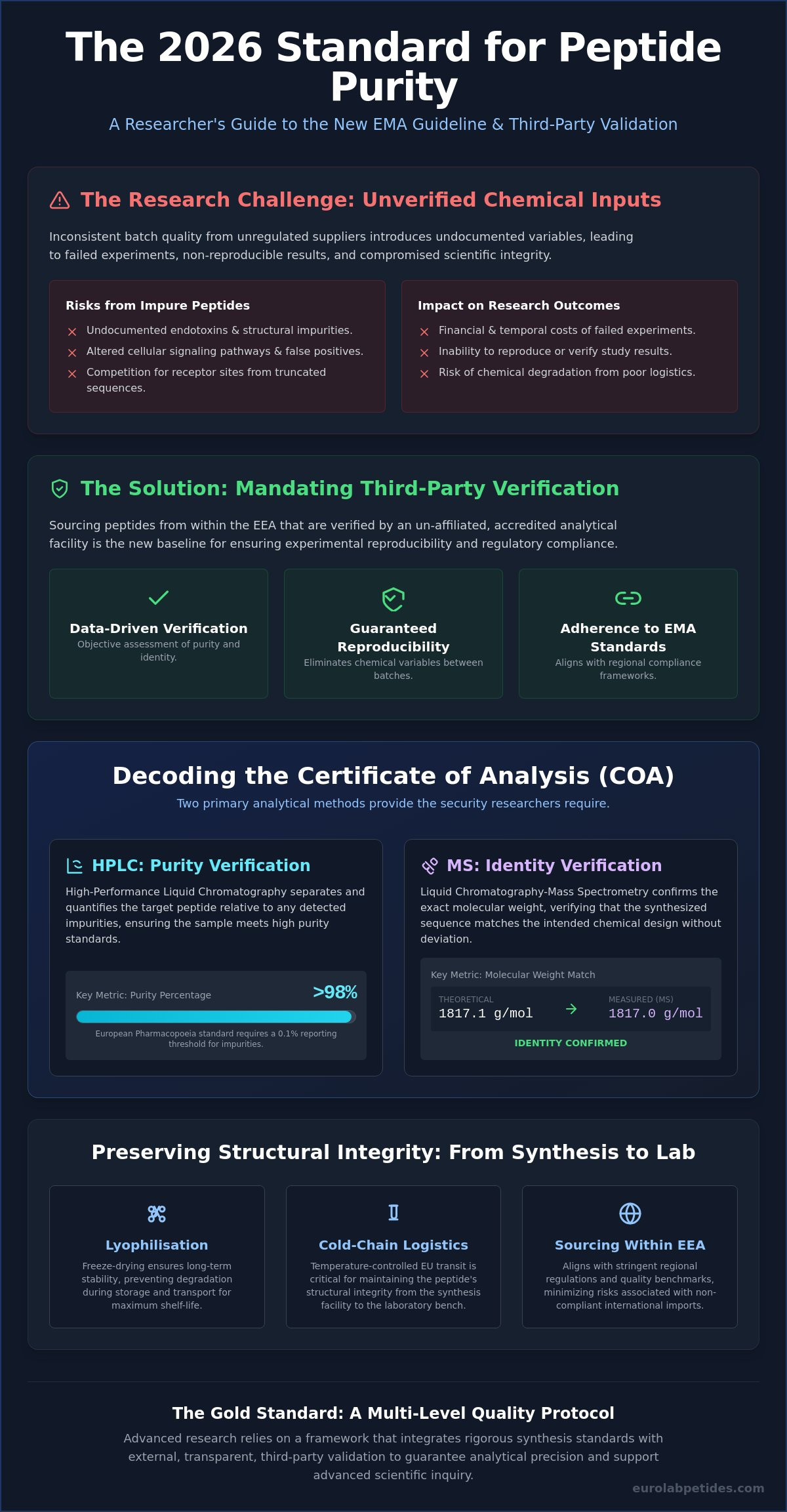
The evolution of laboratory standards in 2026 requires a transition from trust-based procurement to data-driven verification. As the European Medicines Agency (EMA) tightens its oversight on synthetic sequences, the acquisition of third-party tested peptides Europe has become the primary safeguard against experimental drift. Independent validation serves as the cornerstone of modern protocols; it ensures that the chemical identity of a compound matches its theoretical design. While internal quality control is a standard component of manufacturing, it doesn’t provide the objective scrutiny necessary for high-stakes research. External laboratories offer a detached assessment of purity, identity, and the presence of residual solvents, providing the security researchers require.
Differentiating between manufacturer claims and independent results is vital for maintaining scientific integrity. In-house data is often generated using optimized parameters that may overlook specific impurities or truncated sequences. Conversely, independent facilities use standardized, accredited methodologies to provide an unbiased profile of the material. Sourcing within Europe further reduces procurement uncertainty by aligning with regional regulatory frameworks and minimizing the risks associated with non-compliant international imports.
Reproducibility Crisis and Chemical Purity
The integrity of in-vitro data depends entirely on the absence of undocumented chemical variables. Minor peptide fragments, often the result of incomplete Peptide synthesis methodologies, can alter cellular signaling pathways and yield false positives. These truncated sequences or diastereomers compete for receptor sites, which complicates the interpretation of biological activity. In the current scientific environment, “research-grade” is strictly defined as a metric of verifiable purity exceeding 98%. The financial and temporal costs of failed experiments due to unverified materials are substantial; they often exceed the initial savings found through lower-tier suppliers.
The 2026 European Landscape for Peptide Sourcing
The 2026 landscape is characterized by a significant shift toward localized, high-transparency chemical suppliers providing third-party tested peptides Europe within the European Economic Area. This movement is driven by the need for reliable, temperature-controlled transit and strict adherence to regional compliance standards. For a validation to be considered truly “third-party,” it must originate from an un-affiliated, accredited analytical facility that has no financial stake in the manufacturing outcome. This transparency is essential for researchers who require absolute security in their chemical inputs. For those seeking a deeper understanding of these standards, consult our comprehensive guide for researchers to learn more about peptide characteristics and selection.
Analytical Methodologies: Decoding the Certificate of Analysis (COA)
Effective analysis of research materials requires a granular understanding of the data provided in a Certificate of Analysis (COA). Standardized metrics are essential for ensuring that third-party tested peptides Europe meet the rigorous demands of modern biochemistry. Verification is achieved through a multi-instrumental approach where each methodology addresses a specific facet of chemical integrity. High-Performance Liquid Chromatography (HPLC) is employed to determine the exact percentage of the target sequence within a sample. This process separates components based on chemical properties as they pass through a stationary phase under high pressure. HPLC measures the concentration of the primary peptide relative to any detected impurities. While HPLC quantifies the purity, Liquid Chromatography-Mass Spectrometry (LC-MS) is required to verify the molecular weight and structural identity of the sequence.
Advanced techniques such as Fourier-Transform Infrared Spectroscopy (FTIR) and quantitative Nuclear Magnetic Resonance (qNMR) provide additional layers of verification for secondary structures and absolute quantification. Furthermore, bioburden and endotoxin testing are mandatory protocols to ensure the absence of biological contaminants. Adherence to these Regulatory Guidelines for Analysis ensures that methodologies align with the stringent criteria established by European oversight bodies. Researchers requiring these precise benchmarks can verify the specifications of EuroLab’s research-grade materials to ensure experimental consistency.
HPLC vs. Mass Spectrometry: Identity vs. Purity
Identity does not inherently guarantee purity. A peptide sequence can be identified correctly via Mass Spectrometry yet remain only 80% pure due to the presence of truncated sequences or residual reagents. Reading a chromatogram requires identifying the primary peak and assessing the baseline noise for secondary peaks that indicate impurities. A clean baseline with a singular, sharp peak is indicative of high-purity synthesis. When evaluating third-party tested peptides Europe, both data sets must be correlated to confirm that the material is both the correct molecule and free from significant contamination.
Screening for Elemental Impurities and Heavy Metals
Inductively Coupled Plasma Mass Spectrometry (ICP-MS) is utilized to identify residual catalysts and heavy metals from the synthesis process. Standards such as USP <232> and <233> serve as relevant benchmarks for research-grade peptides to ensure elemental safety. Excessive levels of acetate or trifluoroacetate (TFA) are particularly hazardous in sensitive assays. These counter-ions can significantly impact pH levels and cellular viability, potentially skewing results in in-vitro models. Monitoring these levels is a non-negotiable requirement for maintaining the reliability of laboratory data.
Sourcing Within the EEA: Quality Benchmarks and Compliance
Procurement within the European Economic Area (EEA) provides a logistical and regulatory framework that minimizes chemical degradation during transit. Shorter transit durations and localized distribution networks allow for superior control over thermal exposure compared to intercontinental shipping. The implementation of the new EMA draft guidelines has established a more rigorous CMC (Chemistry, Manufacturing, and Controls) framework for synthetic sequences. This regulatory alignment ensures that regional synthesis facilities operate under standardized safety and quality protocols. Utilizing suppliers of third-party tested peptides Europe within the EEA ensures that materials are subject to European laboratory standards, which prioritize analytical precision and verifiable data over marketing assertions.
Transparency in the European market is a verifiable metric rather than a generalized claim. Accountability is maintained through the ability to verify laboratory credentials and synthesis origins within a single jurisdiction. This regional oversight reduces the procurement uncertainty that often characterizes the global chemical market. By sourcing locally, researchers bypass the complexities of varied international trade laws and ensure that the chemicals they receive have been handled according to European safety standards, reducing variables in the laboratory.
The Risk of Unregulated International Imports
International “grey market” imports present significant risks to experimental reproducibility and institutional compliance. Customs seizures are frequent when sourcing from non-EU vendors, often resulting in the total loss of material with no legal recourse. The global supply chain is currently saturated with “re-labeled” peptides, where materials of inferior grade are repackaged as research-grade without adequate analytical verification. These unregulated products frequently contain undocumented impurities that compromise in-vitro models. Understanding how to buy research peptides safely requires a focus on vendors who operate within the EEA and provide batch-specific documentation.
Verifiable Benchmarks for 2026
A verifiable Certificate of Analysis (COA) must include specific data points to be considered valid in a 2026 laboratory setting. Essential components include unique batch numbers, precise timestamps of analysis, and the digital signatures of the certifying chemists. It’s critical to ensure that testing facilities hold ISO/IEC 17025 accreditation, as this standard guarantees the technical competence and impartiality of the laboratory. This accreditation confirms that the lab has undergone rigorous assessment to perform specific tests, including HPLC and Mass Spectrometry, with consistent accuracy. Researchers should establish an internal protocol for the verification of supplier data, which may include cross-referencing batch numbers with the independent laboratory’s database. This “proof-first” approach ensures that third-party tested peptides Europe meet the necessary quality benchmarks before they are introduced into a sensitive research environment.
Stability and Integrity: From Lyophilisation to Laboratory Bench
The preservation of chemical integrity extends beyond the synthesis phase and into the logistics of storage and handling. Lyophilisation, or freeze-drying, is the standard method for stabilizing peptide sequences. This process involves freezing the sample and then reducing the surrounding pressure to allow the frozen water to sublimate directly from the solid phase to the gas phase. By removing moisture, the peptide’s primary and secondary structures are protected from hydrolysis and enzymatic degradation. For researchers acquiring third-party tested peptides Europe, ensuring that the material has been correctly lyophilised is vital for long-term stability. While the peptide remains in its solid, freeze-dried state, its molecular bonds are significantly more resistant to environmental stressors.
Cold-chain logistics play a critical role in minimizing thermal degradation during transit across the continent. While some suppliers emphasize shipping speed, the primary focus must remain on maintaining a stable thermal environment. Regional European distribution allows for shorter transit times, which reduces the risk of exposure to temperatures that could catalyze peptide breakdown. This logistical advantage ensures that the high-purity benchmarks verified during third-party analysis remain intact upon arrival at the laboratory.
Maintaining Lyophilised Peptide Stability
Storage protocols are dictated by the intended duration of use. Lyophilised peptides are generally stable at 4°C for approximately four weeks. For durations exceeding this period, storage at -20°C is required to maintain structural integrity, while archival storage necessitates temperatures of -80°C. The use of inert gases, such as Argon or Nitrogen, during vial sealing further prevents oxidative damage by displacing atmospheric oxygen. Proper handling of specific sequences, such as those found in the BPC-157 handling guide, requires strict adherence to these temperature benchmarks to ensure experimental reproducibility. Light exposure and humidity must also be controlled, as UV radiation can cause peptide bond cleavage.
Best Practices for Laboratory Handling
Preventing cross-contamination and degradation during the reconstitution phase is essential for data accuracy. Researchers must operate within a sterile environment, utilizing filtered pipette tips and high-purity reconstitution media. Averting “freeze-thaw” cycles is a primary requirement for preserving peptide potency. Aliquoting is the division of a bulk sample into smaller, single-use portions. This practice ensures that only the required amount of material is brought to room temperature, leaving the remainder of the stock undisturbed at sub-zero temperatures. To secure high-purity sequences for your next study, explore the range of third-party tested peptides Europe available for professional research.
EuroLab Peptides: A Multi-Level Quality Protocol for 2026
EuroLab Peptides operates as a specialized partner for the European scientific community, providing a synthesis-to-validation pipeline that prioritizes analytical precision. The integration of in-house manufacturing with independent verification establishes a redundant quality assurance system. This protocol ensures that third-party tested peptides Europe meet the rigorous demands of 2026 laboratory standards. By maintaining control over the synthesis process while subjecting every batch to external audit, a higher degree of accountability is achieved than through third-party distribution alone. This systematic approach eliminates the uncertainty often found in global procurement, providing researchers with a verifiable metric of excellence.
Our Triple-Verification Process
The EuroLab quality framework is defined by a triple-verification sequence designed to eliminate chemical variability. This process begins with a comprehensive screening of raw materials to ensure precursor purity before synthesis commences. Following the manufacturing phase, an internal post-synthesis HPLC analysis is performed to confirm the target sequence’s concentration. The final and most critical stage involves an independent audit by an accredited laboratory, where the material undergoes a definitive assessment of purity and identity. Any batch that fails to reach our non-negotiable 98% purity threshold is immediately rejected and excluded from the inventory. Our Ipamorelin technical profile serves as a representative example of the exhaustive documentation provided for every sequence in our catalog.
Batch-specific transparency is facilitated through our centralized COA vault, allowing researchers to access and verify analytical data in real-time. This system provides a historical record of quality that supports long-term study reproducibility, a process made more efficient by the robust digital frameworks provided by Centrum voor IT for modern laboratories. We uphold a strict mandate for research-only distribution, ensuring that our materials are utilized exclusively for legitimate scientific inquiry. This moral and scientific consistency is reinforced by localized European support, where technical inquiries regarding logistics or chemical specifications are addressed by professionals familiar with EEA regulatory requirements. Our commitment to radical honesty ensures that every data point is empirical and objective.
Partnering for Scientific Excellence
EuroLab Peptides supports advanced inquiry in fields such as longevity, metabolic function, and tissue repair research across the continent. Our procurement systems are optimized for the specific requirements of universities and private research institutes, providing a streamlined path from order to delivery within the EEA. By removing the variables associated with global supply chains, we enable researchers to focus on data generation rather than material validation. The availability of third-party tested peptides Europe ensures that every experiment is built on a foundation of chemical certainty. To advance your current study, explore our third-party tested research catalog at EuroLab Peptides.
Advancing Research Integrity through Analytical Precision
The 2026 research landscape necessitates a shift from speculative procurement to a model defined by empirical validation. As demonstrated, the integration of independent HPLC and Mass Spectrometry data is the only viable method for ensuring sequence identity and purity thresholds. Securing third-party tested peptides Europe within the EEA provides the dual benefit of regional regulatory compliance and superior cold-chain integrity. These standards are essential for the mitigation of experimental variables and the preservation of long-term data reproducibility in high-precision laboratory settings.
EuroLab Peptides maintains a multi-level quality protocol where every batch is subjected to independent European laboratory verification. Our commitment to transparency is evidenced by the provision of batch-specific HPLC/MS data for all sequences. These materials are intended strictly for in-vitro research use; this ensures that your study is supported by the highest benchmarks of chemical synthesis and analytical rigor. Professional inquiry is most successful when it’s built on a foundation of verifiable chemical excellence. High-purity inputs are the catalyst for reliable scientific discovery.
Secure High-Purity Research Peptides with Independent Validation
Frequently Asked Questions
Why is third-party testing more reliable than manufacturer testing?
Third-party validation is more reliable because it removes the inherent conflict of interest associated with in-house manufacturer testing. An independent laboratory provides an objective, unbiased audit of the chemical profile using standardized analytical methodologies. This external scrutiny ensures that the results are based solely on empirical data rather than commercial objectives. It’s a fundamental requirement for researchers who demand absolute security and reproducibility in their laboratory inputs.
How do I verify the authenticity of a peptide Certificate of Analysis?
Authenticity is verified by cross-referencing batch-specific identifiers and timestamps directly with the accredited laboratory that performed the analysis. A legitimate Certificate of Analysis (COA) must feature digital signatures and the ISO/IEC 17025 accreditation mark. Any discrepancy in the documentation or a lack of verifiable contact details for the testing facility should be viewed as a significant risk to data integrity.
What are the risks of using peptides with less than 98% purity in research?
Peptides falling below the 98% purity threshold introduce undocumented chemical variables that can significantly alter cellular signaling pathways. These impurities, often truncated sequences or residual solvents, compete for receptor sites and yield false positives. This contamination compromises the reliability of in-vitro data and results in the financial and temporal loss of failed experiments. High-purity sequences are non-negotiable for high-stakes professional inquiry.
Do European peptide suppliers follow different standards than US or Asian vendors?
European suppliers operate under the new EMA guidelines effective June 1, 2026, which impose more comprehensive lifecycle oversight than many US or Asian frameworks. These regional standards require stricter reporting of impurities above 0.1% and risk assessments for nitrosamines. Sourcing third-party tested peptides Europe ensures that materials comply with the European Pharmacopoeia’s rigorous benchmarks for analytical purity and structural identity.
What specific contaminants are screened for during third-party testing?
Testing protocols screen for a range of contaminants including residual catalysts, heavy metals, and bacterial endotoxins. HPLC is utilized to detect peptide-related impurities while Mass Spectrometry verifies the molecular weight. Additionally, screening for counter-ions like trifluoroacetate (TFA) is critical, as excessive levels can disrupt pH stability and cellular viability in sensitive research models.
How does temperature during shipping affect the purity of research peptides?
Temperature fluctuations during transit can catalyze the hydrolysis of peptide bonds, leading to structural degradation and reduced potency. Localized logistics for third-party tested peptides Europe utilize temperature-controlled environments to mitigate this risk. Shorter transit durations within the EEA ensure that the lyophilised material remains stable and reaches the laboratory bench without the thermal stress typical of intercontinental shipping.
What is the shelf-life of a third-party tested lyophilised peptide?
Lyophilised peptides maintain stability for approximately four weeks when stored at 4°C, but long-term storage requires colder environments. Storage at -20°C extends the shelf-life to two years, while archival storage at -80°C further minimizes oxidative damage. Proper sealing with inert gases like Argon also prevents degradation by displacing atmospheric oxygen, ensuring the chemical integrity of the sequence remains intact.
Can I request a specific batch test result before purchasing for my lab?
Reputable suppliers provide access to batch-specific HPLC and MS data prior to purchase to ensure material transparency. This data is typically hosted in a secure COA vault, allowing researchers to confirm that the specific lot meets their purity requirements. Verifying these metrics before procurement is a standard protocol for institutional labs aiming to reduce variables and maintain the highest levels of scientific accountability.
