

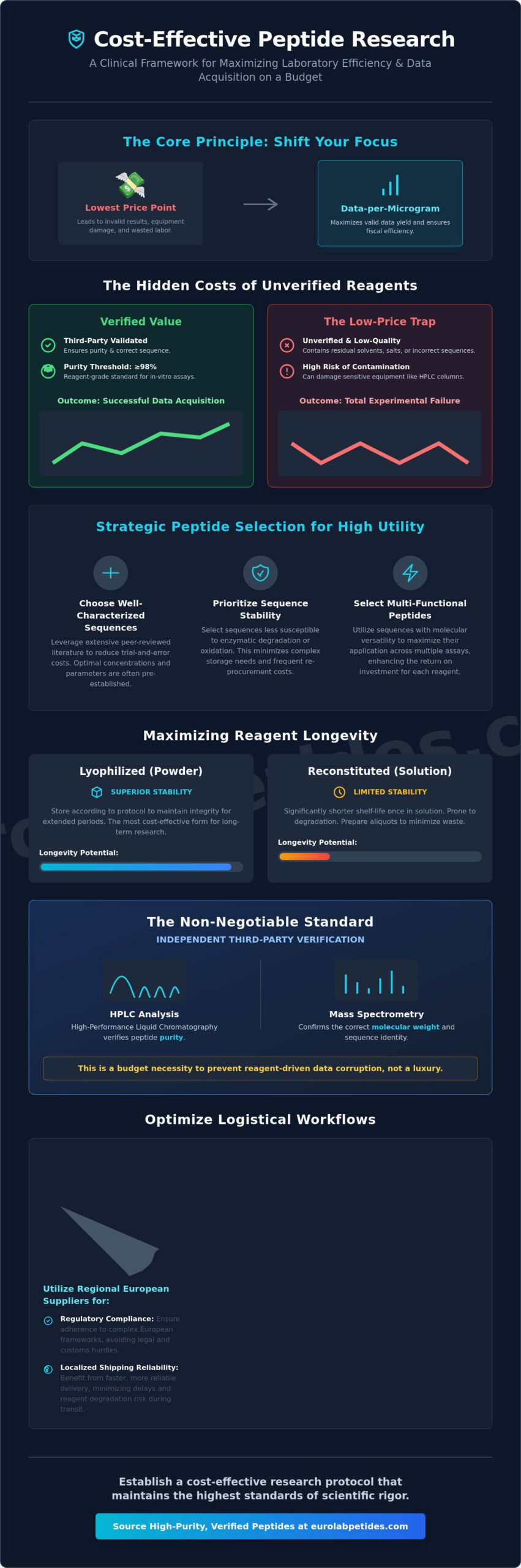
In high-stakes biochemical inquiry, the most expensive reagent is not necessarily the one with the highest procurement cost; it’s the one that produces invalid or unrepeatable results. For many professional facilities, getting started with peptide research on a budget necessitates a fundamental shift from seeking the lowest price point to maximizing the quantitative data yield per microgram. While the global peptide therapeutics market is projected to exceed $160 billion by 2026, individual researchers often face the prohibitive costs of custom synthesis and the necessity of third-party verification.
The frustration of navigating complex European regulatory frameworks while maintaining reagent integrity is a common challenge in the field. This article provides a clinical framework for researchers to maximize laboratory efficiency and data acquisition through strategic peptide sourcing and handling. We’ll examine the technical specifications of high-purity reagents, the logistics of localized shipping compliance, and the standardized protocols required to minimize reagent waste. By prioritizing verifiable metrics over marketing claims, laboratories can establish a cost-effective research protocol that maintains the highest standards of scientific rigor.
Key Takeaways
- Prioritize the “Data-per-Microgram” metric by analyzing synthesis scale and HPLC purification levels as the primary drivers of laboratory fiscal efficiency.
- Reduce experimental trial-and-error costs by selecting multi-functional peptide sequences supported by extensive peer-reviewed literature.
- Implement independent third-party HPLC and Mass Spectrometry verification as a non-negotiable standard when getting started with peptide research on a budget to prevent reagent-driven data corruption.
- Maximize reagent longevity through rigorous storage protocols that leverage the superior stability of lyophilized compounds compared to reconstituted solutions.
- Optimize logistical workflows by utilizing regional European suppliers that ensure regulatory compliance and localized shipping reliability.
The Economics of In-Vitro Peptide Research: Establishing a Budgetary Framework
In the 2026 scientific environment, peptide research is characterized by the utilization of high-purity synthetic sequences designed to trigger specific cellular pathways. When getting started with peptide research on a budget, the primary objective is the optimization of the data yield relative to procurement costs. This requires a granular understanding of cost-drivers, specifically synthesis scale, High-Performance Liquid Chromatography (HPLC) purification levels, and analytical validation protocols. Peptides are typically synthesized through solid-phase methodology, where costs are determined by sequence length and the complexity of removing truncated byproducts.
Budgetary frameworks must distinguish between reagent-grade materials and clinical-grade compounds. For in-vitro applications, reagent-grade peptides with a purity threshold of ≥98% are standard. Clinical-grade materials, which necessitate Good Manufacturing Practice (GMP) certification, represent a prohibitive and unnecessary financial burden for laboratory-based assays. A functional, low-cost research environment is established by focusing on high-purity synthetic reagents while maintaining standardized protocols for reconstitution and aliquot storage. Establishing these baseline requirements is the first step when getting started with peptide research on a budget, ensuring that fiscal constraints don’t compromise the integrity of the resulting data.
Defining the Scope: In-Vitro vs. In-Vivo Budgeting
In-vitro models provide a superior Return on Investment (ROI) for preliminary data collection. The overhead associated with maintaining cell cultures is a fraction of the capital required for animal models or clinical trials. Laboratory development allows for the high-throughput screening of multiple sequences, which accelerates the identification of viable research leads. It’s established that all materials must be sourced strictly for laboratory use. The distribution of “research use only” peptides for human consumption is illegal under 2026 regulations.
The Hidden Costs of Unverified Reagents
Procuring reagents based solely on the lowest unit price frequently results in total experimental failure. Low-quality peptides often contain residual solvents, salts, or incorrect sequences that invalidate weeks of laboratory labor. These contaminants can damage sensitive analytical equipment, such as HPLC columns, leading to significant maintenance costs. The concept of “Verified Value” dictates that the initial investment in third-party validated reagents is more cost-effective than the cumulative loss of labor hours and equipment downtime caused by unverified materials.
Selecting High-Utility Peptides for Cost-Effective Laboratory Models
Efficiency in the laboratory is dictated by the strategic selection of reagents that offer the highest degree of molecular versatility. When getting started with peptide research on a budget, selecting sequences with a robust body of existing literature is a critical risk-mitigation strategy. Utilizing well-characterized peptides reduces the financial burden of exploratory trial-and-error, as optimal concentrations and reaction parameters are often already established in peer-reviewed data. Rigorous quality control standards ensure that these sequences perform predictably across multiple assays, protecting the laboratory’s resource allocation from the volatility of unverified materials.
Sequence stability is a vital factor in long-term budget planning. Peptides with high susceptibility to enzymatic degradation or oxidation require more complex storage solutions and frequent replacement. By prioritizing foundational sequences known for their relative stability in lyophilized form, researchers can maintain a consistent reagent inventory without the frequent costs of re-procurement. This methodological approach ensures that the laboratory budget is directed toward data acquisition rather than the replacement of degraded materials. Strategic planning at the procurement stage is the most effective way to maintain high-stakes precision while getting started with peptide research on a budget.
Foundational Sequences for Tissue Repair Research
BPC-157 remains a primary reagent for budget-conscious gastric and musculoskeletal models due to its documented stability and broad range of biological activity. As a stable gastric pentadecapeptide, it offers high data yield across diverse experimental frameworks. TB-500 (Thymosin Beta-4) serves as a secondary high-utility reagent, often utilized for its distinct regenerative pathways. Implementing a Recovery Research Stack allows for the simultaneous evaluation of these synergistic sequences, which reduces the total reagent volume needed for comprehensive tissue repair analysis.
Metabolic and Growth Factor Models on a Budget
In the study of growth hormone secretagogues, Ipamorelin is a cost-effective alternative to more complex, less stable analogs. Its high receptor selectivity and predictable pharmacokinetic profile make it an ideal tool for professional inquiry. CJC-1295 is frequently paired with Ipamorelin to facilitate sustained growth hormone research, providing a more comprehensive metabolic model without the costs associated with rarer synthetic compounds. Utilizing Advanced Metabolic Stacks maximizes experimental throughput by providing a standardized ratio of these sequences. Researchers seeking to optimize their reagent procurement can find these foundational tools through EuroLab Peptides to ensure regional manufacturing excellence.
The Price of Purity: Why Third-Party Verification is a Budget Necessity
In the professional laboratory, the procurement of reagents is governed by the 2026 “Gold Standard” of multi-level quality control. While some facilities attempt to reduce overhead by skipping independent validation, this practice is mathematically flawed. When getting started with peptide research on a budget, the cost of a single failed experiment due to reagent-driven data corruption far exceeds the fee for third-party verification. High-Performance Liquid Chromatography (HPLC) is utilized to determine the precise purity of the sample by separating individual components based on their chemical properties and measuring the area under the resulting peaks. Simultaneously, Mass Spectrometry (MS) confirms the molecular weight by ionizing the sample and analyzing the mass-to-charge ratio. This ensures the amino acid sequence identity matches the theoretical specification exactly. Without these metrics, the researcher lacks the empirical foundation required for valid professional inquiry. The presence of just 5% impurities can trigger unintended cellular responses, effectively nullifying the entire research budget allocated to that study.
Reading a Certificate of Analysis (COA)
A Certificate of Analysis (COA) serves as the primary instrument of accountability. A researcher must verify that the document includes a clear chromatogram, the specific batch number, and a date of analysis within the last six months. Outdated documents are a significant red flag, as they suggest the data may not reflect the current batch’s integrity. For valid research data, a 98% purity threshold is considered the non-negotiable standard. Purity levels below this metric introduce uncontrolled variables, such as residual trifluoroacetic acid (TFA) or truncated sequences, which can lead to erroneous conclusions. Investing in reagents that meet these stringent benchmarks is the only way to ensure that the data produced is repeatable and publishable.
Sourcing Safely in Europe
Sourcing reagents from within the European Union offers distinct logistical advantages. Regional procurement minimizes the risk of peptide degradation associated with prolonged customs delays and fluctuating temperatures during transit. It’s critical that professionals prioritize buying research peptides from suppliers who provide full transparency regarding their manufacturing and testing protocols. Regional regulatory compliance ensures that batches are produced under standardized conditions, which contributes to long-term experimental consistency. By utilizing localized logistics, researchers can maintain a lean inventory while getting started with peptide research on a budget, relying on rapid delivery to sustain their methodology. Localized sourcing also simplifies the process of verifying a supplier’s credentials and testing facilities, adding a layer of security to the procurement chain.
Laboratory Efficiency: Maximizing Reagent Longevity and Reducing Waste
Efficiency in the laboratory environment is maintained through the rigorous application of storage and handling protocols. When getting started with peptide research on a budget, it’s clear that the financial risk associated with reagent degradation is a primary concern. Lyophilized peptides, while stable during regional transit, transition into a state of heightened fragility once reconstituted. Standardized laboratory procedures dictate that bulk reagents be handled with high-stakes precision to prevent molecular shearing and hydrolysis. Implementing a zero-waste strategy ensures that every microgram of high-purity sequence contributes to the final data set, protecting the facility’s capital allocation. Professional peptide handling requires a minimal set of high-utility supplies, including bacteriostatic water, sterile glass vials, and precision volume transfer tools. The transition from a freeze-dried solid to a liquid solution represents the point of highest vulnerability for the peptide sequence. Proper methodology at this stage is non-negotiable for maintaining the empirical integrity of the study.
Reconstitution Protocols for Maximum Stability
The choice of diluent is dictated by the intended duration of the research. Bacteriostatic water, which contains 0.9% benzyl alcohol, is preferred for multi-use vials as it inhibits microbial proliferation more effectively than sterile saline. During the mixing process, a gentle swirling motion is employed to dissolve the lyophilized cake. Shaking the vial is strictly avoided to prevent molecular shearing, which can lead to the denaturation of delicate amino acid chains. A peptide reconstitution calculator is utilized as a standardized tool to ensure precise concentration metrics and prevent the loss of reagent through calculation errors.
Advanced Storage Solutions for Small Labs
Temperature regulation is the most critical factor in preserving peptide potency. Short-term storage of reconstituted sequences is maintained at 4°C, while long-term preservation of lyophilized stocks requires temperatures between -20°C and -80°C. Exposure to UV light and moisture must be eliminated to prevent photodegradation and hydrolysis. The aliquot method is implemented by dividing the reconstituted solution into single-use volumes before the initial freeze. This protocol minimizes the number of freeze-thaw cycles, which are known to cause cumulative damage to the peptide’s secondary structure. Researchers can optimize their laboratory inventory by sourcing high-stability Recovery Research Stacks designed for standardized experimental protocols.
Strategizing Your 2026 Research: The EuroLab Peptides Solution
The progression from preliminary data collection to established laboratory protocols requires a methodical approach to resource management. When getting started with peptide research on a budget, the researcher must transition from ad-hoc procurement to a structured acquisition strategy that prioritizes longitudinal data consistency. This evolution is supported by the adoption of standardized peptides, which eliminate the variables associated with batch-to-batch volatility. By utilizing reagents that meet a verifiable purity threshold of ≥98%, facilities can ensure that their findings are both reproducible and suitable for peer-reviewed publication. EuroLab Peptides serves as a clinical partner in this process, providing the high-stakes precision required by the specialized biochemical community.
The EuroLab Quality Benchmark
Every batch distributed by EuroLab Peptides undergoes a dual-track validation process. This includes primary in-house analysis followed by independent third-party verification via HPLC and Mass Spectrometry. European-based logistics are utilized to ensure reagent stability by minimizing the duration of transit and exposure to uncontrolled environmental variables. For targeted investigations, specialized research tools such as the Longevity Research Stack or the Recovery Research Stack are available. These pre-configured stacks provide a standardized ratio of sequences, which maximizes experimental throughput and reduces the labor hours required for individual reagent preparation.
Next Steps for Your Research Laboratory
Initiating a professional research protocol in 2026 begins with the selection of reagents backed by comprehensive documentation. EuroLab Peptides provides detailed technical specifications and Certificates of Analysis for every sequence, which are essential components for the methodology sections of professional research papers. Technical support is available to assist in the integration of these reagents into existing in-vitro models. Facilities ready to establish a cost-effective, high-precision research environment can secure their requirements through the EuroLab Peptides catalog, ensuring regional manufacturing excellence and radical accountability in every shipment.
Advancing Laboratory Standards through Strategic Resource Optimization
The successful execution of a biochemical research program is predicated on the elimination of uncontrolled variables. As established throughout this guide, getting started with peptide research on a budget isn’t a matter of procurement at the lowest price point; it’s the systematic reduction of reagent waste and experimental failure. By prioritizing sequences with a minimum purity threshold of 98% and implementing rigorous aliquot storage protocols, professional facilities can maximize their data acquisition per microgram. The integration of independent HPLC and Mass Spectrometry testing remains the only objective defense against the data corruption caused by unverified sequences.
Maintaining high-stakes precision requires a partner that understands the rigorous demands of the specialized community. EuroLab Peptides provides the technical infrastructure needed to sustain elite research standards through European-based secure logistics and specialized research-grade purity benchmarks. These protocols ensure that every sequence arrives with the empirical validation required for repeatable, publishable results. Professional researchers can Secure High-Purity Reagents for Your 2026 Research at EuroLab Peptides to establish a foundation of radical accountability. Your laboratory is now equipped to produce high-value data through a methodical, cost-effective framework.
Frequently Asked Questions
How do I start peptide research without an expensive laboratory setup?
What are the most cost-effective peptides for a beginning researcher?
Reagents with extensive peer-reviewed documentation, such as BPC-157 and Ipamorelin, offer the highest return on investment due to their established reaction parameters. These foundational sequences reduce the financial burden of exploratory trial-and-error. Utilizing a pre-configured Recovery Research Stack or Longevity Research Stack further optimizes the budget by providing standardized ratios of synergistic compounds. These sequences are characterized by high molecular stability, which minimizes the risk of financial loss through premature reagent degradation.
Can I use tap water for peptide reconstitution if I am on a budget?
Tap water must never be utilized for the reconstitution of synthetic sequences. The presence of minerals, chlorine, and microbial contaminants will trigger immediate peptide aggregation or enzymatic hydrolysis, effectively destroying the reagent. Professional protocols dictate the use of bacteriostatic water containing 0.9% benzyl alcohol to inhibit bacterial proliferation. Utilizing improper diluents is a primary cause of experimental failure, resulting in the total loss of the allocated procurement budget and laboratory labor hours.
How long do lyophilized peptides last when stored at room temperature?
Lyophilized peptides remain stable at room temperature for approximately four weeks, which is sufficient for regional transit within Europe. Extended exposure to ambient temperatures will result in a cumulative loss of potency through oxidation and moisture absorption. For long-term preservation, lyophilized stocks must be transferred to a controlled environment at -20°C or -80°C. Maintaining these temperature benchmarks is a non-negotiable requirement for ensuring that the chemical identity of the sequence remains intact for future assays.
Is it cheaper to buy individual peptides or research stacks?
Research stacks are consistently more cost-effective for multi-level laboratory models. By procuring an Advanced Metabolic Stack or a Muscle Research Stack, the facility reduces the per-unit cost of individual sequences while ensuring batch consistency across the entire experimental group. This approach streamlines the procurement process and simplifies inventory management. When getting started with peptide research on a budget, these specialized stacks provide a clinical framework for maximizing the data yield per microgram of reagent.
What happens if I use a peptide that is only 90% pure in my research?
Utilizing reagents with 90% purity introduces uncontrolled variables that invalidate the resulting data. The remaining 10% often consists of truncated sequences, residual solvents, or salts that trigger unintended cellular responses. Standardized professional inquiry requires a minimum purity threshold of 98% to ensure that observed biological effects are attributed solely to the target sequence. Reagents failing to meet this benchmark are considered sub-standard and are unsuitable for repeatable, high-stakes scientific investigation.
Are there specific European regulations for buying research peptides in 2026?
Current 2026 regulations dictate that all synthetic sequences sold as “Research Use Only” are strictly intended for laboratory environments. The distribution of these compounds for human consumption remains illegal across the European Union. Regional manufacturing standards ensure that batches are produced under rigorous quality control protocols, providing a shorthand for reliability. Researchers are responsible for maintaining compliance by sourcing materials from transparent suppliers that provide verifiable documentation and adhere to localized logistics and safety requirements.
How do I verify if a third-party lab report is authentic?
Authenticity is verified by cross-referencing the batch number on the Certificate of Analysis with the manufacturer’s records. A valid report must include a recent date of analysis, typically within the last six months, and a clear HPLC chromatogram with identified peaks. Professionals should contact the independent testing facility directly to confirm that the reported mass spectrometry data matches the original findings. Radical honesty in documentation is the only protection against the procurement of counterfeit or sub-standard reagents.
