

The efficacy of a single peptide often fails to replicate the multifaceted physiological environment required for advanced tissue synthesis. Modern laboratory protocols now prioritize muscle research stack applications to simulate these complex biological pathways through precise molecular synergy. While the global peptide therapeutics market is projected to reach $163.98 billion in 2026, the transition from isolated compounds to integrated stacks introduces significant analytical challenges. Researchers frequently encounter inconsistent purity levels and a deficit of empirical data regarding peptide-to-peptide interactions, which often compromises the integrity of longitudinal data.
It’s understood that maintaining rigorous standards is difficult when sourcing third-party tested materials within the European Union, especially with the June 2026 EMA guidelines establishing stricter manufacturing benchmarks for synthetic peptides. This scientific review analyzes the specific biochemical mechanisms and laboratory applications of peptide stacks designed for muscle tissue and metabolic inquiry. You’ll gain a clear understanding of the targeted pathways and essential guidelines for reconstitution and handling. We’ll conclude by identifying high-purity sources that meet current regional regulatory requirements, ensuring your research relies on verifiable metrics rather than anecdotal claims.
Key Takeaways
- Synergistic interactions between growth hormone secretagogues and IGF-1 analogs allow for the simulation of complex physiological environments during tissue synthesis research.
- Muscle research stack applications utilize the distinct signaling of mTOR and MAPK/ERK pathways to isolate variables in hypertrophy versus tissue repair models.
- Standardized laboratory handling, specifically the selection of reconstitution media and thermal storage, is critical for preserving the molecular stability of lyophilized peptides.
- Multi-level quality control via HPLC and Mass Spectrometry provides the necessary empirical validation for verifying compound purity and identity in professional inquiry.
- Compliance with the June 2026 EMA guidelines ensures that research procurement meets the highest regional standards for synthetic peptide manufacturing and analytical rigor.
Defining the Muscle Research Stack in Biochemical Inquiry
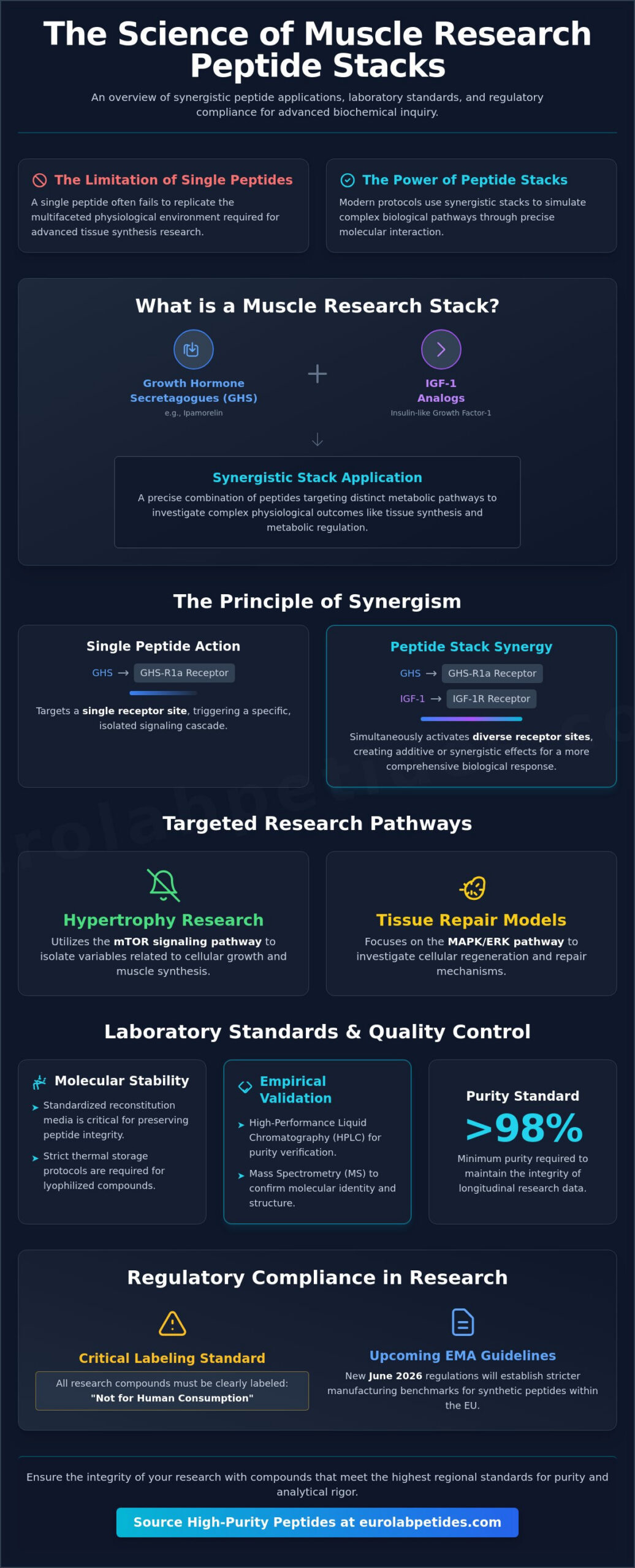
In biochemical inquiry, a muscle research stack is defined as a precise combination of two or more synthetic peptides designed to target distinct metabolic pathways within a controlled laboratory environment. These configurations are used to investigate complex physiological outcomes that a single isolated compound cannot adequately simulate. By utilizing muscle research stack applications, researchers can observe the multi-pathway interactions required for tissue synthesis and metabolic regulation. The primary focus of these stacks typically involves the integration of Growth hormone secretagogues (GHSs), such as Ipamorelin, with insulin-like growth factor (IGF-1) analogs. This dual approach allows for a more comprehensive analysis of how hormonal signaling influences cellular growth and repair mechanisms. Unlike standard supplement “stacks” found in retail environments, these laboratory models utilize high-purity, lyophilized compounds to examine the interplay between endogenous hormone secretion and direct receptor activation.
The Rationale for Peptide Synergism
The scientific basis for stacking relies on the simultaneous activation of diverse receptor sites. For instance, while a GHS targets the ghrelin receptor (GHS-R1a) to stimulate endogenous growth hormone release, an IGF-1 analog interacts directly with the IGF-1 receptor (IGF-1R). This concurrent stimulation often results in additive or synergistic effects, which may reduce the concentration requirements of individual compounds. By lowering the required molarity of each peptide, researchers can minimize potential off-target effects while still achieving the desired biological response. These models are essential for simulating complex in-vivo endocrine environments where multiple signaling molecules operate in concert to maintain homeostasis or drive tissue development. Such multi-receptor targeting is a cornerstone of modern biochemical inquiry, allowing for the observation of downstream signaling cascades that isolated peptides don’t typically trigger in isolation.
Regulatory Compliance in Research Settings
Rigorous adherence to laboratory standards is a non-negotiable requirement in the field of peptide synthesis. It’s critical to distinguish research-grade peptides from pharmaceutical-grade medicines intended for clinical use. Research-grade compounds are synthesized for in-vitro and laboratory development only; they aren’t intended for human or veterinary consumption. All chemical supply containers must carry the “Not for Human Consumption” label to ensure compliance with regional safety protocols. For investigators operating within the European Union, understanding how to buy research peptides involves verifying third-party analytical reports, such as HPLC and Mass Spectrometry, to confirm compound identity and purity. These measures provide a verifiable metric of quality, ensuring that experimental data is derived from high-purity materials rather than sub-standard alternatives. Utilizing compounds with verified purity levels, often exceeding 98%, is necessary to maintain the integrity of longitudinal research data in specialized scientific communities.
Primary Mechanisms of Growth Hormone Secretagogues and IGF-1 Analogs
Ipamorelin is a pentapeptide that mimics ghrelin to stimulate growth hormone release without affecting cortisol or prolactin. This high level of selectivity is vital for muscle research stack applications because it eliminates confounding variables associated with stress hormone elevation. In laboratory models, the objective is often to observe how secretagogues influence the somatotropic axis. Laboratory investigators distinguish between pulsatile GH release, which mimics natural physiological rhythms, and sustained GH elevation. While exogenous GH often leads to a static increase, Ipamorelin facilitates a pulsatile response that allows for the study of more natural cellular signaling cycles. This distinction is critical for longitudinal studies where the timing of metabolic events must be precisely tracked.
Ipamorelin and Growth Hormone Dynamics
Ipamorelin’s high affinity for the GHS-R1a receptor ensures that the laboratory signal remains focused strictly on growth hormone pathways. Researchers often consult Ipamorelin technical profiles to calibrate dosage protocols for secretagogue research. Empirical data indicates that this peptide significantly enhances nitrogen retention and protein synthesis in-vitro. These metrics are essential for quantifying the efficacy of anabolic research models. By stimulating the pituitary gland to release GH in a controlled manner, it provides a stable environment for observing metabolic shifts without the interference of secondary hormonal spikes. This stability is a primary reason why it remains a staple in advanced muscle tissue inquiry.
IGF-1 Variants: DES vs. LR3 in Muscle Studies
Insulin-like Growth Factor-1 variants offer distinct advantages based on the specific research objective. IGF-1 DES possesses a significantly shorter half-life and is utilized primarily for site-specific tissue inquiry. Its lack of the first three amino acids at the N-terminus reduces its affinity for IGF-binding proteins (IGFBPs), making it highly potent for localized cellular activation. This lack of binding allows the peptide to act immediately on the IGF-1R, facilitating the study of rapid cellular signaling events in isolated muscle fibers. It’s an ideal tool for researchers focusing on acute tissue response rather than systemic metabolic changes.
Conversely, IGF-1 LR3 contains an arginine substitution at position 3 and a 13-amino acid extension. This structural modification drastically reduces its binding to IGFBPs, which effectively extends its half-life and facilitates systemic research. When these variants are integrated into a Muscle Research Stack, the synergistic potential increases significantly. The combination of endogenous GH stimulation via secretagogues and direct receptor activation via IGF-1 analogs provides a robust framework for analyzing muscle tissue development. These integrated muscle research stack applications allow for the observation of complex biological signals that simpler models can’t replicate.
Synergistic Pathways: Hypertrophy vs. Tissue Repair Research
Effective muscle research requires a comprehensive understanding of the molecular overlap between anabolic signaling and structural tissue reconstruction. Muscle research stack applications allow for the simultaneous investigation of hypertrophy and structural integrity by targeting multiple signaling cascades. While hypertrophy research focuses on the mammalian target of rapamycin (mTOR) pathway to regulate protein synthesis, tissue repair inquiry often targets the mitogen-activated protein kinase (MAPK/ERK) pathway. Stacking these compounds enables researchers to observe how repair-focused peptides mitigate inflammatory markers that might otherwise inhibit growth signaling in muscle tissue models. This dual-pathway approach provides a more accurate simulation of biological recovery than isolated peptide studies.
BPC-157 and TB-500: The Recovery Foundation
The integration of BPC-157 and TB-500 (Thymosin Beta-4) creates a robust foundation for examining angiogenesis and fibroblast migration. BPC-157, a gastric pentadecapeptide, is frequently utilized in stacks due to its ability to upregulate growth hormone receptors in tendon and muscle fibroblasts. This upregulation enhances the cellular response to the growth hormone secretagogues discussed in previous sections. Researchers often utilize the BPC-157 technical guide to calibrate these recovery-centric stacks for investigating chronic tissue degradation. TB-500 complements this by promoting actin sequestration, which is vital for cellular motility and the organization of the cytoskeleton during the repair of damaged myofibrils. These mechanisms are essential for maintaining the structural framework required for sustained muscle tissue development.
Metabolic Efficiency and Myostatin Inhibition
Advanced muscle research stack applications also explore the suppression of myostatin (GDF-8), a negative regulator of muscle mass. Emerging in-vitro research into Follistatin suggests that its role in neutralizing myostatin can be significantly enhanced when combined with metabolic regulators. Compounds like MOTS-c are integrated into these models to examine their influence on mitochondrial efficiency and muscle tissue maintenance during catabolic simulations. The synergy between myostatin inhibition and improved metabolic signaling allows for the observation of accelerated hypertrophy in controlled environments. Laboratory protocols must optimize stack ratios to ensure that the suppression of inhibitory proteins doesn’t compromise overall cellular homeostasis. These configurations represent the high-stakes precision required in modern biochemical inquiry, where every molecular interaction is a verifiable metric of research quality.
Laboratory Standards for Muscle Research Stack Applications
Precision in laboratory handling is a prerequisite for generating reproducible data. Muscle research stack applications require strict adherence to biochemical stabilization protocols to maintain the structural integrity of the constituent peptides. Lyophilized peptides must be stored at -20°C for long-term stability to prevent proteolytic degradation. If research involves long-term storage exceeding several months, it’s often preferred to utilize temperatures of -80°C to ensure maximum peptide longevity. These temperature benchmarks are non-negotiable for preserving the primary sequence and secondary structure of the compounds.
Storage and Handling Protocols
The sensitivity of synthetic peptides to thermal and mechanical fluctuations can’t be overstated. Once a peptide is reconstituted, its secondary structure becomes vulnerable to aggregation and hydrolysis. Reconstituted vials should be stored at 4°C and utilized within a specific timeframe, typically not exceeding 14 to 21 days depending on the sequence complexity. Mechanical stress, such as vigorous shaking, must be avoided during the dissolution process. Researchers should instead use gentle swirling to prevent the denaturing of delicate peptide chains. Swirling is safer. Additionally, sequences prone to photo-oxidation require storage in amber vials or light-shielded containers to maintain analytical accuracy throughout the duration of the study.
Precision Reconstitution
Accurate molarity is essential for quantifying the biological response in in-vitro models. Calculating precise concentrations involves dividing the total mass of the lyophilized powder by the volume of the diluent. For instance, reconstituting a 5mg vial with 2.5mL of bacteriostatic water yields a concentration of 2mg/mL. Researchers must choose the appropriate solvent based on the intended application. Bacteriostatic water, containing 0.9% benzyl alcohol, is the standard for multi-use research vials because it inhibits bacterial growth. Conversely, sterile saline is often utilized when physiological osmolarity is the priority for a specific assay.
Foundational laboratory techniques for handling these compounds are detailed in our general peptide guides. Utilizing high-purity solvents is necessary to avoid cross-contamination that could skew Mass Spectrometry results. To ensure your laboratory is equipped with the highest grade materials for your next study, you can procure a third-party tested Muscle Research Stack directly from our European facility. Maintaining these rigorous standards ensures that every variable in your muscle research stack applications is accounted for and verifiable, providing the high-stakes precision required by the specialized scientific community.
EuroLab Peptides: Analytical Rigor in Muscle Tissue Research
The integrity of longitudinal data depends entirely on the chemical purity of the compounds utilized. In the context of muscle research stack applications, where multiple peptides are combined, even minor impurities can lead to significant off-target effects or skewed results. EuroLab Peptides addresses these risks through a multi-level quality control framework that prioritizes empirical validation over marketing claims. Every batch undergoes rigorous testing via High-Performance Liquid Chromatography (HPLC) and Mass Spectrometry (MS). These analytical methods confirm both the identity of the peptide sequence and its quantitative purity. Quantitative purity isn’t just a number; it’s a verifiable metric that dictates the accuracy of every molar concentration calculation in the laboratory.
Verifiable Purity Metrics
A Certificate of Analysis (COA) serves as a verifiable metric of quality for research chemicals. This documentation provides the specific chromatograms and mass spectra required to confirm that the product meets defined specifications. For serious scientific inquiry, third-party validation is a non-negotiable standard. EuroLab Peptides utilizes independent laboratories to verify that purity levels consistently exceed 99%. This level of transparency ensures that researchers aren’t relying on internal manufacturer data alone. Independent verification mitigates the risk of batch-to-batch variability, which is essential for maintaining the reproducibility of experimental outcomes in muscle tissue models. Without this data, the synergy between compounds in a stack cannot be accurately assessed.
The EuroLab Advantage for European Researchers
Operating within the European Union requires a sophisticated understanding of regional regulatory landscapes and logistics. With the implementation of the June 2026 EMA guidelines, the demand for standardized manufacturing and analytical scrutiny has intensified. EuroLab Peptides provides localized logistics that streamline the procurement process for EU-based institutions, reducing the complexities often associated with international chemical shipping. By maintaining facilities within Europe, the brand ensures that temperature-sensitive materials spend less time in transit, preserving the stability of lyophilized stacks. This regional presence serves as a shorthand for reliability in a global market often fraught with quality concerns and inconsistent shipping protocols.
The brand’s catalog supports advanced metabolic and recovery research by offering specialized configurations designed for specific endpoints. These include the Advanced Metabolic Stack and the Longevity Research Stack, alongside the core offerings for tissue synthesis inquiry. Each product is framed as an elite tool for professional inquiry, backed by formal certifications and radical accountability. Researchers can explore the Muscle Research Stack for their next laboratory inquiry to ensure their data is built on a foundation of verifiable precision. This commitment to analytical rigor and localized logistical excellence positions EuroLab as a reliable partner in the high-stakes environment of chemical synthesis. By choosing a partner that prioritizes objective data, you ensure that your muscle research stack applications yield the most accurate and reproducible results possible.
Advancing Analytical Standards in Peptide Synergy Research
The evolution of biochemical inquiry necessitates a transition from isolated compound analysis to the sophisticated integration of synergistic molecular configurations. Effective muscle research stack applications depend on the simultaneous activation of distinct signaling pathways, such as the mTOR and MAPK/ERK cascades, to simulate complex biological environments accurately. Maintaining data integrity requires absolute adherence to the laboratory standards previously detailed, particularly regarding thermal stability and precision reconstitution. It’s essential that researchers rely on verifiable metrics rather than anecdotal evidence to ensure the reproducibility of their findings in muscle tissue models.
EuroLab Peptides provides the specialized laboratory-grade chemical synthesis required for these high-stakes inquiries. Our European-based manufacturing and localized logistics ensure that your materials arrive with their molecular integrity intact, avoiding the degradation risks associated with extended transit. View the Analytical Specifications of Our Muscle Research Stack to confirm third-party HPLC/MS verified purity levels exceeding 99%. We’re committed to supporting your next laboratory inquiry with compounds synthesized with uncompromising analytical rigor and moral consistency.
Frequently Asked Questions
What is the primary benefit of stacking peptides in muscle research?
The primary benefit involves the simultaneous activation of multiple signaling pathways to simulate complex physiological environments. By utilizing muscle research stack applications, investigators can observe the synergistic interplay between growth hormone secretagogues and tissue repair compounds. This multi-pathway approach provides a more comprehensive analysis of cellular development than isolated peptide models, allowing for the observation of downstream cascades that single compounds don’t typically trigger.
Can Ipamorelin and BPC-157 be reconstituted in the same vial for research?
Standard laboratory protocols dictate that peptides should be reconstituted in separate vials to maintain chemical stability. Mixing different peptide sequences in a single solution before application can lead to unpredictable molecular interactions or cross-reactions that compromise the integrity of the study. Maintaining separate solutions ensures that the molar concentration of each compound remains a verifiable metric throughout the duration of the laboratory inquiry.
How should a Muscle Research Stack be stored to ensure long-term stability?
Lyophilized peptides must be stored at -20°C to prevent proteolytic degradation and maintain structural integrity over extended periods. For studies exceeding several months, storage at -80°C is often preferred to maximize peptide longevity. Once a muscle research stack has been reconstituted, the vials must be kept at 4°C and utilized within 14 to 21 days to avoid the risks of hydrolysis or bacterial contamination.
What are the differences between IGF-1 DES and IGF-1 LR3 in a stack application?
IGF-1 DES is utilized for site-specific tissue inquiry due to its short half-life and lack of affinity for IGF-binding proteins. It’s an ideal tool for observing acute cellular signaling in isolated muscle fibers. Conversely, IGF-1 LR3 features a structural modification that significantly extends its half-life, making it suitable for systemic metabolic research. The choice between these variants depends on whether the research objective is localized or systemic in nature.
Is a Certificate of Analysis (COA) provided with EuroLab Peptides stacks?
Every batch of research chemicals provided by EuroLab Peptides is accompanied by a Certificate of Analysis. This documentation includes HPLC chromatograms and Mass Spectrometry reports to verify the identity and quantitative purity of the compounds. Providing these metrics is a non-negotiable standard for ensuring that laboratory data is derived from high-purity materials, typically exceeding 99% purity, rather than sub-standard alternatives.
What solvents are recommended for reconstituting muscle research peptides?
Bacteriostatic water is the recommended solvent for multi-use research vials because the inclusion of 0.9% benzyl alcohol inhibits bacterial growth. In specific assays where physiological osmolarity is the priority, sterile saline may be utilized instead. Researchers must ensure that all solvents are of the highest analytical grade to avoid cross-contamination that could skew Mass Spectrometry results or interfere with delicate cellular assays.
How does the Muscle Research Stack target the mTOR pathway?
The stack targets the mammalian target of rapamycin (mTOR) pathway primarily through the action of IGF-1 analogs and growth hormone secretagogues. These compounds trigger the phosphorylation of downstream signaling proteins, which are essential regulators of protein synthesis and cellular hypertrophy. By combining these agents, researchers can investigate how the somatotropic axis influences the rate of synthesis within controlled muscle tissue models.
Are these peptide stacks intended for human clinical use?
These compounds are synthesized strictly for in-vitro laboratory research and development and aren’t intended for human or veterinary consumption. All products must carry the “Not for Human Consumption” label to comply with regional regulatory standards. EuroLab Peptides does not provide medical advice or pharmaceuticals; instead, it serves as a reliable partner for professional researchers requiring high-purity chemical tools for scientific inquiry.
