

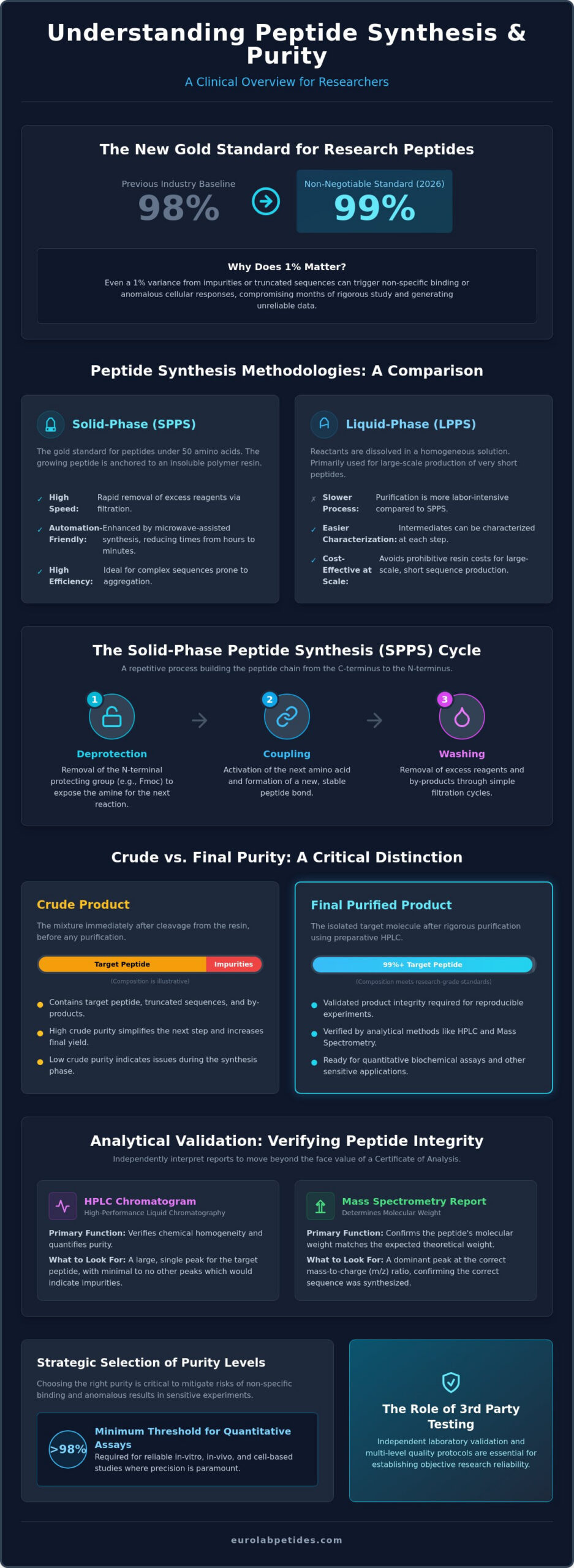
As of 2026, the industry baseline for research-grade peptide purity has shifted from 98% to a non-negotiable 99% standard. This elevation in quality benchmarks highlights why understanding peptide synthesis and purity is no longer a peripheral concern but a fundamental requirement for experimental reproducibility. You’re likely aware that even a 1% variance in trifluoroacetate (TFA) salts or truncated sequences can trigger non-specific binding or anomalous cellular responses, effectively compromising months of rigorous longitudinal study. Unreliable data is frequently generated when the nuances of the analytical validation process are overlooked.
This technical guide provides a clinical overview of modern Solid Phase Peptide Synthesis (SPPS) methodologies and the rigorous testing protocols required to ensure chemical integrity. A framework is established for the independent interpretation of HPLC and Mass Spectrometry reports, moving beyond the face value of a Certificate of Analysis. By the conclusion of this analysis, you’ll possess the specialized knowledge necessary to evaluate supplier metrics and select the precise purity levels required for your specific research stacks.
Key Takeaways
- Distinguish between heterogeneous and homogeneous synthesis environments to determine the optimal methodology for complex amino acid sequence assembly.
- Master the technical nuances of understanding peptide synthesis and purity by differentiating between crude post-cleavage yields and final validated product integrity.
- Develop the proficiency to independently interpret HPLC chromatograms and Mass Spectrometry reports to verify chemical homogeneity and molecular weight.
- Identify why quantitative biochemical assays require a minimum 98% purity threshold to mitigate the risks of non-specific binding and anomalous experimental results.
- Understand the critical role of independent third-party laboratory testing and multi-level quality protocols in establishing objective research reliability in Europe.
Solid-Phase vs. Liquid-Phase Peptide Synthesis (SPPS vs. LPPS)
The chemical assembly of amino acids into defined sequences is achieved through two primary methodologies: Solid-Phase Peptide Synthesis (SPPS) and Liquid-Phase Peptide Synthesis (LPPS). The distinction between these environments is critical for researchers focused on understanding peptide synthesis and purity. While LPPS occurs in a homogeneous solution where all reactants are dissolved, SPPS utilizes a heterogeneous environment. In this approach, the growing peptide chain is covalently anchored to an insoluble polymeric resin. This solid support allows for the rapid removal of excess reagents and by-products through simple filtration and washing cycles, which significantly enhances the speed of the process.
Current standards in 2026 confirm that SPPS remains the gold standard for synthesizing peptides containing fewer than 50 amino acids. The automation of this process has been further refined by microwave-assisted synthesis. This technology utilizes electromagnetic radiation to accelerate coupling and deprotection rates, effectively reducing reaction times from hours to minutes. These efficiency gains are vital for maintaining high crude purity in complex or “difficult” sequences that are prone to aggregation. Peptide synthesis precision is dictated by the chemical stability of the resin and the efficiency of the solvent system employed during each cycle.
The Mechanism of Solid-Phase Peptide Synthesis (SPPS)
The SPPS process follows a repetitive cycle designed to build the peptide chain from the C-terminus to the N-terminus. This cycle includes:
- Deprotection: Removal of the N-terminal protecting group.
- Coupling: Activation of the next amino acid and formation of the peptide bond.
- Washing: Removal of excess reagents and reaction by-products.
The Fmoc/tBu protection strategy serves as the primary method for ensuring regiospecificity by preventing side-chain reactions during the assembly phase. Final yields and purity levels are heavily influenced by resin loading density and the choice of solvents, such as dimethylformamide (DMF), which facilitate optimal resin swelling and reagent accessibility.
Liquid-Phase Peptide Synthesis (LPPS) and Hybrid Approaches
LPPS is predominantly utilized for the large-scale production of very short peptide sequences where the cost of resin becomes prohibitive. This method allows for easier characterization of intermediates at each step, though the purification process is more labor-intensive than the filtration used in SPPS. Hybrid approaches, specifically fragment condensation, combine these methodologies to build complex targets. Large peptide fragments are synthesized via SPPS and then joined in a liquid phase to create long-chain proteins. European manufacturing facilities are increasingly adopting “green” solvents like gamma-valerolactone (GVL) to replace traditional hazardous chemicals, aligning technical precision with sustainability standards. This evolution in methodology is a core component of understanding peptide synthesis and purity in modern laboratory settings.
Determinants of Crude Purity and Synthesis Yield
Crude purity represents the percentage of the target peptide within the mixture immediately following its cleavage from the resin. It’s distinct from the final purified product, which undergoes rigorous preparative HPLC to isolate the target molecule from truncated sequences and by-products. A fundamental component of understanding peptide synthesis and purity involves the distinction between these two metrics. High crude purity is desirable because it simplifies the subsequent purification steps and increases the overall synthesis yield. Low crude purity often indicates systemic issues during the assembly phase, such as steric hindrance or suboptimal coupling efficiency. Protecting group efficiency is paramount here; if the Fmoc or tBu groups don’t remain stable, unwanted side reactions will inevitably degrade the crude profile.
Sequence Complexity and ‘Difficult’ Peptides
Sequence-specific challenges often dictate the success of a synthesis run. Hydrophobic residues like Leucine, Valine, and Isoleucine frequently cause inter-chain aggregation through hydrogen bonding. This aggregation effectively buries the N-terminus, preventing the next amino acid from coupling and leading to amino acid deletions. Sequences containing Aspartic Acid followed by Glycine are particularly prone to aspartimide formation, a side reaction that alters the peptide backbone. Racemization, the conversion of L-amino acids to D-isomers, remains a technical risk during the activation of C-terminal residues. Synthesizing long-chain peptides beyond 30 residues requires specialized strategies, such as the use of pseudoproline building blocks, to disrupt secondary structures during assembly. For those prioritizing high-yield results, sourcing from a facility with proven tissue repair and recovery research standards is recommended.
Post-Synthesis Processing: Cleavage and Lyophilization
Following assembly, the peptide must be cleaved from the solid support. This is typically achieved using Trifluoroacetic Acid (TFA) cocktails. These mixtures contain scavenger molecules like triisopropylsilane (TIS) or ethanedithiol (EDT) to capture liberated carbocations, preventing them from re-attaching to sensitive residues like Cysteine or Tryptophan. Incomplete deprotection or deletions result in near-miss impurities that share similar hydrophobic profiles with the target, complicating the purification process. Final processing involves lyophilization, a freeze-drying technique that removes water and residual solvents through sublimation. This step is essential for the stability of lyophilized peptides, ensuring they remain chemically inert during transit and storage. Complete removal of TFA and scavengers is mandatory to prevent cytotoxicity in cellular assays.
Analytical Validation: Interpreting HPLC and Mass Spectrometry
A Certificate of Analysis (COA) isn’t merely a supplementary document; it’s a non-negotiable requirement for any rigorous research project. It serves as the primary empirical evidence of a batch’s chemical profile, providing the data necessary to account for impurities that might interfere with receptor-binding assays or metabolic studies. True proficiency in understanding peptide synthesis and purity requires a critical eye when reviewing these reports. The data presented must be batch-specific and include both chromatograms and mass spectra to ensure the material meets the 99% purity benchmark required in 2026.
High-Performance Liquid Chromatography (HPLC) Analysis
HPLC is the definitive method for measuring the chemical homogeneity of a peptide sample. This process relies on the interaction between the peptide and a stationary phase, typically a C18 column, under high pressure. The purity of a peptide is calculated using the ‘area under the curve’ (AUC) method, where the area of the target peak is expressed as a percentage of the total area of all detected peaks. This percentage represents the relative amount of the target molecule compared to all other UV-absorbing components in the sample.
A high-quality chromatogram features a single, sharp, and symmetrical peak with a clear baseline. Broad peaks or “shoulders” indicate the presence of closely related impurities, such as diastereomers or sequences with incomplete deprotection. Retention time is a critical metric that must align with the expected hydrophobic profile of the sequence. If multiple significant peaks appear, the batch fails to meet the standards for high-stakes research. Researchers must verify that the resolution between the main peak and any minor impurities is sufficient to justify the reported purity percentage.
Mass Spectrometry (MS) and Molecular Identification
While HPLC confirms the quantity of the target molecule, Mass Spectrometry (MS) validates its identity. MS measures the mass-to-charge ratio of the ionized peptide, allowing for the confirmation of the exact molecular weight. Electrospray Ionization (ESI-MS) and Matrix-Assisted Laser Desorption/Ionization Time-of-Flight (MALDI-TOF) are the two primary techniques used. ESI-MS is often preferred for its precision in analyzing larger, more complex molecules through the generation of multiple charge states.
Mass-shift analysis serves as a vital diagnostic tool for identifying specific contaminants. For instance, a mass increase of +16 Da typically signifies the oxidation of Methionine or Tryptophan residues. Conversely, a mass deficiency often points to truncated sequences where an amino acid wasn’t successfully coupled during the synthesis cycles. By cross-referencing MS data with the theoretical molecular weight, researchers ensure that no “near-miss” impurities remain in the final batch. This dual-verification protocol is the cornerstone of understanding peptide synthesis and purity for professional applications in biochemistry and analytical science.
Strategic Selection of Purity Levels for Research Applications
Selecting the appropriate purity level is a strategic decision that directly impacts the validity of experimental outcomes. While 95% purity may suffice for initial screening or antibody production, quantitative biochemical assays and signaling studies require a minimum threshold of 98%. In 2026, high-precision laboratories have adopted 99% as the baseline to eliminate variables associated with truncated sequences. Understanding peptide synthesis and purity involves recognizing that “purity” refers to the peptide content relative to other peptidic substances, but it doesn’t account for residual salts or moisture. Trifluoroacetate (TFA) salts, used in the cleavage process, can exhibit cellular toxicity if they aren’t properly exchanged for acetate or chloride. This is particularly critical in longevity research, where long-term cellular viability is the primary metric of success.
Purity Requirements for Cellular and Metabolic Studies
In metabolic research, the presence of trace impurities can significantly alter receptor-ligand binding affinity. Non-peptide contaminants or amino acid deletions can compete for receptor sites, leading to inaccurate calculations of potency or efficacy. For instance, studies involving ipamorelin require absolute chemical integrity to ensure that observed growth hormone secretagogue activity isn’t masked by inflammatory by-products. High-purity standards prevent the occurrence of false positives that often plague lower-grade batches. Ensuring that the chemical profile matches the theoretical model is the only way to guarantee that signaling data remains objective and reproducible.
The Impact of Impurities on Tissue Repair Models
Tissue repair models are exceptionally sensitive to the chemical environment. Residual solvents can inadvertently alter cellular proliferation rates, leading to skewed data in regenerative medicine. In bpc 157 research, the presence of truncated peptides can trigger unwanted inflammatory markers, confounding the assessment of the peptide’s actual properties. Batch-to-batch consistency is mandatory for longitudinal recovery studies. A variance of even 2% in purity can lead to statistically significant deviations in tissue healing outcomes across different experimental groups. Researchers must prioritize consistent, validated batches to ensure the integrity of their data sets. For high-precision requirements, exploring a specialized longevity research stack ensures that all components meet these rigorous analytical benchmarks.
EuroLab Peptides Quality Assurance: Third-Party Validation in Europe
Objective verification serves as the final safeguard in the analytical chain. While internal synthesis reports provide initial data, independent third-party laboratory testing is essential for establishing an unbiased baseline of chemical integrity. For researchers, understanding peptide synthesis and purity requires a transition from trusting manufacturer claims to verifying empirical results. EuroLab Peptides implements a multi-level quality protocol where every batch is subjected to external audits before distribution. This ensures that the reported 99% purity threshold is a verifiable metric rather than a theoretical projection. Transparency is maintained through the provision of comprehensive analytical data for every research lot, allowing users to account for every milligram of material.
Multi-Level Quality Control Protocol
Internal batch testing is conducted immediately post-lyophilization to confirm that the crude synthesis met the required specifications. Following this, samples are dispatched to independent European laboratories for comprehensive verification of purity, identity, and quantity. This process includes:
- Verification of Purity: Confirmation of chemical homogeneity via HPLC.
- Identity Validation: Exact molecular weight confirmation using Mass Spectrometry.
- Net Peptide Content (NPC): Measuring the actual peptide weight relative to residual water and counterions.
Strict adherence to regional standards for research-grade chemicals ensures that every lot remains compliant with the rigorous analytical benchmarks expected in 2026. This multi-stage verification eliminates the ambiguity often found in global supply chains.
European Standards and Laboratory Accountability
European sourcing offers distinct advantages in terms of regulatory oversight and logistical stability. The proximity of manufacturing facilities to high-precision analytical hubs allows for rapid, climate-controlled transport; this is critical for maintaining the stability of sensitive sequences. EuroLab Peptides utilizes localized logistics to mitigate the risks of degradation during transit. This clinical, proof-first approach is reinforced by the consistent application of European standards for laboratory accountability. It’s a system designed to instill absolute security in the professional user by prioritizing empirical data over anecdotal evidence. By maintaining a meticulous focus on regional manufacturing excellence, the brand provides the technical precision required for advanced inquiry in biochemistry and analytical science. This commitment to transparency is a core component of understanding peptide synthesis and purity in a professional research context.
Advancing Research Standards through Analytical Precision
The transition toward a 99% purity standard in 2026 necessitates a more rigorous approach to material validation. Researchers must move beyond surface-level metrics and prioritize the objective data provided by batch-specific HPLC and Mass Spectrometry. By distinguishing between crude yields and final verified homogeneity, scientific inquiry is protected from the confounding variables of truncated sequences and residual TFA salts. A comprehensive understanding peptide synthesis and purity is the prerequisite for ensuring that metabolic and signaling data remains reproducible across longitudinal studies.
Reliability in the chemical space is established through a multi-level quality control protocol and independent third-party laboratory verification. Utilizing European-based sourcing and logistics further ensures that the chemical integrity of sensitive research stacks is maintained from synthesis to delivery. These rigorous analytical benchmarks provide the security required for high-stakes professional inquiry. Explore the EuroLab Peptides Catalog of Third-Party Tested Research Peptides to secure validated tools for your upcoming experimental models. Precision in the laboratory begins with the verifiable excellence of the starting material.
Frequently Asked Questions
What is the difference between crude purity and final purity in peptide synthesis?
Crude purity refers to the chemical homogeneity of the peptide mixture immediately following its cleavage from the solid-phase resin. This mixture contains the target molecule alongside all synthesis by-products, truncated sequences, and protecting group fragments. Final purity is achieved through preparative HPLC, which isolates the target molecule from these impurities. Achieving high crude purity is essential because it facilitates more efficient final purification and increases the overall yield of the validated batch.
Why is 98% purity preferred over 95% for quantitative research?
A 98% purity threshold is required for quantitative biochemical assays to minimize the risk of non-specific binding and interference with receptor-ligand interactions. While 95% may be sufficient for initial screening or antibody production, signaling studies demand higher precision to ensure that observed metabolic effects are attributable solely to the target molecule. In 2026, many high-stakes laboratories have moved to a 99% baseline to eliminate experimental variables and ensure data reproducibility.
How do I read an HPLC chromatogram on a Certificate of Analysis?
Interpretation of an HPLC chromatogram involves analyzing the resolution and symmetry of the primary peak relative to the baseline. The purity percentage is calculated using the area under the curve (AUC) method, where the target peak’s area is divided by the total area of all detected peaks. A sharp, symmetrical peak indicates high chemical homogeneity. Conversely, shoulders or secondary peaks suggest the presence of closely related impurities or incomplete deprotection that could compromise experimental results.
Can residual TFA in peptides affect my in-vitro research results?
Residual trifluoroacetate (TFA) salts can induce significant cellular toxicity and alter the local pH of in-vitro environments. These salts are a byproduct of the cleavage process and must be exchanged for more biocompatible counterions, such as acetate or chloride, if the peptide is intended for sensitive cellular assays. High levels of residual TFA can lead to false positives or cell death, effectively compromising the integrity of longitudinal research models and signaling data.
What does mass spectrometry confirm that HPLC cannot?
Mass spectrometry confirms the molecular weight and identity of the peptide, whereas HPLC only measures its chemical homogeneity. While HPLC indicates how much of the target molecule is present, MS verifies that the molecule is actually the intended sequence. This distinction is critical for understanding peptide synthesis and purity because it identifies “near-miss” impurities, such as sequences with amino acid deletions, which might co-elute with the target in an HPLC column.
Why does EuroLab Peptides emphasize independent third-party testing?
Independent third-party testing is utilized to provide an objective, unbiased validation of every batch’s chemical profile. This secondary verification removes the inherent bias of internal manufacturer reporting and ensures that the material meets strict analytical benchmarks before distribution. By relying on external European laboratories, a transparent and verifiable record of quality is established. This process instills absolute security in the professional user regarding the reliability of their research materials.
How should high-purity peptides be stored to maintain their analytical profile?
High-purity peptides should be stored in a lyophilized state at -20°C or -80°C to prevent hydrolysis and oxidation. Vials must be kept in a desiccated environment and allowed to reach room temperature before opening to avoid condensation, which can degrade the peptide’s analytical profile. Once reconstituted in a sterile buffer, the resulting solution should be aliquoted and frozen to minimize the damage caused by repeated freeze-thaw cycles, which can lead to aggregation.
Is net peptide content the same as purity?
Net peptide content (NPC) is not the same as purity; it measures the actual percentage of peptide by weight relative to non-peptidic substances like residual salts and water. Purity refers only to the percentage of the target peptide relative to other peptidic impurities. For example, a sample with 99% purity might only have an 80% NPC. The remaining 20% of the mass consists of moisture and counterions like TFA or acetate, which must be accounted for during concentration calculations.
