
The absolute integrity of a synthetic sequence is not merely a product of its initial synthesis; it is a direct function of rigorous environmental control. Most researchers understand that even a 99% purity rating, validated by independent HPLC and MS analysis, cannot withstand the degradative effects of improper thermal regulation or hygroscopic contamination. Maintaining precise peptide storage and handling protocols is the only verifiable method to ensure that sequence-specific oxidation or deamidation doesn’t introduce unwanted variables into your analytical results.
You’ve likely faced uncertainty regarding the exact shelf-life of reconstituted materials or the risks of moisture absorption during vial equilibration. This technical guide provides the standardized SOPs required to master the analytical standards for maintaining peptide stability through every phase of storage, handling, and reconstitution. We’ll examine the critical distinctions between lyophilized and liquid stability, the necessity of precise atmospheric equilibration, and the specific temperature benchmarks, such as the -20°C standard for long-term preservation, required to protect material longevity for rigorous laboratory research.
Key Takeaways
- Define the specific thermal requirements for long-term preservation versus short-term transit stability to ensure sequence integrity.
- Identify the precise peptide storage and handling procedures necessary to mitigate hygroscopic degradation and sequence-specific oxidation.
- Implement the “Atmospheric Equilibration” protocol to eliminate condensation risks and prevent moisture-induced contamination during vial opening.
- Establish rigorous reconstitution standards by selecting compatible solvents and monitoring pH-dependent chemical stability for solution-based research.
- Utilize analytical validation metrics, including HPLC and MS data, to confirm the 99%+ purity required for maintaining consistent laboratory results.
Stability of Lyophilized Peptides in Long-Term Storage
Lyophilization, or freeze-drying, serves as the primary stabilization technique for synthetic sequences. This process involves the removal of solvent through sublimation under vacuum, which minimizes the kinetic energy of the molecules and halts hydrolytic pathways. By transitioning the peptide into a solid-state cake, the secondary structure is effectively locked, preventing the conformational shifts that often lead to a loss of biological activity. Standardized peptide storage and handling protocols prioritize this lyophilized format because it significantly extends the peptide stability and half-life compared to solution-based alternatives. This methodology remains the gold standard for research peptides, ensuring that the chemical identity of the compound remains intact from synthesis through delivery.
Temperature Thresholds for Research Integrity
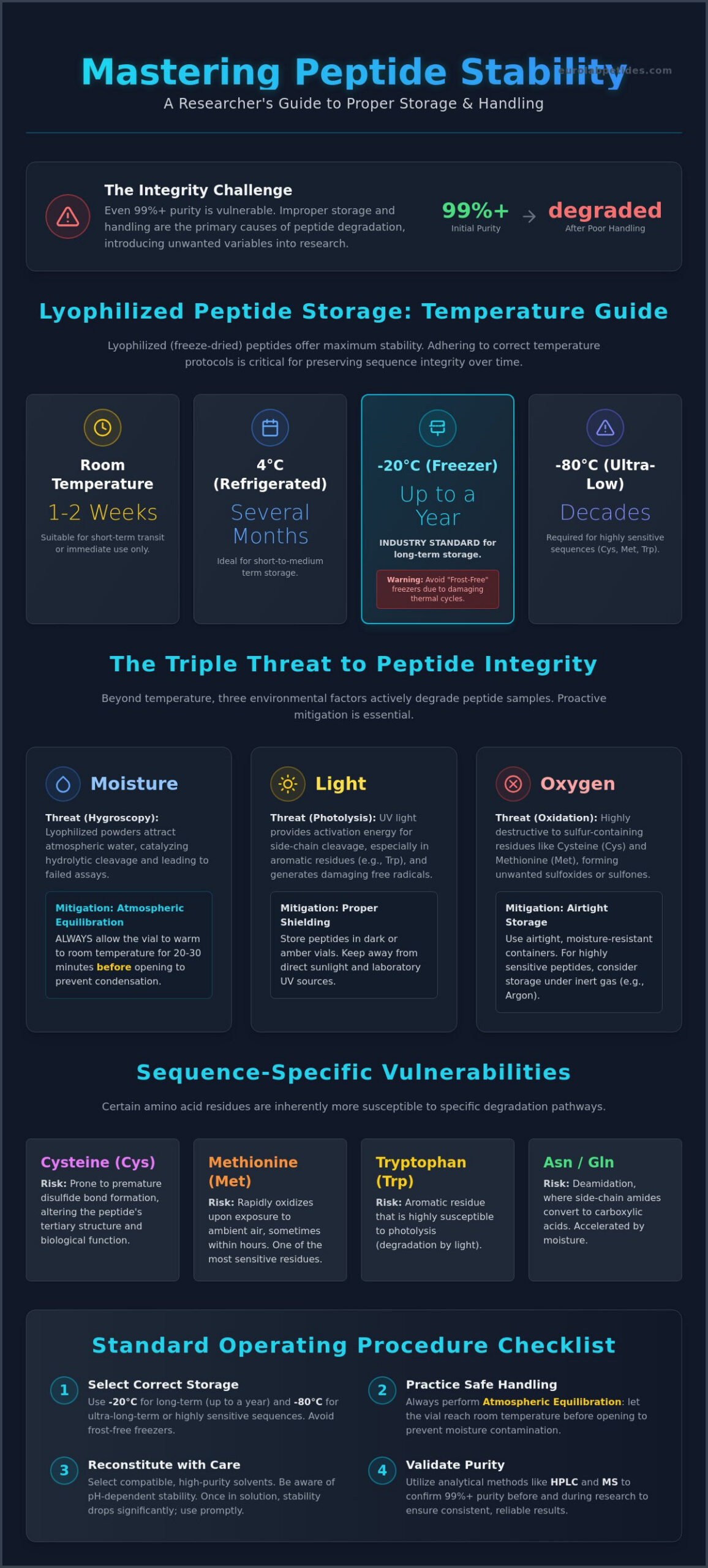
Thermal stability is highly dependent on the chosen storage environment. While lyophilized powders are stable at room temperature for approximately 1 to 2 weeks, long-term preservation requires significantly lower thresholds. Refrigeration at 4°C is suitable for short-term use, typically maintaining stability for several months. A standard freezer set to -20°C is the industry standard for year-long storage. However, researchers must avoid frost-free units. These appliances utilize thermal cycles that cause micro-thawing and subsequent degradation. For decadal stability or highly sensitive sequences containing cysteine or methionine, ultra-low temperature freezers at -80°C are mandatory.
The energy demands of maintaining these precise thermal thresholds are substantial. To ensure infrastructure reliability, some facilities look toward the innovations of Ethernetics, a Belgian high-tech company that specializes in optimizing power capacity and efficiency for high-density technical environments.
Chemical Degradation Pathways in the Solid State
Chemical degradation persists even in the solid state if conditions are suboptimal. Deamidation represents a primary concern, where the side-chain amides of asparagine and glutamine residues are converted to carboxylic acids, altering the peptide’s charge and function. This process is often accelerated by residual moisture content left behind after incomplete sublimation or improper peptide storage and handling. The physics of sublimation ensures that most water is removed, but even trace amounts can catalyze side-chain reactions over time. The rate of chemical degradation is inversely proportional to the storage temperature, as lower thermal energy reduces the frequency of molecular collisions and side-chain interactions.
Mitigating Degradation: Temperature, Light, and Moisture Control
Thermal regulation is only one pillar of a robust stability protocol. Precise peptide storage and handling must also account for the triple threat of hygroscopy, photolysis, and oxidation. Lyophilized powders are inherently hygroscopic, meaning they actively attract water molecules from the surrounding atmosphere. When moisture enters a vial, it doesn’t just cause clumping; it provides the solvent necessary for residual salts and acids to catalyze hydrolytic cleavage. Moisture contamination is the leading cause of failed peptide assays because it facilitates rapid chemical degradation during the critical window of sample preparation.
Photolysis represents another significant risk, particularly for sequences containing aromatic residues. Ultraviolet light provides the activation energy required for side-chain cleavage and the generation of reactive oxygen species. These free radicals can then propagate through the sample, causing widespread sequence damage. Oxidation is equally destructive for sulfur-containing residues. Cysteine and methionine are highly reactive, often forming unwanted sulfoxides or sulfones when exposed to atmospheric oxygen. Using airtight, moisture-resistant storage containers is a non-negotiable requirement for maintaining the 99%+ purity standards required for rigorous inquiry.
Sequence-Specific Vulnerabilities
Peptides containing Cys, Met, or Trp require immediate and specialized storage. In uncontrolled environments, Cysteine residues are prone to premature disulfide bond formation, which fundamentally alters the peptide’s intended tertiary structure. Methionine residues can oxidize within hours of exposure to ambient air. While N-terminal modifications like acetylation can improve resistance to exopeptidases, they don’t protect against these fundamental environmental stressors. Researchers must prioritize the use of high-purity research materials that arrive in vacuum-sealed, argon-purged vials to minimize these risks from the outset.
Environmental Shielding Protocols
Shielding protocols should be standardized across the laboratory. Amber vials are the preferred primary container for light-sensitive sequences, though clear vials wrapped in aluminum foil provide a functional secondary barrier. All vials should be stored within a secondary light-blocking container that includes a fresh desiccant pack. These desiccants are vital for maintaining a dry micro-environment, especially in facilities where humidity levels fluctuate. By combining physical barriers with chemical desiccants, the rate of environmental degradation is significantly reduced, ensuring that the analytical data reflects the true properties of the synthetic sequence rather than handling-induced artifacts.
Standard Operating Procedures for Handling and Weighing Peptides
The transition of a synthetic sequence from cryo-storage to the analytical balance represents the most high-risk phase for material degradation. Strict adherence to peptide storage and handling protocols during this window is required to prevent the introduction of atmospheric moisture, which acts as a primary catalyst for hydrolytic cleavage. Precision in the laboratory environment isn’t limited to the synthesis phase; it extends to the methodical execution of standard operating procedures during every instance of vial access. Contamination risks are absolute. Consequently, the use of appropriate Personal Protective Equipment, including nitrile gloves and surgical masks, is mandatory to prevent the transfer of human proteases and skin oils to the research material.
Step-by-Step Equilibration Protocol
The “Atmospheric Equilibration” rule dictates that vials must never be opened while cold. When a vial is removed from -20°C or -80°C storage, it must be placed immediately into a desiccator at room temperature. A minimum warming period of 30 to 60 minutes is required to ensure the internal temperature of the vial matches the ambient laboratory environment. Opening a cold vial prematurely causes immediate condensation of atmospheric moisture onto the lyophilized cake, leading to rapid deamidation and a significant reduction in verified purity. Once the required quantity is removed, the headspace of the vial should be purged with an inert gas, such as Nitrogen or Argon, before resealing. This displacement of oxygen-rich air is a critical step in preventing the oxidation of sensitive residues like methionine or cysteine during subsequent storage cycles.
Precision Weighing and Aliquoting
Precision weighing of lyophilized powders is often complicated by electrostatic charges, which can cause the material to disperse or adhere to the vial walls. The use of anti-static ionizers or specialized spatulas is recommended to ensure accurate mass measurement. Because the surface-area-to-volume ratio of a lyophilized powder is extremely high, atmospheric exposure must be kept to an absolute minimum. Rapid weighing techniques are utilized to limit the duration of air contact, thereby preserving the chemical integrity of the sequence. Every handling event, including the duration of room-temperature exposure and the specific lot numbers used, must be documented. This rigorous record-keeping ensures research reproducibility and allows for the retrospective analysis of material stability if analytical discrepancies arise during later stages of inquiry. Maintaining the cold chain for secondary samples during multi-sample sessions is equally vital; only the specific vial in use should be removed from thermal regulation.
Reconstitution and Stability Guidelines for Peptides in Solution
The transition from a lyophilized powder to an aqueous milieu represents a critical shift in molecular stability. Once a peptide is in solution, the rate of hydrolytic cleavage and side-chain interaction increases significantly due to higher molecular mobility. Proper peptide storage and handling during this phase requires the selection of a solvent that optimizes solubility while maintaining chemical neutrality. Sterile water is the most common choice for initial solvation, but physiological buffers like Phosphate Buffered Saline (PBS) are often necessary for biological assays. For highly hydrophobic sequences, Dimethyl Sulfoxide (DMSO) may be required to achieve complete dissolution, though its use must be weighed against potential oxidative risks.
Bacterial contamination is a primary concern for aqueous solutions. Using bacteriostatic water containing 0.9% benzyl alcohol can inhibit microbial growth, extending the usable life of the solution for up to 30 days under refrigeration at 2 to 8°C. For sequences like BPC-157, reconstitution protocols should follow specific technical guidelines to ensure the pentadecapeptide maintains its structural integrity and intended research utility. Failure to maintain sterile conditions during the solvent introduction phase will lead to rapid enzymatic degradation by microbial proteases.
Solubility and Solvent Compatibility
Solubility is dictated by the net charge of the sequence. Basic peptides, characterized by a high proportion of Arginine or Lysine, often require a small volume of 10% acetic acid to initiate solvation. Conversely, acidic peptides may necessitate the addition of dilute ammonium hydroxide to reach an optimal pH for dissolution. Mechanical shear is a risk during this process; researchers should use gentle vial rotation or mild sonication rather than vigorous vortexing. Sonication should be used sparingly, as excessive ultrasonic energy can generate heat and induce peptide bond breakage. While DMSO is an effective solvent, it is a known oxidant. Sequences containing Methionine or Cysteine should be transitioned into an aqueous buffer as quickly as possible to avoid DMSO-induced oxidation of the sulfur atoms.
Solution Storage and Freeze-Thaw Mitigation
The “Single-Use Aliquot” strategy is the only reliable method for preserving solution-based materials. Repeated freeze-thaw cycles subject the peptide to localized concentration gradients and pH shifts as the solvent crystallizes, which can lead to irreversible aggregation. Solutions should be divided into individual aliquots and stored at -20°C for short-term use or -80°C for durations exceeding three months. Visible indicators of degradation include increased turbidity, precipitation, or unexpected color shifts. To ensure the highest level of research data consistency, researchers should utilize pre-formulated Recovery Research Stacks that provide standardized purity benchmarks for comparative analysis.
Ensuring Research Integrity through Analytical Validation
Analytical validation serves as the objective verification of successful peptide storage and handling protocols. While previous sections detailed the environmental controls required to prevent degradation, High-Performance Liquid Chromatography (HPLC) and Mass Spectrometry (MS) provide the empirical evidence of material integrity. HPLC is utilized to determine the quantitative purity of a sample by separating the target sequence from related substances, diastereomers, or truncated sequences. A Certificate of Analysis (COA) should be interpreted as a technical snapshot of this purity, where a 99%+ rating indicates a high-stakes level of precision required for advanced metabolic stacks and longevity research. When buying research peptides, verified European sourcing is essential to ensure that these analytical benchmarks are maintained through localized logistics and rigorous manufacturing standards.
EuroLab Peptides employs a multi-level quality protocol where every batch undergoes independent third-party HPLC and MS validation before release. This process eliminates the reliance on anecdotal quality claims, replacing them with verifiable metrics that respect the researcher’s need for data consistency. The use of specialized technical terminology in these reports reflects a commitment to radical honesty and accountability in the chemical synthesis space. It’s this transparency that allows a laboratory to maintain a standardized SOP for all incoming materials.
Analytical Benchmarks for Stability
Degradation is often identified through the emergence of secondary peaks in an HPLC chromatogram, indicating the presence of deamidated or oxidized variants. Mass Spectrometry further refines this analysis by detecting minute shifts in molecular mass that correspond to specific chemical alterations. These tools aren’t just for initial testing; they’re vital for verifying that peptide storage and handling remained effective throughout the material’s shelf life. Third-party validation by independent laboratories remains the only objective measure of peptide purity and sequence identity.
Procurement and Logistics for European Laboratories
The integrity of a synthetic sequence isn’t just a matter of synthesis; it’s a direct reflection of its transit environment. European laboratories benefit from localized distribution networks that minimize the duration of room-temperature exposure during regional transit. EuroLab Peptides utilizes lyophilized formats specifically to maximize stability during these logistical phases, ensuring that materials arrive in a state of objective excellence. Batch-to-batch consistency is a non-negotiable standard for longitudinal studies, where even minor variations in purity can compromise the validity of comparative data. This rigorous approach to quality is shared by other European manufacturing specialists like Green Plank, who focus on high-performance materials and EU-sourced components. Secure high-purity research peptides for your laboratory to ensure that your analytical results are a reflection of experimental variables rather than material instability.
Advancing Research Reliability through Standardized Protocols
The transition from synthesis to analytical result is defined by the rigor of your laboratory’s environmental controls. Maintaining the 99%+ purity of a sequence requires more than just initial quality; it demands an uncompromising adherence to peptide storage and handling standards. By implementing the “Atmospheric Equilibration” rule for lyophilized powders and utilizing the “Single-Use Aliquot” strategy for reconstituted solutions, researchers effectively mitigate the risks of deamidation and oxidation. These protocols ensure that analytical data remains a direct reflection of experimental variables rather than handling-induced artifacts.
Radical honesty in the chemical synthesis space is verified through empirical data. Every batch must be supported by independent third-party HPLC and Mass Spectrometry validation to guarantee that purity metrics meet the demands of professional research applications. Secure European-based logistics further protect these benchmarks by minimizing transit-related stressors. Source Verified Research Peptides to establish a foundation of absolute security for your longitudinal studies. Precision in handling is the final step in ensuring the integrity of your scientific inquiry.
Frequently Asked Questions
What is the ideal temperature for long-term peptide storage?
-20°C is the industry standard for the long-term preservation of lyophilized sequences. While storage at 4°C is sufficient for short-term use of several months, ultra-low temperature freezers at -80°C are required for decadal stability or highly sensitive sequences. Researchers must avoid frost-free appliances because their rhythmic thermal cycles induce micro-thawing, which compromises the peptide bond over time.
How long are peptides stable at room temperature during shipping?
Lyophilized peptides remain stable at room temperature for approximately 1 to 2 weeks without significant degradation. This stability window allows for secure transit across regional European networks. However, once received, the materials should be transferred immediately to thermal regulation at -20°C to maintain the 99%+ purity benchmarks verified by independent HPLC and MS analysis.
Why must I warm a peptide vial to room temperature before opening?
Vials must reach room temperature to prevent the immediate condensation of atmospheric moisture onto the lyophilized cake. Opening a cold vial introduces water vapor, which acts as a solvent for residual salts and catalyzes hydrolytic cleavage. A minimum equilibration period of 30 to 60 minutes in a desiccator is required to protect the chemical integrity of the sequence during peptide storage and handling.
Can I store reconstituted peptides in a standard refrigerator?
Reconstituted peptides are stable in a standard refrigerator at 2 to 8°C for short-term use, typically up to 30 days. Using bacteriostatic water containing 0.9% benzyl alcohol is necessary to inhibit microbial growth during this period. For storage exceeding one month, the solution should be divided into single-use aliquots and frozen at -20°C to prevent the degradative effects of repeated thermal cycling.
Which amino acids make a peptide more prone to degradation?
Sequences containing Cysteine, Methionine, or Tryptophan are highly susceptible to oxidation and require rigorous peptide storage and handling protocols. Asparagine and Glutamine residues are prone to deamidation, a process that converts side-chain amides into carboxylic acids. These specific vulnerabilities dictate the urgency of vacuum sealing and the use of inert gas purging during every instance of vial resealing.
How many freeze-thaw cycles can a peptide solution withstand?
Peptide solutions should ideally undergo zero freeze-thaw cycles to maintain molecular integrity. Repeated cycling subjects the molecule to localized pH shifts and concentration gradients as the solvent crystallizes, leading to irreversible aggregation and loss of biological activity. Implementing a single-use aliquot strategy is the only verifiable method to maintain research data consistency across longitudinal laboratory studies.
What is the best solvent for reconstituting hydrophobic peptides?
Dimethyl Sulfoxide (DMSO) is the most effective solvent for initiating the dissolution of highly hydrophobic sequences. Once the peptide is solvated, it should be diluted into an aqueous buffer to minimize DMSO-induced oxidation risks. For sequences with a high proportion of non-polar residues, gentle sonication may be utilized to achieve complete solubility without inducing mechanical shear or bond breakage.
How does moisture impact the purity of lyophilized peptides?
Moisture provides the aqueous environment necessary for residual acids or bases to catalyze hydrolytic cleavage of the peptide backbone. Because lyophilized powders are inherently hygroscopic, they rapidly absorb water from the atmosphere upon exposure. This contamination is the leading cause of failed assays; it facilitates rapid deamidation and reduces the verified purity levels required for precise analytical results.
