

In the 2026 research environment, a peptide’s certificate of analysis is not a courtesy. It is the only objective metric of its chemical integrity. Many investigators have experienced the frustration of batch-to-batch inconsistency and the degradation risks inherent in cross-border transit from non-EU sources. You require a procurement strategy that prioritizes absolute precision over marketing hyperbole. This technical resource establishes a framework for evaluating analytical standards and sourcing logistics among providers of europepeptides. The implications of the June 2026 EMA guidelines on synthesis purity and the necessity of independent HPLC and MS validation are examined. Following the 2026 Operation Pangea XVIII enforcement actions, the distinction between verified laboratory standards and the grey market has never been more critical. This guide provides the data required to secure a stable, EU-based partner for consistent, high-purity laboratory procurement. Detailed analysis is provided regarding the 98% purity benchmark and the logistical advantages of localized, REACH-compliant supply chains. It’s essential to utilize a proof-first methodology when selecting a synthesis partner to ensure the validity of your metabolic studies.
Key Takeaways
- Establish a 98% purity benchmark by requiring batch-specific HPLC and Mass Spectrometry data for every analytical reagent procurement.
- Leverage the logistical advantages of europepeptides providers to ensure cold-chain stability and rapid transit within the EU single market.
- Assess the utility of specialized Research Stacks for longevity and metabolic studies to improve laboratory efficiency and protocol consistency.
- Navigate the 2026 regulatory environment by prioritizing REACH-compliant suppliers who adhere to the latest EMA guidelines for synthetic peptides.
- Validate chemical integrity through a multi-level quality protocol that combines internal synthesis oversight with independent third-party verification.
The Evolving Landscape of European Peptide Synthesis
The European research chemical market in 2026 is defined by a significant transition toward stringent analytical accountability. This shift is driven largely by the implementation of the new EMA guideline on the development and manufacture of synthetic peptides, which became effective on June 1, 2026. While these guidelines specifically target medicinal products, their influence has established a new baseline for excellence within the research-only sector. Investigators now prioritize The Evolving Landscape of European Peptide Synthesis to ensure that in-vitro and in-vivo models aren’t compromised by batch-to-batch inconsistency. This evolution marks the end of reliance on anecdotal quality. Instead, the procurement of europepeptides now requires verifiable, empirical data as a non-negotiable metric for laboratory excellence. Precision is the priority.
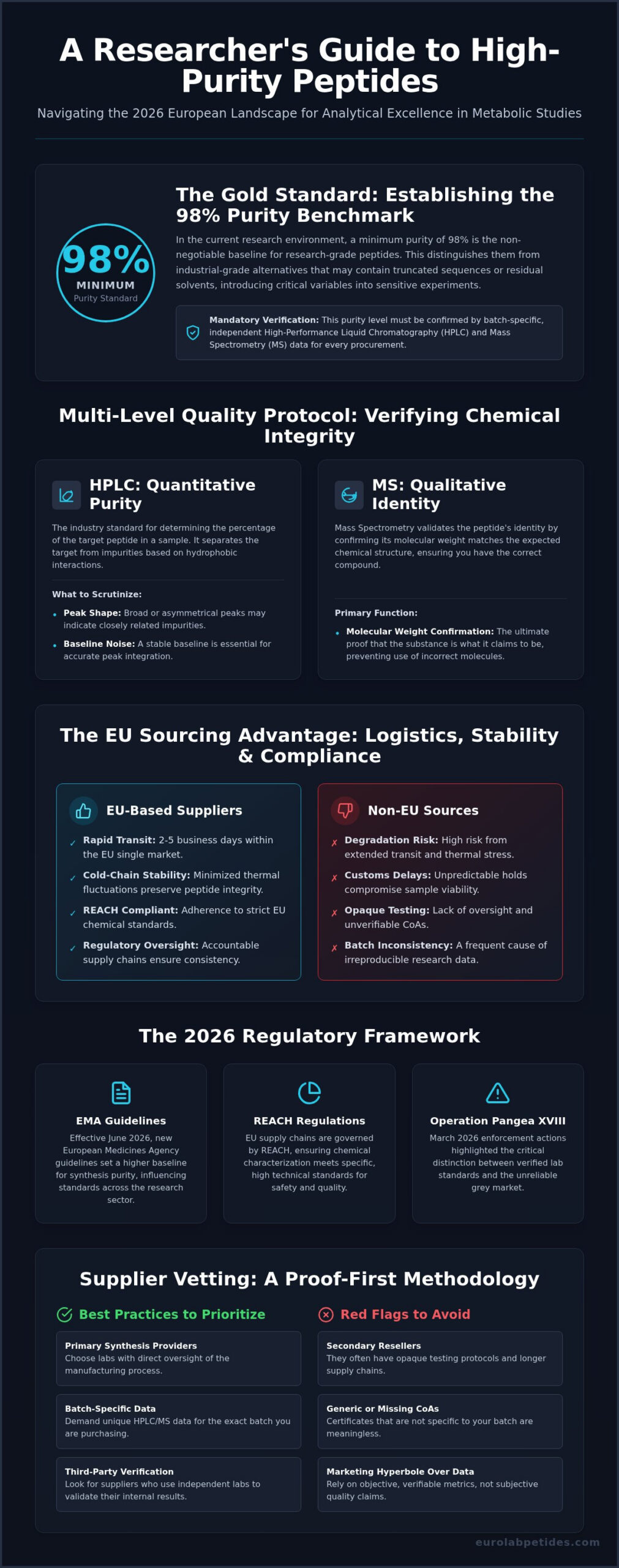
Research-grade synthesis is distinguished from industrial-grade alternatives by a minimum purity threshold of 98% as determined by High-Performance Liquid Chromatography (HPLC). Industrial-grade synthesis often lacks the rigorous purification steps necessary to remove truncated sequences or residual solvents, which can introduce significant variables into complex metabolic studies. By sourcing within the EU, researchers access supply chains governed by REACH regulations, ensuring that chemical characterization meets specific technical standards. Shifting away from non-EU suppliers has become a priority for critical studies to avoid the degradation risks and customs delays that characterize international transit.
The Rise of Analytical Rigor in EU Labs
The transition from subjective supplier trust to verifiable data-driven sourcing is now a standard requirement in European laboratories. Certificates of Analysis (CoA) are no longer viewed as static documents but as dynamic proofs of chemical identity. Standardized expectations now include batch-specific HPLC and Mass Spectrometry (MS) data. This rigor is reinforced by regional regulatory frameworks that restrict the circulation of sub-standard substances, particularly following the large-scale seizures of illicit materials during Operation Pangea XVIII in March 2026. Labs that prioritize these standards ensure that their research data remains reproducible and scientifically sound.
Identifying Validated Research Suppliers
A critical distinction must be made between primary synthesis providers of europepeptides and secondary resellers. Resellers often lack direct oversight of the manufacturing process, leading to opaque testing protocols and increased degradation risks during extended transit. Red flags in supplier documentation include the absence of batch-specific numerical data or the use of generic, non-verifiable HPLC chromatograms. Regional manufacturing within the EU ensures that peptide integrity is maintained through localized logistics, typically resulting in transit times of 2 to 5 business days. This proximity minimizes the thermal fluctuations that often plague international shipments, ensuring that lyophilized products arrive with their secondary structures intact.
Evaluating Analytical Standards: HPLC and MS Verification
Analytical verification remains the primary safeguard against the batch-to-batch inconsistency that frequently compromises metabolic research. While a high purity percentage is often cited in marketing materials, researchers must distinguish between quantitative purity and qualitative identity. High-Performance Liquid Chromatography (HPLC) is the industry standard for determining the percentage of the target peptide within a sample. However, 98% purity as reported by one facility may not be equivalent to 98% from another if the detection parameters, such as wavelength or column temperature, are not standardized. For providers of europepeptides, the inclusion of raw chromatogram data is essential to verify that the baseline is stable and that secondary peaks are properly integrated.
HPLC: More Than Just a Purity Percentage
The interpretation of an HPLC report requires an examination of the peak shape and the baseline noise level. A broad or asymmetrical peak often indicates the presence of closely related impurities, such as diastereomers or truncated sequences, which can interfere with receptor binding affinity. HPLC identifies degradation products by separating the target peptide from related substances based on their differential hydrophobic interactions with the stationary phase. In 2026, the reliance on independent third-party validation has become a non-negotiable standard to ensure that internal manufacturer data is not biased. This external oversight provides a necessary layer of security for laboratories conducting high-stakes longitudinal studies.
Identity Confirmation via LC-MS
While HPLC measures how much of a substance is present, Mass Spectrometry (MS) confirms exactly what that substance is. Without MS data, a researcher cannot be certain that the synthesized sequence matches the intended molecular design. Liquid Chromatography-Mass Spectrometry (LC-MS) provides a definitive molecular weight by measuring the mass-to-charge (m/z) ratio of the ionized peptide. This process is critical for HPLC and MS Verification because it detects incorrect amino acid sequences or cross-contamination that HPLC alone might miss. Effective identity confirmation ensures that the research objective is not derailed by the use of an incorrect chemical analog.
The shift toward rigorous analytical standards is reflected in the multi-level quality protocols utilized by elite suppliers. Every batch must be accompanied by a specific MS report that aligns with the theoretical mass of the peptide. If the observed mass deviates by even a small fraction of a Dalton, the batch is rejected to maintain the integrity of the supply chain. This level of scrutiny is particularly important for europepeptides intended for complex in-vitro models where chemical precision is paramount. Researchers seeking to streamline their procurement should prioritize partners who provide these verifiable analytical standards as a standard component of every order. This proof-first approach eliminates the variables associated with opaque testing protocols and ensures that laboratory resources are directed toward valid scientific inquiry.
Sourcing Framework: Individual Peptides vs. Research Stacks
Analyzing the distinction between isolated catalog peptides and integrated research stacks is fundamental for protocol design. Individual peptides allow for the granular investigation of specific biochemical pathways, ensuring that observed results are attributable to a single molecular structure. Conversely, the emergence of ‘Research Stacks’ addresses the need for complex metabolic and longevity models where synergistic effects are the primary focus. For laboratories sourcing europepeptides, the decision often centers on the balance between isolation and systemic modeling. While individual vials offer maximum flexibility, standardized stacks improve reproducibility by providing consistent ratios for multi-peptide titration.
Cost-effectiveness in multi-peptide studies is often realized through the procurement of specialized stacks rather than individual catalog items. This approach reduces shipping overhead and administrative processing while ensuring that all components share the same batch-specific analytical pedigree. Stability remains a primary concern. Lyophilized vials are the standard for long-term storage; however, researchers must evaluate whether pre-mixed configurations maintain the 98% purity benchmark over time. It’s essential to verify that each component in a stack has undergone the same rigorous HPLC and MS verification described in previous sections.
Longevity and Metabolic Research Models
Sourcing for longevity research frequently involves compounds like Epitalon and GHK-Cu. Understanding what are peptides in the context of telomere biology or collagen synthesis requires high-purity standards to avoid confounding metabolic data. In weight management research, substances such as SLU-PP-332 and Tesofensine are utilized to investigate mitochondrial biogenesis and appetite regulation. Evaluating purity requirements for these metabolic pathway investigations is critical. Utilizing a Longevity Research Stack or Advanced Metabolic Stack can improve reproducibility by providing standardized ratios of these components in a single procurement cycle. This minimizes the variables introduced by sourcing individual reagents from disparate batches.
Tissue Repair and Recovery Investigation
Recovery models often utilize pentadecapeptide standards, specifically BPC-157, to study angiogenesis and soft tissue healing. While BPC-157 is effective in isolation, cellular repair studies frequently compare its efficacy against or alongside TB-500. A Recovery Research Stack or Muscle Research Stack provides a controlled framework for observing these interactions. Selection criteria for these stacks must prioritize the stability of individual lyophilized vials within the kit. This methodical approach to sourcing europepeptides ensures that tissue repair research remains cost-effective without sacrificing the precision of the underlying scientific inquiry. By maintaining a focus on verifiable data, researchers can secure a stable supply chain for complex recovery models.
Logistics, Stability, and Regulatory Compliance in the EU
Transit within the European single market eliminates the unpredictability of customs-related delays and secondary inspections. For researchers sourcing europepeptides, this logistical efficiency is a primary determinant of chemical stability. While lyophilized peptides are engineered for resilience, prolonged exposure to thermal extremes during international transit can induce primary sequence degradation or secondary structure alterations. Vacuum sealing and moisture-resistant packaging are implemented as standardized barriers against hygroscopic degradation. Mitigating risks during the last mile of delivery requires a localized supply chain that minimizes time spent in non-climate-controlled courier hubs, ensuring that transit times remain within the 2 to 5 business day window typical for EU hubs.
Peptide Stability and Reconstitution
Lyophilized peptides must be stored at -20°C or -80°C to maintain maximum long-term stability. Temperature fluctuations during the European summer or winter cycles can compromise the integrity of the peptide bonds if the reagents are not properly insulated. Upon receipt of a shipment, laboratory personnel should immediately verify the integrity of the vacuum seal and transfer the vials to stabilized cold storage. Reconstitution protocols must be followed with high-purity solvents to ensure that the analytical standards established during synthesis are preserved during the experimental phase. Maintaining a consistent cold-chain is essential for the reproducibility of in-vitro models.
Compliance and Institutional Procurement
Institutional procurement requires adherence to specific safety and ethical documentation. European law maintains a clear legal distinction for substances labeled Not for Human Consumption, positioning them strictly within the framework of laboratory research under REACH regulations. These frameworks ensure that suppliers maintain comprehensive safety data sheets (SDS) and adhere to chemical characterization standards. Streamlining the buy research peptides process involves selecting partners who provide localized logistics and transparent regulatory documentation. This approach ensures that institutional ethics committees receive the verifiable data required for project approval without the complications of international import declarations.
The integration of localized logistics with rigorous stability testing provides a baseline for research excellence. Laboratories that prioritize these parameters reduce the variables associated with reagent degradation and regulatory non-compliance. To secure a supply chain characterized by localized logistical precision and multi-level quality control, laboratories may evaluate the EuroLab procurement protocol. Adopting a proof-first logistics strategy ensures that the analytical integrity of europepeptides is maintained from the point of synthesis to the final laboratory titration.
EuroLab Peptides: A Protocol for Analytical Excellence
EuroLab Peptides operates through a Multi-Level Quality Protocol designed to eliminate the uncertainties of the global chemical market. This framework integrates primary synthesis oversight with mandatory, independent third-party verification for every batch. Precision is mandatory. By maintaining this dual-layer validation, the integrity of europepeptides is secured against the purity fluctuations that often derail longitudinal research. The protocol ensures that every vial meets the 98% purity threshold as determined by standardized HPLC methodologies. This commitment to analytical excellence supports European scientific discovery by providing reagents that adhere to the most rigorous quality metrics available in 2026. It’s a standard that respects the intelligence of the specialized community.
The offerings are categorized by research objective, ranging from specialized individual compounds like SLU-PP-332 to integrated models such as the Cognitive Research Stack and the Longevity Research Stack. These stacks are engineered to facilitate complex investigations into metabolic pathways and cellular health. By centralizing procurement through a verified EU-based supplier, laboratories mitigate the risks associated with international logistics and opaque testing protocols. The focus remains strictly on in-vitro research and laboratory development. This ensures that all documentation aligns with REACH and institutional ethics requirements without the ambiguity found in non-EU supply chains. Every shipment is treated as a high-stakes delivery of critical scientific tools.
The EuroLab Quality Benchmark
In 2026, EuroLab maintains chromatography standards where the signal-to-noise ratio and peak integration parameters are calibrated to detect impurities at the 0.01% threshold. This high-resolution analysis is essential for identifying truncated sequences that might otherwise pass through less rigorous screening. Batch-specific HPLC and Mass Spectrometry data are provided to institutional researchers as a standard component of the Certificate of Analysis (CoA). This transparency allows investigators to verify the molecular weight and purity of their reagents before initiating experimental protocols. Radical honesty in analytical reporting is maintained to instill absolute security in the professional user. No anecdotal evidence is permitted.
Next Steps for Laboratory Procurement
Evaluating the current inventory of high-purity research peptides is the first step toward stabilizing a laboratory’s supply chain. EuroLab provides specialized options like the Muscle Research Stack and the Recovery Research Stack to accommodate diverse study designs in tissue repair and inflammation. If a specialized study requires specific synthesis parameters or unique peptide ratios, technical support is available to discuss complex requirements. Sourcing europepeptides through a localized, REACH-compliant partner ensures that research excellence isn’t compromised by logistical or analytical variables. It’s the most efficient route to verifiable results. Laboratories can initiate the procurement process by reviewing the analytical data associated with the current Advanced Metabolic Stack or other specialized research models.
Advancing Scientific Integrity Through Analytical Precision
The selection of a synthesis partner in 2026 is a decision that directly influences the validity of experimental outcomes. Research excellence depends on the systematic elimination of chemical variables, requiring a shift from subjective trust to verifiable data. By prioritizing providers of europepeptides that offer independent third-party laboratory testing for every batch, investigators secure the high-purity reagents necessary for reproducible results. Analytical integrity is maintained through a proof-first methodology that utilizes batch-specific HPLC and MS reports as the primary metric of success. The integration of specialized research stacks further optimizes laboratory procurement by ensuring consistent titration ratios across complex longevity and metabolic models. Localized EU logistics remain the most effective safeguard against the thermal degradation and regulatory delays associated with international transit. EuroLab Peptides maintains a multi-level quality control protocol to ensure that every sequence meets the rigorous demands of the scientific community. Secure high-purity reagents for your next study at EuroLab Peptides and proceed with the absolute security that your data is built on a foundation of chemical precision.
Frequently Asked Questions
What are the primary differences between European and non-EU peptide suppliers?
European suppliers provide a significant logistical advantage through the EU single market, resulting in transit times typically ranging from 2 to 5 business days. This localized supply chain minimizes the thermal exposure and degradation risks associated with international shipping from non-EU sources. Additionally, providers of europepeptides operate under REACH regulations, ensuring that chemical characterization and safety documentation meet specific regional laboratory standards. Non-EU shipments often face unpredictable customs delays and secondary inspections that can compromise the stability of lyophilized reagents.
How do I verify the authenticity of a third-party HPLC report?
Authenticity is verified by contacting the independent testing facility to cross-reference the report’s reference number with their internal database. A valid report must include raw chromatogram data featuring integrated peaks and a stable baseline rather than a simple summary percentage. Researchers should also ensure the timestamp on the report aligns with the production date of the specific batch. EuroLab utilizes a multi-level quality protocol where these third-party laboratory results are mandatory for every procurement cycle to ensure absolute transparency.
What is the shelf life of lyophilized peptides when stored at -20°C?
Lyophilized peptides generally maintain chemical stability for 24 to 48 months when kept in a stable -20°C environment. For maximum long-term integrity, storage at -80°C is preferred, which can extend stability beyond 5 years. It’s essential to minimize freeze-thaw cycles and ensure that vials remain vacuum-sealed to prevent moisture ingress. Once the peptide is reconstituted into a liquid state, the stability period decreases significantly, typically requiring use within several weeks under refrigerated conditions to avoid sequence degradation.
Are research peptides in Europe subject to the same regulations as pharmaceuticals?
No, research-use-only peptides in the EU are governed by REACH regulations for chemical substances rather than the stringent EMA frameworks reserved for medicinal products. While the June 2026 EMA guidelines established new standards for synthetic peptides intended for human use, laboratory reagents are legally classified as “Not for Human Consumption.” This distinction allows for their distribution within the scientific community for in-vitro and non-clinical development, provided that institutional safety and ethics protocols are strictly maintained.
What is the significance of TFA counter-ions in catalog peptides?
TFA counter-ions are residues from the purification process used to stabilize the peptide’s secondary structure and ensure solubility. While standard for most catalog reagents, TFA can exhibit cytotoxic effects in specific sensitive in-vitro models or cellular assays. Researchers conducting high-precision metabolic studies should evaluate whether their protocol requires acetate or HCl salt exchange to remove these residues. EuroLab provides specialized research stacks where counter-ion considerations are integrated into the synthesis design to ensure compatibility with diverse experimental objectives.
How does temperature during transit affect the purity of lyophilized peptides?
Temperature fluctuations during transit can induce chemical degradation, such as deamidation or oxidation, which effectively lowers the quantitative purity of the sample. Although lyophilized peptides are more resilient than liquid formulations, exposure to temperatures above 30°C for extended periods can alter binding affinity. Sourcing europepeptides through localized cold-chain logistics mitigates these risks by ensuring that the reagents remain within a controlled thermal window throughout the delivery process, protecting the integrity of the secondary structure.
Why is LC-MS identity testing as important as HPLC purity testing?
HPLC determines the percentage of the target molecule relative to impurities, but it cannot differentiate between two molecules with the same retention time. LC-MS identity testing provides the definitive molecular weight by measuring the mass-to-charge ratio, ensuring the synthesized sequence matches the research objective exactly. Without MS data, a laboratory cannot be certain they aren’t working with a chemical analog or an incorrect sequence, even if the HPLC purity appears high. Identity confirmation is the only safeguard against synthesis errors.
Can I request batch-specific Certificates of Analysis before purchase?
Reputable suppliers provide batch-specific Certificates of Analysis (CoA) upon request to ensure transparency before the commitment to purchase. These documents include the raw HPLC and MS data necessary to confirm that the specific lot meets the 98% purity benchmark. EuroLab prioritizes radical honesty by making this empirical data accessible to institutional researchers as a standard procedure. This transparency allows for the alignment of reagent quality with the specific demands of complex metabolic or longevity study designs before procurement is finalized.
