

The May 2026 reporting of TRIUMPH-1 topline results, which documented a 28.3% mean weight reduction in specific research models, has recalibrated the benchmarks for metabolic study outcomes. You understand that moving beyond dual-agonist frameworks introduces significant complexity, particularly when balancing the thermogenic effects of glucagon receptor activation. Investigating retatrutide peptide research applications necessitates a precise understanding of triple-agonist synergy to ensure data integrity. Many researchers find that inconsistent peptide purity and a lack of granular data on receptor binding affinities hinder the reproducibility of their metabolic and endocrine models.
This article delivers a rigorous scientific analysis of retatrutide’s triple-mechanism, focusing on the specific biochemical advantages of its GIP, GLP-1, and glucagon receptor integration. We’ll outline a standardized laboratory protocol for handling lyophilized materials, including stability metrics and reconstitution parameters that align with the June 2026 EMA guidelines. This technical preview into advanced metabolic research will help you establish a reliable methodology and identify high-purity European sources for your laboratory requirements.
Key Takeaways
- Analyze the triple-agonist mechanism involving GIP, GLP-1, and glucagon receptors to understand its functional divergence from earlier single and dual-agonist incretin mimetics.
- Identify retatrutide peptide research applications within metabolic and endocrine models, specifically regarding cellular potency assays and energy expenditure markers.
- Establish standardized laboratory protocols for the reconstitution and storage of lyophilized material to maintain molecular stability and ensure experimental reproducibility.
- Verify product integrity through multi-level quality control metrics, utilizing HPLC and Mass Spectrometry to confirm a minimum purity threshold of 99%.
- Navigate the European procurement landscape by identifying suppliers that provide lot-matched documentation and adhere to the 2026 EMA guidelines for synthetic peptides.
The Evolution of Metabolic Research: Understanding Retatrutide
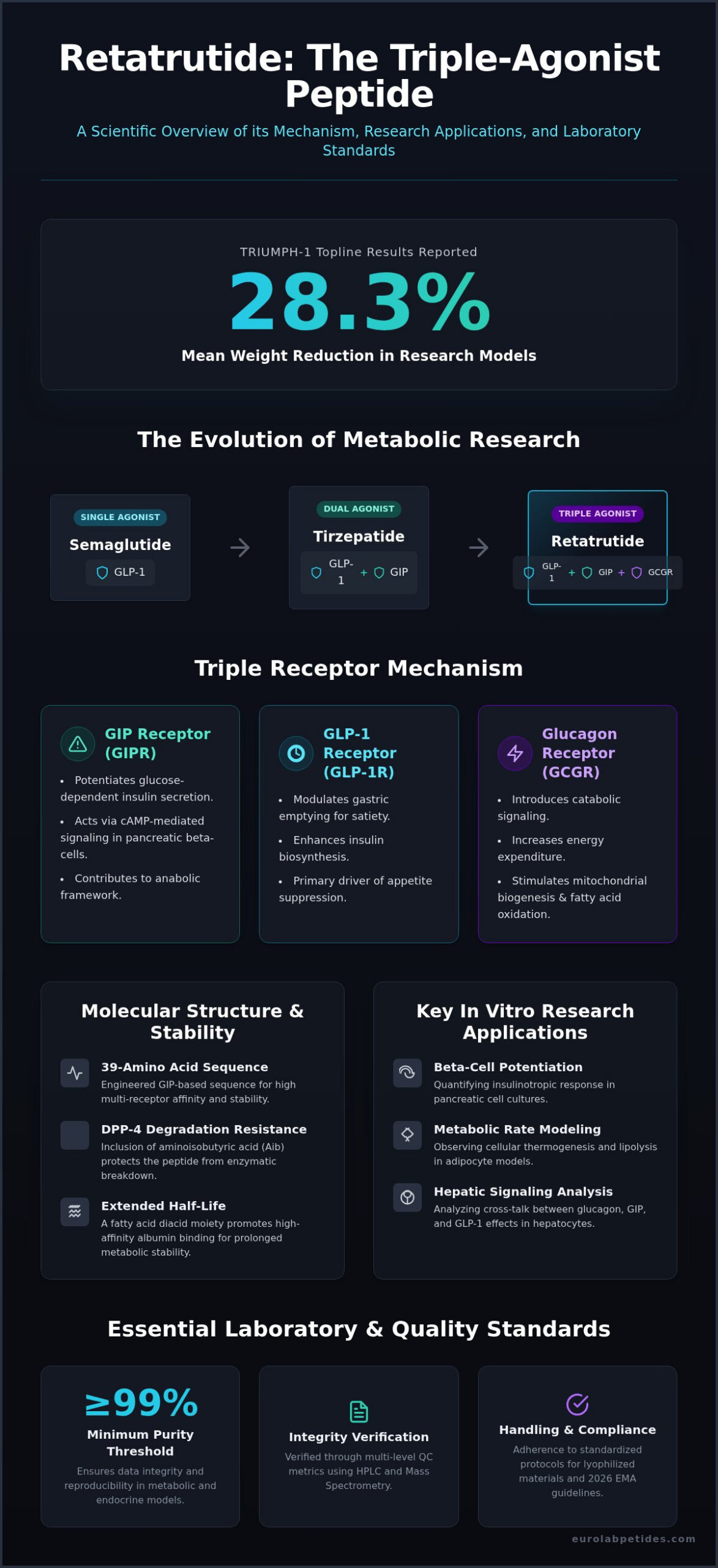
Retatrutide represents a significant technical advancement in the study of metabolic syndromes and obesity-related signaling pathways. Its development follows the iterative progress of incretin-based research, where Semaglutide served as a benchmark for GLP-1 receptor (GLP-1R) isolation and Tirzepatide introduced the synergistic effects of dual GLP-1R/GIPR agonism. Retatrutide is a unimolecular triple agonist targeting GIP, GLP-1, and GCGR. This integration of the glucagon receptor (GCGR) into the established GIP/GLP-1 framework allows for a more nuanced examination of energy balance and glucose homeostasis. The scope of retatrutide peptide research applications centers on how these three distinct pathways converge to influence metabolic rate and lipid oxidation.
The Structural Composition of the Molecule
The peptide is characterized by its 39-amino acid sequence, which is engineered for high stability and multi-receptor affinity. Its architecture is fundamentally based on the GIP sequence, but it incorporates specific modifications to accommodate GLP-1R and GCGR binding. For instance, the inclusion of aminoisobutyric acid (Aib) at specific positions protects the peptide from dipeptidyl peptidase-4 (DPP-4) degradation. Additionally, the molecule features a fatty acid diacid moiety attached via a linker. This modification is crucial for research because it promotes high-affinity albumin binding, thereby extending the peptide’s metabolic stability. This prolonged half-life is a prerequisite for complex in vitro models that require sustained receptor occupancy to observe downstream signaling cascades.
In Vitro Research Objectives
Researchers utilize the triple-agonist profile to conduct high-stakes precision analysis across several endocrine systems. These studies typically focus on the following parameters:
- Beta-Cell Potentiation: Quantifying the insulinotropic response in pancreatic cell cultures under varying glucose concentrations.
- Metabolic Rate Modeling: Observing changes in cellular thermogenesis and lipolysis within adipocyte models, specifically looking for GCGR-driven increases in energy expenditure.
- Hepatic Signaling: Analyzing the cross-talk between glucagon-induced gluconeogenesis and the counter-regulatory effects of GIP and GLP-1 activation in hepatocytes.
These retatrutide peptide research applications allow for the verification of binding affinities across all three receptors within a single experimental setup. The ability to analyze these interactions simultaneously reduces the statistical noise often found in multi-peptide studies, providing a more reliable metric for endocrine signaling research.
Biochemical Mechanisms: Analyzing Triple Agonism at GIP, GLP-1, and Glucagon Receptors
Retatrutide’s biochemical profile is defined by its high-affinity binding to three distinct G-protein coupled receptors (GPCRs). While traditional models rely on GLP-1R or dual GLP-1R/GIPR pathways, this molecule incorporates the glucagon receptor (GCGR) to create a more comprehensive metabolic stimulus. The GIPR interaction is central to potentiating glucose-dependent insulin secretion, acting through cAMP-mediated signaling within the pancreatic beta cells. Simultaneously, the GLP-1R pathway modulates gastric emptying models and enhances insulin biosynthesis. This dual-pathway foundation is significantly altered by the addition of GCGR agonism, which introduces catabolic signaling to the anabolic framework of the incretins. The resulting metabolic profile targets weight reduction through both appetite suppression and increased energy expenditure.
Glucagon Receptor (GCGR) Synergy
Targeting the glucagon receptor provides a technical solution for researchers investigating energy expenditure and lipid metabolism. In laboratory models, GCGR activation stimulates mitochondrial biogenesis, effectively increasing the metabolic capacity of the cell. This synergy is particularly evident in skeletal muscle cultures, where triple agonism promotes accelerated fatty acid oxidation compared to dual-agonist controls. For laboratories conducting retatrutide peptide research applications, the presence of GCGR signaling allows for the observation of thermogenic effects that are absent in GLP-1/GIP models. Data suggests that this triple-receptor engagement leads to a more pronounced reduction in lipid accumulation within hepatic models. Establishing these benchmarks requires research-grade materials that maintain precise binding ratios across all three targets to ensure data reproducibility. It’s critical to verify these ratios during the initial phase of any study.
Signal Transduction Pathways
The intracellular response to retatrutide is characterized by a robust induction of cAMP across the GIP, GLP-1, and glucagon receptors. This elevation in second messenger concentration triggers downstream cascades, including the MAPK and PI3K signaling pathways, which regulate cell survival and glucose transport. The efficacy of these retatrutide peptide research applications depends on “balanced agonism.” This refers to the specific potency ratio engineered into the peptide sequence, designed to harness the weight-modulating benefits of glucagon without inducing the excessive hepatic glucose output typically associated with pure GCGR agonists. Researchers don’t ignore the PI3K pathway, as its activation is monitored to evaluate its role in insulin sensitivity improvements. Quantifying these signal transduction markers provides a verifiable metric for assessing the molecule’s metabolic impact in in-vitro systems. This balanced approach ensures that the catabolic signals from the glucagon receptor don’t overwhelm the insulinotropic signals from the GIP and GLP-1 receptors.
Comparative Analysis: Retatrutide vs. Traditional Incretin Mimetics
Semaglutide serves as the primary mono-agonist control in many retatrutide peptide research applications. While Semaglutide targets the GLP-1 receptor exclusively to modulate appetite and insulin secretion, Retatrutide’s triple-agonist profile provides a broader signaling footprint. In cellular potency assays, the integration of GIP and glucagon receptor (GCGR) engagement allows for a more complex simulation of metabolic homeostasis. This shift is essential for researchers who need to move beyond simple gastric emptying models to investigate systemic energy expenditure. To establish a technical baseline for these biochemical structures, researchers often consult our guide on What Are Peptides? before initiating comparative studies.
Efficacy Profiles in Metabolic Modeling
In lipid reduction assays, Retatrutide demonstrates a distinct efficacy profile that diverges from Tirzepatide. While Tirzepatide utilizes a dual GLP-1R/GIPR agonism, Retatrutide features a GIP-dominant backbone specifically engineered for high-affinity triple engagement. The addition of the glucagon receptor agonist component acts as the primary driver for increased mitochondrial activity and lipid oxidation in hepatic models. This makes it a superior tool for studying Metabolic Dysfunction-Associated Steatotic Liver Disease (MASLD) in vitro. In these specific research environments, the reduction in intrahepatic triglycerides often exceeds the results documented in dual-agonist controls. Retatrutide is currently the focus of an Advanced Metabolic Stack because it addresses energy expenditure gaps that previous mimetics could not bridge.
Research Application Divergence
The choice between Tirzepatide and Retatrutide in a protocol depends on the specific signaling pathways under investigation. Tirzepatide remains a reliable control for studying incretin-driven insulinotropic effects without the thermogenic variables introduced by glucagon. Conversely, retatrutide peptide research applications are prioritized when the study targets metabolic rate or cellular vitality. While glucagon activation carries a theoretical risk of hyperglycemia, the balanced potency ratio in the Retatrutide sequence is designed to mitigate this in most laboratory settings. For researchers examining systemic recovery or tissue repair alongside metabolic shifts, comparing these results with other specialized sequences in our BPC-157 Technical Guide provides a broader context for multi-peptide research. This comparative approach ensures that the data reflects the full spectrum of triple-agonist synergy rather than isolated receptor responses.
Laboratory Standards: Reconstitution, Stability, and Handling
The integrity of experimental data in metabolic studies depends entirely on the chemical purity of the reagents employed. For retatrutide peptide research applications, a purity threshold of ≥99% is the established laboratory standard. This metric is verified through High-Performance Liquid Chromatography (HPLC) for purity quantification and Mass Spectrometry (MS) for sequence identity confirmation. A lot-matched Certificate of Analysis (COA) serves as the primary document of external validation; it provides the necessary empirical evidence that the peptide sequence is correct and free from synthesis byproducts. Without these benchmarks, the triple-agonist synergy cannot be accurately measured, as impurities may interfere with receptor binding affinities or induce unintended cellular responses.
Reconstitution Protocol for Researchers
When preparing the peptide for in-vitro assays, precision is paramount. Always allow the vial to reach room temperature before reconstitution to prevent condensation, which can lead to peptide degradation. The following protocol is recommended for maintaining molecular integrity:
- Diluent Selection: Bacteriostatic water (0.9% benzyl alcohol) is typically preferred for its antimicrobial properties in multi-assay environments, although sterile saline may be used for specific short-term protocols.
- Concentration Calculation: Determine the required volume of diluent based on the total milligram content of the vial to ensure precise laboratory dosing across multiple experimental wells.
- Diluent Introduction: Introduce the liquid slowly against the glass wall of the vial using a sterile syringe to minimize agitation.
- Dissolution: Rotate the vial gently until the lyophilized powder is completely dissolved.
Researchers don’t shake the vial, as high mechanical stress causes peptide shearing. This shearing leads to the denaturation of the 39-amino acid structure, rendering the triple-agonist mechanism ineffective and compromising the validity of the research model.
Stability and Storage Guidelines
Storage conditions directly influence the longevity of the molecule. Lyophilized Retatrutide should be stored at -20°C for long-term stability, though -80°C is optimal for extended archival. Once reconstituted, the solution is sensitive to both temperature and light. It should be stored at 2-8°C and is generally stable for 28 to 30 days. To maintain experimental consistency, the solution should be aliquoted into single-use volumes immediately after reconstitution. This practice eliminates the risks associated with repeated freeze-thaw cycles, which compromise the structural integrity of the peptide. For laboratories requiring verified materials, you can source high-purity retatrutide that meets these rigorous analytical standards.
Procurement and Quality Assurance in Europe
The sourcing of high-purity materials for retatrutide peptide research applications in Europe requires strict adherence to the June 1, 2026, EMA guidelines regarding the manufacture of synthetic peptides. These standards establish rigorous thresholds for impurity reporting (at >0.1%) and qualification (at >1.0%), which are essential for maintaining the integrity of metabolic research models. Unverified suppliers frequently bypass these requirements, resulting in vials that contain synthesis byproducts, truncated sequences, or incorrect peptide concentrations. Such inconsistencies introduce significant variables into laboratory assays, potentially invalidating longitudinal data. For a comprehensive analysis of procurement standards, researchers should refer to the 2026 Guide to Buying Research Peptides.
EuroLab Peptides’ Multi-Level Quality Protocol
EuroLab Peptides utilizes a dual-stage verification framework to ensure absolute chemical precision. Every batch is subjected to initial in-house analysis before being submitted to an independent third-party laboratory for final validation. This multi-level protocol guarantees that every vial is accompanied by a lot-matched Certificate of Analysis (COA), confirming a purity level of at least 99%. By maintaining regional manufacturing and logistical operations within Europe, regulatory compliance is consistently verified. This localized infrastructure also provides a critical advantage for cold-chain integrity; transit times are minimized to prevent the thermal degradation of the lyophilized 39-amino acid structure during shipping.
Ensuring Analytical Rigor
Analytical rigor is maintained through the combined application of High-Performance Liquid Chromatography (HPLC) and Mass Spectrometry (MS). In a standard HPLC chromatogram for Retatrutide, a single, dominant peak must be observed at the specific retention time, with secondary peaks remaining below the 0.1% reporting threshold. Mass Spectrometry is then employed to confirm the exact molecular weight, ensuring the peptide backbone and fatty acid diacid moiety are correctly synthesized. These metrics provide the empirical evidence required for reproducible retatrutide peptide research applications. Explore the EuroLab Peptides catalog for high-purity Retatrutide and metabolic research stacks.
Advancing Metabolic Research Benchmarks
The integration of glucagon receptor agonism into the GIP/GLP-1 framework marks a technical shift in endocrine modeling. This triple-receptor synergy allows for the simultaneous investigation of appetite suppression and thermogenic energy expenditure within a single unimolecular structure. As you develop your laboratory protocols, maintaining the structural integrity of the 39-amino acid sequence through precise reconstitution and storage remains the primary variable for data validity. The expansion of retatrutide peptide research applications in 2026 underscores the necessity for rigorous analytical standards and verified chemical reagents in every metabolic study.
EuroLab Peptides supports these requirements through a multi-level quality protocol, providing lot-matched Certificates of Analysis and independent third-party validation for every vial. Our European-based logistics ensure that your research materials arrive with their molecular stability intact, meeting a minimum purity threshold of 99% through HPLC and mass spectrometry verification. You can Secure High-Purity Retatrutide for Your Research Protocol and ensure your next study is built on a foundation of verifiable precision.
Frequently Asked Questions
What is the primary difference between Retatrutide and Tirzepatide in research?
Retatrutide functions as a triple agonist targeting GIPR, GLP-1R, and GCGR, whereas Tirzepatide is limited to dual GLP-1R/GIPR agonism. The inclusion of the glucagon receptor (GCGR) allows researchers to study catabolic pathways and lipid oxidation not present in dual-agonist models. This distinction is critical for studies targeting metabolic rate and mitochondrial biogenesis. Researchers use this molecule to observe the synergy of three distinct pathways within a single, highly stable unimolecular structure.
Is Retatrutide for sale for human use?
No, Retatrutide is not for sale for human or veterinary use under any circumstances. It’s sold strictly as a research chemical for in-vitro laboratory development and scientific inquiry. EuroLab Peptides doesn’t provide pharmaceuticals, medicines, or medical advice. Any application of this peptide must be confined to controlled laboratory environments. This ensures compliance with regional regulations and maintains the high-stakes precision required by the specialized research community the brand serves.
How should Retatrutide be stored to maintain its 39-amino acid integrity?
Lyophilized Retatrutide requires storage at -20°C for long-term stability, though -80°C is the optimal benchmark for maintaining the 39-amino acid sequence. Once the peptide is reconstituted, it should be kept at 2-8°C and used within a 30-day window. Protecting the vial from light exposure is also necessary to prevent photodegradation. Aliquoting the solution immediately after reconstitution prevents the mechanical stress associated with repeated freeze-thaw cycles that can compromise structural integrity.
What is the recommended diluent for Retatrutide reconstitution in a lab setting?
Bacteriostatic water, containing 0.9% benzyl alcohol, is the standard diluent for most retatrutide peptide research applications. The preservative properties of bacteriostatic water inhibit microbial growth during multi-day assays. While sterile saline is an alternative for short-term protocols, it lacks the antimicrobial protection required for extended studies. The diluent should be introduced slowly against the vial wall to avoid shearing the delicate peptide structure, which could lead to molecular denaturation and experimental failure.
How does the glucagon receptor agonism affect energy expenditure in models?
Glucagon receptor (GCGR) agonism stimulates mitochondrial biogenesis and increases cellular thermogenesis. In metabolic research models, this activation promotes the oxidation of fatty acids, particularly within hepatic and skeletal muscle cultures. This catabolic signaling works in tandem with the insulinotropic effects of GIP and GLP-1. Researchers prioritize this triple-agonist profile when the study objective is to quantify shifts in systemic energy balance that dual-agonist controls can’t replicate in isolation within a single model.
What purity level is required for Retatrutide in in-vitro research?
A minimum purity threshold of 99% is required for reproducible in-vitro research results. High-purity reagents ensure that the observed receptor binding affinities are a direct result of the peptide sequence rather than synthesis byproducts. EuroLab Peptides utilizes HPLC and mass spectrometry to verify this metric for every batch. Using lower-purity materials introduces unquantifiable variables that can invalidate the longitudinal data of complex metabolic modeling, compromising the integrity and reliability of the study.
Can Retatrutide be used in combination with other peptides in a research stack?
Retatrutide is frequently integrated into an Advanced Metabolic Stack to examine the interactions between triple-agonist signaling and other endocrine pathways. These retatrutide peptide research applications allow researchers to study cross-talk between multiple receptor systems, including longevity-focused sequences. Every component in a research stack must meet the same 99% purity standards to ensure the accuracy of the resulting data. This systemic approach provides a more comprehensive view of cellular vitality and metabolic markers.
Why is third-party testing critical for triple-agonist peptides?
Third-party testing provides an objective, external validation of the peptide’s chemical identity and purity. For a complex triple agonist, independent analysis via HPLC and mass spectrometry is the only way to confirm the correct 39-amino acid sequence and binding ratios. EuroLab Peptides provides a lot-matched Certificate of Analysis (COA) to establish this transparency. This verification process eliminates the risks associated with incorrect sequences or varying concentrations that are often found with unverified or non-compliant suppliers.
