

Why does a specific structural modification at the Aib8 position dictate the entire metabolic trajectory of a GLP-1 receptor agonist? For scientists investigating incretin mimetics, the biochemical integrity of semaglutide for research remains the primary variable in achieving reproducible data. It’s well understood that even minor deviations in peptide sequence or secondary structure can lead to rapid proteolytic degradation by dipeptidyl peptidase-4. This technical profile addresses the critical need for absolute molecular precision, moving beyond surface-level observations to analyze the engineered resilience of the C18 fatty acid side chain.
You likely recognize that maintaining stability during transport and ensuring high-concentration solubility are persistent challenges in the laboratory environment. This article provides a rigorous scientific overview of semaglutide’s molecular architecture and its specific metabolic signaling mechanisms. We’ll examine the DPP-4 resistance mechanism in detail, establish standardized handling protocols for in-vitro applications, and outline the metrics for identifying third-party verified, research-grade compounds. The following analysis serves as a definitive resource for establishing high-stakes precision in metabolic research.
Key Takeaways
- Analyze the molecular engineering behind the Aib8 substitution and C18 fatty acid side chain to understand the metabolic stability of semaglutide for research.
- Identify the intracellular signaling cascades, specifically the adenylyl cyclase pathway, initiated by high-affinity GLP-1 receptor activation.
- Evaluate the preclinical evidence supporting the peptide’s neuroprotective and anti-inflammatory potential in specialized laboratory models.
- Master standardized reconstitution and storage protocols using sterile diluents to maintain biochemical integrity and ensure data reproducibility.
- Learn to interpret third-party HPLC and MS analytical reports to verify the ≥99% purity standards required for rigorous scientific inquiry.
The Biochemistry of Semaglutide: Engineered Structural Stability
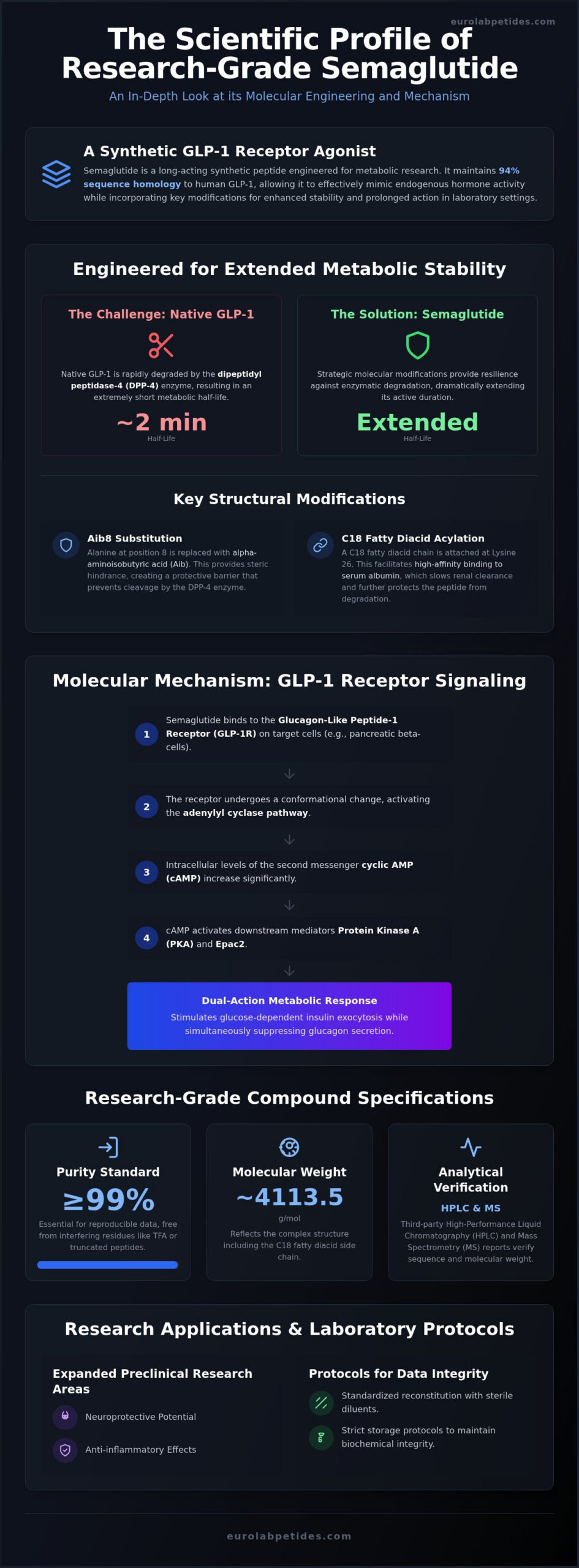
Semaglutide is a long-acting synthetic peptide designed for metabolic and incretin signaling research. As a synthetic GLP-1 receptor agonist (GLP-1RA), it maintains a 94% sequence homology to human GLP-1. This high degree of similarity ensures that the peptide effectively mimics endogenous ligand-receptor interactions while incorporating specific modifications to overcome the inherent limitations of the native hormone. Utilizing semaglutide for research allows for a more sustained analysis of incretin pathways due to its engineered resilience against rapid metabolic degradation.
The peptide’s architecture is defined by three primary modifications that distinguish it from endogenous GLP-1. First, the substitution of Alanine with alpha-aminoisobutyric acid (Aib) at position 8 serves as a protective barrier. Second, the attachment of a C18 fatty diacid chain via a linker at Lysine 26 facilitates high-affinity albumin binding. When examining semaglutide’s history and development, it becomes clear that these synthetic refinements were specifically engineered to transition from unstable, short-lived molecules to a robust tool for long-term laboratory observation.
DPP-4 Resistance and Half-Life Extension
The primary vulnerability of native GLP-1 is its immediate susceptibility to dipeptidyl peptidase-4 (DPP-4), an enzyme that cleaves the peptide at the N-terminal. The Aib substitution at position 8 provides steric hindrance that prevents this enzymatic cleavage. In laboratory models, this modification dramatically extends the peptide’s metabolic stability. While the native hormone typically exhibits a half-life of approximately 2 minutes, semaglutide remains active for a significantly longer duration. This extended plasma residence time, frequently observed in animal studies, provides a stable baseline for researchers investigating chronic metabolic signaling without the need for constant re-administration.
Molecular Weight and Synthetic Purity Standards
The structural complexity of the molecule results in a molecular weight of approximately 4113.5 g/mol. The inclusion of the C18 fatty diacid chain is the critical factor in its albumin-binding capacity, which further slows renal clearance and protects the peptide from degradation. Because these modifications are precise, verifying the biochemical integrity of the compound is a non-negotiable step in the research process. High-Performance Liquid Chromatography (HPLC) is employed to verify the correct amino acid sequence, while Mass Spectrometry (MS) confirms the molecular weight matches the theoretical profile.
Achieving a purity standard of ≥99% is essential for ensuring that in-vitro results aren’t compromised by residual trifluoroacetic acid (TFA) or truncated peptide sequences. For investigators seeking a broader technical foundation on these molecules, our comprehensive guide to peptides details the fundamental biochemical properties that govern modern peptide synthesis and quality control. Maintaining these rigorous standards ensures that data remains reproducible across different laboratory environments and experimental batches.
Molecular Mechanism: GLP-1 Receptor Interaction and Signaling
Semaglutide functions as a potent agonist for the Glucagon-Like Peptide-1 Receptor (GLP-1R), facilitating a highly specific interaction that mimics endogenous incretin activity. This G protein-coupled receptor is primarily localized in pancreatic beta-cells, the gastrointestinal tract, and specific regions of the central nervous system. Upon binding, the receptor undergoes a conformational change that activates the adenylyl cyclase pathway. This activation results in a measurable increase in intracellular cyclic AMP (cAMP), which serves as the primary second messenger for downstream signaling cascades. Investigators utilize semaglutide for research to observe the suppression of glucagon secretion within laboratory environments, providing a dual-action mechanism for glucose homeostasis studies.
Intracellular Signaling Cascades
The elevation of cAMP activates two primary downstream mediators: Protein Kinase A (PKA) and Exchange Protein directly Activated by cAMP 2 (Epac2). These proteins are essential for the exocytosis of insulin-containing vesicles, a process that is strictly glucose-dependent in pancreatic beta-cell models. In cellular research, semaglutide modulates calcium ion influx by facilitating the closure of ATP-sensitive potassium channels, which leads to membrane depolarization and the subsequent opening of voltage-gated calcium channels. Semaglutide acts as a biased agonist in certain GLP-1R conformational models, potentially favoring G-protein signaling over beta-arrestin recruitment, which may contribute to its prolonged signaling efficacy and reduced receptor internalization.
Metabolic Pathway Regulation
The physiological impact of semaglutide extends to the regulation of gastric emptying rates, as demonstrated in various preclinical rodent models. By slowing the transit of nutrients through the gastrointestinal tract, the peptide alters the postprandial glucose curve and influences nutrient absorption kinetics. This mechanism is a focal point in weight management research, where the interplay between satiety signals and metabolic rate is quantified in a controlled setting.
Central nervous system (CNS) signaling also plays a significant role in appetite regulation research. The peptide interacts with the hypothalamus and hindbrain, specifically targeting POMC/CART neurons to increase satiety and reduce reward-based feeding behaviors. Recent preclinical semaglutide research suggests that these interactions may have implications beyond simple metabolic control, potentially influencing neuroprotective pathways in aging models. For laboratories investigating these complex systems, sourcing high-purity research peptides from verified European suppliers is vital for maintaining the integrity of the signaling data.
Preclinical Research Landscapes: Beyond Metabolic Studies
While initial investigations focused on glycemic control, the scope of semaglutide for research has expanded into diverse preclinical landscapes. Modern studies examine the peptide’s pleiotropic effects, particularly its influence on systemic inflammation and cellular longevity. These investigations often utilize in-vitro models to quantify the reduction of proinflammatory cytokines, such as IL-6 and TNF-alpha, providing a foundation for understanding the compound’s broad regulatory potential. The objective is to determine if these anti-inflammatory properties are a direct result of GLP-1R activation or secondary to metabolic stabilization. Researchers prioritize high-purity analogs to ensure that observed cytokine modulation isn’t skewed by synthetic impurities.
Neuroprotective Signaling in Research
In preclinical studies, semaglutide demonstrates the ability to cross the blood-brain barrier, interacting directly with neuronal GLP-1 receptors. This interaction appears to modulate synaptic plasticity and enhance mitochondrial function within neuronal cell lines by promoting mitophagic clearance. Researchers observing Alzheimer’s and Parkinson’s models have noted a correlation between GLP-1R activation and a reduction in proteotoxic stress. Such findings are central to current cognitive function research, identifying molecular targets that preserve neural architecture against degenerative stimuli.
Cardiovascular and Anti-Inflammatory Models
The cardiovascular implications of GLP-1R agonists are currently analyzed through the lens of atherosclerotic plaque stability. In modified mouse models, semaglutide administration is associated with the modulation of endothelial function and a decrease in oxidative stress markers. This profile is often compared with other GLP-1 analogs to determine relative efficacy in stabilizing arterial walls. Quantitative analysis of vascular cell adhesion molecule-1 (VCAM-1) expression provides an empirical metric for these anti-atherogenic effects in laboratory environments.
Beyond isolated signaling, investigators are exploring potential synergy in recovery models. For instance, the combined application of semaglutide and BPC-157 is a subject of interest in tissue repair and systemic recovery research. This multi-peptide approach aims to leverage the metabolic efficiency of GLP-1 analogs alongside the angiogenic and cytoprotective properties of the pentadecapeptide. Such studies require high-purity compounds to ensure that observed interactions aren’t the result of cross-contamination or degraded sequences. Utilizing semaglutide for research in these complex stacks necessitates a rigorous adherence to analytical verification to maintain the integrity of the data set.
Laboratory Protocols: Reconstitution, Stability, and Storage
Handling semaglutide for research requires strict adherence to standardized laboratory protocols to ensure the validity of experimental outcomes. The compound is typically supplied as a lyophilized powder, a state achieved through vacuum-desiccation that maximizes biochemical integrity during global transit. This process preserves the C18 fatty diacid chain and the specific Aib8 substitution previously analyzed. Without this stabilization, the peptide is highly susceptible to hydrolysis and premature enzymatic breakdown before it ever reaches the laboratory environment. Maintaining a controlled environment from delivery to reconstitution is a non-negotiable requirement for high-stakes precision.
The choice of diluent is dictated by the intended duration and nature of the study. Bacteriostatic Water, which contains 0.9% Benzyl Alcohol, is the preferred solvent for maintaining sterility over multiple sampling events. If a study requires the absolute absence of preservatives to avoid interference with cellular signaling, sterile 0.9% sodium chloride may be substituted, provided the reconstituted solution is used immediately. Using non-sterile or inappropriate solvents can lead to peptide aggregation or chemical degradation, rendering the resulting research data unreliable and non-reproducible.
Step-by-Step Reconstitution Protocol
Calculating the precise diluent volume is essential for achieving the required molar concentrations for specific cellular assays. The ‘slow-drip’ method is the industry standard for introducing the solvent into the vial. By directing the stream along the glass wall rather than directly onto the lyophilized cake, the researcher avoids physical impact that can lead to peptide shearing. Vigorous agitation must be avoided to prevent air-interface denaturation of the peptide. A gentle, circular swirling motion is sufficient to achieve a homogenous, clear solution without compromising the delicate molecular structure of the agonist.
Storage and Degradation Prevention
Temperature control is the most significant factor in preventing peptide degradation over time. Long-term stability is best maintained by storing the lyophilized powder at -20°C, where it remains viable for up to 24 months. For short-term laboratory use, storage at 4°C is acceptable for several weeks, provided the vial remains sealed against moisture ingress. Reconstituted solutions are far more fragile and should be refrigerated at 2-8°C for limited durations. Exposure to UV light and temperature fluctuations must be minimized to prevent the oxidation of amino acid residues. To maintain these high standards of experimental precision, researchers can order third-party verified semaglutide from our European logistics hub.
Sourcing Research-Grade Semaglutide in Europe
Sourcing semaglutide for research requires a rigorous evaluation of chemical purity and molecular identity. For data to be considered reproducible in a professional laboratory setting, the compound must achieve a verified purity level of ≥99%. Lower grades often contain residual solvents, truncated peptide sequences, or counter-ions that can interfere with delicate in-vitro signaling assays. EuroLab Peptides addresses these risks through a multi-level quality control protocol that utilizes third-party validation for every production batch. This data-driven approach ensures that the molecular resilience of the Aib8 substitution and the C18 side chain remains intact throughout the synthesis process.
Interpreting analytical reports is a critical skill for the modern investigator. High-Performance Liquid Chromatography (HPLC) provides a quantitative measure of purity by separating the target peptide from related substances; a single, sharp peak indicates a high degree of chemical homogeneity. Mass Spectrometry (MS) serves as the definitive tool for identity verification, ensuring the measured molecular weight aligns with the theoretical 4113.5 g/mol profile of the semaglutide molecule. Without these specific data points, the biochemical identity of the research tool remains an unverified variable that could compromise the integrity of metabolic signaling studies.
Evaluating Quality Assurance Metrics
Before any laboratory use, lot-matched Certificates of Analysis (COA) must be reviewed to confirm that the specific batch meets the required specifications. These documents represent a verifiable metric of quality, providing empirical evidence of synthetic excellence rather than relying on anecdotal claims. In the European Union, the ‘Research Use Only’ (RUO) designation is a standard classification for chemicals intended strictly for in-vitro research and laboratory development. Investigators should consult our 2026 Guide to Purity and Sourcing for a comprehensive breakdown of procurement standards and analytical benchmarks.
Logistics and Compliance for European Labs
The logistical challenges of importing research chemicals from outside the continent often introduce significant risks to peptide stability. Long transit times and unpredictable customs delays can expose temperature-sensitive lyophilized powders to thermal degradation. Utilizing European-based logistics ensures reduced transit times and maintains the cold-chain integrity essential for preserving the peptide’s secondary structure. EuroLab’s regional infrastructure allows for secure, discreet delivery that complies with regional shipping regulations for research chemicals. Every vial undergoes a final inspection to ensure it meets our rigorous analytical benchmarks, providing a reliable partnership for high-stakes metabolic inquiry. All products are strictly for in-vitro research and aren’t for human consumption.
Advancing Metabolic and Neuroprotective Inquiry
The technical utility of semaglutide for research is defined by its engineered resistance to enzymatic degradation and its high-affinity binding to the GLP-1 receptor. As this profile has demonstrated, the Aib8 substitution and C18 fatty diacid side chain aren’t merely structural features; they’re the primary drivers of the peptide’s prolonged signaling efficacy in laboratory models. Maintaining this biochemical integrity requires a strict adherence to the reconstitution and storage protocols outlined to avoid denaturation and ensure that in-vitro data remains reproducible across experimental batches.
Establishing a reliable baseline in metabolic or neuroprotective studies depends entirely on the analytical purity of the compound. EuroLab Peptides provides a secure infrastructure for investigators, offering third-party tested analogs verified at ≥99% purity through HPLC and MS analysis. Our regional European logistics minimize transit risks, ensuring that cold-chain integrity is maintained from the laboratory to the bench. You can Source High-Purity Semaglutide for Research at EuroLab Peptides to secure the high-stakes precision your specialized inquiry demands. We’re confident that these strictly research-grade quality assurance standards will provide the empirical security necessary for your next phase of discovery.
Frequently Asked Questions
What is the molecular weight of semaglutide for research?
The molecular weight of semaglutide for research is approximately 4113.5 g/mol. This specific value is a result of its engineered amino acid sequence and the inclusion of a C18 fatty diacid chain. Precise molecular weight verification via Mass Spectrometry is a standard quality control metric for every batch. It ensures that the synthetic peptide matches the theoretical profile required for metabolic signaling studies.
Is research-grade semaglutide intended for human consumption?
No, research-grade semaglutide is strictly for in-vitro research and laboratory development purposes only. It’s not intended for human consumption, clinical use, or as a pharmaceutical product. EuroLab Peptides doesn’t provide medical advice or sell products for therapeutic use. All compounds are categorized as ‘Research Use Only’ and must be handled by qualified professionals within a controlled laboratory environment to ensure safety and compliance.
How should semaglutide be reconstituted for in-vitro studies?
Reconstitution should be performed using sterile diluents such as Bacteriostatic Water or sterile 0.9% sodium chloride. The solvent must be introduced slowly along the vial wall to avoid direct physical impact on the lyophilized cake. Vigorous agitation must be avoided to prevent air-interface denaturation of the peptide. A gentle swirling motion is sufficient to achieve a homogenous, clear solution suitable for precise experimental assays.
What is the purity requirement for semaglutide in metabolic research?
A purity level of ≥99% is the required standard for ensuring reproducible results in metabolic research. High-purity peptides minimize the presence of residual solvents, trifluoroacetic acid, or truncated sequences that could interfere with receptor-binding data. EuroLab Peptides verifies these standards through independent third-party High-Performance Liquid Chromatography (HPLC) and Mass Spectrometry (MS) analysis for every batch to maintain a high-stakes precision environment.
How long is semaglutide stable once reconstituted?
Reconstituted semaglutide is significantly less stable than its lyophilized form and should be stored under refrigeration at 2-8°C. While stability depends on the diluent used, it’s generally recommended to utilize the solution within a limited duration to prevent hydrolysis. Protection from UV light and moisture ingress is essential to maintain the biochemical integrity of the peptide during short-term laboratory use and sampling events.
What is the role of the C18 diacid chain in semaglutide biochemistry?
The C18 fatty diacid chain is a structural modification that facilitates high-affinity binding to albumin. This binding mechanism slows renal clearance and protects the peptide from enzymatic degradation, extending its half-life compared to native GLP-1. In a laboratory context, this modification allows for the sustained study of incretin signaling without the rapid proteolytic breakdown typical of endogenous hormones, providing a stable baseline for long-term observation.
Can semaglutide be used in combination with other peptides for research?
Yes, semaglutide is frequently studied in combination with other compounds to investigate potential synergistic effects in laboratory models. Research stacks often include peptides like BPC-157 to observe multi-pathway interactions in tissue repair or systemic recovery research. It’s vital that each component in a research stack meets the same ≥99% purity standards to avoid cross-contamination and ensure that observed results are due to the intended molecular interactions.
Does EuroLab Peptides provide third-party testing data for semaglutide?
Yes, EuroLab Peptides provides lot-matched Certificates of Analysis (COA) for all research products. These documents include independent third-party HPLC and MS testing data to verify purity levels and molecular identity. This commitment to transparency ensures that researchers have access to objective, verifiable metrics before beginning any in-vitro application. Every vial is subjected to rigorous analytical benchmarks to support the demands of the specialized scientific community.
