

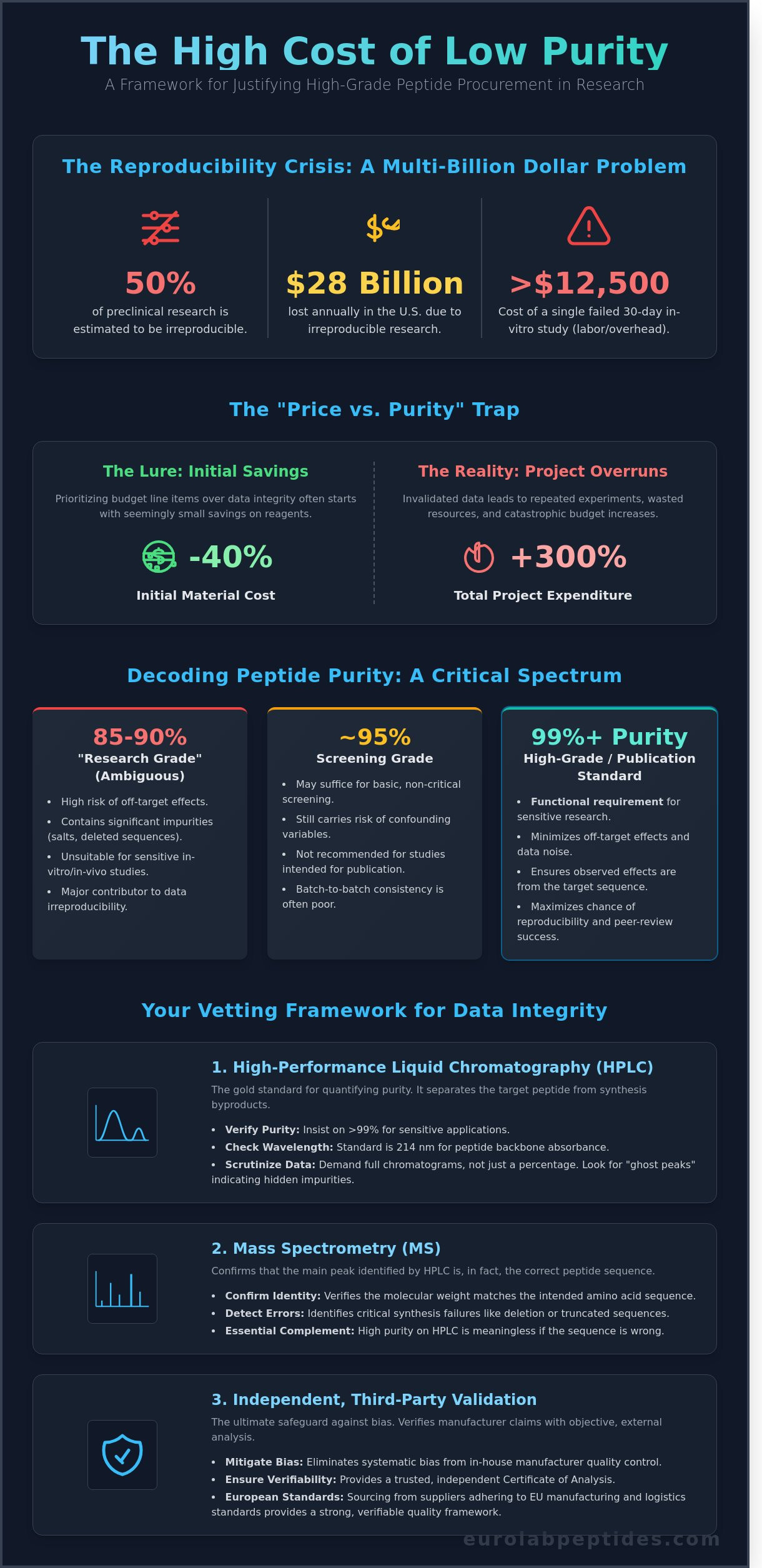
A 2015 report published in PLOS Biology calculated that approximately 50% of preclinical research is irreproducible, resulting in an estimated $28 billion in annual losses. Researchers understand that a single batch of contaminated reagent can invalidate months of work. It’s a common challenge to balance the immediate pressure of budget constraints with the long-term necessity of analytical precision. You’ve likely faced the difficulty of explaining why a cheaper alternative isn’t just a saving, but a significant technical risk.
This article establishes a rigorous methodology for justifying lab procurement of high-grade peptides, shifting the conversation from simple line-item costs to the preservation of data integrity. You’ll learn how to quantify the financial risks of batch-to-batch variation and why 99%+ purity is a functional requirement rather than a luxury. We’ll examine a technical framework for supplier vetting that utilizes mass spectrometry and HPLC data to ensure every milligram meets stringent European manufacturing standards.
Key Takeaways
- Learn to utilize HPLC and Mass Spectrometry benchmarks to verify sequence accuracy and identify deletion sequences before initiating sensitive in-vitro protocols.
- Master the framework for justifying lab procurement of high-grade peptides to institutional committees by calculating the risk-adjusted cost of research reagents.
- Understand the necessity of independent, third-party laboratory validation to mitigate systematic bias inherent in manufacturer-provided data.
- Evaluate the long-term economic impact of the “Price vs. Purity” trap and how 99%+ purity baselines minimize total project expenditure.
- Discover how European manufacturing standards and EU-based logistics provide a verifiable framework for ensuring data reproducibility and logistical reliability.
The False Economy of Substandard Peptides in Research
In molecular biology, the procurement of reagents represents a critical decision point where fiscal constraints often collide with scientific rigor. Low-cost reagents frequently present a “Price vs. Purity” trap, where an initial 40% saving on material costs results in a 300% increase in total project expenditure. High-grade peptides are defined by their verified chemical identity and absolute purity, typically exceeding 99% as confirmed by High-Performance Liquid Chromatography (HPLC) and Mass Spectrometry (MS). When labs prioritize upfront savings over these metrics, they compromise the integrity of their entire data set. Justifying lab procurement of high-grade peptides requires an analysis of long-term viability rather than short-term budget line items. Understanding the nuances of peptide synthesis methods is vital for researchers to recognize how impurities, such as truncated sequences, deleted residues, or residual salts, are introduced during production. These contaminants don’t just sit idle; they interact with biological systems, creating noise that masks true physiological signals.
The Hidden Cost of Data Irreproducibility
Batch-to-batch variation in substandard peptides invalidates longitudinal studies, rendering months of observation useless. A single failed 30-day in-vitro study can cost a laboratory upwards of $12,500 in labor and overhead, excluding the price of the reagent. Beyond the financial loss, researchers face significant career setbacks when results cannot be replicated in subsequent phases. This contributes directly to the “Reproducibility Crisis” currently affecting approximately 70% of researchers who have failed to reproduce another scientist’s experiments. When a sequence is inconsistent, the psychological toll on a team can lead to a breakdown in project momentum and lost credibility during peer review.
Defining High-Grade vs. Research-Grade
The term “Research Grade” remains dangerously ambiguous in the global market, often masking purity levels as low as 85% to 90%. While 95% purity might suffice for basic screening, it’s insufficient for sensitive metabolic or cognitive research where even 1% of a TFA salt or a residual solvent can trigger off-target cellular responses. For peptides intended for peer-reviewed publication, a 99%+ purity threshold is the baseline requirement. This level of stringency ensures that observed biological effects are attributable solely to the target sequence. Stringent verification through third-party analysis is the only way to move beyond the marketing label and into the realm of verifiable science.
Analytical Benchmarks: Defining ‘High-Grade’ via HPLC and MS
High-Performance Liquid Chromatography (HPLC) remains the primary analytical tool for determining the chemical purity of synthetic peptides. By measuring the absorbance of the peptide backbone at a 214 nm wavelength, HPLC provides a quantitative assessment of the target molecule relative to synthesis byproducts. However, purity percentages alone are insufficient for justifying lab procurement of high-grade peptides if they aren’t paired with Mass Spectrometry (MS). While HPLC confirms the concentration of the main peak, MS verifies that the peak actually contains the intended amino acid sequence. Lyophilization follows these tests, utilizing vacuum sublimation to remove residual solvents and achieve a stable, moisture-free powder. This process ensures structural integrity during long-term storage at -20°C, preventing the hydrolytic degradation that occurs in aqueous environments.
Interpreting HPLC Chromatograms for Procurement
The Area Under the Curve (AUC) is the standard metric for calculating purity in a laboratory setting. A 98% purity rating indicates that 98% of the detected UV absorbance originates from the primary peak. Researchers must scrutinize the baseline for “ghost peaks,” which often represent residual solvents, TFA salts, or oxidation products. Manipulated reports often truncate the x-axis or adjust the baseline sensitivity to hide these impurities. High-stakes research requires full-scale chromatograms to ensure that the 99%+ purity claim is mathematically sound and not a result of selective data reporting. These metrics are the foundation of a verifiable chain of quality for any serious research facility.
Sequence Integrity and Deletion Peptides
Solid-phase peptide synthesis (SPPS) is prone to specific errors, particularly during the coupling of sterically hindered amino acids or long sequences. These errors result in deletion sequences, where one or more residues are omitted from the chain. These truncated peptides are biologically active risks because they may retain partial binding affinity. They often act as competitive inhibitors, blocking target receptors without triggering the intended biological response, which can completely invalidate an assay. This phenomenon is a primary driver for improving research data reproducibility, as substandard reagents lead to “false negative” results or inconsistent data sets across different labs.
Mass spectrometry is the only definitive method to confirm the molecular weight matches the theoretical value. Without MS, a 99% pure sample could still contain significant percentages of truncated sequences that HPLC failed to resolve due to similar retention times. Verifying the sequence integrity of each batch ensures that the molecule being studied is exactly what was designed. This level of scrutiny is essential for justifying lab procurement of high-grade peptides, as it eliminates the variables associated with synthesis errors that could compromise months of experimental work.
Third-Party Verification: Mitigating Systematic Bias
The reliance on in-house supplier testing creates an inherent conflict of interest that can compromise the integrity of a research project. When a manufacturer provides their own purity data, the results lack the necessary separation of duties required for scientific rigor. Independent laboratory validation serves as the only objective mechanism for justifying lab procurement of high-grade peptides. This external oversight ensures that the analytical results are not influenced by commercial quotas or production deadlines. By standardizing procurement through third-party verification, researchers establish a transparent audit trail that stands up to peer review and institutional scrutiny.
Blind testing represents the gold standard for maintaining long-term supplier accountability. This process involves submitting samples to an independent facility without identifying the source or the expected purity level. It removes the risk of “cherry-picking” the best vials from a batch for analysis. This methodology closely mirrors the stringent protocols required for pharma grade peptides, where every step of the synthesis and distribution chain is verified by an autonomous entity. Precise analytical characterization, particularly through Mass Spectrometry (MS), is foundational for impactful quantitative proteomics, where even minor sequence variations can invalidate a study’s conclusions.
The Anatomy of a Valid Certificate of Analysis (COA)
A legitimate COA isn’t just a document; it’s a verifiable data record. Every valid certificate must include a unique batch number, the specific date of analysis (not the date of purchase), and the digital or physical signature of the lab manager. Procurement teams should cross-reference these documents with independent lab databases, such as those maintained by Janoshik or similar 2024-standard analytical facilities. A COA that’s older than 12 months is a major procurement red flag. Peptide stability can degrade even in lyophilized form if storage conditions aren’t perfect, making recent testing a non-negotiable requirement for data integrity.
Contaminant Profiles: Beyond the Peptide Sequence
High purity percentages on an HPLC chromatogram don’t tell the full story. Residual Trifluoroacetic acid (TFA), a common byproduct of the cleavage process in solid-phase peptide synthesis, can significantly impact cell viability in-vitro if levels exceed 10%. For immunological and tissue repair research, endotoxin testing is critical. We define high-grade peptides by an endotoxin threshold of less than 0.01 EU/mg to prevent non-specific inflammatory responses. While TFA is the standard salt, researchers often require an acetate salt exchange for sensitive biological assays. Choosing the correct salt form is an essential step in justifying lab procurement of high-grade peptides for specific research applications.
- HPLC Purity: Must be 99% or higher for sensitive assays.
- Mass Spec: Confirms the molecular weight matches the theoretical sequence.
- Salt Content: Specifies whether the peptide is a TFA, Acetate, or HCl salt.
- Appearance: Lyophilized white powder, indicating successful moisture removal.
Building the Business Case: ROI of Data Reproducibility
Securing institutional approval for premium reagents requires a shift from viewing peptides as simple consumables to viewing them as critical infrastructure. When justifying lab procurement of high-grade peptides to finance committees, the narrative must center on the Risk-Adjusted Cost (RAC). A budget peptide with 95% purity carries a hidden failure tax; if a single 21-day study is invalidated due to baseline contaminants, the loss includes not just the reagent cost but also thousands in laboratory overhead and specialized labor. High-grade reagents accelerate the bench-to-publication timeline by eliminating the 3 to 6 month troubleshooting cycles often necessitated by inconsistent batches. It’s a matter of protecting the laboratory’s most valuable asset: time.
Reagent Quality as a Grant-Winning Strategy
Funding bodies like the European Research Council (ERC) increasingly scrutinize “Rigorous Methodology” sections. Researchers who specify 99%+ purity and provide third-party validation data proactively address reviewer skepticism regarding chemical artifacts. Utilizing supplier transparency as a benchmark for laboratory excellence demonstrates a commitment to reproducible science. This level of detail in a grant application signals that the project’s outcomes won’t be compromised by secondary metabolites or residual solvents left over from sub-standard synthesis processes. Stringent procurement isn’t just a technical choice; it’s a strategic one that elevates the credibility of the entire research proposal.
Comparative ROI: High-Grade vs. Budget Suppliers
Consider a case study involving a BPC-157 recovery model. A laboratory utilizing a budget supplier experienced a 40% variance in peptide concentration across three batches, leading to a total loss of €12,000 in technician hours and animal housing costs. In contrast, amortizing the 15% higher initial cost of high-purity peptides across the 12-month project lifecycle reduces the total cost per data point by nearly 22%. Reliable, EU-based logistics further minimize overhead by ensuring that temperature-sensitive shipments arrive within 48 to 72 hours, preventing the degradation risks associated with extended international transit times. By justifying lab procurement of high-grade peptides through these metrics, PIs can demonstrate fiscal responsibility alongside scientific rigor.
Ensure the integrity of your next study by selecting verified compounds. Access our database of third-party HPLC and MS analysis reports to confirm your procurement meets the highest European standards.
Strategic Sourcing: The EuroLab Multi-Level Quality Protocol
Procurement decisions in high-stakes research require more than a simple cost-benefit analysis. They require a framework where chemical purity is a quantifiable, reproducible metric rather than a marketing claim. EuroLab mandates a 99%+ purity threshold for every catalog item. This standard serves as the non-negotiable baseline for release into the scientific supply chain. Establishing a rigorous verification framework is essential when justifying lab procurement of high-grade peptides to institutional review boards or department heads who demand absolute data integrity.
The European manufacturing advantage provides a distinct layer of security. By centralizing production within the European Union, EuroLab adheres to stringent ISO 9001:2015 standards and REACH compliance protocols. This regional focus eliminates the uncertainties often associated with international gray-market sourcing. A ‘Security of Supply’ strategy is implemented for long-term laboratory projects, ensuring that batch-to-batch consistency is maintained over multi-year longitudinal studies. This prevents the “data drift” that occurs when researchers are forced to switch suppliers due to inventory volatility.
This dedication to verified chemical composition and European standards is equally critical in fields like agricultural science; for example, ROfert România offers advanced plant nutrition and biostimulators that adhere to rigorous manufacturing protocols. Similarly, in specialized health sectors, Velobiotics applies meticulous standards to their probiotic-based formulations for intimate wellness to ensure product integrity.
Uncompromising Quality Control
Every batch undergoes a multi-step verification process where purity is verified through both in-house and independent third-party analysis. High-Performance Liquid Chromatography (HPLC) and Mass Spectrometry (MS) are utilized to confirm both the primary sequence and the absence of truncated sequences or residual solvents. This level of precision is critical for complex molecules such as Ipamorelin, where even minor structural deviations can lead to off-target effects in growth hormone secretagogue research. Certificates of Analysis (CoA) are provided with every shipment, offering the transparent data necessary for justifying lab procurement of high-grade peptides.
The Logistics of Scientific Integrity
The stability of a peptide is often compromised before it reaches the laboratory bench. EuroLab utilizes advanced lyophilization techniques to remove moisture, followed by vacuum sealing in medical-grade vials to ensure long-term shelf stability. Logistics are managed through EU-based shipping channels, which reduces transit times and minimizes exposure to temperature fluctuations that can degrade sensitive disulfide bonds. For specialized requirements, EuroLab provides direct technical support:
- Bulk procurement protocols for large-scale institutional trials.
- Custom synthesis services for specific amino acid sequences.
- Cold-chain transport solutions for highly sensitive research chemicals.
- Direct consultation for laboratory-specific documentation needs.
EuroLab operates as a meticulous scientific partner rather than a traditional vendor. By prioritizing the “language of the laboratory” over commercial hyperbole, the protocol ensures that every milligram of material delivered contributes to the accuracy and reproducibility of the researcher’s final data set.
Securing the Future of Experimental Reproducibility
The transition from speculative procurement to a data-driven acquisition strategy is essential for maintaining the integrity of modern biochemical research. Substandard reagents introduce uncontrolled variables that invalidate longitudinal studies and waste significant institutional resources. By prioritizing 99%+ purity verified by HPLC and Mass Spectrometry, researchers eliminate the systematic bias inherent in unverified materials. Establishing a robust framework for justifying lab procurement of high-grade peptides ensures that every milligram of compound contributes to a reproducible and peer-reviewed outcome.
EuroLab Peptides provides the technical infrastructure necessary for high-stakes inquiry. Every batch undergoes independent third-party testing to confirm sequence identity and chemical stability. Our protocol guarantees that the analytical benchmarks defined in your methodology are met without compromise. With fast EU-based shipping and dedicated technical support, your laboratory’s operational efficiency is maintained alongside its scientific rigor. It’s time to align your procurement standards with the precision your research demands.
Secure High-Grade Peptides for Your Next Research Project
We’re ready to support your next breakthrough with uncompromising analytical precision.
Frequently Asked Questions
What is the minimum purity required for peer-reviewed peptide research?
Peer-reviewed research typically requires a minimum purity of 98% as verified by High-Performance Liquid Chromatography (HPLC). When justifying lab procurement of high-grade peptides, researchers must account for the fact that impurities below the 2% threshold can interfere with receptor-binding assays or cause unintended cellular responses. Lower purity levels often lead to data rejection by journals such as Nature or Science during the rigorous peer-review process.
How do I verify if a supplier’s third-party lab report is authentic?
Authenticity is verified by cross-referencing the unique report ID number with the database of the independent testing facility. Every legitimate High-Performance Liquid Chromatography (HPLC) and Mass Spectrometry (MS) report includes a timestamp and a signature from a certified analytical chemist. Eurolab Peptides provides direct links to third-party portals where these 99%+ purity results are hosted. This prevents the use of forged or recycled data from 2022 or earlier.
Why does Trifluoroacetic acid (TFA) matter in in-vitro studies?
Trifluoroacetic acid (TFA) functions as a counter-ion during the cleavage and purification stages of solid-phase peptide synthesis. In in-vitro studies, residual TFA concentrations exceeding 1% can significantly alter the pH of the culture medium, leading to cell death or inhibited growth. Researchers should specify TFA-removal or acetate-exchange processes to ensure that observed biological effects aren’t merely artifacts of acid toxicity. Our laboratory standards ensure these levels are strictly monitored.
Is there a difference between ‘99% purity’ and ‘99% peptide content’?
Purity refers to the ratio of the target peptide sequence to other peptide-based impurities, while peptide content represents the actual weight percentage of the peptide in the lyophilized powder. A sample might show 99% purity on an HPLC chromatogram but only contain 75% peptide by weight. The remaining 25% often consists of water and counter-ions like acetate or TFA. This distinction is critical for precise molar calculations in quantitative experiments.
How should lyophilized peptides be stored to maintain their grade over time?
Lyophilized peptides must be stored at -20°C for short-term use or -80°C for long-term stability to prevent enzymatic degradation and moisture absorption. When justifying lab procurement of high-grade peptides, maintaining a temperature-controlled environment ensures the 99%+ purity remains stable for up to 24 months. Vials should reach room temperature in a desiccator before opening to avoid condensation, which can trigger rapid hydrolysis of the peptide bonds.
Can I use research-grade peptides for clinical pilot studies?
Research-grade peptides aren’t suitable for human clinical pilot studies because they aren’t manufactured under Good Manufacturing Practice (GMP) conditions. While research-grade materials often exceed 99% purity, they lack the rigorous documentation and environmental controls required by regulatory bodies like the EMA or FDA. Clinical applications demand a higher level of validation, including sterility testing and endotoxin quantification, which aren’t standard for basic laboratory research.
What are the risks of deletion sequences in complex peptide synthesis?
Deletion sequences occur when an amino acid fails to couple during a specific cycle of solid-phase synthesis, resulting in a truncated peptide chain. These impurities are problematic because they often share similar hydrophobic profiles with the target molecule, making them difficult to remove via HPLC. In a 2023 study, deletion sequences were shown to act as competitive inhibitors, potentially masking the true biological activity of the primary sequence and skewing experimental data.
How does EuroLab Peptides ensure batch-to-batch consistency for long-term trials?
Batch-to-batch consistency is maintained through standardized automated synthesis protocols and rigorous internal quality control benchmarks. Every batch undergoes identical purification cycles and is verified against a master reference standard using Mass Spectrometry to ensure sequence identity. By adhering to European manufacturing standards, the variance in peptide content is kept below a 5% margin. This level of precision allows for reproducible results across multi-year longitudinal studies.
