

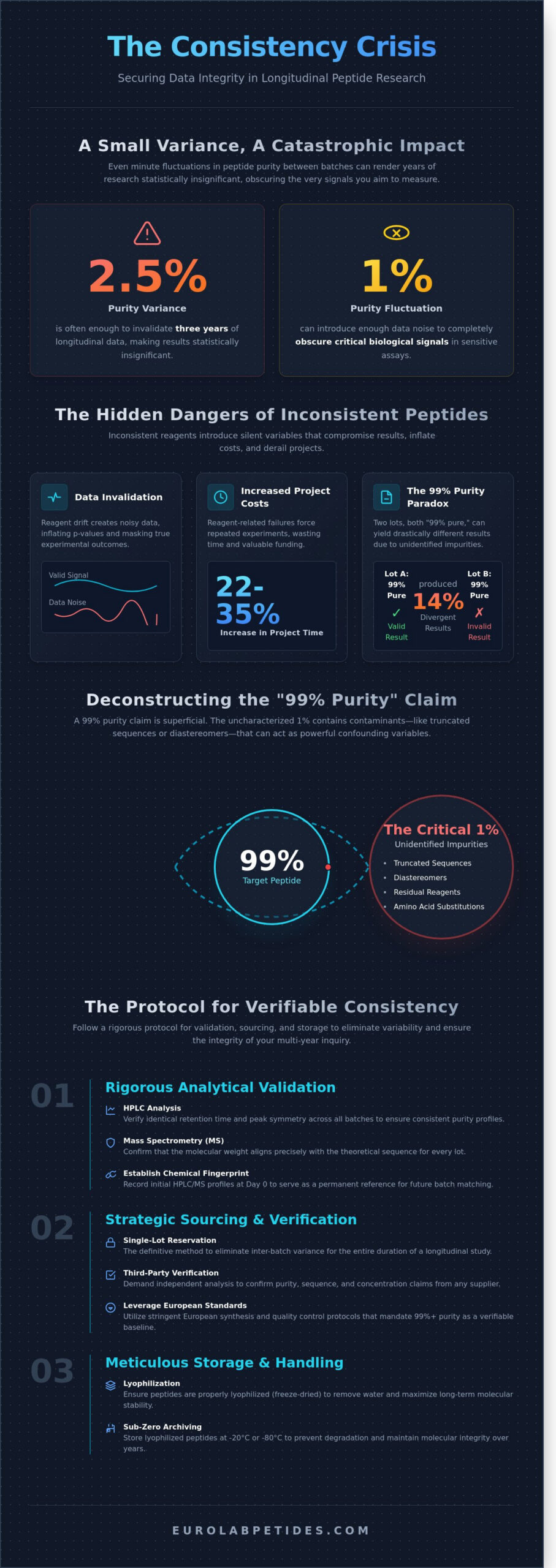
A 2.5% variance in peptide purity between study phases is often enough to render three years of longitudinal data statistically insignificant. Researchers understand that data drift caused by reagent variability isn’t just a minor inconvenience; it’s a fundamental threat to the integrity of a multi-year inquiry. Getting consistent batches for longitudinal research requires moving beyond simple certificates of analysis and into the realm of stringent sequence validation, HPLC analysis, and mass spectrometry. When purity levels fluctuate by even 1% across quarterly acquisitions, the resulting noise in the data set can obscure the very biological signals you’re attempting to measure.
This technical guide outlines the analytical and logistical protocols through which batch-to-batch variability is eliminated and the integrity of long-term scientific inquiries is ensured. You’ll master the methodologies needed to secure zero-variability data sets and establish verifiable chemical fingerprints for every study phase. We’ll examine the role of 99%+ purity standards, the necessity of third-party verification, and how European manufacturing protocols provide the stability required for high-stakes biochemistry. By the conclusion of this analysis, you’ll have a roadmap for securing a reliable sourcing partner that adheres to the uncompromising standards of the European scientific community.
Key Takeaways
- Analyze the technical limitations of standard purity claims and the necessity of HPLC sequence verification for absolute analytical precision.
- Implement single-lot reservation strategies as the definitive method for getting consistent batches for longitudinal research and eliminating inter-batch variance.
- Establish rigorous storage protocols using lyophilization and sub-zero archiving to maintain molecular stability across extended study durations.
- Quantify the impact of batch-to-batch variability on statistical significance to safeguard the integrity of long-term experimental data.
- Leverage stringent European synthesis standards to ensure that 99%+ purity serves as a verifiable baseline for every phase of your project.
The Criticality of Batch Consistency in Longitudinal Study Design
Batch-to-batch variability in peptide synthesis represents a fundamental threat to the integrity of long-term scientific inquiry. When chemical profiles shift between synthesis cycles, the resulting data noise can inflate p-values beyond the threshold of statistical significance. Longitudinal research is uniquely vulnerable to these fluctuations because even subtle shifts in impurity profiles introduce uncontrolled variables over months or years of observation. In a multi-phase laboratory environment, success depends on getting consistent batches for longitudinal research to ensure that every reaction remains predictable.
Silent variables often undermine a study before the first assay is performed. These include amino acid sequence errors, such as leucine and isoleucine substitutions, which are indistinguishable by standard mass spectrometry alone. Variations in salt content, specifically the ratio of Trifluoroacetic acid (TFA) to acetate, can also alter solubility and cellular toxicity. A standardized baseline is a non-negotiable requirement. Without a verified chemical fingerprint, researchers cannot determine if a biological shift is a result of the experimental variable or a change in the reagent’s molecular composition.
The Impact of Reagent Drift on Data Reproducibility
Reagent drift occurs when minor impurities act as confounding variables within cellular signaling models. These impurities can bind to non-target receptors, triggering off-target effects that invalidate entire data sets. The financial cost is high; studies show that reagent-related failures can increase the temporal cost of a project by 22% to 35%. In one 2023 analysis, two peptide lots both verified at 99% purity produced 14% divergent results in receptor activation assays. This discrepancy was traced to a 0.5% difference in a specific truncated peptide fragment that acted as a competitive inhibitor.
Defining the Longitudinal Baseline
Establishing a chemical fingerprint at Study Day 0 is the only way to safeguard a project’s future. This involves recording the exact HPLC and mass spectrometry profiles to serve as a permanent reference point. peptides are foundational tools in longevity and metabolic research, where small changes in peptide stability can lead to degraded potency over time. Research areas focused on tissue repair are particularly sensitive to batch variance. In these models, even a minor sequence error can disrupt the precise protein-folding pathways required for cellular regeneration. Achieving 99%+ purity is only half the battle; the other half is getting consistent batches for longitudinal research so that Day 1 and Day 500 remain chemically identical.
Analytical Validation: Beyond the 99% Purity Claim
While many suppliers advertise 99% purity, this figure remains a superficial metric without deep analytical context. In the rigorous environment of a laboratory, “99% purity” refers specifically to the percentage of the target peptide relative to other substances detected by UV absorbance at 214nm or 220nm. It doesn’t account for the specific nature of the remaining 1% of impurities. These contaminants often consist of truncated sequences, diastereomers, or residual reagents that can introduce significant variables into a study. For researchers focused on getting consistent batches for longitudinal research, the identity of that 1% is as critical as the 99% main peak. High-Performance Liquid Chromatography (HPLC) is utilized to separate these components, ensuring that the primary peak represents the intended molecule without interference from synthesis byproducts.
Interpreting HPLC and MS Reports for Batch Matching
Ensuring reproducibility requires a meticulous comparison of chromatograms across different lots. Researchers must verify that the retention time and peak symmetry remain identical. Variations in these metrics often indicate differences in the synthesis or purification process that could compromise data. Mass Spectrometry (MS) serves as the definitive tool for identifying batch-specific mass-to-charge ratios, confirming that the molecular weight aligns with the theoretical sequence. Advanced peptide characterization techniques are necessary to detect subtle structural deviations that standard testing might overlook. For complex molecules like BPC-157, sequence validation is critical to confirm the precise 15-amino acid arrangement. Analysis also focuses on residual solvents and TFA (Trifluoroacetic acid) content. High TFA levels, which can exceed 10% in unrefined batches, may alter the pH of the research environment and skew long-term results.
The Role of Third-Party Laboratory Audits
Dependency on a manufacturer’s internal data introduces a risk of supplier bias. Independent Certificate of Analysis (COA) verification is the non-negotiable standard for maintaining longitudinal integrity. EuroLab implements a multi-level quality protocol where initial in-house analysis is followed by external validation from accredited European laboratories. This process ensures that every vial meets the uncompromising standards required for serious inquiry. Batch-identity is the alignment of HPLC retention times across multiple synthesis cycles. This stringent approach allows scientists to focus on data acquisition without concerns regarding chemical drift. If you’re getting consistent batches for longitudinal research, you must demand this level of transparency. For those seeking to secure high-integrity materials, you can view our verified peptide selection to ensure your study remains uncompromised by analytical variance.
Sourcing Strategies for Multi-Phase Research Projects
Procurement decisions in longitudinal studies often dictate the validity of the final data set. Researchers typically choose between Just-in-Time (JIT) procurement and the Single-Lot Reservation model. JIT sourcing involves purchasing material as needed for each phase, but this introduces the risk of inter-batch variance where subtle shifts in impurity profiles or counter-ion concentrations can skew results. For researchers, getting consistent batches for longitudinal research is best achieved through Single-Lot Reservation. This strategy involves purchasing an entire synthesis run at the project’s inception. By eliminating the variables associated with multiple synthesis cycles, the laboratory ensures that the molecular footprint remains identical from the baseline measurement to the final time point.
The Single-Lot Procurement Model
The Single-Lot Procurement Model requires a precise calculation of the total mass needed for the entire study timeline. It’s standard practice to procure the calculated amount plus a 15% surplus to account for analytical repeats or handling losses. Once the synthesis is complete, the large batch is divided into smaller, sealed aliquots under inert gas. This method protects the integrity of the compound by preventing repeated exposure to oxygen and moisture. Maintaining peptide stability and delivery strategies is easier when the chain of custody is localized. EU-based shipping provides a logistical advantage here, as shorter transit times and strict adherence to cold-chain protocols reduce the risk of thermal degradation before the material reaches the freezer.
Vetting Suppliers for Long-Term Reliability
Reliability in a chemical partner is verified through technical transparency rather than marketing promises. When vetting a supplier, the primary focus should be on their synthesis scale capabilities and lot-tracking systems. It’s essential to confirm that the supplier can produce the total required quantity in a single reactor run. Splitting a single order across multiple reactors can introduce the very variance that longitudinal studies seek to avoid. European manufacturing standards offer a more rigorous regulatory environment, ensuring that certified peptides meet 99%+ purity benchmarks consistently. 99%+ purity is verified through HPLC and mass spectrometry for every lot, providing the empirical evidence required for high-stakes research. A professional partner will offer batch-holding agreements, where a verified lot is stored in optimized conditions and released in phases, ensuring that getting consistent batches for longitudinal research remains a logistical reality rather than a challenge.
Stability in raw material sourcing is another critical metric. Suppliers with established European supply chains are less susceptible to the fluctuations in reagent quality that can plague offshore manufacturers. This stability ensures that if a study must be extended, the subsequent synthesis runs will mirror the original specifications as closely as possible. The goal is to establish a partnership where quality is a verifiable metric, allowing the researcher to focus entirely on the data.
Mitigating Degradation: Storage and Handling Protocols
Lyophilization, or freeze-drying, serves as the primary defense against molecular instability in synthetic peptides. By removing solvent through sublimation under high vacuum, the peptide is transitioned into a stable, solid state. This process is vital for researchers getting consistent batches for longitudinal research, as it minimizes the kinetic energy available for chemical reactions that lead to sequence degradation. Without this stabilization, the primary structure remains vulnerable to enzymatic or chemical cleavage during transport and storage.
The primary enemy of batch consistency is hygroscopy. Peptides are naturally “thirsty” molecules that rapidly absorb atmospheric moisture if the vial seal is compromised. This moisture acts as a catalyst for hydrolysis, breaking the peptide bonds and rendering the sample useless for precise analytical work. Maintaining a dry, inert environment is not merely a recommendation; it’s a requirement for data integrity. Handling archived research-grade chemicals requires a strict adherence to the “cold chain” to prevent thermal fluctuations from introducing variables into the study.
Optimizing Lyophilized Peptide Stability
The laboratory environment utilizes vacuum sealing and inert gas blanketing, typically with high-purity nitrogen, to eliminate atmospheric oxygen. This prevents oxidative degradation of sensitive amino acid residues like Methionine or Cysteine. For growth hormone secretagogues like Ipamorelin, maintaining this inert environment is mandatory to prevent sequence fragmentation over time. While storage at -20°C is acceptable for short-term use, long-term archives require -80°C to halt all molecular motion and ensure zero drift in purity levels. Each vial must reach room temperature before opening to prevent the condensation of atmospheric moisture on the lyophilized powder, which would trigger immediate degradation.
Reconstitution Best Practices in Longitudinal Models
Maintaining identical concentration levels across different study phases requires a standardized reconstitution protocol. Researchers must use precise volumetric measurements to ensure the molarity remains constant throughout the duration of the project. This is a critical step in getting consistent batches for longitudinal research where even a 2% variance in concentration can invalidate comparative data. The choice of diluent significantly affects shelf-life. Bacteriostatic water, containing 0.9% benzyl alcohol, is the preferred choice for multi-use vials because it inhibits microbial proliferation. Sterile saline, while useful for immediate applications, lacks preservative properties and often leads to faster peptide aggregation. Consistent storage temperatures are as critical as initial purity for longitudinal data integrity. Researchers should avoid frequent freeze-thaw cycles, as the resulting mechanical stress often denatures the peptide structure.
EuroLab Peptides: Engineering Consistency for Global Research
EuroLab Peptides operates on the principle that 99%+ purity is the absolute baseline for scientific inquiry, not an aspirational goal. Longitudinal studies require a level of precision that standard commercial suppliers often fail to meet over extended timelines. By utilizing European-based synthesis facilities, the brand maintains direct oversight of every chemical reaction and purification step. This localized control minimizes the variables that lead to batch-to-batch drift. It ensures that a 24-month study isn’t compromised by sudden shifts in peptide potency or impurity profiles. Researchers who prioritize getting consistent batches for longitudinal research find that EuroLab’s rigid manufacturing standards provide the stability needed for reproducible data.
The brand positions itself as a meticulous partner for high-stakes scientific inquiry. Every vial produced is a result of uncompromising synthesis protocols designed to withstand the scrutiny of the global research community. We recognize that the integrity of your longitudinal data depends entirely on the chemical integrity of the tools you use. This commitment to technical excellence allows researchers to focus on their metabolic or longevity observations without questioning the underlying substrate.
The EuroLab Quality Assurance Protocol
The EuroLab Quality Assurance Protocol is built on a multi-stage verification system that eliminates guesswork. Every synthesized sequence undergoes in-house Mass Spectrometry (MS) to confirm molecular weight and sequence identity. This is followed by independent, third-party High-Performance Liquid Chromatography (HPLC) to verify purity levels exceed the 99% threshold. We don’t accept anecdotal feedback or subjective observations as proof of quality. Instead, we rely on verifiable chemical metrics that are provided with every order.
- Synthesis Validation: Direct oversight of the solid-phase peptide synthesis process.
- Analytical Precision: Utilization of MS and HPLC to ensure sequence accuracy.
- Logistical Reliability: EU-based shipping reduces transit-related stress and thermal degradation common in long-haul international freight.
By keeping the supply chain within Europe, we maintain a shorter, more secure path from the laboratory to your facility. This reduces the risk of environmental factors affecting the lyophilized product during shipping. It’s a standardized approach that respects the rigorous demands of your laboratory environment.
Support for Longitudinal Research Stacks
Managing bulk orders for long-term metabolic and longevity studies requires more than just volume; it requires a transparent chain of custody. EuroLab supports complex research stacks by offering batch-tracking that spans years, not just months. Getting consistent batches for longitudinal research becomes a streamlined process through our comprehensive COA database. Researchers can retrieve the analytical data for every vial in their inventory at any time, which simplifies the process of data normalization across multi-year projects.
Our infrastructure is designed to accommodate the heavy data requirements of modern biochemistry and pharmacology. We provide the documentation necessary for peer-reviewed publication, ensuring that your methodology is backed by solid analytical evidence. When your research requires unrivaled precision and radical transparency, EuroLab Peptides is the professional choice. Secure your research-grade batches from EuroLab Peptides today.
Securing Long-Term Data Reliability through Standardized Synthesis
Longitudinal research demands an uncompromising approach to chemical stability. Variations in peptide synthesis can introduce confounding variables that compromise years of data collection. It’s essential to prioritize 99%+ purity verified by independent third-party laboratories to ensure that each phase of a study remains analytically sound. The technical foundation for getting consistent batches for longitudinal research rests on rigorous HPLC and mass spectrometry validation. EuroLab Peptides maintains these standards through EU-based manufacturing and secure worldwide shipping; this provides the technical infrastructure necessary for advanced laboratory development. Every batch is analyzed to confirm sequence integrity before dispatch. These materials are strictly for in-vitro research and laboratory development. Establishing a reliable supply chain early in the project lifecycle mitigates the risks associated with degradation and synthesis drift. Precision in the laboratory begins with the integrity of the compound. Your commitment to scientific excellence is matched by our dedication to chemical precision.
Browse our third-party tested research peptides for your next study.
Frequently Asked Questions
How do I know if a new batch of peptides is identical to my previous one?
Verify identity by comparing the High-Performance Liquid Chromatography (HPLC) chromatogram and Mass Spectrometry (MS) data from the new batch against previous records. Each batch must demonstrate a consistent molecular weight and a purity profile exceeding 99%. Discrepancies in the retention time or the presence of secondary peaks indicate variations that compromise longitudinal integrity. Eurolab Peptides ensures each shipment includes detailed analytical documentation to facilitate this comparison.
Can I use peptides from different suppliers in the same longitudinal study?
Using peptides from multiple suppliers is discouraged because it introduces uncontrollable variables into the experimental framework. Differences in synthesis protocols, purification methods, and salt content can alter biological activity and baseline data. For researchers getting consistent batches for longitudinal research, sourcing from a single, reliable EU-based manufacturer is the only way to ensure 100% uniformity across a 24-month study period.
What is the maximum shelf life of lyophilized peptides for research purposes?
Lyophilized peptides remain stable for 24 to 36 months when stored at -20°C in a desiccated environment. Stability decreases significantly once the vial is opened or exposed to moisture. Studies indicate that a 1% increase in moisture content can accelerate peptide degradation by 15% over a 6-month period. Researchers should utilize temperature-controlled storage to maintain the structural integrity of the compound.
Is third-party testing necessary if the supplier provides their own COA?
Third-party verification is essential to eliminate internal bias and ensure the validity of the Certificate of Analysis (COA). While a manufacturer’s report provides baseline data, independent labs use standardized HPLC and MS protocols to confirm 99%+ purity levels. This dual-layer validation process provides the radical transparency required for high-stakes longitudinal studies where data precision is non-negotiable and requires an uncompromising approach to quality.
How does TFA (Trifluoroacetic acid) content affect longitudinal research results?
Residual TFA acts as a counter-ion that can influence the pH of the cellular environment and potentially induce cytotoxic effects at concentrations exceeding 5%. In longitudinal research, inconsistent TFA levels between batches lead to skewed data and poor reproducibility. Standardizing TFA content to a specific threshold, such as less than 1%, ensures that observed biological responses are due to the peptide itself rather than the counter-ion.
What is the best way to transport peptides for a multi-center longitudinal study?
Transporting lyophilized peptides requires vacuum-sealed vials and cold-chain logistics to prevent thermal degradation during transit. Utilizing specialized couriers that maintain a constant temperature of 4°C ensures the physical stability of the samples across multiple sites. For researchers getting consistent batches for longitudinal research, EU-based shipping protocols provide the necessary regulatory compliance and speed to minimize environmental exposure during the 48-hour delivery window.
Does the synthesis method (solid-phase vs. liquid-phase) impact batch consistency?
Solid-phase peptide synthesis (SPPS) typically offers superior batch-to-batch consistency for sequences under 50 amino acids compared to liquid-phase methods. SPPS allows for precise control over reagent ratios and washing cycles, which results in a more predictable purity profile. Maintaining the same synthesis platform throughout a study prevents the introduction of impurities that vary by process, ensuring that the 99%+ purity standard remains constant across all phases.
How can I verify the sequence of a peptide batch independently?
Sequence verification is achieved through tandem mass spectrometry (MS/MS) or Edman degradation to confirm the exact amino acid order. MS/MS analysis provides a fragmentation pattern that serves as a molecular fingerprint, verifying that the synthesized sequence matches the theoretical design. This level of rigorous analysis is a standard requirement for researchers who prioritize scientific accuracy and need to confirm the structural integrity of their chemical tools.
