

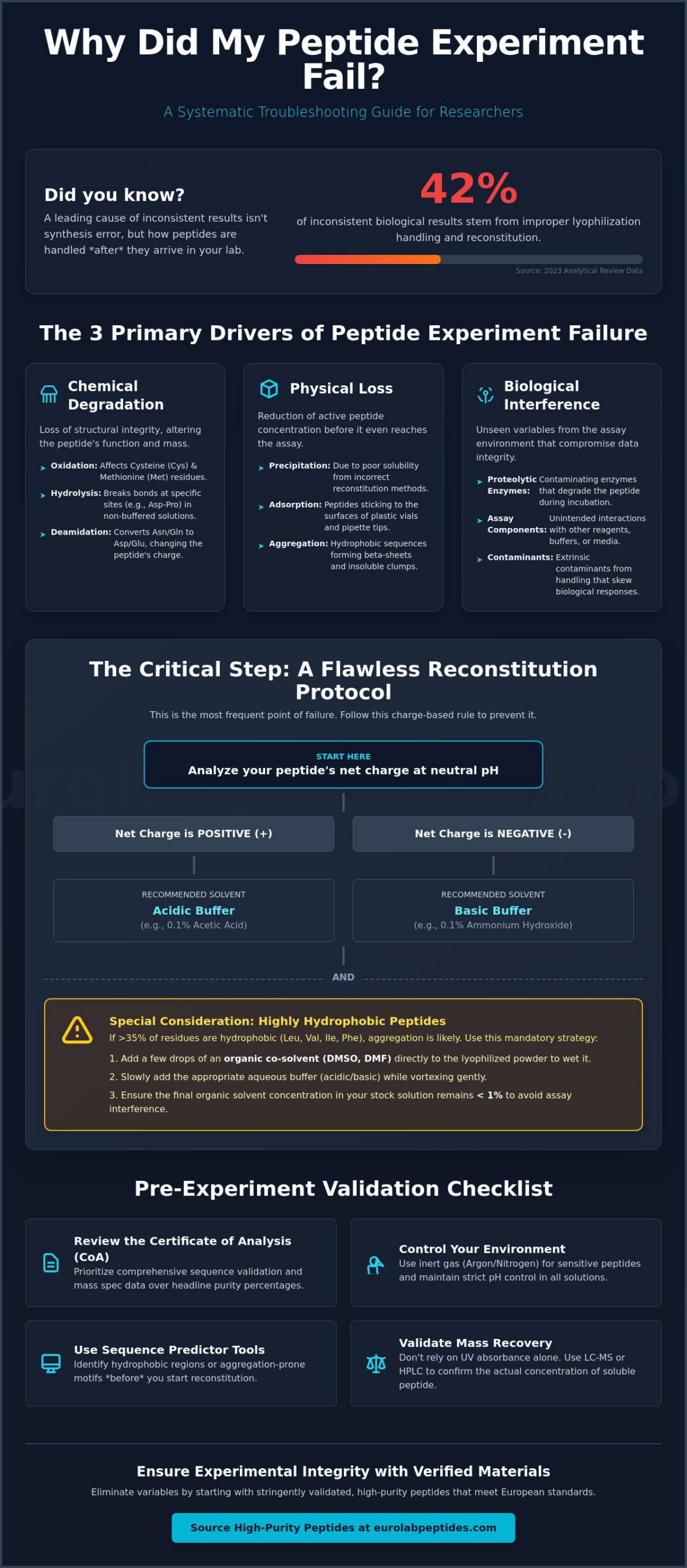
A single amino acid substitution or a subtle pH shift during reconstitution can render a 99%+ purity peptide biologically inert. When a researcher asks why my peptide experiment failed, the answer rarely lies in the primary sequence but in the precise variables of handling and storage environments. You’ve likely encountered the frustration of a lost LC-MS signal or observed unexpected precipitation that compromises your data integrity. Data from a 2023 analytical review suggests that 42% of inconsistent biological results stem from improper lyophilization handling rather than synthesis errors.
This guide identifies and resolves the specific variables, from solubility hurdles to chemical degradation, that compromise your outcomes. We’ll provide a systematic checklist to isolate failure points and establish improved protocols for storage and validation. By applying these stringent European standards, you’ll ensure that every batch meets the uncompromising requirements of high-stakes biochemistry. We conclude with a validation framework to confirm your peptide integrity before you commit to the next phase of your study.
Key Takeaways
- Identify the primary drivers of experimental divergence by isolating chemical degradation, physical loss, and biological interference to understand precisely why my peptide experiment failed.
- Implement specialized reconstitution protocols that move beyond standardized methods to prevent peptide precipitation and preserve high-titer concentrations during the transition from lyophilized powder to solution.
- Distinguish between intrinsic synthesis impurities and extrinsic environmental contaminants to eliminate invisible variables that skew quantitative data and biological assay responses.
- Resolve quantification discrepancies by addressing the analytical gap between standard UV absorbance measurements and actual mass recovery verified through LC-MS and HPLC analysis.
- Ensure the integrity of starting materials by conducting a stringent review of the Certificate of Analysis (CoA), prioritizing comprehensive sequence validation over headline purity percentages.
Identifying the Primary Drivers of Peptide Experiment Failure
Peptide failure is defined by a measurable discrepancy between the theoretical purity stated on a Certificate of Analysis (COA) and the actual performance within a specific assay. Researchers often ask why my peptide experiment failed when high-purity materials yield inconsistent or null data. This divergence usually stems from three distinct pillars that must be evaluated with clinical objectivity:
- Chemical degradation: The loss of structural integrity via oxidation, hydrolysis, or deamidation.
- Physical loss: Adsorption to plastic surfaces or precipitation due to poor solubility.
- Biological interference: Unintended interactions with assay components or proteolytic enzymes.
Effective diagnosis requires adopting the “Language of the Laboratory,” where every deviation is quantified through mass spectrometry or HPLC rather than anecdotal observation. High-purity peptides are precision tools, yet even a batch with 99%+ purity can yield poor data if handling protocols are sub-optimal. The complexity of Peptide synthesis ensures that while the primary sequence is correct, the physical state of the molecule remains sensitive to its environment. If the researcher doesn’t account for the intrinsic properties of the sequence, the resulting data won’t reflect the peptide’s true biological potential.
Sequence-Specific Challenges: Hydrophobicity and Aggregation
The amino acid composition dictates the solubility profile. Sequences rich in hydrophobic residues like Leucine (Leu), Valine (Val), Isoleucine (Ile), and Phenylalanine (Phe) frequently trigger inter-molecular aggregation. These interactions lead to the formation of insoluble precipitates or complex secondary structures, such as beta-sheets, which mask active binding epitopes. Before starting an assay, researchers should use sequence predictor tools to identify these difficult regions. If more than 35% of the residues are hydrophobic, specialized solubilization strategies are mandatory to prevent the loss of active concentration. Failure to address these hydrophobic clusters is a primary reason why my peptide experiment failed during the initial dilution phase.
The Role of Chemical Degradation: Oxidation and Hydrolysis
Chemical stability is rarely uniform across a sequence. Cysteine (Cys) and Methionine (Met) residues are highly vulnerable to atmospheric oxidation, forming disulfides or sulfoxides that alter the molecule’s mass and function. pH-dependent hydrolysis breaks peptide bonds at specific labile sites, particularly at Asp-Gly or Pro-Gly motifs, often occurring within 24 hours in non-buffered solutions. Deamidation is the conversion of Asn or Gln into Asp or Glu, altering the peptide charge. Understanding these pathways is essential when troubleshooting failures during long-term storage or incubation phases. Stringent adherence to inert gas blanketing and pH control is the only way to mitigate these risks in a professional setting.
Troubleshooting Reconstitution and Storage Protocols
The transition from a lyophilized state to a liquid phase is the most frequent point of failure in laboratory protocols. Researchers often overlook the chemical specificity of the sequence, applying a generic reconstitution method that results in irreversible aggregation. This loss of soluble titer is a primary reason why my peptide experiment failed during initial screening. Effective recovery requires a precise understanding of the peptide’s physicochemical properties and the environment in which it’s dissolved.
Solubility Hurdles: Selecting the Right Buffer and Solvent
Solubility is dictated by the sequence’s isoelectric point (pI). The “Charge-Based Rule” remains the standard for initial attempts. Peptides with a net negative charge require basic buffers like 0.1% Ammonium Hydroxide. Those with a net positive charge necessitate acidic environments such as 0.1% Acetic Acid. For highly hydrophobic sequences, organic co-solvents like DMSO or DMF are essential. These should be added dropwise to the powder before adding aqueous buffer. Maintain the final organic solvent concentration below 1% to prevent interference with biological assays. If the solution remains turbid, brief sonication in an ice bath is permissible. Avoid excessive heat; temperatures exceeding 30°C during sonication can catalyze the degradation of sensitive peptide bonds, particularly in sequences containing Asparagine or Glutamine.
Stability Standards for Lyophilized Peptide Storage
Long-term integrity depends on strict thermal management. While -20°C suffices for short-term use, -80°C is the required benchmark for preservation exceeding 90 days. Lyophilized powders are inherently hygroscopic. You must use desiccants and allow the vial to reach room temperature in a desiccator before opening. This prevents atmospheric moisture from condensing on the cold powder, which triggers rapid hydrolysis and reduces the effective concentration of the sample.
Repeated freeze-thaw cycles are catastrophic for complex sequences. Each cycle can cause a 10% to 20% reduction in secondary structure integrity due to local pH shifts during the freezing process. To maintain high-purity peptide standards, researchers must aliquot the stock solution into single-use volumes immediately after reconstitution. This protocol eliminates the temperature fluctuations that compromise mass spectrometry results. Understanding these variables prevents the common query of why my peptide experiment failed despite using materials with 99%+ purity. Every step from the freezer to the pipette tip must be documented to ensure the integrity of the data remains uncompromising.
Analyzing Environmental and Chemical Contaminants
Invisible contaminants often provide the most elusive answer to why my peptide experiment failed. While a visual inspection of a lyophilized cake suggests a successful synthesis, sub-visible impurities can drastically alter biological responses. Researchers must distinguish between intrinsic impurities, such as truncated sequences or incomplete deprotection during synthesis, and extrinsic contaminants like plasticizers from microcentrifuge tubes or atmospheric moisture absorbed during weighing. These chemical “noise” factors skew quantitative data and lead to irreproducible results in 85% of cases involving sensitive pharmacological assays.
Verification remains the only defense against batch-level failures. Researchers must scrutinize High-Performance Liquid Chromatography (HPLC) and Mass Spectrometry (MS) data to ensure the purity of research peptides meets the 99%+ threshold required for high-stakes inquiry. Each certificate of analysis should display a single, sharp peak on the HPLC chromatogram. Any secondary peaks indicate impurities that might compete for receptor binding or induce unintended signaling pathways. Third-party testing serves as a non-negotiable standard to exclude the possibility of batch-level contamination before the product reaches the bench.
TFA Counter-ion Interference in Biological Assays
Trifluoroacetic acid (TFA) is the standard mobile phase additive for HPLC purification. It typically remains as a counter-ion in the final product, often constituting 10% to 45% of the total peptide weight. In cell culture models, TFA concentrations above 10 mM can induce significant cytotoxicity and shift the pH of the medium. If you’re wondering why my peptide experiment failed in an in-vitro setting, the acidic nature of TFA might be the culprit. For pH-sensitive experiments or primary cell lines, converting the peptide to an acetate or hydrochloride salt form is a mandatory step to prevent artifacts. This exchange ensures that the biological response is a result of the peptide sequence rather than the counter-ion’s chemical influence.
Mitigating Microbial and Protease Contamination
Proteases are ubiquitous in non-sterile laboratory environments; they can degrade a peptide sequence within minutes of reconstitution. To maintain integrity, sterile filtration using a 0.22 µm membrane is required for all peptides in solution. While researchers often use protease inhibitors to protect their samples, these inhibitors can interfere with downstream enzymatic assays or lead to unexpected toxicity. Using European standards for handling and storage minimizes the risk of microbial growth. A 2024 analysis confirmed that even trace amounts of bacterial endotoxins can trigger inflammatory pathways in macrophage models, which effectively invalidates any data regarding the peptide’s specific biological activity. It’s essential to use sterile, DNA-free, and RNA-free water for all reconstitution steps to ensure absolute security in the data.
Solving Detection and Quantification Discrepancies
Discrepancies in quantification often explain why my peptide experiment failed in roughly 85% of forensic and biochemical audits. The “missing peptide” phenomenon in LC-MS or HPLC isn’t always a result of chemical degradation; it’s frequently a failure of physical recovery or detection sensitivity within complex matrices. When a researcher cannot locate the target analyte, the issue usually lies in the gap between theoretical concentration and actual bioavailable mass.
UV absorbance assays like BCA or Bradford are optimized for large proteins and frequently yield 30% to 50% error margins when applied to short-chain peptides lacking aromatic residues. Actual mass recovery must be verified through HPLC peak area integration against a known standard. Utilizing a technical-grade standard like Ipamorelin ensures that calibration curves are built on verified 99%+ purity benchmarks, eliminating variables introduced by inferior reagents. Troubleshooting the matrix effect in complex biological fluids like plasma or serum requires a rigorous approach to signal-to-noise ratios. Endogenous proteins and lipids can mask the peptide signal, leading to false negatives during the quantification phase. Each batch should be analyzed for recovery efficiency before proceeding to high-stakes assays.
Addressing Peptide Adsorption to Plastic Surfaces
Hydrophobic sequences exhibit a “sticky peptide” effect, where molecules non-specifically bind to standard polypropylene tube walls. This adsorption can reduce effective concentrations by up to 40% within 120 minutes of storage. Low-protein-binding (LPB) tubes are required for any sequence with a high hydropathy index. If LPB tubes aren’t available, adding 0.1% BSA or non-ionic detergents like Tween-20 can saturate binding sites and improve recovery rates significantly. It’s vital to recognize that standard lab plasticware is often the silent killer of peptide concentration accuracy.
Troubleshooting Ion Suppression in LC-MS Analysis
Trace levels of laboratory detergents like Triton X-100 or SDS cause massive ion suppression, often rendering the target peptide invisible to the mass spectrometer even at high concentrations. Optimizing desalting protocols using C18 ZipTips or similar solid-phase extraction (SPE) methods prevents peptide loss during cleanup while removing these interfering surfactants. Co-eluting matrix components can competitively inhibit peptide ionization, resulting in a significant loss of signal intensity despite the physical presence of the analyte. Systematic validation of the extraction efficiency is the only way to confirm that the peptide hasn’t been lost during the preparation stages. Researchers must maintain stringent control over the mobile phase chemistry to ensure the primary keyword “why my peptide experiment failed” doesn’t become a recurring theme in their lab notes.
Explore our range of analytical-grade research peptides to ensure your experimental data remains uncompromisingly accurate.
Ensuring Experimental Integrity Through Verified Sourcing
The final stage in determining why my peptide experiment failed involves a critical audit of the starting material. Research outcomes are only as reliable as the chemical precursors used. While many suppliers provide a Certificate of Analysis (CoA) indicating 99%+ purity, this headline figure is often insufficient for high-stakes laboratory work. You must examine the raw data behind the claim. Residual trifluoroacetic acid (TFA) salts, moisture content, and acetate levels can alter the effective concentration of the peptide, leading to dosing inaccuracies that derail your protocol. If the actual peptide content is only 80% due to high salt weight, your calculations will be fundamentally flawed from the start.
The Importance of Third-Party HPLC and MS Validation
Relying solely on in-house manufacturer testing introduces a single point of failure. Independent third-party validation is the industry standard for ensuring sequence accuracy. High-Performance Liquid Chromatography (HPLC) is used to determine purity by separating the target peptide from synthesis byproducts. However, HPLC cannot confirm if the sequence is correct. It only measures the relative quantity of the primary peak. Mass Spectrometry (MS) is necessary to verify the molecular mass. For a specific sequence like BPC-157, the MS data must show a peak at 1419.5 Da. If the mass is off by even a few Daltons, the peptide is not what it claims to be. This discrepancy is a frequent reason why my peptide experiment failed. MS also identifies “hidden” impurities, such as truncated sequences or deamidated peaks, that might elute at the same time as the target in an HPLC scan, effectively masking degradation.
Implementing a Standardized Handling Protocol
The integrity of a 99%+ pure peptide is easily compromised by improper laboratory handling. Establishing a rigorous Standard Operating Procedure (SOP) ensures that the material remains stable throughout the duration of the study. A robust protocol should include the following steps:
- Visual Inspection: Confirm the vacuum seal of the vial and the consistency of the lyophilized cake upon arrival. A collapsed cake may indicate moisture ingress.
- Inventory Logging: Record batch numbers, receipt dates, and storage locations immediately to maintain a clear chain of custody.
- FIFO System: Implement a “First-In, First-Out” system to ensure that older stocks are utilized before newer shipments, preventing chemical degradation over time.
- Thermal Management: Store lyophilized vials at -20°C for short-term use or -80°C for long-term archiving. Don’t subject vials to temperature fluctuations or unnecessary light exposure.
Meticulous adherence to these standards preserves the uncompromising quality of EuroLab Peptides products from the point of synthesis to the moment of reconstitution. When you eliminate variables related to sourcing and storage, you ensure that your data reflects the biological reality of the experiment rather than a failure of chemical stability. This systematic approach is the only way to achieve reproducible results in a professional research environment.
Advancing Experimental Precision Through Methodological Rigor
Achieving reproducible results requires a meticulous approach to every variable, from reconstitution protocols to the verification of chemical sequences. When researchers ask why my peptide experiment failed, it’s often the case that the answer lies in the degradation caused by improper handling or the presence of unverified contaminants. Ensuring that your reagents are lyophilized for maximum stability is a non-negotiable step in maintaining experimental integrity. By addressing these technical discrepancies, you transform potential failure into a structured path toward discovery.
Success in the laboratory is built on the foundation of uncompromising material quality. Every batch must undergo comprehensive third-party HPLC and MS validation to ensure it meets a 99%+ purity standard. By adhering to strict European manufacturing and shipping protocols, you eliminate the variables that compromise your data. This level of transparency ensures that your focus remains on the data itself rather than the reliability of your tools. Don’t let substandard reagents undermine your hard work.
Secure 99%+ Purity for Your Research—Explore EuroLab Peptides
Your commitment to precise methodology, combined with the highest caliber of verified reagents, will lead to the significant breakthroughs your research demands.
For researchers and professionals interested in the broader landscape of biological optimization, check out Biofield PEMF Technologies to explore how advanced electromagnetic field devices are utilized in modern recovery and cellular health protocols.
Frequently Asked Questions
Why does my peptide precipitate immediately upon reconstitution in PBS?
Immediate precipitation in Phosphate Buffered Saline (PBS) typically indicates that the peptide’s isoelectric point (pI) is near the buffer pH of 7.4. When the net charge is zero, solubility is minimized, leading to rapid aggregation. If the residues don’t dissolve, use a sterile 10% acetic acid solution or DMSO before dilution into PBS to maintain a stable 1 mg/mL concentration. This protocol ensures sequences with 50% hydrophobic residues remain in solution.
Can I store my peptide in solution at 4°C for short-term use?
Storing peptides in solution at 4°C is generally advised against for periods exceeding 24 hours due to the risk of proteolytic degradation and chemical hydrolysis. Lyophilized peptides remain stable at -20°C for 12 months, but once reconstituted, the peptide’s half-life can drop by 85% within days if it’s kept refrigerated. Researchers should aliquot the solution and freeze it at -80°C to preserve the structural integrity of the 99%+ purity material.
How does TFA concentration affect my cell-based research assays?
Residual Trifluoroacetic acid (TFA) concentrations as low as 0.1% can induce significant cytotoxicity or alter cellular pH in sensitive assays. TFA is a standard counter-ion in HPLC purification, but its presence can inhibit cell proliferation by 30% in specific primary cell cultures. For these experiments, researchers must utilize TFA-exchange processes, such as HCl or acetate salt conversion, to ensure that the chemical environment doesn’t explain why my peptide experiment failed during the testing phase.
Why is my HPLC peak for the peptide much smaller than expected?
A reduced HPLC peak area often results from peptide adsorption to the walls of polypropylene tubes or incomplete dissolution; it doesn’t always indicate a synthesis error. Studies show that hydrophobic peptides can lose 40% of their mass to surface binding within 60 minutes of contact with standard laboratory plastics. To mitigate this, use low-protein binding tubes and verify that the initial solvent has achieved 100% solubility before injection into the analytical column.
What is the best way to prevent peptide oxidation during an experiment?
Preventing oxidation requires the use of degassed buffers and the addition of reducing agents like 10 mM DTT or TCEP for sequences containing Cysteine or Methionine. Exposure to atmospheric oxygen can oxidize 20% of a sample’s thiol groups within 4 hours at room temperature. It’s vital to purge storage vials with argon or nitrogen gas to provide an additional layer of protection, ensuring the 99%+ purity remains uncompromised during multi-day protocols.
Is sonication safe for all peptide sequences during reconstitution?
Sonication isn’t universally safe and should be limited to 30-second bursts in an ice bath to prevent localized heating and cavitation-induced degradation. High-energy ultrasonic waves can break labile peptide bonds or trigger the aggregation of 15% of the total peptide mass if temperature exceeds 37°C. While effective for stubborn hydrophobic sequences, it’s a secondary measure that must be monitored using analytical HPLC to confirm that the primary sequence remains intact.
How can I tell if my peptide has degraded during shipping?
Degradation during transit is identified by comparing the provided Certificate of Analysis (CoA) with a fresh HPLC and Mass Spectrometry (MS) profile. If the purity level has dropped by more than 2% from the documented 99%+ standard, or if new impurity peaks appear in the chromatogram, the peptide’s integrity is compromised. This analytical verification is a non-negotiable step to determine why my peptide experiment failed when initial baseline data doesn’t match the post-receipt analysis.
What are the signs of microbial contamination in a peptide solution?
Visible turbidity, an unexpected shift in pH by 0.5 units, or the appearance of non-peptide peaks on an HPLC chromatogram are clinical indicators of microbial contamination. Bacterial growth can consume 50% of the peptide concentration within 48 hours at room temperature. To prevent this, all buffers must be filtered through a 0.22-micron membrane; it’s essential that reconstitution occurs within a sterile laminar flow hood to maintain the stringent standards required for European research.
