
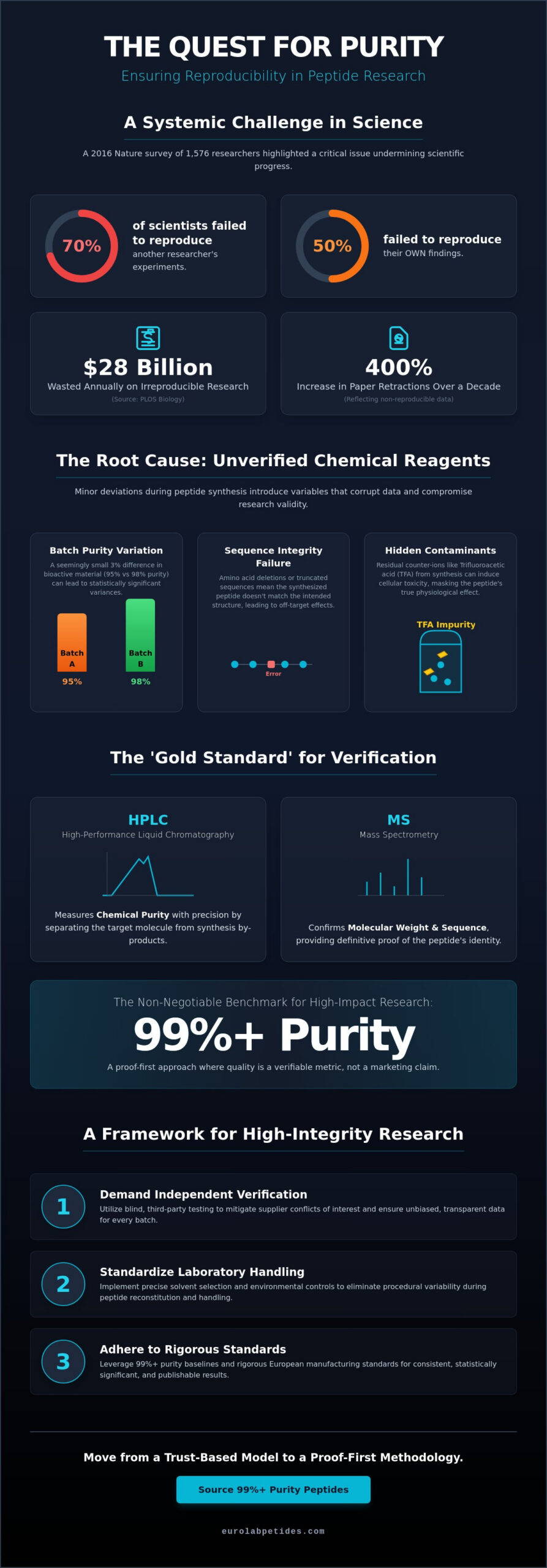
A 2016 survey published in Nature involving 1,576 researchers revealed that 70% of scientists failed to reproduce another researcher’s experiments; even more concerning, 50% failed to reproduce their own findings. These systemic failures often originate from the use of reagents with unverified chemical profiles, making the task of ensuring reproducibility in peptide studies a critical priority for the modern laboratory. You recognize that the validity of a metabolic assay depends entirely on the absolute precision of the peptide sequence. When a supplier’s Certificate of Analysis lacks transparency or a batch shows inconsistent purity, the integrity of your research is compromised.
By implementing a rigorous framework, you’ll master the analytical standards necessary to eliminate batch-to-batch variability. This guide provides the technical roadmap to verify chemical identity independently through HPLC and mass spectrometry. We’ll outline a gold standard protocol for sourcing and handling that ensures your results are statistically significant and ready for publication. You’ll learn to move beyond marketing claims toward a proof-first methodology centered on 99%+ purity and the uncompromising European standards that define high-stakes research.
Key Takeaways
- Define the critical parameters of the reproducibility crisis and how sub-standard chemical reagents compromise longitudinal study data.
- Master the interpretation of the ‘Gold Standard’ analytical duo—HPLC and Mass Spectrometry—to verify sequence identity and absolute purity.
- Evaluate the strategic importance of blind, independent third-party verification in ensuring reproducibility in peptide studies and mitigating supplier-side conflicts of interest.
- Standardize laboratory handling procedures, including precise solvent selection and environmental controls, to eliminate procedural variability during reconstitution.
- Establish a high-integrity research framework by leveraging 99%+ purity baselines and rigorous European manufacturing standards for consistent results.
The Reproducibility Crisis in Peptide Science
Reproducibility represents the cornerstone of the scientific method, yet the life sciences currently face a systemic challenge where over 50% of published preclinical research cannot be replicated by independent laboratories. In the context of peptide-mediated cellular assays, a distinction must be made between repeatability, which is the consistency of results within a single laboratory using identical equipment, and reproducibility, the ability of external teams to achieve identical outcomes using the same experimental design. The failure to achieve the latter often stems from the utilization of sub-standard research chemicals. When chemical reagents lack verified purity, the resulting data is inherently flawed, contributing to a crisis that costs the global scientific community an estimated $28 billion annually in wasted resources according to data published in PLOS Biology. Ensuring reproducibility in peptide studies requires a shift from trust-based procurement to a data-centric model where every molecular variable is accounted for before the first pipette is drawn.
Peptides are uniquely susceptible to experimental variability due to their complex synthesis pathways. Minor deviations during solid-phase peptide synthesis (SPPS) can lead to sequence errors, amino acid deletions, or truncated sequences that remain undetected without rigorous analytical oversight. These impurities don’t just reduce the effective concentration of the target molecule; they act as competitive inhibitors or off-target agonists. The high cost of non-reproducible data is reflected in the 400% increase in paper retractions observed over the last decade, alongside stalled innovation in therapeutic development pipelines. Researchers who fail to validate their starting materials risk building entire projects on a foundation of chemical artifacts.
Common Variables Affecting Research Outcomes
Batch-to-batch variation in peptide purity directly shifts dose-response curves, rendering longitudinal data sets incomparable. If a 95% pure batch is replaced by a 98% pure batch, the 3% difference in bioactive material can lead to statistically significant variances in IC50 values. The role of counter-ions like Trifluoroacetic acid (TFA) is also frequently overlooked. Residual TFA modulates biological activity and induces cellular toxicity, often masking the actual physiological effect of the peptide. Sequence integrity is the primary requirement for peptides to ensure the synthesized chain matches the intended primary structure without error.
The Stakes of In-Vitro Research Accuracy
In metabolic and longevity studies, minor impurities function as confounding variables that lead to false-positive results. Establishing a baseline of chemical identity via High-Performance Liquid Chromatography (HPLC) and Mass Spectrometry (MS) is mandatory before initiating any protocol. Academic peer review is increasingly demanding independent verification of materials, with journals now requiring raw analytical data to be submitted as supplementary material. Ensuring reproducibility in peptide studies is no longer a recommendation; it’s a prerequisite for publication in high-impact journals and the securing of future research grants. Researchers must treat chemical validation as an integral part of their methodology rather than an administrative afterthought.
Analytical Validation: Reading the Language of the Laboratory
Analytical validation constitutes the bedrock of scientific credibility. High-Performance Liquid Chromatography (HPLC) and Mass Spectrometry (MS) represent the “Gold Standard” duo for verifying chemical identity and purity. HPLC separates the target molecule from synthesis by-products, measuring chemical purity with exacting precision. Mass Spectrometry provides the definitive confirmation of molecular weight and sequence accuracy. For serious inquiry, 99%+ purity isn’t a goal; it’s a non-negotiable benchmark. Lower thresholds introduce unquantified variables that compromise results. Ensuring reproducibility in peptide studies requires this level of stringent oversight to eliminate the risk of contaminants influencing biological outcomes.
The laboratory environment demands a proof-first approach where quality is a verifiable metric rather than a marketing claim. Each batch must undergo rigorous testing to ensure it aligns with the theoretical profile. When researchers utilize materials from a transparent European partner, they gain access to the raw data required to justify their experimental conclusions. This technical transparency is essential for maintaining the integrity of the scientific record.
Interpreting HPLC Chromatograms for Red Flags
Chromatograms reveal more than just a single peak. Researchers must scrutinize the baseline for “ghost peaks” and noise, which indicate hidden impurities or degradation products. It’s critical to distinguish between “purity” and “content” in an analytical report. Purity refers to the percentage of the target peptide relative to other UV-absorbing components, while content accounts for the actual peptide weight including counter-ions and residual water. A single-point analysis is insufficient for ensuring reproducibility in peptide studies because it fails to account for longitudinal stability and batch-to-batch variability. Uncompromising standards dictate that every vial must mirror the original validated profile.
Mass Spectrometry and Sequence Validation
MS analysis matches the theoretical mass of a peptide to its observed mass-to-charge ratio (m/z) with high precision. High-resolution instrumentation detects discrepancies as small as 0.1 Dalton, which allows for the identification of truncated sequences or incomplete deprotection. These errors occur during the Solid Phase Peptide Synthesis (SPPS) process if coupling steps aren’t executed to completion. Sequence validation prevents the study of off-target biological effects that arise from structural deviations or incorrect amino acid sequences.
- Theoretical Mass: The calculated weight based on the amino acid sequence.
- Observed Mass (m/z): The actual weight recorded during MS analysis.
- Truncated Sequences: Fragments caused by incomplete chain elongation.
Sourcing Strategy: The Role of Independent Third-Party Testing
The integrity of any peptide study rests on the chemical identity of the starting material. Relying on in-house testing creates a conflict of interest that compromises the scientific method. When a supplier audits their own synthesis, the risk of confirmation bias is high. Independent third-party testing eliminates this risk by providing an objective assessment of purity and sequence. A “blind” test is the gold standard; the testing facility receives a sample with no identifying brand markers, ensuring the results aren’t influenced by commercial relationships.
Ensuring reproducibility in peptide studies requires this level of verification. Researchers must verify that the testing facility holds ISO 17025 accreditation. This certification confirms the lab uses calibrated equipment and follows standardized protocols for High-Performance Liquid Chromatography (HPLC) and Mass Spectrometry. In the research market, the term “Pharma Grade” is often used as a marketing descriptor rather than a technical specification. Real analytical data, specifically a purity level of 99% or higher, is the only metric that matters for experimental accuracy.
The Anatomy of a Verifiable Certificate of Analysis (CoA)
A verifiable CoA isn’t a decorative document. It’s a forensic record. It must contain the specific batch number, the exact date of synthesis, and raw analytical data from HPLC and Mass Spectrometry. Researchers shouldn’t take these documents at face value. Forgery is a documented issue in the global chemical market. You should contact the third-party lab directly to confirm the report’s authenticity using the reference number. This step is vital when you learn more about how to buy research peptides with verified standards.
European Manufacturing Standards vs. Global Alternatives
European manufacturing operates under stringent regulatory oversight. EU laws govern chemical synthesis and waste management more strictly than many global alternatives. Localized sourcing within Europe also mitigates “transit stress.” Peptides are susceptible to degradation if exposed to temperature fluctuations for extended periods. Shipping from an EU-based facility ensures a shorter logistical chain, maintaining the cold chain of integrity. Reliability isn’t just about the synthesis; it’s about the delivery of a stable molecule. Ensuring reproducibility in peptide studies depends on these logistical safeguards as much as the chemical purity itself.
Laboratory Handling: Minimizing Procedural Variables
Ensuring reproducibility in peptide studies requires a rigorous suppression of environmental and procedural fluctuations. Ambient laboratory conditions, including temperature excursions above 25°C or humidity levels exceeding 40%, can catalyze the degradation of sensitive sequences. Photodegradation is a primary concern for peptides containing tryptophan or tyrosine residues; exposure to direct laboratory light for as little as 120 minutes can initiate oxidative pathways that compromise the molecular integrity of the sample. Standardizing the handling environment is not a recommendation but a foundational requirement for data validity.
Inter-operator reproducibility depends on the elimination of “tribal knowledge” in favor of stringent, documented protocols. When multiple researchers handle the same batch, every deviation in pipette calibration or equilibration time introduces a new variable. Each step, from the moment the vial is removed from the freezer to the final dilution, must be logged in an Electronic Lab Notebook (ELN). This level of detail ensures that if a study’s results deviate, the researcher can isolate procedural errors from biological responses. Precision in the laboratory isn’t about intuition; it’s about the uncompromising adherence to cold, hard data.
Reconstitution Best Practices for Stability
The transition from a lyophilized powder to a liquid phase is a high-risk event for peptide stability. Solvent choice is dictated by the peptide’s primary sequence and hydrophobicity. While 0.9% saline or bacteriostatic water is standard, acidic peptides may require a 1% acetic acid solution to achieve full solubility, whereas basic peptides often require dilute ammonia. A 5% shift in the intended pH of the buffer can lead to immediate peptide aggregation or precipitation, rendering the sample useless for quantitative analysis.
Mechanical stress is another critical factor. Researchers must avoid the use of a vortex mixer, which can introduce shear forces that disrupt delicate secondary structures. A gentle swirling motion is the only validated method for reconstitution. Furthermore, managing the vial vacuum is essential. Rapidly injecting air or solvent into a vacuum-sealed vial can cause aerosolization of the lyophilized powder, leading to significant mass loss and potential contamination of the workspace.
Storage Protocols for Lyophilized and Solvated Peptides
Long-term stability is achieved through a hierarchical storage strategy. Lyophilized peptides are most stable at -20°C for short-term projects, but multi-year storage requires a controlled -80°C environment to halt all kinetic degradation. Moisture is the enemy of the peptide bond. The use of desiccants in storage containers prevents moisture-induced hydrolysis, a process that can degrade a sample even while it remains frozen. For a more comprehensive technical breakdown, researchers should consult our storing lyophilized peptides guide.
Once solvated, peptides are significantly more labile. Repeated freeze-thaw cycles are catastrophic, as the transition between phases causes localized concentration gradients and pH shifts that denature the peptide. Aliquotting the solution into single-use volumes is the only scientifically sound method to maintain consistency across a series of experiments. By minimizing the time a sample spends at room temperature, the researcher protects the 99%+ purity levels established during manufacturing.
Maintain the integrity of your research by using only the highest-grade materials. View our catalog of third-party verified peptides to secure the foundation of your next study.
EuroLab Peptides: Your Partner in Research Reproducibility
Scientific inquiry demands more than just chemical availability; it requires a guarantee of molecular consistency. EuroLab Peptides addresses the core challenges of ensuring reproducibility in peptide studies by implementing a multi-level quality protocol. Every batch undergoes rigorous in-house analysis before being subjected to independent, third-party verification. This dual-layer scrutiny ensures that the 99%+ purity baseline isn’t a marketing target but a documented reality. Researchers receive transparent, batch-specific HPLC and Mass Spectrometry (MS) data for every order, allowing for precise calibration of experimental variables and eliminating the guesswork often associated with reagent sourcing.
Our logistical infrastructure is designed to protect the chemical stability of every compound. Based in the European Union, our distribution chain minimizes transit times and exposure to uncontrolled environmental variables. This EU-based approach ensures minimal degradation and maximum sequence integrity, which is vital when conducting longitudinal studies where the chemical profile must remain constant from the first day of the trial to the last.
Uncompromising Integrity for Longevity and Metabolic Studies
Research involving metabolic pathways and cellular longevity requires compounds that remain stable under varied experimental conditions. Our Ipamorelin and BPC-157 batches are considered industry benchmarks because they undergo comprehensive sequence validation and lyophilization processes that meet stringent laboratory standards. We support researchers by providing exhaustive technical documentation that facilitates the peer-review process. We invite researchers to audit our latest third-party lab results to verify the specific purity metrics of our current inventory. This transparency is a cornerstone of our commitment to scientific data integrity.
The EuroLab Advantage: Precision Meets Reliability
By providing direct access to high-purity chemicals, EuroLab eliminates the quality drop often associated with middleman distribution networks. We utilize standardized synthesis processes that prioritize batch-to-batch consistency, a critical factor for ensuring reproducibility in peptide studies across multi-year projects. When you remove the “middleman” from the supply chain, you also remove the risk of improper storage or cross-contamination that can compromise sensitive assays. Our focus remains on providing the “language of the laboratory,” where quality is a verifiable metric rather than a claim.
- Standardized synthesis protocols for unrivaled consistency.
- Direct EU-based shipping to preserve molecular structure.
- Comprehensive HPLC and MS reports included with every shipment.
- Baseline purity of 99%+ for all research-grade products.
Secure high-purity peptides for your next study at EuroLab Peptides
Advancing Precision Through Analytical Rigor
Maintaining data integrity requires a fundamental shift from reliance on supplier claims to the implementation of rigorous analytical validation. Success in the laboratory depends on the systematic elimination of procedural variables and the procurement of compounds that meet uncompromising standards. By prioritizing independent third-party verification and batch-specific analysis, researchers can effectively mitigate the risks associated with the global reproducibility crisis. Ensuring reproducibility in peptide studies isn’t just a professional goal; it’s a technical requirement for scientific advancement.
Eurolab Peptides provides the infrastructure for this level of precision. Every batch is subjected to independent analysis, confirming a 99%+ purity threshold before it reaches your bench. We provide comprehensive HPLC and MS data for each specific lot, ensuring that your starting material is a known quantity rather than an uncontrolled variable. Our logistics framework utilizes direct shipping from our European facility to maintain maximum chemical stability throughout transit. High-stakes research demands a partner that speaks the language of the laboratory through verifiable metrics.
Source Research-Grade Peptides with 99%+ Verified Purity
Your commitment to meticulous methodology will pave the way for the next generation of breakthrough discoveries.
Frequently Asked Questions
Why is reproducibility so difficult to achieve in peptide-based research?
Reproducibility is compromised by batch-to-batch variability in chemical synthesis and the high sensitivity of peptide bonds to environmental degradation. Ensuring reproducibility in peptide studies requires absolute control over sequence accuracy and impurity profiles. Even a 1% deviation in peptide content can alter binding affinity or biological activity. Research from the Journal of Biological Chemistry indicates that up to 50% of preclinical research is irreproducible due to reagent inconsistency.
How does peptide purity (95% vs 99%) specifically affect my experimental data?
A 4% difference in purity introduces unidentified chemical species that can compete for receptor sites or cause cellular toxicity. While 95% purity is standard for initial screening, 99%+ purity is the non-negotiable requirement for quantitative assays and structural determination. Impurities in a 95% sample represent 50 micrograms of unknown material per milligram. These contaminants often include truncated sequences or deleted amino acids that yield false-positive results in sensitive assays.
What are the most common contaminants found in research-grade peptides?
The primary contaminants are residual solvents, salts, and truncated peptide sequences resulting from incomplete coupling during solid-phase synthesis. Common residuals include Trifluoroacetic acid (TFA), which can constitute up to 30% of the final weight if it’s not properly exchanged. Other contaminants include acetonitrile, water, and scavengers like triisopropylsilane. These substances interfere with cellular metabolism and alter the pH of the final buffer solution, leading to inconsistent outcomes.
Can I rely solely on the Certificate of Analysis (CoA) provided by a supplier?
Relying exclusively on a manufacturer’s CoA is a risk because internal standards vary across the industry. Verification via independent third-party HPLC and mass spectrometry is essential for ensuring reproducibility in peptide studies. A study by the Global Biological Standards Institute found that 30% of researchers couldn’t replicate results because of misidentified or contaminated reagents. Direct validation of the 99%+ purity claim through secondary analysis ensures the integrity of your data.
How often should I re-verify the purity of my stored peptide samples?
You should re-verify peptide purity every 6 months when stored at -20°C or immediately if a sample undergoes more than 3 freeze-thaw cycles. Peptides containing Cys, Met, or Trp residues are prone to oxidation, which can decrease the concentration of the active molecule by 15% within weeks if exposed to moisture. Routine HPLC analysis confirms that the sequence remains intact and hasn’t degraded into inactive fragments over time.
What happens if I use the wrong solvent during the peptide reconstitution process?
Using an incompatible solvent leads to irreversible aggregation or accelerated hydrolysis of the peptide backbone. If a hydrophobic peptide is dissolved in an aqueous buffer without first using an organic modifier like DMSO, it can form fibrils that reduce the effective concentration by 90%. This mistake results in zero biological activity and wasted materials. Always consult the solubility profile to ensure the solvent maintains the peptide’s monomeric state.
How does the presence of TFA (Trifluoroacetic acid) impact in-vitro study results?
TFA acts as a metabolic inhibitor and can reduce cell viability by 20% to 40% at concentrations as low as 10 mM. It’s a common counter-ion in peptide synthesis that lowers the pH of culture media, potentially denaturing proteins or interfering with enzymatic assays. For sensitive in-vitro work, you must use peptides where TFA has been exchanged for acetate or hydrochloride salts to prevent cytotoxic interference and ensure accurate readings.
Is there a difference in reproducibility between lyophilized and solution-based peptides?
Lyophilized peptides offer significantly higher stability and reproducibility compared to solution-based formats. A lyophilized powder maintains its chemical integrity for 2 years when stored at -80°C, whereas peptides in solution can degrade by 5% within 48 hours at room temperature. The freeze-drying process removes water and residual solvents, which prevents the hydrolysis reactions that compromise the accuracy of your molar calculations during experimental setup.
