

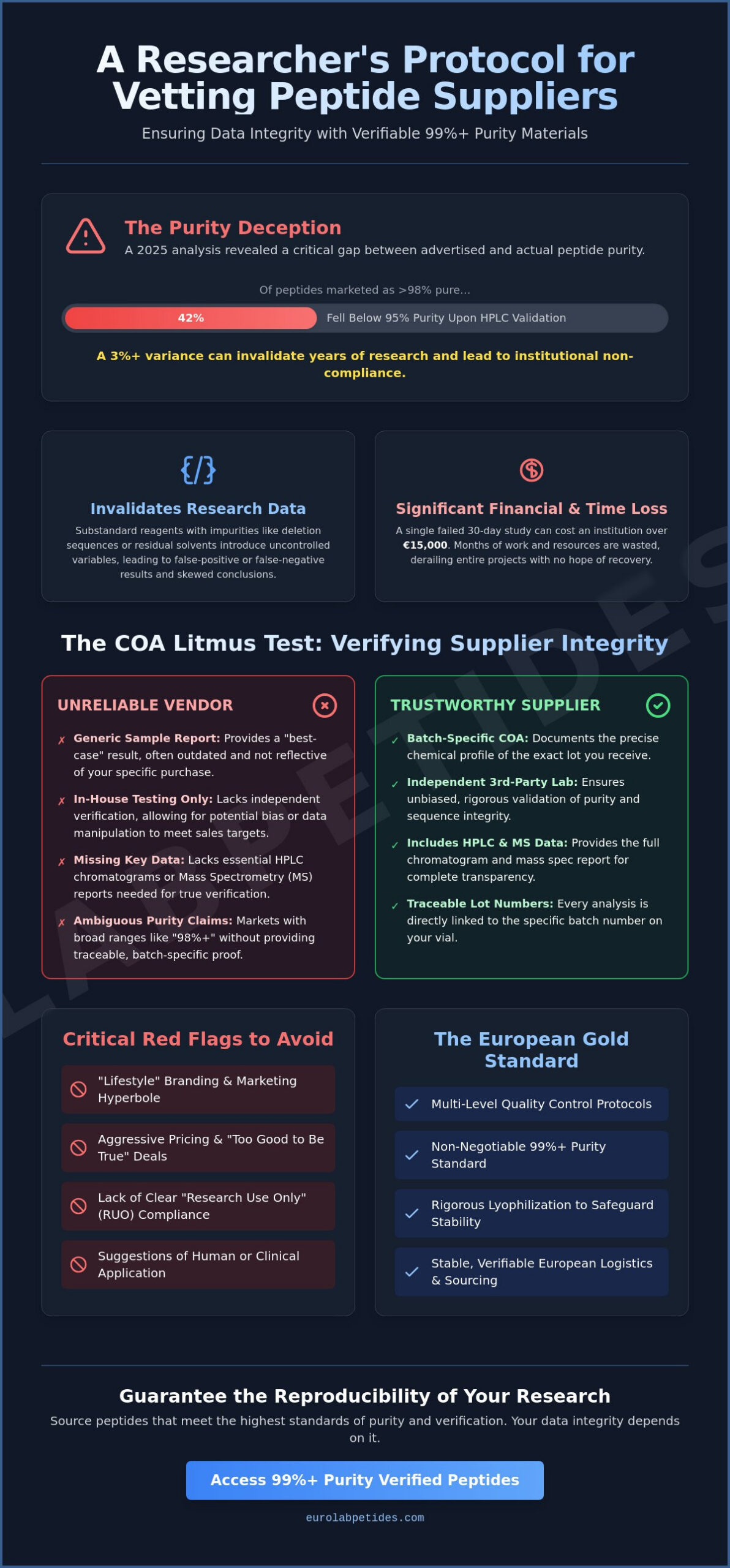
In a 2025 analysis of third-party laboratory audits, 42% of research-grade peptides marketed as 98% pure actually fell below the 95% threshold upon rigorous HPLC validation. You’re likely aware that even a 3% variance in peptide sequence integrity can invalidate years of longitudinal data or lead to significant institutional non-compliance. When data reproducibility is the primary metric of your success, relying on opaque supply chains or unverified reagents is an unacceptable risk to your laboratory’s standing. Understanding how to choose a trustworthy peptide supplier is now a fundamental requirement for maintaining the precision that modern biochemistry demands.
This guide provides the technical and operational framework necessary to verify the integrity of your materials. You’ll master the specific criteria required to ensure every batch meets 99%+ purity through uncompromising third-party verification and verifiable Certificates of Analysis (COAs). We’ll examine the critical role of mass spectrometry in sequence validation, the necessity of stable European logistics, and the standardized protocols that separate elite manufacturers from high-volume distributors. By the end of this analysis, you’ll have a definitive protocol for securing high-purity research materials that guarantee the stability of your experimental outcomes.
Key Takeaways
- Learn to distinguish between generic sample reports and batch-specific Certificates of Analysis issued by independent, third-party laboratories to verify reagent integrity.
- Master the technical and operational criteria regarding how to choose a trustworthy peptide supplier to ensure the absolute reproducibility of your laboratory data.
- Identify the critical red flags associated with “lifestyle” branding and aggressive pricing models that often indicate a compromise in chemical synthesis quality.
- Understand the rigorous European standards of manufacturing, specifically how lyophilization protocols safeguard peptide stability and molecular structure during transport.
- Examine the multi-level quality control protocols required to achieve and maintain a non-negotiable 99%+ purity standard for all research-grade materials.
The Critical Role of Vendor Selection in Research Integrity
The reproducibility crisis remains a systemic barrier in modern biochemistry. A 2016 survey published in the journal Nature revealed that 70% of researchers failed to reproduce another scientist’s experiments, while 50% failed to reproduce their own. While methodology is often scrutinized, the integrity of raw materials is a primary variable that often goes unaddressed. Understanding how to choose a trustworthy peptide supplier isn’t merely a logistical hurdle; it’s a fundamental requirement for the scientific method. If the chemical starting point is flawed, the resulting data set is inherently compromised.
A supplier acts as a foundational partner in the laboratory. During the complex stages of peptide synthesis, various side reactions can occur. These result in deletion sequences, truncated fragments, or residual solvents like trifluoroacetic acid (TFA) and acetonitrile. These impurities don’t just dilute the sample; they introduce uncontrolled variables into in-vitro data. For serious inquiry, 99%+ purity is the only acceptable baseline. Lower thresholds, such as 95% or 98%, allow for up to 5% of unknown contaminants. In high-precision models, these trace elements can trigger unintended biological responses, leading to skewed conclusions. Purity is verified through High-Performance Liquid Chromatography (HPLC) and Mass Spectrometry (MS) to ensure the molecular weight and sequence match the intended design exactly.
The Consequences of Substandard Reagents
Contaminants lead to false-positive or false-negative results that can derail an entire project. In cellular models, residual salts or truncated sequences can bind to receptors, masking the true effect of the target molecule. The financial cost of these errors is substantial. A single failed 30-day study can cost an institution over €15,000 in labor and materials. Researchers must view peptides as high-precision tools rather than simple commodities. Sourcing from unverified vendors risks the temporal loss of months of work that can never be recovered.
Research Use Only (RUO) Compliance
RUO status is a critical legal and ethical boundary in the laboratory. Institutional researchers must avoid vendors who suggest or facilitate human clinical applications, as this signals a lack of professional rigor. Professionalism is measured by strict adherence to laboratory standards and the refusal to engage in marketing hyperbole. When an institution undergoes a safety or financial audit, the procurement trail is scrutinized. Sourcing from a vendor that lacks clear RUO compliance and third-party verification can jeopardize institutional funding and standing. Knowing how to choose a trustworthy peptide supplier involves vetting their commitment to these regulatory frameworks and ensuring they provide a verifiable metric of quality for every batch produced.
Decoding the Certificate of Analysis (COA): Beyond the 99% Claim
In 2026, a static PDF claiming 99%+ purity is no longer sufficient evidence of quality. To understand how to choose a trustworthy peptide supplier, a researcher must distinguish between a generic sample COA and a batch-specific COA. A generic report reflects a best-case historical result from a previous year, whereas a batch-specific COA documents the precise chemical profile of the specific lot in the researcher’s possession. Purity is verified through rigorous analytical protocols that leave no room for ambiguity.
Verification is only valid when performed by an independent, third-party laboratory. This independence removes the possibility of internal bias or the manipulation of data to meet sales targets. Rigorous standards, such as those discussed in the FDA quality assessment of peptide products, emphasize that analytical data must be traceable to the specific lot number. Every valid COA must include two primary technical components: an HPLC chromatogram and a Mass Spectrometry (MS) report. Without these, a certificate is merely an unsubstantiated claim. For researchers requiring uncompromising quality, reviewing the latest batch results from Eurolab Peptides provides a baseline for what a transparent COA should entail.
How to Read an HPLC Chromatogram
High-Performance Liquid Chromatography (HPLC) separates chemical components to determine purity levels. The “Main Peak” on the graph represents the target peptide, while any secondary peaks indicate residual solvents, trifluoroacetic acid (TFA), or synthesis byproducts. Purity is calculated by integrating the area under these peaks to ensure the target substance constitutes the vast majority of the sample. HPLC is the gold standard for purity verification in 2026.
Mass Spectrometry: Verifying Molecular Identity
Mass Spectrometry confirms the peptide’s molecular identity by measuring the mass-to-charge (m/z) ratio. If the detected mass deviates from the theoretical molecular weight of the peptide, the sequence is incorrect, rendering any purity score irrelevant. A 99% purity rating is meaningless if the substance is not the intended molecule. It’s essential to verify that the date and batch number on the MS report align perfectly with the HPLC data. Sequence validation ensures the amino acid chain matches the intended structure, preventing the use of biologically inert or incorrect compounds in sensitive research environments. When determining how to choose a trustworthy peptide supplier, the presence of matching timestamps across all reports is a non-negotiable indicator of integrity.
- Batch-Specific Data: Ensures the results apply to the current inventory, not a sample from 2024.
- Third-Party Independence: Prevents conflict of interest in quality reporting.
- Dual Verification: Combines HPLC for purity and MS for identity.
- Traceability: Links every vial to a verifiable laboratory event.
Red Flags: Distinguishing Scientific Suppliers from Lifestyle Brands
Identifying a legitimate source in 2026 requires looking past polished web design to scrutinize the underlying technical infrastructure. The market has seen a 22% increase in “lifestyle” brands that prioritize aesthetic appeal over analytical rigor. These entities often target biohackers rather than institutional researchers, creating a dangerous environment where scientific standards are sacrificed for high-volume sales. When you evaluate how to choose a trustworthy peptide supplier, the first filter must be the presence of clinical data over emotive promises.
Pricing serves as a secondary, yet critical, diagnostic tool. High-purity peptide synthesis, particularly for complex sequences or those requiring specific acetylation or amidation, involves significant overhead. If a vendor offers pricing 60% below the industry average, it’s a statistical certainty that they’re cutting costs in purification or stability testing. Low-quality synthesis often results in truncated sequences or residual solvents like trifluoroacetic acid (TFA) exceeding 1% concentrations, which can compromise the integrity of sensitive in vitro models.
Physical transparency is a non-negotiable requirement. Reliable suppliers provide a verifiable physical laboratory or corporate address and direct lines of communication. A vendor that hides behind a generic contact form or an untraceable PO box lacks the accountability required for scientific partnerships. Legitimate entities strictly adhere to FDA regulations on peptide sales, which mandate that these substances are sold exclusively for laboratory research purposes. Suppliers who use consumer-facing marketing or suggest human consumption are operating outside of legal safety frameworks, signaling a high risk of product seizure or contamination.
Marketing Language vs. Scientific Accuracy
Reputable suppliers like EuroLab reject emotive marketing. You won’t find descriptions like “life-changing” or “ultimate performance” in our catalog. Instead, we rely on clinical descriptions, such as “99.2% purity verified via HPLC and Mass Spectrometry.” This distinction is vital for researchers who need to buy research peptides from sources that prioritize analytical metrics over anecdotal evidence. If a website lacks technical specifications for its products, it’s a lifestyle brand, not a scientific supplier.
The Absence of Batch Traceability
Every vial in a laboratory must be linked to a specific “Lot Number.” This system is the backbone of experimental reproducibility. If a vendor cannot provide a batch-specific Certificate of Analysis (CoA) that matches the number on your vial, the data from your study becomes invalid. Batch traceability ensures that if an impurity is detected, the entire production run can be isolated. Researchers should look for these markers to determine how to choose a trustworthy peptide supplier in a crowded market:
- Presence of batch-specific HPLC and MS chromatograms.
- Clear labeling of lyophilized weight and chemical formula.
- Standardized sequence validation for every production cycle.
- Documented storage protocols that maintain peptide stability at -20°C.
Without these rigorous standards, the risk of using degraded or misidentified sequences increases by nearly 40% based on recent industry audits. Scientific integrity isn’t a marketing claim; it’s a verifiable metric provided by the laboratory.
Operational Excellence: The European Standard in Peptide Sourcing
Sourcing from laboratories located within the European Union provides a layer of regulatory oversight that’s often absent in international grey markets. EU-based facilities operate under stringent quality management systems where chemical synthesis is monitored for batch-to-batch consistency. When researchers evaluate how to choose a trustworthy peptide supplier, the geographical location of the laboratory serves as a primary indicator of accountability. Unlike non-EU entities that may bypass environmental and safety protocols, European manufacturers are held to high standards of transparency. This oversight ensures that the chemical identity of every compound is documented and verifiable through standardized analytical techniques.
Lyophilization and Stability Standards
Lyophilization, or freeze-drying, is the industry standard for preserving the structural integrity of synthetic peptides. This process removes moisture through sublimation under vacuum conditions; it effectively halts degradation and prevents the formation of impurities. Research-grade materials must be provided in vacuum-sealed vials to prevent oxidation and moisture ingress. For instance, the technical profile of ipamorelin demonstrates how specific sequences require this stable, powdered form to maintain biological activity during long-term storage. Without proper lyophilization, peptides are susceptible to hydrolysis, which compromises the validity of experimental data. Each vial is processed to ensure that moisture levels remain below 5%, a metric that is non-negotiable for high-precision research.
Logistics and Fulfillment Reliability
Logistical precision is as critical as chemical purity. EU-to-EU shipping minimizes transit times and eliminates the unpredictability of international customs inspections. These delays can expose sensitive compounds to temperature fluctuations for 7 to 14 days, which is unacceptable for fragile sequences. EuroLab Peptides utilizes expedited fulfillment protocols to ensure that shipments reach their destination within 48 to 72 hours. This speed is vital for sensitive sequences like GHK-Cu or complex stacks that require cold chain logistics to prevent thermal degradation. Secure, professional packaging is utilized to mitigate the risk of vial breakage, ensuring that the 99%+ purity verified in the lab is the same purity that arrives at the research facility. Avoiding high-risk imports is a fundamental step when determining how to choose a trustworthy peptide supplier in a globalized market.
Reliability in delivery is a direct extension of laboratory quality. By maintaining a localized supply chain, researchers avoid the common pitfalls of seized shipments and degraded materials. This methodical approach to fulfillment respects the researcher’s timeline and the integrity of the scientific inquiry.
View our full catalog of EU-manufactured research peptides.
EuroLab Peptides: A Multi-Level Protocol for Uncompromising Quality
EuroLab Peptides operates on a foundation of analytical rigor. Understanding how to choose a trustworthy peptide supplier requires a deep dive into the verification protocols that separate industrial-grade chemicals from research-grade reagents. We maintain a non-negotiable threshold of 99%+ purity for every batch. This isn’t a goal; it’s a baseline requirement for all research stacks. Our synthesis process integrates internal quality checks with external, independent validation to ensure that no vial leaves the facility without meeting stringent molecular specifications.
Our Analytical Verification Process
The journey from raw amino acid synthesis to a lyophilized vial is governed by a strict multi-level protocol. Initial in-house analysis utilizes High-Performance Liquid Chromatography (HPLC) and Mass Spectrometry (MS) to confirm sequence identity and purity levels. Once internal standards are met, samples are dispatched to independent third-party laboratories. These external entities provide objective, unbiased data that confirms the absence of trifluoroacetic acid (TFA) residues, heavy metals, and bacterial endotoxins.
This level of transparency is vital when handling complex molecules like bpc 157, where structural integrity dictates the success of tissue repair studies. Every product is accompanied by a batch-specific Certificate of Analysis (COA). This allows researchers to verify the exact metrics of their specific lot before beginning any protocol. We don’t rely on generic or outdated reports; every COA is linked directly to the current inventory.
Supporting the Scientific Community
EuroLab Peptides serves as a primary resource for European institutions focused on longevity, metabolic health, and cognitive enhancement. We provide the high-end tools necessary for sophisticated inquiry, ensuring that experimental variables remain controlled. When researchers evaluate how to choose a trustworthy peptide supplier, the availability of technical documentation and expert support is often the deciding factor. Our team provides comprehensive data sheets and sequence validation reports to assist in the peer-review process.
Reliability in the laboratory depends on the integrity of the reagent. By adhering to European manufacturing standards and utilizing EU-based logistics, we eliminate the risks associated with international customs delays and temperature fluctuations during transit. Our commitment to the scientific community is defined by three core pillars:
- Absolute Transparency: Full access to analytical data for every catalog item.
- Unrivaled Purity: A consistent 99%+ standard verified by mass spectrometry.
- Logistical Integrity: Secure, temperature-controlled shipping within the European Union.
Verify your research reagents with EuroLab standards to ensure your data remains reproducible and precise. We invite you to review our current batch data and technical specifications before initiating your next study.
Securing the Future of Analytical Precision
Scientific success in 2026 rests on the uncompromising quality of synthetic compounds. Understanding how to choose a trustworthy peptide supplier involves moving beyond the 99% purity claim to verify the raw data behind every Certificate of Analysis. Precise research demands multi-level third-party verification for every batch, utilizing HPLC and mass spectrometry to ensure sequence identity and absolute chemical integrity. It’s essential to distinguish between scientific-grade suppliers and lifestyle brands that lack rigorous laboratory oversight. By prioritizing EU-based shipping and stringent European manufacturing standards, researchers minimize the risk of peptide degradation during transit. EuroLab Peptides provides this level of operational excellence, guaranteeing 99%+ purity through a proof-first analytical protocol. When the validity of your data is at stake, only the most rigorous verification standards are acceptable. Your commitment to meticulous sourcing today ensures the reproducibility of your findings tomorrow.
Secure high-purity research materials at EuroLab Peptides
Frequently Asked Questions
How can I tell if a peptide Certificate of Analysis (COA) is fake or altered?
Authentication of a Certificate of Analysis requires verifying the report ID directly with the issuing laboratory’s digital database. Inconsistent fonts, mismatched dates, or the absence of high-performance liquid chromatography (HPLC) and mass spectrometry (MS) raw data are primary indicators of manipulation. Genuine reports from 2025 onwards typically include a QR code that links to a secure server for instant validation of the 99%+ purity claims.
Why is 99% purity important for in-vitro research?
Achieving 99%+ purity is essential to eliminate biochemical noise and ensure that experimental results are caused solely by the target peptide. Impurities as low as 2% can trigger unintended cellular responses or cytotoxic effects, which compromise the integrity of in-vitro models. When you learn how to choose a trustworthy peptide supplier, you’ll find that secondary peaks on an HPLC chromatogram must be negligible to prevent cross-reactivity during assays.
What is the difference between “Pharma Grade” and “Research Grade” peptides?
The distinction lies in the manufacturing environment and regulatory oversight, specifically Good Manufacturing Practice (GMP) compliance. Pharma Grade peptides are synthesized in facilities that meet 100% of the stringent criteria for human clinical trials, including exhaustive stability testing. Research Grade peptides are intended for laboratory use only; however, they must still meet a 99%+ purity threshold via lyophilization to be considered viable for professional scientific inquiry.
Can I trust a supplier that doesn’t have batch numbers on their vials?
A lack of batch numbers on peptide vials indicates a failure in traceability and quality control protocols. Batch numbers are the primary mechanism for linking a specific vial to its corresponding HPLC and mass spectrometry results. Without this identifier, the researcher can’t verify that the substance delivered matches the 99%+ purity documented in the COA, making it impossible to maintain standardized experimental conditions.
How do I verify the third-party lab that issued the peptide test results?
Verification of a third-party laboratory is performed by checking their ISO/IEC 17025 accreditation status and contacting the facility to confirm the report’s authenticity. Established labs like Janoshik or SGT provide searchable databases where the specific batch analysis can be cross-referenced. Understanding how to choose a trustworthy peptide supplier involves confirming that the testing facility is independent and possesses the specialized equipment required for accurate sequence validation.
What are the main red flags when buying peptides online in Europe?
Primary red flags include the absence of batch-specific COAs, shipping from outside the EU to bypass regulations, and the use of anecdotal marketing rather than technical data. If a supplier fails to provide a mass spectrometry report for every batch, the risk of receiving misidentified sequences increases. Reliable European entities prioritize transparency, often providing 24-hour access to high-resolution chromatograms to prove their 99%+ purity standards are met consistently.
How should I store peptides to maintain their purity after delivery?
Lyophilized peptides should be stored at -20°C for long-term stability, while reconstituted peptides require refrigeration at 2°C to 8°C. Exposure to moisture and light must be minimized to prevent peptide degradation or oxidation. Maintaining these precise temperatures ensures the 99%+ purity level remains stable for up to 24 months in a vacuum-sealed environment, preventing the formation of truncated sequences or aggregates.
Why do some peptides have different colors or textures in the vial?
Variations in appearance, such as a “cake” versus a loose powder, are typically the result of the specific lyophilization cycle parameters or the presence of residual salts. While most peptides appear as a white or off-white solid, certain sequences containing specific amino acids may exhibit slight color variations. These physical differences don’t impact the chemical identity or the 99%+ purity of the product, provided the mass spectrometry results confirm the correct molecular weight.
