

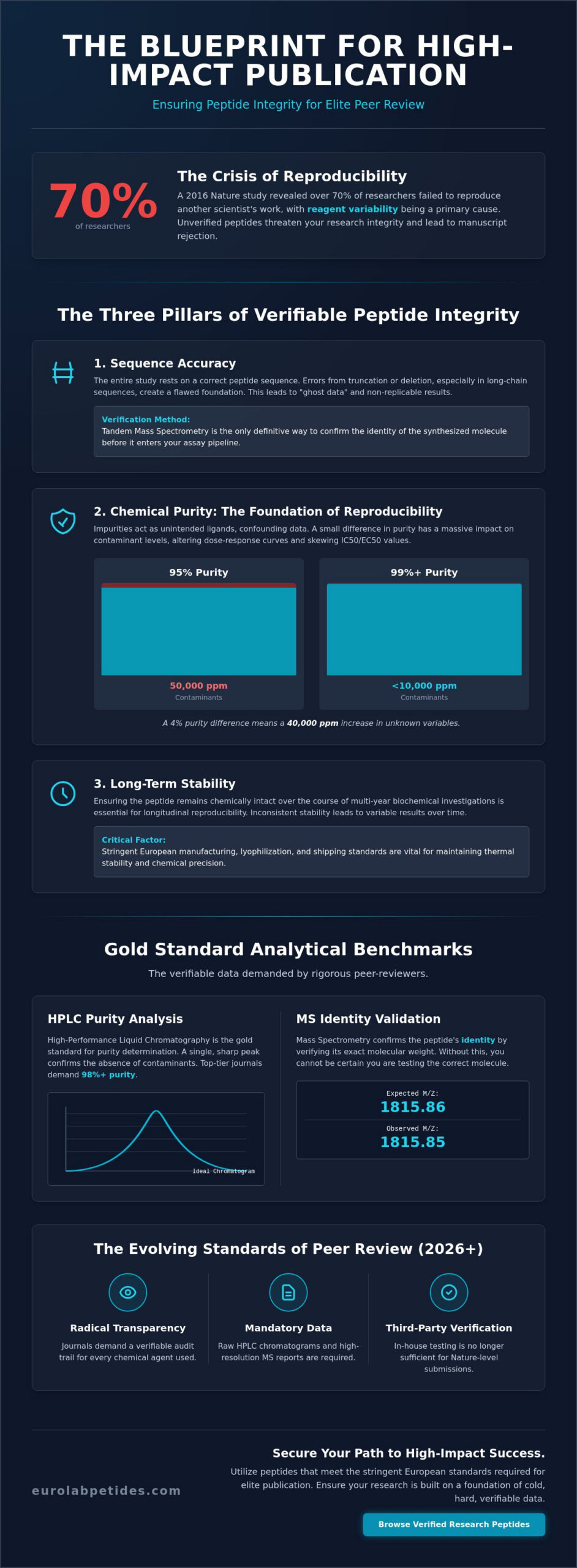
How many peer-reviewed submissions are rejected not due to flawed hypotheses, but because of unverified chemical reagents? A 2016 study published in Nature revealed that over 70% of researchers failed to reproduce another scientist’s experiments, often citing reagent variability as a primary cause. You likely recognize that in the rigorous environment of academic publishing, batch-to-batch variation isn’t just a minor nuisance; it’s a direct threat to your professional integrity. Securing peptides for high-impact journal publication requires more than a simple purchase. It demands a verifiable chain of quality that stands up to the most intense scrutiny.
This guide details the stringent technical benchmarks and documentation standards required to ensure your research meets the uncompromising demands of elite peer review. You’ll discover how 99%+ purity, verified through independent HPLC and mass spectrometry, provides the foundation for reproducible data sets. We’ll examine the specific Materials and Methods documentation necessary for seamless review and how third-party validation eliminates the uncertainty often associated with chemical tools. By adhering to these European standards, your path to high-impact success is secured through cold, hard data rather than anecdotal claims.
Key Takeaways
- Establish the critical metrics of peptide integrity—sequence accuracy, chemical purity, and stability—required to meet the uncompromising standards of elite scientific publishing.
- Identify the essential analytical benchmarks, specifically HPLC and Mass Spectrometry, necessary to provide the verifiable data demanded by rigorous peer-reviewers.
- Address the replication crisis by mastering the protocols for batch-to-batch consistency and longitudinal reproducibility in multi-year biochemical investigations.
- Learn the precise documentation and reconstitution protocols for peptides for high-impact journal publication to ensure your methodology is transparent and technically sound.
- Understand why adhering to stringent European manufacturing and shipping standards is vital for maintaining the chemical precision and thermal stability of your research tools.
The Critical Role of Peptide Integrity in High-Impact Scientific Publishing
High-impact journals prioritize technical rigour and reproducibility above all other metrics. For researchers aiming for publication in Q1 journals, the integrity of chemical tools is a non-negotiable prerequisite. Peptide integrity is defined as the precise convergence of sequence accuracy, chemical purity, and long-term stability. When these parameters are compromised, the resulting “ghost data” leads to non-replicable results, often resulting in manuscript rejection or post-publication retraction. Reviewers in 2026 increasingly scrutinize the provenance and validation of research-grade chemicals, moving beyond a simple acceptance of manufacturer claims. Utilizing high-quality peptides for high-impact journal publication ensures that the biological effects observed are a direct result of the intended ligand, not an artifact of synthesis.
The laboratory environment demands absolute precision. Every variable must be accounted for to ensure that experimental outcomes are valid. When a peptide’s sequence is incorrectly validated, the entire study rests on a flawed foundation. This risk is particularly high with complex, long-chain sequences where truncation or deletion errors can occur during the assembly process. Rigorous sequence validation via tandem mass spectrometry is the only way to confirm the identity of the synthesized molecule before it enters the assay pipeline.
Why Purity is the Foundation of Reproducibility
Impurities in a peptide sample act as unintended ligands, confounding metabolic or cellular data. Residual trifluoroacetic acid (TFA), a common byproduct of peptide synthesis methods, significantly impacts cell culture viability even at low concentrations. While a 95% purity level might seem sufficient for preliminary screening, it can fundamentally alter dose-response curves compared to 99% purity. A 4% difference in purity represents a 40,000 ppm increase in unknown contaminants. These contaminants may interact with off-target receptors or induce cellular stress responses, skewing the IC50 or EC50 values. This variance often makes the difference between a reproducible breakthrough and a failed replication study during the peer-review process.
The Evolving Standards of Peer Review in 2026
The standards for peer review have undergone a significant shift toward radical transparency. Journals now demand extensive supplemental data regarding chemical characterization, including raw HPLC chromatograms and high-resolution mass spectrometry reports. There is a clear trend toward mandatory third-party verification for all synthesized ligands used in pivotal experiments. Relying solely on in-house testing is no longer sufficient for Nature-level submissions. Editors expect evidence of stringent, independent validation to ensure that peptides for high-impact journal publication meet the advertised specifications. This transparency builds the absolute trust required for high-stakes scientific inquiry. Researchers must provide a verifiable audit trail for every chemical agent to satisfy the scrutiny of today’s editorial boards.
Analytical Benchmarks: Purity, Sequence Validation, and Counter-Ion Analysis
Establishing rigorous analytical benchmarks is a non-negotiable requirement for researchers aiming to secure peptides for high-impact journal publication. High-Performance Liquid Chromatography (HPLC) remains the gold standard for purity determination. A single, sharp peak at a detection wavelength of 214 nm or 220 nm validates the absence of significant contaminants. However, purity is only one metric. Mass Spectrometry (MS) must be utilized to confirm the exact molecular weight and sequence identity. Without these data points, the reproducibility of the study remains questionable. Top-tier journals often require a purity threshold of 98% or higher to ensure that observed biological effects aren’t the result of residual impurities or synthesis byproducts.
Interpreting HPLC and MS Reports for Your Thesis
Analyzing chromatograms requires a meticulous eye for detail. You shouldn’t just look at the primary peak; identifying “shoulder peaks” is critical. These small deviations often indicate truncated sequences or deletion peptides where an amino acid failed to couple during synthesis. Verifying the mass-to-charge ratio (m/z) against theoretical peptide maps ensures the correct sequence was produced. It’s also vital to distinguish between total purity and peptide content. Total purity measures the ratio of the target peptide to other organic impurities. Peptide content, however, accounts for the actual mass of the peptide relative to non-peptide components like residual salts and water. This distinction is essential for calculating precise molar concentrations in your experiments.
The Significance of Lyophilization and Salt Removal
The lyophilization process is fundamental for maintaining the integrity of the sample. By removing solvent through sublimation under vacuum, the secondary structure of the peptide is preserved. This prevents hydrolytic degradation and ensures long-term stability. Selecting the correct counter-ion for your specific model is equally decisive for experimental success. While Trifluoroacetic acid (TFA) is the standard salt used during cleavage, its known cytotoxicity can compromise cell-based assays. Researchers often opt for acetate or HCl salts to mitigate these effects. Ensuring low moisture content, typically verified to be below 5%, prevents the formation of aggregates that can lead to inconsistent results. Securing high-purity peptides that meet these stringent European standards is a prerequisite for reliable data.
- HPLC Purity: Minimum 98% for high-impact results.
- Mass Spectrometry: Confirms sequence identity via m/z ratio.
- Counter-Ion Analysis: Acetate or HCl salts for sensitive in-vitro models.
- Solubility Profiles: Must be established to ensure consistent delivery in physiological buffers.
Solubility profiles must be established early to ensure consistent in-vitro delivery. A peptide that precipitates in cell culture media will yield inaccurate dose-response curves. Testing solubility in a variety of buffers, ranging from pH 4.0 to pH 8.0, allows for the optimization of delivery protocols. This level of technical transparency instills confidence in peer reviewers and facilitates the transition from raw data to a published manuscript.
Overcoming the Replication Crisis: Batch Consistency and Reproducibility
The replication crisis remains a primary obstacle for researchers aiming for top-tier journals. A 2016 survey published in Nature revealed that over 70% of researchers failed to reproduce another scientist’s experiments, and more than 50% failed to reproduce their own. Undocumented batch-to-batch variation in synthesized compounds is a significant driver of this statistical instability. When peptides for high-impact journal publication lack chemical uniformity, longitudinal data collected over multi-year studies becomes scientifically invalid.
Variations often arise from the presence of sequence isomers or truncated sequences that standard, low-resolution testing fails to identify. Standardized synthesis protocols are required to mitigate these risks. European manufacturing standards enforce rigid chemical uniformity by utilizing automated solid-phase peptide synthesis (SPPS) under climate-controlled conditions. This precision ensures that the molecular profile of a peptide synthesized in January is identical to one produced in December, providing the stability necessary for multi-phase clinical or laboratory trials.
Implementing Multi-Level Quality Control
Rigorous verification requires testing every batch, not just a representative sample from a larger production run. EuroLab Peptides utilizes independent third-party laboratories to conduct high-performance liquid chromatography (HPLC) and mass spectrometry (MS) on every lot. This external validation eliminates internal bias and confirms that 99%+ purity is a verified reality rather than a projection. Integrating certified peptides into your standard operating procedures protects the integrity of the raw data. It removes chemical impurity as a confounding variable in your results.
Documenting Batch Provenance for Supplemental Data
High-impact journals increasingly demand comprehensive supplemental data to support primary claims. Peer reviewers expect a meticulous library of Certificates of Analysis (COAs) covering every experimental phase. Maintaining these records is essential for batch-tracking, which directly reinforces the credibility of your statistical analysis. If a study spans multiple years and requires different chemical lots, the analytical profile must remain constant to ensure result reproducibility. Multi-site replication studies depend entirely on this provenance. When researchers use peptides for high-impact journal publication that carry a documented history of chemical consistency, the likelihood of successful peer review increases significantly. This transparency demonstrates a commitment to the “language of the laboratory” and objective excellence.
Handling and Documentation: Preparing Your Materials and Methods for Peer Review
Peer reviewers for top-tier journals prioritize the reproducibility of experimental results above all else. This starts with the materials. When preparing peptides for high-impact journal publication, your Materials and Methods section must provide an unambiguous trail of quality and provenance. You should document the vendor, the catalog number, and the specific lot number used for each experiment. High-stakes research demands that you treat the chemical identity of your reagents with the same rigor as your primary data sets. Transparency in sourcing isn’t just a courtesy; it’s a fundamental requirement for scientific validation in the modern publishing environment.
Writing the “Peptide Synthesis and Sourcing” Section
Journals now expect a precise statement regarding purity levels. A simple mention of a vendor is insufficient. You must state that the peptides reached 99%+ purity and specify that this was confirmed through stringent third-party verification. High-impact journals often require the inclusion of HPLC and mass spectrometry (MS) chromatograms within the supplemental information. This data acts as a primary defense against reviewer skepticism. For example, specify that sequence validation was performed via electrospray ionization mass spectrometry (ESI-MS) to ensure the molecular weight matches the theoretical value within a 0.1% margin of error. Using phrasing such as “purity was verified via reversed-phase HPLC to exceed 99%” establishes immediate technical credibility.
Best Practices for Laboratory Handling
The physical state of the material dictates its stability and subsequent performance in assays. Most researchers receive their order in a lyophilized state, which is the gold standard for maintaining integrity during shipping and long-term storage at -20°C or -80°C. Once you begin reconstitution, the risk of peptide degradation increases. Use sterile, filtered solvents (0.22 μm) to prevent microbial contamination. It’s critical to avoid the freeze-thaw cycle. You should create single-use aliquots immediately after the initial reconstitution. This ensures that every experimental replicate uses a sample that hasn’t undergone repeated thermal stress or moisture absorption.
Documentation of the reconstitution protocol should include:
- The exact solvent used, such as sterile water, 10% acetic acid, or DMSO for hydrophobic sequences.
- The final concentration in mg/mL or mM.
- Storage conditions, including protection from light to prevent the oxidation of sensitive residues like Tryptophan or Cysteine.
- The specific aliquot strategy used to maintain batch consistency.
By providing this level of detail, you demonstrate a meticulous approach to laboratory management that mirrors the quality of your results. This precision reduces the likelihood of “major revisions” based on reagent ambiguity.
Sourcing for Success: Why European Standards Define High-Impact Research Tools
European manufacturing is synonymous with stringent regulatory oversight and exact chemical precision. For researchers seeking peptides for high-impact journal publication, the origin of the compound is as critical as the hypothesis itself. EU-based production facilities operate under rigorous quality management systems that prioritize molecular integrity and sequence accuracy. This regional focus provides a distinct advantage in shipping logistics. Reduced transit times directly correlate with enhanced thermal stability; sensitive lyophilized powders remain within optimal temperature ranges throughout the delivery cycle. EuroLab Peptides functions as a dedicated partner in the pursuit of high-impact scientific inquiry, providing the raw materials necessary for weight management, longevity, and cognitive research.
The EuroLab Multi-Level Quality Protocol
Purity is a verifiable metric rather than a marketing claim. Our protocol begins with in-house synthesis validation, where each sequence is confirmed using High-Performance Liquid Chromatography (HPLC) and Mass Spectrometry. This internal data is then subjected to independent laboratory analysis to ensure objective verification of every batch. We provide transparency through accessible, batch-specific Certificates of Analysis. These documents allow investigators to account for every milligram of material in their methodology sections. Our catalog supports specialized research areas, including the study of ipamorelin as a growth hormone secretagogue and various tissue repair models. Utilizing these peptides for high-impact journal publication ensures that the data meets the scrutiny of the most rigorous peer-review processes.
Securing Your Research Assets
The logistics of sourcing high-purity chemicals within the European Union eliminate the unpredictability of international customs. Elite researchers prioritize bpc 157 and other high-purity ligands from EuroLab because our supply chain is optimized for the scientific community’s needs. Don’t settle for unverified sources that introduce variables into your data. Maintaining 99%+ purity ensures that experimental outcomes are the result of the peptide’s primary sequence, not contaminants or synthesis byproducts. Peer-reviewed journals often reject studies where the chemical origin is opaque or the purity is unverified. By choosing EuroLab, you secure the assets required for reproducible, high-caliber data. Align your laboratory with European standards to provide the foundation for your next publication. High-impact science requires high-impact tools.
Securing Scientific Integrity Through Analytical Precision
Achieving publication in prestigious journals requires an uncompromising commitment to analytical rigor. High-impact research relies on 99%+ purity levels and absolute batch consistency to mitigate the replication crisis currently affecting the global scientific community. When researchers utilize verified peptides for high-impact journal publication, the focus shifts from questioning material integrity to analyzing experimental data. Every batch is subjected to stringent sequence validation and counter-ion analysis via HPLC and mass spectrometry; this ensures that results are reproducible across multiple trials. By adhering to EU-based manufacturing and shipping standards, scientists gain a reliable partner in the pursuit of academic excellence. This methodical approach to sourcing ensures that your Materials and Methods section remains beyond reproach during intensive peer review. Independent third-party verification remains a non-negotiable standard for those seeking to contribute meaningful data to their fields. Your next breakthrough depends on the quality of the tools used today.
Secure high-purity research peptides for your next publication and ensure your work meets the highest global benchmarks. We’re excited to see your findings contribute to the future of science.
Frequently Asked Questions
What is the minimum peptide purity required for publication in high-impact journals?
High-impact journals typically require a minimum peptide purity of 98%, though 99%+ is the preferred benchmark for top-tier publications like Nature or Science. Using 99%+ purity peptides for high-impact journal publication ensures that observed biological effects aren’t attributed to synthesis byproducts. Peer reviewers often scrutinize purity levels to validate that experimental outcomes are reproducible and free from contaminant interference during the study.
Why is third-party testing more credible than manufacturer-provided COAs?
Third-party testing provides an unbiased validation of chemical integrity that manufacturer-provided Certificates of Analysis often lack. While a manufacturer might report 98% purity, independent HPLC and Mass Spectrometry analysis by a certified laboratory ensures the data isn’t skewed by internal production biases. This secondary verification is a critical step for researchers who need to provide absolute proof of material quality during the rigorous peer-review process.
How does residual TFA affect in-vitro research results?
Residual Trifluoroacetic Acid acts as a metabolic inhibitor that can significantly decrease cell viability in in-vitro assays. Even at concentrations below 1%, TFA can shift the pH of culture media, leading to false-positive or false-negative results in sensitive signaling experiments. To prevent these artifacts, researchers should utilize acetate or hydrochloride salt exchange processes to remove TFA before beginning their experimental protocols.
Should I include the HPLC and MS reports in my supplemental data?
You should always include raw HPLC chromatograms and Mass Spectrometry reports in your supplemental data to provide full transparency to reviewers. Journals such as the Journal of Biological Chemistry have established specific guidelines requiring detailed characterization of all synthetic materials. Providing these documents proves the sequence identity and purity of your peptides, which strengthens the overall credibility and integrity of your submitted manuscript.
How can I ensure batch-to-batch consistency for a multi-year study?
Securing a single, large-scale batch of lyophilized peptide is the most effective way to maintain consistency throughout a multi-year longitudinal study. If a single batch isn’t feasible, you must ensure that each subsequent lot undergoes identical 99%+ purity verification and sequence validation. This meticulous approach prevents inter-batch variability from introducing confounding variables that could invalidate years of experimental data and results.
What are the risks of using peptides with less than 98% purity in metabolic research?
Using peptides with less than 98% purity in metabolic research introduces a 2% margin of unknown impurities that can cause significant off-target effects. These contaminants often include truncated sequences or protective group residues that interfere with ligand-receptor binding affinities. In a 2022 study, even minor impurities were shown to alter metabolic rate measurements, highlighting why 99%+ purity is the non-negotiable standard for metabolic inquiry.
How do European manufacturing standards compare to global alternatives for research peptides?
European manufacturing standards, governed by ISO 9001:2015 and ECHA regulations, offer a more rigorous framework for quality control than many global alternatives. These standards mandate strict documentation of every synthesis step and ensure that reagents meet high-grade analytical requirements. Utilizing peptides produced under these stringent European protocols provides researchers with the reliability needed for peptides for high-impact journal publication and long-term research success.
What is the best way to document peptide reconstitution for peer review?
The most effective way to document peptide reconstitution is to record the exact mass of the peptide, the volume and type of solvent, and the final molar concentration. You should also note the specific temperature and the duration of the dissolution process to ensure reproducibility. Including these precise details in your Materials and Methods section allows other scientists to replicate your experimental conditions with absolute precision.
